
A trader can feel brilliant right up until a small pullback wipes out a much larger position than expected.
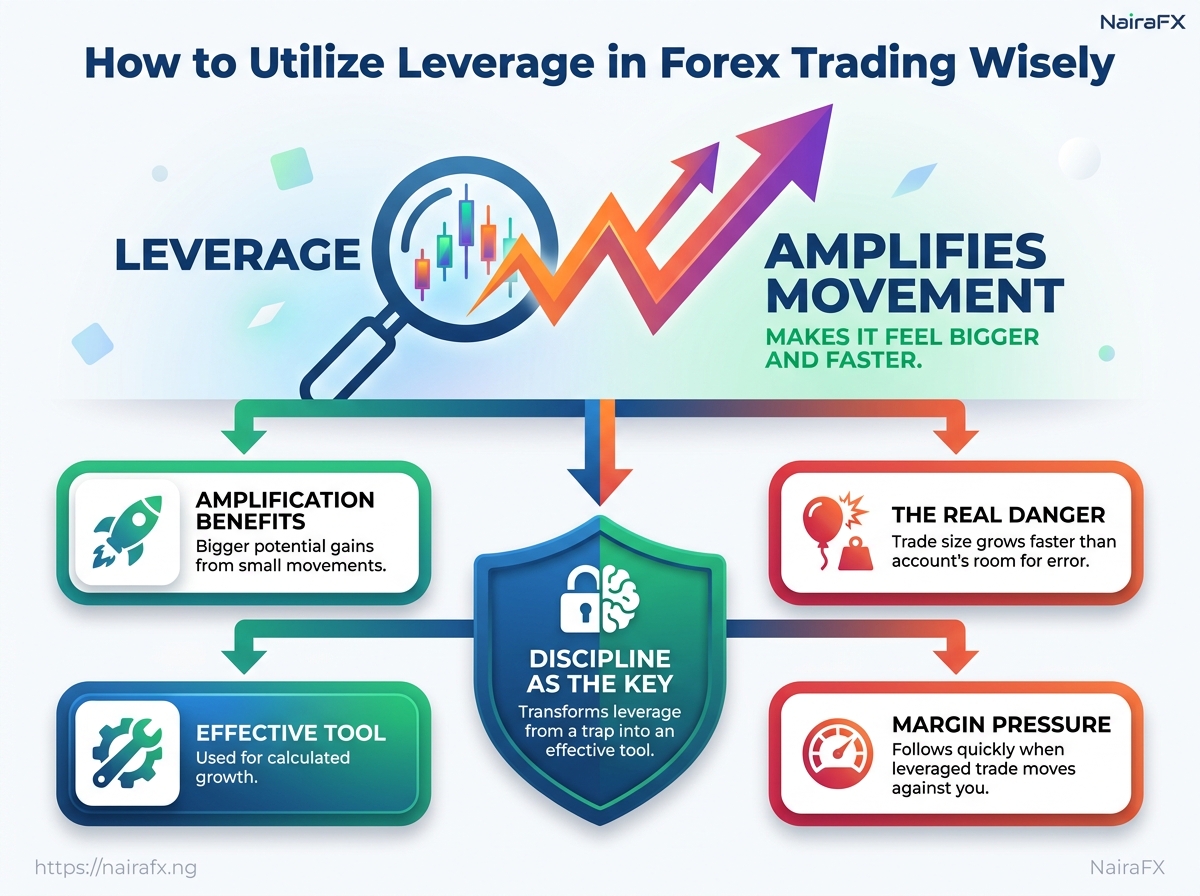
That is the strange pull of forex leverage: it makes movement feel bigger, faster, and a lot less forgiving.
The real danger is not using leverage itself.
The trouble starts when the trade size grows faster than the account’s room for error, and the stop loss is treated like an afterthought.
According to Forex.com, leverage lets you control a much larger trade with only a fraction of the deposit as margin.
That is why leverage strategies matter more than the headline leverage ratio.
A sensible setup keeps risk tied to the account, not to ego, boredom, or a lucky streak.
When a leveraged trade moves the wrong way, the damage shows up quickly, and margin pressure can follow just as fast, as Markets.com explains.
The traders who last are not the ones chasing the biggest numbers.
They are the ones who know how much can be lost before the trade even opens, how far the stop can sit, and when to leave the size alone.
That discipline turns leverage from a trap into a tool.
Quick Answer: Use forex leverage as a position-sizing tool—not as an excuse to “buy bigger.” First, decide a small fixed maximum loss per trade, then size your position from your stop-loss distance so a stop-out equals that planned loss. Finally, stress-test the position for margin pressure (spread/news volatility and reduced free margin) so you’re unlikely to hit a margin call or forced liquidation. (Full margin/lot-size mechanics and the risk-check routine are covered in the next sections.)
What Forex Leverage Really Means
Ever wondered why a trader with a small account can still open a much larger forex position?
That is leverage at work.
At NairaFX, we treat it as a position-sizing tool, not a magic profit switch.
According to FOREX.com’s margin and leverage guide, 50:1 leverage means you only need about 2% margin to control a much larger trade.
Traders care because that tiny deposit gives them access to markets that would otherwise be out of reach.
The catch is simple.
Leverage changes your buying power, not the size of the market move itself.
If EUR/USD rises or falls by 1%, the pair still moved by 1%.
Your account just feels that move more sharply because you controlled a bigger notional position.
- Buying power expands: A small margin deposit can control a much larger trade.
- Market risk stays the same: Price still moves by the same percentage, leveraged or not.
- Account swings get bigger: Gains look attractive, but losses grow just as fast.
- Margin pressure rises: A bad move can trigger a margin call sooner.
That is why leverage strategies start with risk, not with the biggest number a broker advertises.
SwitchMarkets explains that when a leveraged trade moves too far against you, the broker may issue a margin call to restore required funds.
Markets.com’s 2026 guide on margin calls and forced liquidation makes the same point in plainer language: leverage can turn a normal losing trade into a funding problem very quickly.
That is why the same price move can feel manageable at 5:1 and brutal at 50:1.
Leverage limits also depend on where you trade.
LiquidityFinder’s 2026 regulator comparison shows major FX caps around 30:1 in the EU and UK, with 50:1 for major pairs in the US.
Used well, forex leverage gives room to trade.
Used carelessly, it just makes mistakes louder.
How Leverage Works in Real Trading Conditions
A trade can be “right” and still feel dangerous.
That happens when position size, margin, and account balance are pulling in different directions.
In live forex trading, leverage does not sit by itself.
It changes how much margin gets locked up, how big the lot can be, and how fast free margin shrinks when price moves.
Brokers also vary by jurisdiction, so the same trade can carry different margin pressure under different caps; LiquidityFinder’s 2026 leverage-limit comparison shows that major FX caps differ across regions, including 30:1 in the EU and UK, and 50:1 in the United States for major pairs.
A simple $1,000 account makes this easier to see.
If a trader risks 1% per trade, that is $10 at stake, and lot size has to fit that limit.
Naira Forex Trading’s 2026 risk guide gives the same kind of math: on a $1,000 account, a 50-pip stop on EUR/USD can translate to 2 micro lots when the pip value is about $0.10 per micro lot.
Margin, lot size, and account balance together
| Concept | What It Means | Why It Matters | Example |
|---|---|---|---|
| Leverage | Borrowed exposure that lets a small deposit control a larger trade | It decides how much buying power a trader gets | 50:1 leverage can control 50,000 with about 1,000 in margin |
| Margin | The funds set aside as collateral for the trade | It is not a fee; it is locked capital | A 2% margin requirement means $2,000 controls a $100,000 position |
| Lot size | The trade volume, usually measured in standard, mini, or micro lots | Bigger lots move P/L faster, for better or worse | 1 micro lot = 1,000 units; 1 standard lot = 100,000 units |
| Account balance | Cash in the account before open-trade profit or loss is counted | It sets the ceiling for risk planning | A $1,000 balance with 1% risk allows only $10 on the trade |
| Free margin | Equity minus used margin | It shows how much room is left for new trades or drawdown | If $200 is tied up in margin, the remaining free margin drops fast |
That usually gives free margin more breathing room, but the locked margin on the open trade still stays in place.
When price moves against the trade, the chain reaction is faster.
Equity falls, free margin shrinks, and the broker watches whether the margin level can still support the position; Switch Markets explains how margin calls work in leveraged forex trading, while FXStreet’s 2026 guide on margin calls and forced liquidation shows how quickly a thin buffer can turn into liquidation.
That is why clean leverage strategies focus on the math before the trade opens.
Size the lot from the stop distance, keep per-trade risk small, and leave enough free margin for normal price noise.
Used well, leverage becomes a tool for precision, not a shortcut to stress.
The Real Benefits and Risks of Using Leverage
Why does leverage feel like a shortcut until it suddenly doesn’t? The appeal is obvious: a smaller account can control a trade that would otherwise be out of reach, which makes forex leverage attractive for traders who want more market access without tying up all their cash.
Brokers describe this as putting up only a fraction of the trade value as margin, such as the 50:1 example explained by forex.com on trade margins.
That flexibility is real, but it cuts both ways.
In leveraged trading, a move that helps a position can also hurt it just as fast, and the danger rises when traders ignore how quickly equity can slip toward a margin warning.
Markets.com’s 2026 breakdown of margin calls and forced liquidation makes that sequence pretty clear.
The safest leverage strategies start with position size, not excitement.
Our risk rules follow the same idea: keep per-trade risk tight, and cap total exposure so one bad stretch does not spill into the whole account.
Why small accounts like leverage
A modest account can still take part in cleaner setups, hedge briefly, or test a strategy without waiting forever to build capital.
That is useful for traders who trade part-time or need room to adjust entries and exits.
- More market access: Smaller balances can still participate in trades that need larger nominal size.
- Better capital use: Cash stays available instead of sitting frozen in one oversized position.
- Flexible trade planning: Leverage can help with staged entries, not just single-shot trades.
- Practical sizing: A fixed-risk approach, such as 1% per trade, keeps the account from getting bullied by one mistake.
Where leverage turns dangerous
A trader can be right on direction and still lose badly if size is too aggressive.
LiquidityFinder’s 2026 regulator comparison shows why jurisdiction matters too: caps vary, and higher leverage usually means less room for error.
Warning signs traders often miss: shrinking free margin, repeated “almost hit stop-loss” trades, and the urge to add size after a win streak.
ThinkMarkets notes that margin calls are usually a symptom of positions pushed too far, while FXStreet’s 2026 explanation shows how the buffer gets thinner as leverage rises.
The practical habit is simple: respect the stop, respect the size, and never confuse a bigger position with a better trade.
That discipline is what keeps using leverage from becoming a fast route to a margin call.
Leverage Levels: What They Mean for Different Trading Styles
Why does one trader swear by 10:1 while another reaches for 100:1? The answer usually has less to do with bravado and more to do with how long the trade stays open.
A position trader holding through overnight sessions needs breathing room.
An intraday trader wants enough exposure to make a clean move matter, without turning every spread wobble into a crisis.
Our risk checks start with that reality first, not with the biggest number a broker will allow.
Forex leverage only makes sense when it matches the trade’s lifespan.
Forex.com explains that margin is just the deposit fraction behind a larger position, while LiquidityFinder’s 2026 regulator comparison shows how tightly those limits differ by jurisdiction, with major FX caps like 30:1 in the EU and 50:1 in the United States.
That difference matters because the longer a trade stays exposed, the more time normal volatility has to test your account.
Typical leverage bands by trader type
| Leverage Level | Typical Trader Profile | Risk Level | Best Use Case | Main Warning |
|---|---|---|---|---|
| Low | Cautious swing traders and position traders | Lower | Longer holds, wider stops, overnight trades | Can feel slow if the account is small |
| Medium | Active intraday traders | Moderate | Same-day setups, clearer entry and exit rules | Overtrading can erase the benefit fast |
| High | Aggressive scalpers and speculative traders | Very high | Tiny moves on small accounts, short bursts of exposure | Buffer shrinks quickly; margin calls and liquidation can come fast |
That is exactly why it gets dangerous so quickly.
At higher leverage, the buffer between open trade and trouble narrows.
Markets.com’s 2026 guidance on margin calls and forced liquidation, along with FXStreet’s 2026 explanation of shrinking margin buffers, both point to the same problem: when leverage climbs, room for error falls.
A trader who wants speed without that pressure usually does better with moderate leverage and tighter trade selection.
For most styles, the cleanest leverage strategies are boring ones.
Use lower leverage when the plan depends on time, moderate leverage when the plan depends on timing, and keep high leverage for rare, tightly controlled setups only.
That discipline usually protects the account better than any flashy entry ever will.
Leverage Strategies Nigerian Traders Can Actually Use
A $1,000 account can look powerful on paper, but the real test is whether one bad trade can wound it.
That is where forex leverage stops being a bragging right and starts becoming a planning problem.
Good leverage strategies begin with size, not excitement.
Regulated brokers and jurisdictions still matter here too; LiquidityFinder’s 2026 regulator comparison shows caps like 30:1 in the EU and UK, while major FX in the U.S. is typically 50:1, so the real edge comes from how carefully the trade is sized, not from chasing the biggest ratio available.
See LiquidityFinder’s 2026 comparison of CFD retail broker leverage limits by regulator.
The cleanest habit is boring, which is usually a good sign.
Risk a fixed percentage per trade, set the stop before entry, and let volatility decide the final lot size.
NairaFX’s own risk framework puts common per-trade risk in the 0.5%–2% range for 2026, with total open risk often capped around 3%–5% of the account; that keeps using leverage from turning into random damage.
Naira Forex Trading’s essential risk management guide and its 2025 mistakes guide on stop-loss discipline both point in the same direction.
Volatility is where many traders get caught.
A 14-period ATR of 80 pips demands a wider stop than a calm 40-pip market, which means the position size must shrink to keep the same dollar risk.
That is a lot safer than forcing the same lot size through every setup, especially in a market where margin calls and forced liquidation arrive faster when the buffer gets thin.
- Risk a fixed slice: Keep each trade near
1%of equity, not whatever feels bold that day.
- Set the stop first: Define the exit before entry, then size the trade from that distance.
- Shrink size in wild markets: Wider ATR, smaller position. Same risk, less noise.
- Cap the whole book: Several open trades can stack risk fast, so keep the total in check.
That discipline matters even more after a winning streak, when size creep starts whispering bad ideas.
The best leverage setup is the one that still looks sensible after three ugly trades in a row.
How to Choose the Right Leverage for Your Trading Plan
A trader who cannot state the stop distance is not ready to choose leverage.
The right leverage number is not pulled from the broker menu—it comes from the trade’s risk and timeline.
Second: the wider your stop, the smaller your position must be (even if leverage would let you open bigger).
Third: the position still has to fit inside your account’s risk limits, including any other trades already running.
A quick pre-trade checklist (answer these before you place the order)
- How far is the stop? A wider stop needs a smaller position to keep your downside controlled.
- What kind of trade is this? Intraday setups can tolerate less exposure time than multi-day trades.
- How many trades are already open? Total account risk matters more than one isolated setup.
- Will you realistically follow the stop? If your confidence feels like a hunch, lower leverage and/or reduce size.
- Is major news coming soon? High-impact releases can create fast moves and widen spreads—conditions where leverage punishes sloppy sizing.
- Would this still look good after a loss? If the plan changes when emotions show up, the leverage decision is probably emotional, not planned.
Trading style changes the answer fast.
A scalper may use more exposure in theory, but only with strict risk control and immediate exit discipline.
A position trader usually needs less leverage because the trade needs time to breathe.
Experience matters too.
Beginners often confuse confidence with control. After a losing streak, the smarter move is usually to reduce size and wait for conditions to improve—not to chase revenge with higher exposure.
The best leverage choice is the one that lets a good plan survive a bad day.
That may sound boring—but boring is what keeps the account intact long enough for the edge to show up.
Common Leverage Mistakes That Hurt Traders
Why do some traders survive plenty of losing streaks, while others get chewed up by the first few busy sessions? The answer is rarely the market alone.
It is usually a mix of forex leverage misuse, rushed entries, and a few small habits that quietly snowball.
The first trap is overtrading because the account can support it.
A margin screen can look generous and still be dangerous.
Our risk guide keeps the focus on per-trade risk and also caps total open risk at 3%–5% of the account, because too many positions can turn one bad stretch into a mess fast (The second trap is thinking high leverage means low risk.
It does not.
Higher leverage simply lowers the margin needed to open a trade, which shrinks the room between normal movement and a margin problem (LiquidityFinder broker leverage limits by regulator, Forex.com on margin and leverage).
When the trade moves against you, that smaller buffer can trigger a margin call, and then forced liquidation if the account cannot recover (Markets.com on margin calls and forced liquidation).
A few habits cause most of the damage.
- Adding positions too easily: If a setup would not pass on its own, stacking more trades is not a strategy. It is just more exposure.
- Confusing margin with safety: Plenty of free margin only means the broker has not complained yet. It says nothing about whether the trade is well-sized.
- Ignoring carrying costs: Spreads, swaps, and fast news moves all eat into a leveraged trade faster than most traders expect.
- Skipping pre-trade checks: A quick review of stop distance, account risk, and news timing saves more money than almost any indicator.
- Trading through surprise volatility: Central bank comments, data releases, and thin-liquidity hours can turn a tidy setup into a sharp loss in seconds.
A simple rule helps here.
Before every order, check whether the position still fits the stop, the day’s news risk, and the total exposure already on the books.
That habit matters more than finding a “perfect” entry.
Leverage behaves best when it stays quiet.
The moment it starts driving trade count, cost blindness, or skipped checks, it stops being a tool and starts acting like a trap.
A demo account catches obvious mistakes.
A small live account catches the ones that only appear when money is real.
That’s where forex leverage stops feeling theoretical and starts showing its teeth—especially when margin buffers shrink and broker/jurisdiction rules differ.
Test leverage use with one controlled routine
The goal is not to “make it work” in a good week. The goal is to see whether your rules still hold when price noise, spreads, and emotions show up.Before you increase size, keep these constants for a fixed testing block: one setup, one stop method, and one risk plan.
> A smaller account is not the goal. A controlled process is.
A simple testing routine (before you trade bigger)
- Fix the risk first.
- Use the same setup every time.
- Log the real pressure points.
- Scale only after consistency.
A strategy is ready when it behaves the same under pressure—not when it had one lucky run.
If you want extra help pressure-testing your decision rules, review your equity curve and leverage behavior before committing more capital.
What is forex leverage and how does margin work?
Forex leverage lets you control a larger trading position with a smaller deposit posted as margin. When price moves against your position, your account equity drops, which reduces free margin. If free margin falls below the broker’s minimum requirement for the open position, the broker may issue a margin call or close positions to limit further losses.How much leverage is safe for beginners in forex trading?
Beginners should prioritize risk control over the leverage ratio. Choose leverage so your position still fits your plan when volatility increases, spreads widen, and your stop-loss is hit. A practical approach is to use a low-to-moderate leverage level and keep per-trade risk fixed while sizing from the stop-loss distance.What is a margin call and when does it happen in leveraged forex?
A margin call happens when your equity declines enough that you no longer meet the broker’s margin/free-margin requirements for your open trades. If you can’t add funds and the position can’t be supported, the broker may force a partial or full closure (forced liquidation) to protect the account from a deeper deficit.How should I size positions when using forex leverage?
Position size should be determined by (1) your stop-loss distance and (2) the maximum dollar loss you’re willing to take on that trade. Leverage affects how much margin is required and how quickly your available free margin can be reduced, but the market move still determines whether you gain or lose your planned amount.How do I avoid emotional leverage mistakes like increasing position size after wins?
Avoid emotional sizing by keeping your risk tied to your plan rather than to confidence or recent results. Don’t increase position size after wins unless you re-check the stop distance and re-run your position sizing. Also, do not treat the stop-loss as optional—if the stop and risk don’t still work, reduce size or wait for better conditions.Trading Leverage With a Cooler Head
The part worth remembering is simple: forex leverage is not the enemy, and it is not a shortcut either.
It is a magnifier, which means your risk grows just as fast as your profit potential when the market turns against you.
That is why the trader who sizes a position too large can feel brilliant on Monday and shaken by Tuesday’s pullback.
The example from earlier still says it best: a small move against an oversized trade can hurt far more than the market move itself deserves.
Good using leverage starts with the boring stuff that saves accounts — position size, stop-loss placement, and how much of the account is actually exposed.
The strongest leverage strategies are usually the least dramatic, because they leave room for the trade to breathe.
One useful move today is to check your next trade before you place it: ask how much you lose if price hits your stop, then cut the size until that number feels comfortably small.
If you want a second opinion on risk control, our equity-curve and leverage analysis can help traders pressure-test those decisions before real money is on the line.