
A bad trade feels heavier when nobody around you understands why it happened.
For many Nigerian traders, the real problem is not only the chart; it is the silence after a loss, the doubts before a setup, and the habit of second-guessing every decision.
That is where a strong trading community changes the game.
It gives traders a place to compare notes, challenge weak ideas, and stay grounded when the market gets noisy.
Good networking forex is not about collecting contacts.
It is about finding people who trade different pairs, use different timeframes, and still speak the same language of risk, discipline, and patience.
One trader’s mistake can become another trader’s lesson before money is lost twice.
For Nigerian traders, support for traders matters even more because the local reality is not generic.
Payment issues, broker trust, unstable internet, and fast-moving currency swings all add pressure that isolated traders often carry alone.
A useful community does more than cheerlead.
It helps traders stay accountable, spot weak habits early, and make cleaner decisions when emotions start shouting louder than the plan.
Quick Answer: A forex trading community helps Nigerian traders learn faster and trade with better discipline by turning losses and hesitation into faster feedback from peers who trade under similar market conditions. It also creates accountability, so you catch weak risk habits early instead of repeating costly mistakes.
Why trading alone can slow progress
Some traders notice a sharp contrast between planning and execution—how a trade can look clean at first glance and then deteriorate as the day moves on.
That effect gets worse when you learn forex alone.
Without a trading community, every mistake becomes a private lesson, and private lessons are expensive when real money is on the line.
In fast markets, the delay between confusion and correction is often where losses grow.
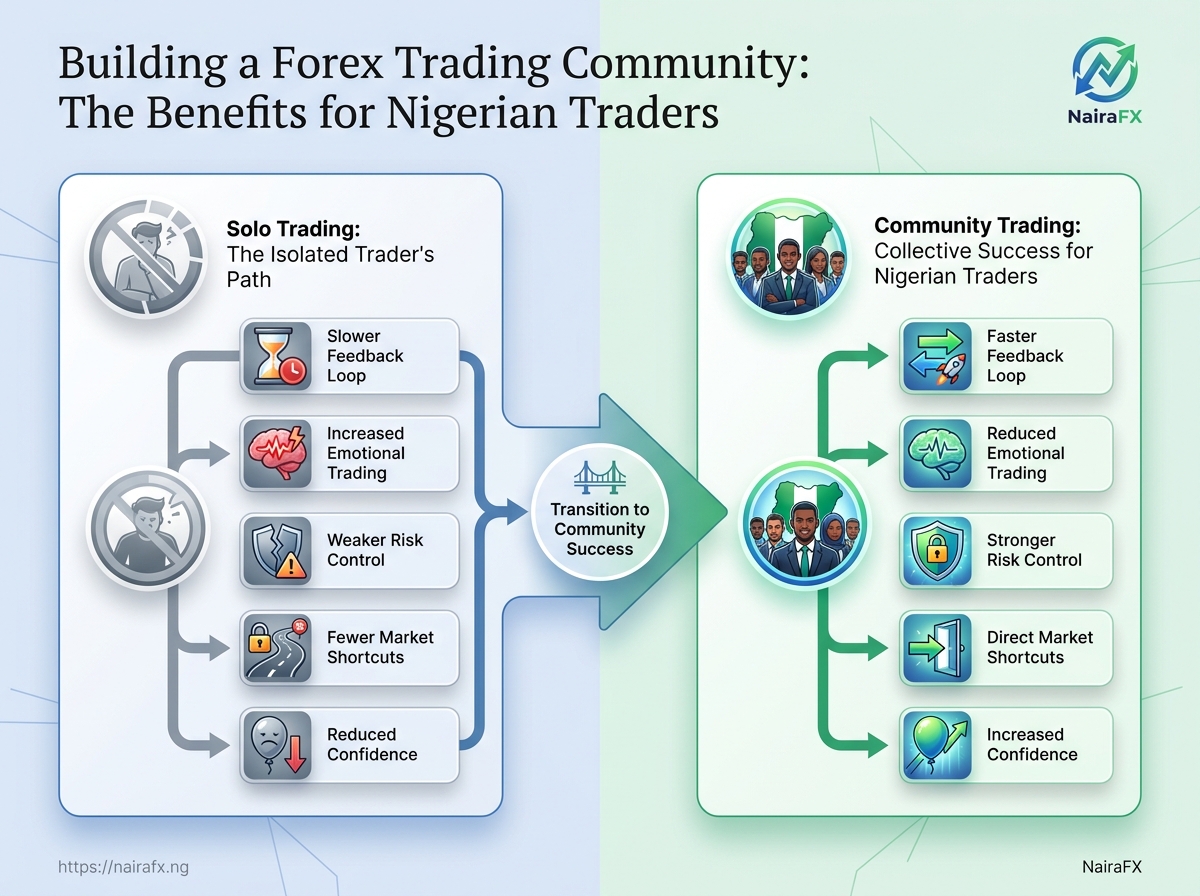
The hidden cost is not just bad entries. It is slower feedback, weaker risk habits, and more emotional trading because there is no one to challenge your thinking.
A support network also helps you see patterns sooner, especially when market conditions change quickly—see Building Your Forex Support Network.
Nigerian traders feel that pressure even more. Prices can move fast, internet quality can be uneven, and local market routines often leave less time for long analysis sessions.
Even brokers increasingly integrate trader-facing features like analytics and contextual signals into client portals, which means the “right info at the right time” is becoming more shared than it used to be.
That is why networking forex peers can make a real difference. You hear how others handled the same pair, the same news-driven volatility, or a sudden spread change—and your next decision gets sharper.
- Slower feedback: You may repeat the same mistake for weeks before spotting it.
- More emotion: Lone traders often overreact after one bad loss.
- Weaker risk control: It is harder to sanity-check position size in isolation.
- Fewer market shortcuts: A trading community often shares context faster than solo screen time.
- Less confidence: Uncertainty lingers when no one is there to test your plan.
When traders compare notes, they usually find the same thing: support for traders does not remove risk, but it cuts wasted time.
That matters a lot when every session can turn on a headline, a spread jump, or a sudden liquidity shift.
At NairaFX, we keep that reality in mind because Nigerian traders need practical guidance, not noise.
The traders who progress fastest usually are not the ones staring longest at the screen. They are the ones learning in the right circle.
What a forex trading community really offers
You can often tell how fast someone improves by how quickly they recover from mistakes—especially when a second trader has already encountered the same problem.
That is the real value of a strong trading community.
It turns isolated guesswork into shared experience, which is a much faster way to learn.
A good community does not just hand out opinions. It creates a place where traders compare notes, spot repeating mistakes, and test ideas against people who trade different styles.
That matters because networking forex is not only about finding contacts; it is about finding better ways to think.
Shared education, shared mistakes, faster learning
The fastest progress often comes from hearing where others went wrong.
A trader who missed a news-driven move, over-sized a position, or moved a stop too early can save someone else from repeating the same move.
That is why support networks matter so much.
Fusion Markets notes that building a forex support network can improve the trading journey by connecting education with community benefits, not just chat for the sake of chat.
See their guide on building a forex support network for the practical side of that idea.
- Shared mistakes: You see patterns early, before they become expensive habits.
- Shared methods: Different traders explain the same setup in different ways, which often makes it click.
- Shared standards: Good groups talk about risk, not only wins.
Better ideas usually show up in conversation
The best ideas in a community are rarely flashy. They are often simple changes to entry timing, session choice, or trade management that came from someone else’s screen time.
Broker platforms are also increasingly focused on helping traders make sense of what’s happening (not just placing orders), which makes shared interpretation more useful than ever.
Support matters when emotions get loud
A rough streak feels smaller when someone else can name it for what it is.
That is not therapy. It is practical support for traders when frustration, overconfidence, or fear starts driving decisions.
- Post-loss checks: A good group asks whether the setup changed, not whether the market is “rude.”
- Reality checks: Traders get challenged before revenge trading turns into a bigger hole.
- Confidence repair: A calm voice from a peer can reset focus faster than staring at the chart longer.
A trading community is most useful when it improves judgment, not ego. That is the kind of edge that lasts.
Benefits Nigerian traders can feel in daily trading
A smaller win, repeated daily, matters more than a dramatic jackpot.
That is where a strong trading community starts paying rent in real life.
For Nigerian traders, the feeling shows up in ordinary moments: checking a setup with sharper eyes, cutting risk before a bad entry, or getting a cleaner read on market noise after a busy Lagos morning.
Good networking forex habits do not magically remove losses, but they do make decisions less random.
The practical edge is simple. Peer feedback catches blind spots, shared market context trims bad assumptions, and disciplined routines make it easier to stick to a plan when emotions start shouting.
> Brokers are leaning harder into social tools and analytics inside client portals, adding sentiment/context features to help traders interpret market moves.
- Better risk checks before entry: A second pair of eyes often spots stretched stops, oversized position sizes, or trades that belong on a watchlist instead of a live account.
- Stronger strategy tests: Traders can compare how a setup behaves across sessions, news days, and different pairs before risking money.
- More grounded education: In a solid trading community, people trade ideas—not hype—so market context is easier to trust.
- More disciplined habits: Repeated exposure to rules, journaling, and pre-trade checklists turns guesswork into routine.
This matters even more in fast-changing markets, where faster information flow can tempt traders to act before their plan is ready.
A useful example is a trader who plans to sell EUR/USD after a sharp spike.
In a good group, someone may flag the spread, the news risk, or the weak reward-to-risk ratio before the order goes live.
That kind of support for traders changes the day, not just the month.
Less guessing. Better timing. Fewer costly ego trades.
Different types of trading communities and what to expect
Sometimes a group feels busy because it is constantly moving—but that does not automatically mean it is helping you trade better.
A trading community can be a fast chat room, a structured mentorship circle, or a broker-run space with research and platform support.
Each one behaves differently, so the right choice depends on whether you want ideas, discipline, or technical help.
Telegram groups move fast and often feel like the trading floor of the internet.
Discord servers are usually better organized, while mentorship circles are slower and more personal.
Broker communities sit somewhere else entirely, because they tend to focus on platform education, market updates, and account tools, which fits the broader shift toward broker ecosystems with analytics and sentiment features in 2026, as noted in Finance Magnates’ 2026 broker feature overview and TradingView’s coverage of broker analytics tools in 2026.
Comparing the main community formats
| Community type | Best for | Main benefits | Possible drawbacks | Who should join |
|---|---|---|---|---|
| Telegram groups | Fast updates and market chatter | Quick reactions, easy access, local trader groups | Loud signals, weak moderation, lots of noise | Traders who can filter fast and ignore hype |
| Discord servers | Organized discussion and study | Topic channels, message history, voice chats | Can feel crowded or overstructured | Traders who want archives and deeper discussion |
| Mentorship circles | Guided improvement | Personal feedback, accountability, cleaner learning | Smaller groups, often less spontaneous | Traders who want process over noise |
| Broker communities | Platform help and market research | Broker updates, webinars, tools, sentiment data | Can lean promotional if poorly run | Traders who want platform-specific support |
A noisy one pushes signals, urgency, and vague confidence.
That difference matters, especially when support for traders should build judgment, not dependence, a point echoed in Fusion Markets’ guide to building a forex support network.
A quick test works well in practice.
If people can discuss risk, admit losing trades, and ask sharp questions without getting mocked, the community is probably healthy.
If the room is mostly screenshots, emojis, and “buy now” talk, walk away.
Good networking forex spaces leave room for learning, while the noisy ones just keep you busy.
Use the format that matches your stage.
The best trading community is not the loudest one; it is the one that helps you make cleaner decisions tomorrow.
How to join a community without losing discipline
Many traders can keep a solid plan during calm weeks—but community pressure shows up quickly when the chat feels confident, busy, and full of “can’t-miss” calls.
The trick is to treat networking forex like due diligence, not a social invite.
A good group should add support for traders without nudging you into overtrading, revenge trades, or blind copying.
Questions worth asking first
A serious group can answer simple questions without drama.
Who sets the tone, how are trades discussed, and what happens when someone is wrong? Those answers matter more than flashy results.
Before joining, ask yourself:
- Is the group teaching process or selling excitement? Education usually sounds slower and less theatrical.
- Are losing trades discussed openly? If every post is a win screenshot, the culture is probably fake.
- Do members explain risk before entries? That is a healthy sign, especially in volatile markets.
- Is there a clear rule against signal-chasing? A good group protects discipline, not impulse.
Signs the group is built for learning
A learning-first community gives context, not just calls.
That means chart reasoning, trade reviews, and honest post-trade notes.
It also stays steady when markets get noisy.
That matters in 2026, when AI tools, mobile trading, and social features make it easier for traders to follow the crowd, according to Vocal Media’s forex trading trends in 2026 and Greenwich’s market structure trends for 2026.
- Members ask “why,” not just “what.” That keeps the focus on skill.
- Admins correct bad habits publicly. Quiet tolerance usually means weak standards.
- Trade ideas come with risk notes. That is a stronger sign than confidence alone.
- The group encourages journaling and review. Good habits survive pressure.
Staying selective when voices get loud
A convincing voice is not the same as a useful one.
That is especially true in fast-moving groups, where confidence can sound like competence.
Use a simple filter.
If a post makes you feel rushed, it probably deserves a pause.
If a community repeatedly nudges you toward better entries, cleaner exits, and smaller mistakes, it is doing its job.
That fits the wider idea behind strong support networks in trading, which Fusion Markets discusses in its guide to building a forex support network.
The best communities make discipline easier to keep, not harder.
A good group should calm your execution, not hijack it.
If your rules get louder than the room, you picked well.
How community fits into a broader trading growth plan
A trading community is most valuable when it plugs into your trading system with clear gates. It can improve your speed to learn—but only if you still control (1) what gets considered, (2) what gets risked, and (3) what gets reviewed.
Use community signals as hypotheses, not executions
In a group, you may hear a breakout idea, a pair rotation, or a “news spike” narrative. Treat that as a hypothesis to validate—not as permission to trade.Your job is to run the idea through your own checklist:
- Is the setup valid on your timeframe?
- Does the session timing match your plan?
- Is the spread/reward-to-risk acceptable for your account conditions?
- Does the position size follow your risk limits?
That’s where networking forex becomes practical: it helps you generate possibilities faster, but your rules decide whether anything becomes a trade.
Build a routine that compounds (pre-trade → execution → review)
Instead of consuming more opinions, use community input to power a loop you already run:- Pre-trade (gate): Pick 1 idea from the community, then validate it with your chart notes and risk parameters.
- Execution (limit your exposure): Place the trade only if it passes your risk rules (no rule = no order).
- Review (tight feedback): After the trade, write what matched the thesis, what didn’t, and what you’ll adjust next time.
Over time, the community helps you notice patterns (entries that fail, risk rules that are too loose, narratives that don’t hold). Your review process is what turns those observations into skill.
Where NairaFX fits
This is where NairaFX fits naturally into your learning path. Our long-term forex trading strategies, Monte Carlo simulation approach, and equity-curve reviews are designed to strengthen the parts of your system that communities can’t fully replace: risk governance and performance review.Use the group to pressure-test ideas. Use your chart and risk rules to decide what you trade. Use your review process (and tools like those at NairaFX) to decide what gets improved next week.
When that structure is in place, community becomes an accelerator—not a distraction.
Building a Better Trade, Not a Lonely One
The biggest lesson here is simple: a solid trading community does not replace skill, but it sharpens it.
When you have support for traders around you, bad decisions get questioned faster, good habits get reinforced, and the lonely spiral after a loss loses some of its power.
That mattered in the examples about Nigerian traders who keep second-guessing themselves after a drawdown.
The difference was never just “more tips”; it was having the right people for networking forex conversations, honest feedback, and a calmer way to review mistakes.
A useful community should make your thinking cleaner, not louder.
So start small today. Choose one trading group, one mentor, or one trusted peer to compare notes with this week, and measure whether the conversation improves your discipline.
If you want a structured way to think about risk, equity curves, and longer-term strategy, our own work at NairaFX can fit into that growth path without distracting you from the real goal: trading with more clarity and less guesswork.