

The naira wakes up weaker after a surprise government announcement, your stop gets eaten by a weekend gap, and the platform shows a spread that didn’t exist an hour earlier — familiar moments for anyone trading FX from Nigeria. These experiences show that standard textbook rules fail when local liquidity, regulatory issues, and rapid market changes collide with retail and thin markets.
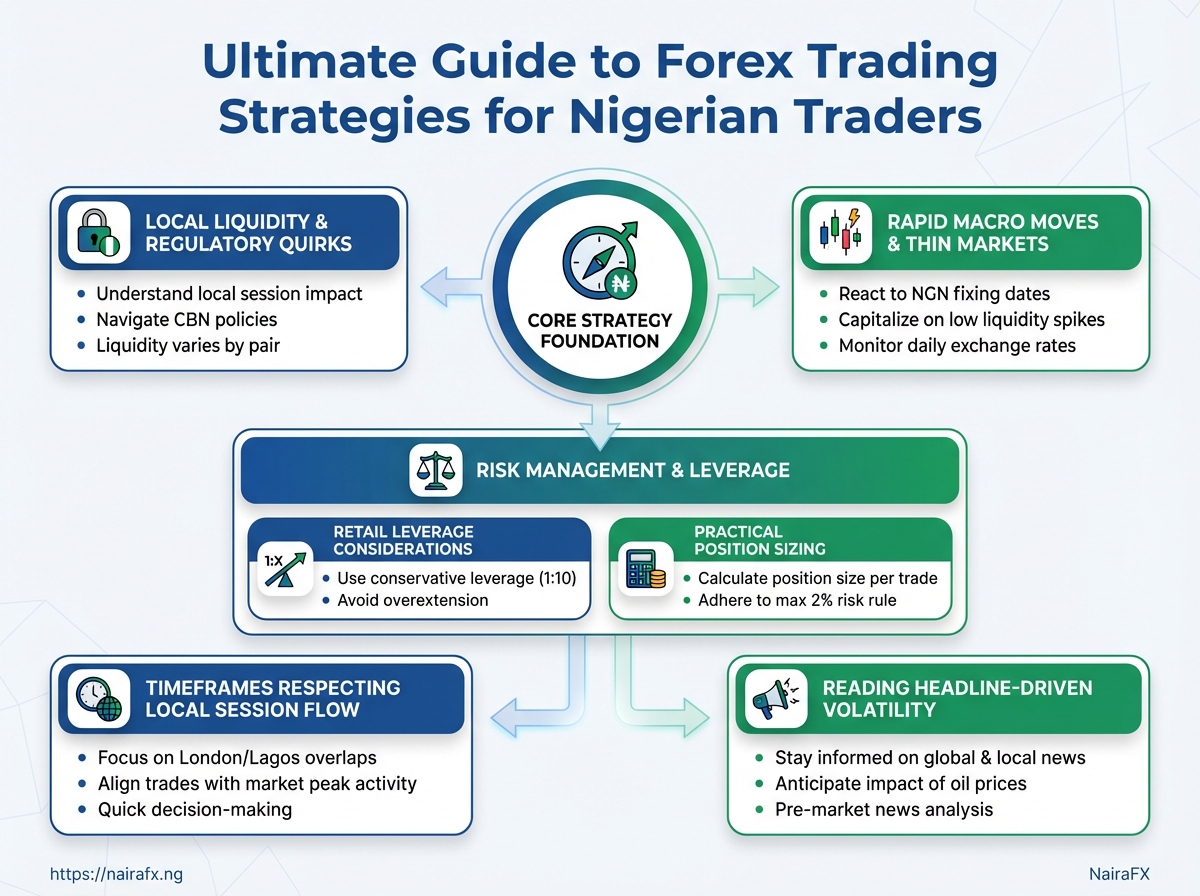
Successful trading here depends less on following indicators. Instead, you must adapt strategies to real constraints. This means managing risk with practical position sizing, selecting timeframes that match local trading hours, and understanding how news-driven volatility affects the market. Thinking of Forex as just a collection of interchangeable tactics leads to losses.
Viewing it as a system customized for Nigerian realities distinguishes successful traders from hobbyists.
Executive Summary
Nigerian forex and equities traders face a market that moves fast and rewards discipline more than bravado. Focused, repeatable strategies…
Executive Summary
Nigerian forex and equities traders face a market that moves fast and rewards discipline more than bravado. Focused, repeatable strategies along with strong risk controls lead to the most reliable results. Here’s a summary of the key takeaways and immediate actions you can implement as a trader in Nigeria.
Market conclusions and recommended actions:
- Trade what fits local liquidity: Favor pairs and instruments with consistent spreads during Nigerian trading hours.
- Match strategy to capital and time: Small accounts benefit from shorter, higher-probability setups; larger accounts can absorb wider swings for trend capture.
- Risk controls are non-negotiable: Position sizing and mechanical stops protect capital and keep strategies testable.
Top 3 strategy recommendations for Nigerian traders
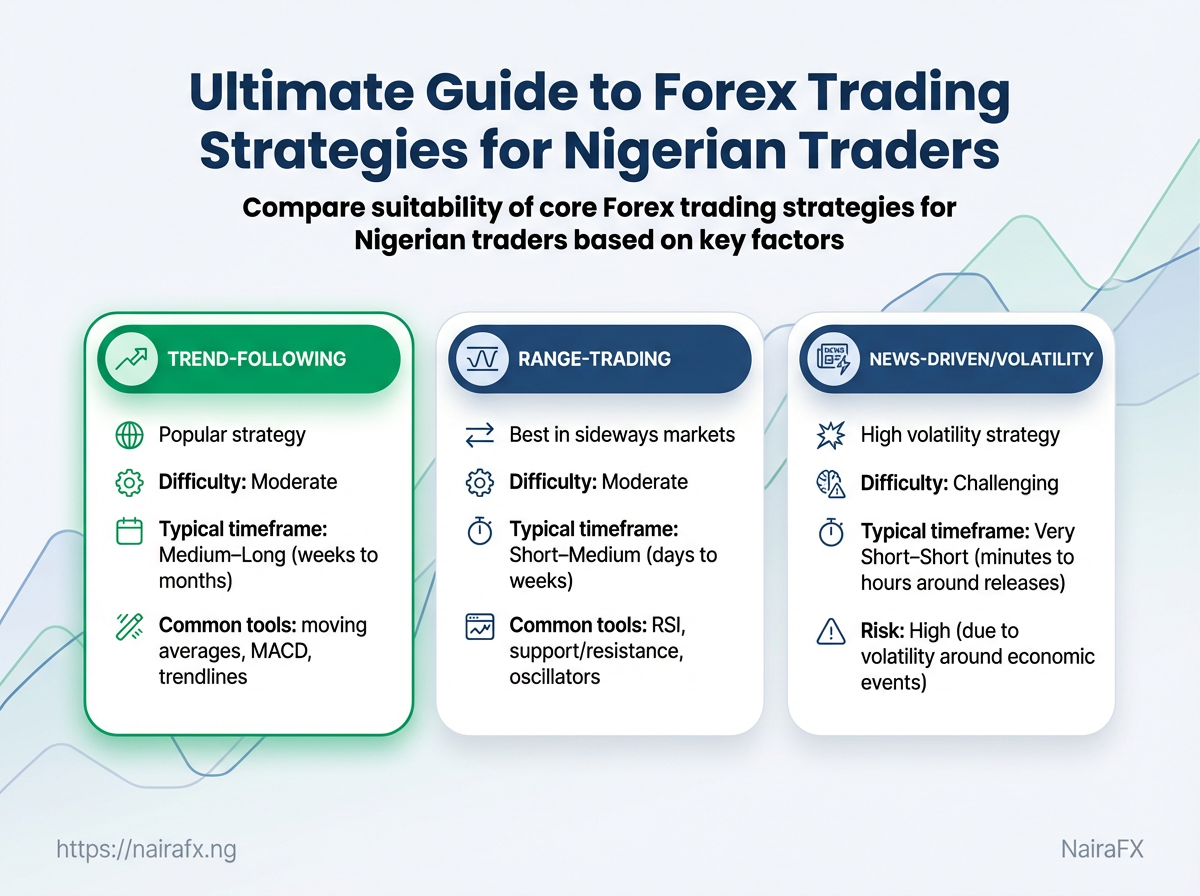
- Trend-following: Use higher-timeframe confirmation with intraday entries; combine moving-average filters with volatility-based stops. 2.
Range-trading: Identify reliable support/resistance with tight risk per trade; works well in low-volatility sessions. 3. News-driven/volatility: Trade headline windows only with predefined edge and reduced size; avoid holding through major macro events unless the edge is proven.
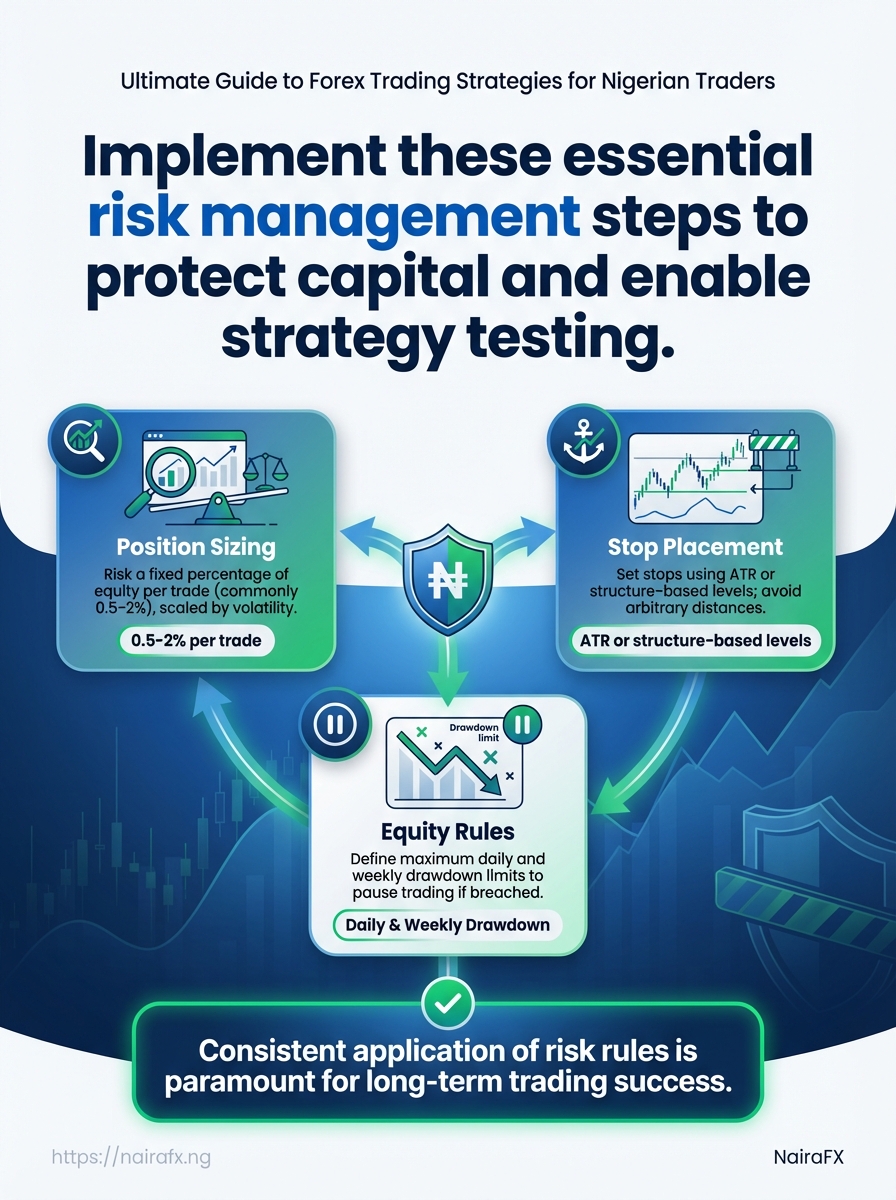
Essential risk management steps Position sizing: Risk a fixed percentage of equity per trade (commonly 0.5–2%), scaled by volatility.
Stop placement: Set stops using ATR or structure-based levels; avoid arbitrary distances.
Equity rules: Define maximum daily and weekly drawdown limits to pause trading if breached.
Immediate next steps (practical)
- Open a demo account and backtest the chosen strategy against at least 6 months of local-hour data.
- Keep a trade journal logging entry reason, stop, target, outcome, and emotional state.
- Set capital rules: maximum risk per trade, maximum daily loss, and a scaling plan as performance permits.
Quick comparison of three recommended strategy types and their suitability for Nigerian traders
Table: Executive Summary — Strategy, Timeframe, Capital requirement & more
| Strategy | Timeframe | Capital requirement | Suitability for Nigerian market |
|---|---|---|---|
| Trend-following | Daily–4H | Moderate ($2,000+) | Good—captures sustained moves during liquid sessions |
| Range-trading | 15min–1H | Low–Moderate ($500+) | Very suitable for quiet hours and tight spreads |
| News-driven/volatility | Minutes–1H | Moderate–High ($1,000+) | Useful around releases; requires discipline and smaller size |
Start by testing one approach consistently, lock down risk rules on every trade, and build from repeatable, measured results rather than intuition.
Understanding the Nigerian Forex Environment
Nigerian forex trading sits at the intersection of global FX…
Understanding the Nigerian Forex Environment
Nigerian forex trading occurs where global FX markets meet local policy issues. Thus, the quality of execution often relies on both macro rules and strategy. Liquidity for major pairs like EUR/USD and GBP/USD is strong during London and New York sessions. In contrast, naira pairs and crypto options often have low liquidity, are fragmented, and experience large daily price swings.
That mix shapes spreads, slippage, and which instruments make sense for different timeframes and risk appetites.
Market structure and liquidity
Interbank vs retail venues: The interbank market focuses liquidity in London and New York. Retail brokers route orders through liquidity providers or internalize flow, which affects fill quality and requotes.
Naira market segmentation: USD/NGN trading happens across official (CBN), Bureau de Change (BDC), and parallel/black-market channels, creating multiple price references and inconsistent depth. Execution in retail platforms may reflect one of those venues or synthetic pricing.
Regulatory considerations
Exchange controls and settlement: Central Bank rules on FX transfers and import/export documentation can delay settlement or constrain capital movement, which indirectly raises funding and hedging costs.
Compliance friction: KYC/AML checks and repatriation rules affect institutional counterparties more than retail traders, but the resulting liquidity withdrawal during policy shifts increases short-term volatility for all participants.
Best session windows for execution
- London session (07:00–16:00 GMT): Best for EUR/USD and GBP/USD liquidity and predictable spreads.
- London–New York overlap (
12:00–16:00 GMT): Peak volume, tighter spreads, ideal for higher-frequency entry/exit. - Asian session (00:00–08:00 GMT): Useful for USD/JPY and carry trades, but lower EUR/USD liquidity.
Instrument selection
Majors: Best for tight spreads and reliable execution; suitable for intraday and swing trades.
Cross pairs: Offer opportunities when majors are quiet but can carry wider spreads.
Naira pairs and crypto: High volatility and larger execution risk; better for traders with explicit liquidity and slippage plans.
Liquidity and volatility characteristics across common currency pairs and session times relevant to Nigerian traders
Table: Understanding the Nigerian Forex Environment — Currency Pair, Typical Spread (pips), Peak Liquidity Session & more
| Currency Pair | Typical Spread (pips) | Peak Liquidity Session | Average Daily Range (pips) |
|---|---|---|---|
| EUR/USD | 0.5–1.0 | London / London–New York overlap | 70–100 |
| GBP/USD | 0.8–1.5 | London / Overlap | 90–140 |
| USD/NGN | 20–300 (highly variable) | Local hours / policy-driven spikes | 200–1000+ |
| USD/JPY | 0.6–1.2 | Asian / Overlap | 60–110 |
| BTC/USD | spreads vary widely (50–500 pips-equivalent) | 24h crypto markets | 400–2000 (crypto ATR) |
Understanding these distinctions reduces surprise during execution: pick majors when you need tight pricing, use overlap hours for best fills, and treat naira/crypto trades with explicit slippage buffers and contingency plans.
Core Forex Trading Strategies (with local adaptations)
Start with a simple rule: choose one…
Core Forex Trading Strategies (with local adaptations)
Begin with a basic rule: pick one main style and adjust it to Nigerian market conditions, such as wider spreads, occasional low liquidity, and volatile Naira crosses. Do not try to master all styles at once. Below are three practical strategies with concrete rules and local adjustments.
Trend-following Use momentum and moving-average confirmation for entries and exits, keeping slippage and spread in mind. Entry rule: Price closes above the 50-period EMA and the 14-period RSI > 55 on the chosen timeframe. Exit rule: Price crosses back below the 50 EMA or RSI falls under 45.
- Indicator settings:
50 EMA,200 EMAfor longer bias,14 RSI(default). 5% of account per trade depending on volatility. Reduce size by 25–40% when trading Naira crosses with wider spreads.
5–3x normal spread during session openings or illiquid hours; add that to your stop distance. Adjustment for lower liquidity: Trade higher timeframes (H4/D1) where spreads matter less and false moves are fewer.
Range trading and mean-reversion Identify clear support/resistance and confirm range via volume and price rejection. Level identification checklist Support/Resistance: Validate with at least three touches on the H1–H4 timeframe. Volume/Price action: Look for wick rejection or volume spikes at level.
Context: Ensure no nearby macro event scheduled within 24 hours.
Trade management
- Entry: Fade extremes after confirmation candle (pin bar, inside bar). Stops: Tight stops—20–40% of typical ATR—to limit risk. 75% risk) to account for frequent false breakouts in thin markets.
- Avoidance rule: Do not trade ranges during low-liquidity windows (overnight local hours) or within 30 minutes of major central-bank announcements.
News-driven and event trading Treat headline events as regime changes—trade only with strict timing and smaller exposures. Event calendar management: Use an economic calendar and remove trades 30 minutes before high-impact releases. 1.
Set alerts for high-impact items (CPI, central bank rates). 2. Decide two windows: pre-event closure (close positions) and post-event re-entry wait (15–60 minutes after release).
- Position sizing: Reduce to 10–25% of normal risk; widen stops to cover volatility spikes. When to avoid: If local FX markets are thin (outside major FX liquidity overlaps like London/New York), skip headline trades.
Range vs trend strategies across risk, time commitment, and expected win-rate
Table: Core Forex Trading Strategies (with local adaptations) — Attribute, Trend-following, Range-trading & more
| Attribute | Trend-following | Range-trading | News-driven |
|---|---|---|---|
| Typical holding period | Days to weeks | Minutes to days | Minutes to hours (event window) |
| Risk per trade | 0.5–1.5% | 0.25–0.75% | 0.1–0.5% (reduced) |
| Sensitivity to spreads | Moderate (mitigate with higher TF) | High (tight stops hurt) | Very high (wider stops needed) |
| Best market hours | London/New York overlap | Local session high-liquidity hours | Around scheduled release windows |
| Required capital | Moderate (for drawdown resilience) | Low–moderate | Low (must absorb rapid moves) |
Key Takeaway: Position sizing, stop placement, and drawdown rules are essential for a successful trading career. Treat them as essential guidelines.
Risk Management and Money Management
Position sizing, stop placement, and drawdown rules are essential for a successful trading career. Treat them as essential guidelines. Use clear, repeatable methods to determine position size. Set stops that recognize market structure and volatility.
Limit daily and weekly losses, so one bad streak does not wipe out months of profit.
Position sizing: Use Risk Amount = Account Size × Risk% then Position Size (lots) = Risk Amount / (Stop Distance (pips) × Pip Value per lot). Stop placement: Anchor stops to market structure first — swing highs/lows, support/resistance, or volatility bands — then convert that distance into pips for the sizing formula. Drawdown limit: Predefine maximum allowable drawdown and a recovery plan; if exceeded, reduce size or pause trading.
- Calculate risk per trade.
- Measure stop distance in pips from entry to the structure-based stop.
- Convert pip distance to position size with the formula above.
- Round to the minimum tradable unit your broker allows and re-check that the rounded position still fits the risk percent.
Practical example: choose 1% risk on a $1,000 account, stop 50 pips, pip value $10 per standard lot: Risk Amount = $10; Position = 10 / (50×10) = 0.02 lots.
Adapting stops for wide-spread environments requires trading less size, not looser risk rules. Wider spreads or higher volatility increase stop distance, so reduce position size proportionally or switch to setups with tighter structure. When liquidity events push spreads out, avoid entering until normal conditions return or plan spread + volatility adjusted stops and smaller sizes.
Daily and weekly risk limits help avoid emotional mistakes:
- Daily cap: Stop trading for the day after losing 1–2% of account equity.
- Weekly cap: Pause trading for the week after cumulative losses of 3–5%.
Sample position size calculations across account sizes and risk percentages
Table: Risk Management and Money Management — Account Size, Risk per Trade (%), Risk Amount (USD) & more
| Account Size | Risk per Trade (%) | Risk Amount (USD) | Stop Distance (pips) | Position Size (lots) |
|---|---|---|---|---|
| $100 | 1% | $1 | 50 | 0.01 (rounded) |
| $500 | 1% | $5 | 50 | 0.01 |
| $1,000 | 1% | $10 | 50 | 0.02 |
| $5,000 | 1% | $50 | 50 | 0.10 |
| $10,000 | 1% | $100 | 50 | 0.20 |
Practical discipline beats clever signals: size for survival first, edge second. Stick to the math, adapt stops to the market, and let consistent risk controls compound into long-term growth.
Key Takeaway: Broker choice and execution infrastructure determine whether a strategy lives or dies. Choose a broker first on reliability and counterparty clarity, then on payment paths and execution characteristics.
Execution, Tools and Technology
Broker choice and execution infrastructure determine whether a strategy lives or dies. Choose a broker first on reliability and counterparty clarity, then on payment paths and execution characteristics. Pair that broker with a consistent execution stack — a low-latency VPS, order-routing software, and simple automation — and trade outcomes become far more about strategy and less about technical noise.
Regulation: Regulation reduces counterparty risk and improves dispute resolution. Payment / Withdrawal: Smooth deposits and reliable withdrawals are essential for Nigerian accounts — long withdrawal delays break position sizing and capital allocation. Execution model: ECN/STP vs dealing desk affects slippage and order transparency.
Broker attributes important to Nigerian traders (regulation, payment methods, typical spreads, withdrawal reliability)
Table: Execution, Tools and Technology — Attribute, Why it matters, What to check & more
| Attribute | Why it matters | What to check | Red flags |
|---|---|---|---|
| Regulation | Lowers counterparty/default risk; enforces segregation rules | Check license (FCA, CySEC, FSCA), client fund segregation, negative balance protection | Unregulated entity, offshore-only licenses, unclear legal entity |
| Payment / Withdrawal | Cash-flow and operating capital depend on it | Local Naira deposit options, NGN bank transfers, withdrawal processing times, KYC requirements | Only crypto/wiring with long delays, repeated withdrawal holds |
| Spreads & Commissions | Direct impact on P&L and scalping viability | Typical EUR/USD spread, commission per lot, slot for promotions or variable spreads | Widely variable spreads, hidden commission structures |
| Customer support | Quick problem resolution for trade/withdrawal issues | Local support channels, response SLAs, escalation path, social proof from Nigerian traders | No local channel, slow email-only support, inconsistent responses |
| Execution model (ECN/STP/Dealing desk) | Determines slippage, requotes, and execution transparency | Order routing details, use of DMA, access to liquidity providers, slippage reports | Frequent requotes, confirmed dealing desk intervention, opaque routing |
Practical execution checklist:
- Use a VPS: colocated or low-latency to the broker’s gateway for consistent fills.
- Monitor latency: measure round-trip time and slippage during peak Lagos trading hours.
- Automate simple checks: script daily connectivity, margin, and open-order reconciliations.
- Choose a regulated broker with NGN rails and transparent execution.
- Set up a VPS near the broker (or cloud region) and test for stable latency.
- Automate order placement/recovery routines; log fills for later analysis.
Nairafx services like Monte Carlo strategy evaluation and risk-focused equity-curve analysis fit naturally here when validating execution sensitivity under varied slippage and withdrawal delays. Proper execution tools turn a well-designed strategy into consistent, repeatable results — that reliability is what separates occasional winners from professional traders.
Key Takeaway: Backtesting is not just a formality; it is a practice that distinguishes informed decisions from guesswork. Treat every strategy like an experiment: define hypotheses, control variables, measure outcomes, and iterate.
Performance Measurement, Backtesting and Continuous Improvement
Backtesting is not just a formality; it is a practice that distinguishes informed decisions from guesswork. Treat every strategy like an experiment: define hypotheses, control variables, measure outcomes, and iterate. Measuring your performance effectively connects your practice results to real trading. This ensures that the strategy acts predictably when real money is involved.
Backtesting best practices
Start with clean, realistic inputs and assume the market will be crueler than you expect.
- Data quality: Use tick- or minute-level data where possible; verify corporate actions, session times, and missing bars.
- Slippage & commissions: Model conservative slippage per trade and realistic commission tiers; prefer
slippage per sideandper-lotvalues over optimistic zero assumptions. - Execution latency: Account for order types—
market,limit,IOC—and how fills vary in stressed markets. - Out-of-sample testing: Reserve a contiguous period for validation; consider walk-forward optimization to prevent overfitting.
- Robustness checks: Run sensitivity tests over parameter grids and use Monte Carlo resampling to examine equity-curve variability. (NairaFX’s Monte Carlo service can be useful here for Nigerian market-specific volatility scenarios.)
Key performance metrics and how to calculate them
Pick metrics that reflect your objectives—drawdown matters as much as returns.
- Annualized return: Multiply period returns, take geometric mean, annualize.
- Max drawdown: Largest peak-to-trough decline in equity curve.
- Sharpe ratio:
(Mean excess return) / (Std dev of returns)using a consistent time base. - Calmar ratio:
Annualized return / Max drawdownfor stress-sensitivity. - Win rate & expectancy:
Expectancy = (Win% × AvgWin) - (Lose% × AvgLoss)—this tells whether the edge is statistically meaningful.
A repeatable test-to-live workflow
- Define hypothesis and measurable success criteria.
- Build and backtest on cleaned historical data with conservative slippage/commission assumptions.
- Validate with out-of-sample and walk-forward testing.
- Run Monte Carlo and scenario tests to estimate distribution of outcomes.
- Paper trade with a strict execution plan and live data for 3–6 months.
- If results align, scale slowly with position-sizing guardrails and realtime monitoring.
Backtest Journal Template
Strategy name: Short descriptive label.
Objective: Market, timeframe, hypothesis.
Data used: Vendor, timeframe, adjustments.
Execution model: Order types, slippage, commissions.
Period tested: In-sample / out-of-sample ranges.
Metrics: Annualized return, max drawdown, Sharpe, expectancy.
Notes: Parameter changes, market regime observations, next steps.
Maintaining this discipline turns fragile systems into resilient ones and makes performance failures actionable rather than mysterious. Keep the journal honest, run conservative assumptions, and treat live trading as another testing phase where continuous improvement earns compounding returns.
Psychology, Habits and Trading Routines
Good traders shape their edge with consistent habits as much as with technical tools. Strong routines reduce decision fatigue, enforce discipline, and make it easier to spot when emotions are driving choices. Start with compact, repeatable morning and pre-market rituals, couple them with a tight pre-trade checklist, and use simple bias-mitigation habits like journaling and forced cooling-offs.
Morning routine and pre-market checks
Begin each trading day with a short, focused ritual that orients you to risk and opportunity.
- Market context: Scan top-five drivers: macro events, local liquidity, interest-rate news, commodity moves, and major pair trends.
- Position review: Quickly confirm current positions fit risk profile and recent price action.
- Mental state check: Rate focus and stress on a 1–5 scale; treat 3 or below as a signal to tighten risk or skip discretionary trades.
Pre-trade checklist
A checklist makes rules explicit and prevents on-the-fly rationalization.
- Define the trade thesis and write it in one sentence.
- Confirm position size and absolute risk (e.g.,
1%of equity).
- Set entry, stop-loss and target levels and convert them to time-based exit rules.
- Check correlation risk with existing positions.
- Ask: “What would invalidate this trade?” — then only execute if that invalidation is outside the immediate probability window.
Each step above should be completed before clicking execute.
Bias recognition and mitigation
Common cognitive traps include confirmation bias, recency bias, and loss aversion.
Confirmation bias: Seeking information that supports an existing belief.
Recency bias: Over-weighting the most recent outcomes.
Loss aversion: Preferring to avoid losses more than achieve equivalent gains.
Mitigation tactics to use every week:
- Trade journaling: Log reason, setup, outcome, and emotion for every trade. Review weekly for patterns.
- Pre-commitment rules: Use the checklist and require a second confirmation (indicator or time filter) for discretionary trades.
- Cooling-off protocol: After three losing trades or when emotional score ≤2, stop trading for a minimum block (e.g., 24 hours).
Routine templates (quick examples)
Morning template: 15 minutes — news scan, position sanity check, mental-state rating.
Pre-market template: 10 minutes — volatility gauge, key levels, order readiness.
Using a Monte Carlo-style simulation of your expected trade frequency and risk can show how routines affect drawdown probability; tools that model equity-curve variation are especially useful if position sizing decisions are frequent.
Good routines don’t eliminate uncertainty, but they make reactions predictable and measurable — and predictable reactions are where repeatable edges are built.
Conclusion
Markets in Nigeria move on headlines, liquidity quirks and execution frictions — the surprise policy announcement that weakens the naira, the weekend gap that eats stops, and the sudden spread blowout are familiar. Remember how the example trade that ignored central-bank windows turned a small loss into a much bigger one; and how a backtested range strategy, adjusted for local session overlaps, produced steadier returns. Those episodes show why position sizing, trade-level stop discipline, and a checklist for execution matter as much as the strategy itself.
For many traders, the key difference between blowing an account and surviving a drawdown isn’t a miracle indicator; it’s having consistent processes tailored to the Nigerian forex scene.
Next steps are practical: build a pre-market execution checklist, backtest any rule-driven idea over at least 200 trades or 6–12 months of local-session data, and keep a trade journal with tagged execution errors. ng) and platform summaries can speed setup and offer templates for money management. ” — get answered by starting small, testing rules, and treating each event as data rather than drama.
This week, pick one rule to backtest, jot down its execution checklist, and test it on a demo account with 30 to 60 trades. That sequence produces clarity fast.