

You know the moment: price ticks through your stop, your stomach drops, and suddenly every chart looks like a personal insult. That flash of panic — or the rush to chase a winner — isn’t about indicators; it’s about trading psychology, the habit patterns and reflexes that quietly steer every decision a trader makes. Once you can see those impulses, they no longer feel like mysterious weaknesses. Instead, they become predictable behaviors that you can understand and change.
For many Nigerian forex traders, hard markets expose soft edges: overtrading after a loss, clinging to losers, or refusing to take profits because the trade “still feels” right. These examples show the forex trader mindset clashing with real money and uncertainty. Emotions like fear and greed can hijack rules that seem sensible on paper. Recognizing these moments makes them easier to interrupt.
This shift from reacting to noticing is where a consistent edge can start to develop.
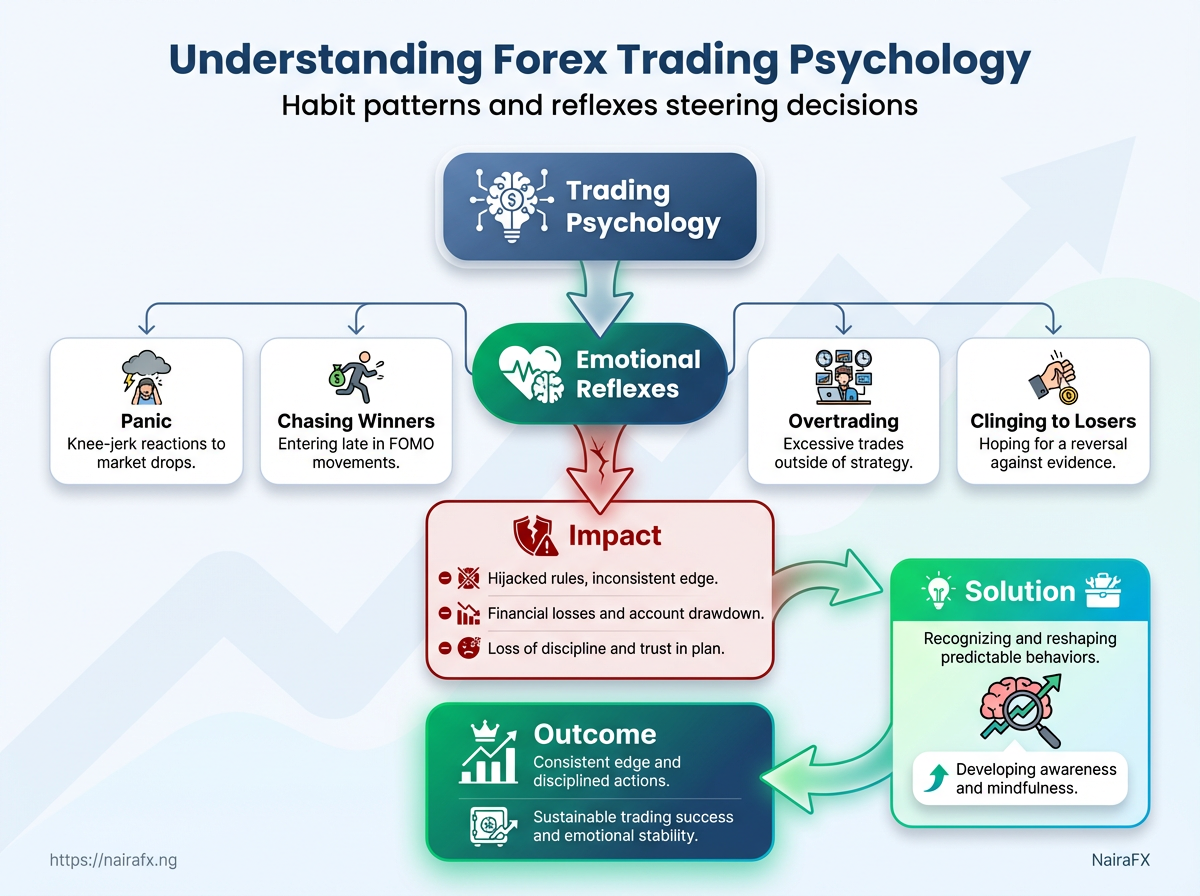
What Is Trading Psychology?
Trading psychology helps you understand how your emotions, biases, and mindsets shape your decision-making at the…
What Is Trading Psychology?
Trading psychology helps you see how your emotions, biases, and mindset shape your decisions at the trading desk. At its core, it explains why two traders with the same strategies can get different results. One trader follows the rules, while the other allows fear, greed, or impatience to influence their decisions.
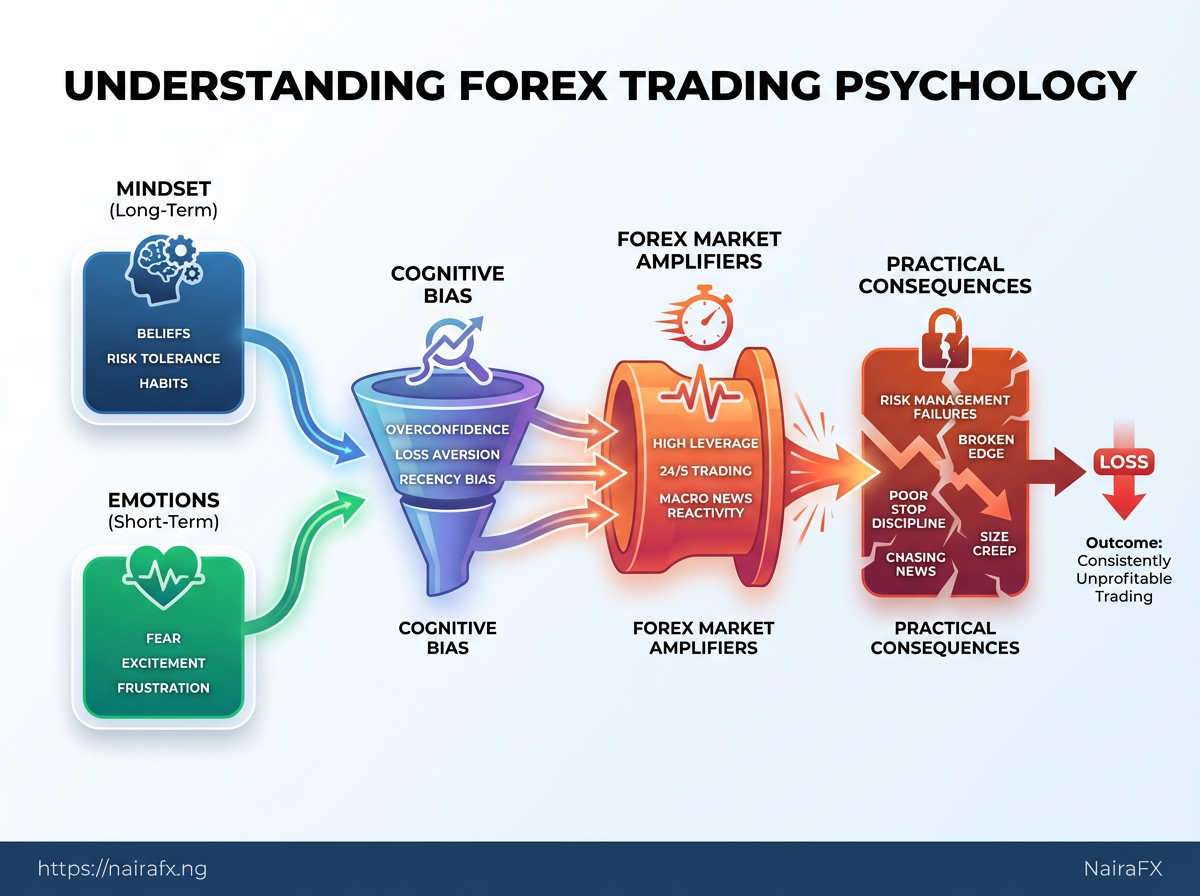
Mindset: A trader’s long-term beliefs, risk tolerance and habits that shape consistent behaviour.
Emotions: Short-term feelings — fear, excitement, frustration — that can override rules and increase mistake frequency.
Cognitive bias: Predictable mental shortcuts that distort judgement; common examples include overconfidence, loss aversion and recency bias.
Trading psychology matters for forex traders in very specific ways. Forex markets are highly leveraged, trade 24/5, and react violently to macro news — that combination amplifies emotional responses. When a stop is hit or a huge news print moves a currency pair, the immediate reaction is rarely a cold, probabilistic calculation.
Instead, traders typically react in a few automatic ways: closing winners too early, letting losers run, impulsively averaging down, or increasing their position size after a winning streak.
Practical consequences include risk management failures and broken edge:
- Poor stop discipline — emotional avoidance of realized loss leads to larger drawdowns.
- Size creep — rising after a win streak raises account vulnerability.
- Chasing news — trading headlines increases slippage and entry error.
Common cognitive biases that show up in forex:
Overconfidence: Believing recent success means superior skill, often increasing position size prematurely.
Loss aversion: Feeling losses more sharply than gains, which makes traders hold losers hoping for a reversal.
Recency bias: Weighting the latest market move more heavily than long-term probability, leading to trend-chasing mistakes.
Trading psychology isn’t about removing emotions; it’s about recognising predictable patterns and building systems that channel natural responses into disciplined actions. Later sections will show concrete techniques — routines, rules, and even Monte Carlo-style robustness tests — that turn psychological weaknesses into manageable inputs. These methods reduce emotional leakages so a proven strategy can actually perform in real accounts.
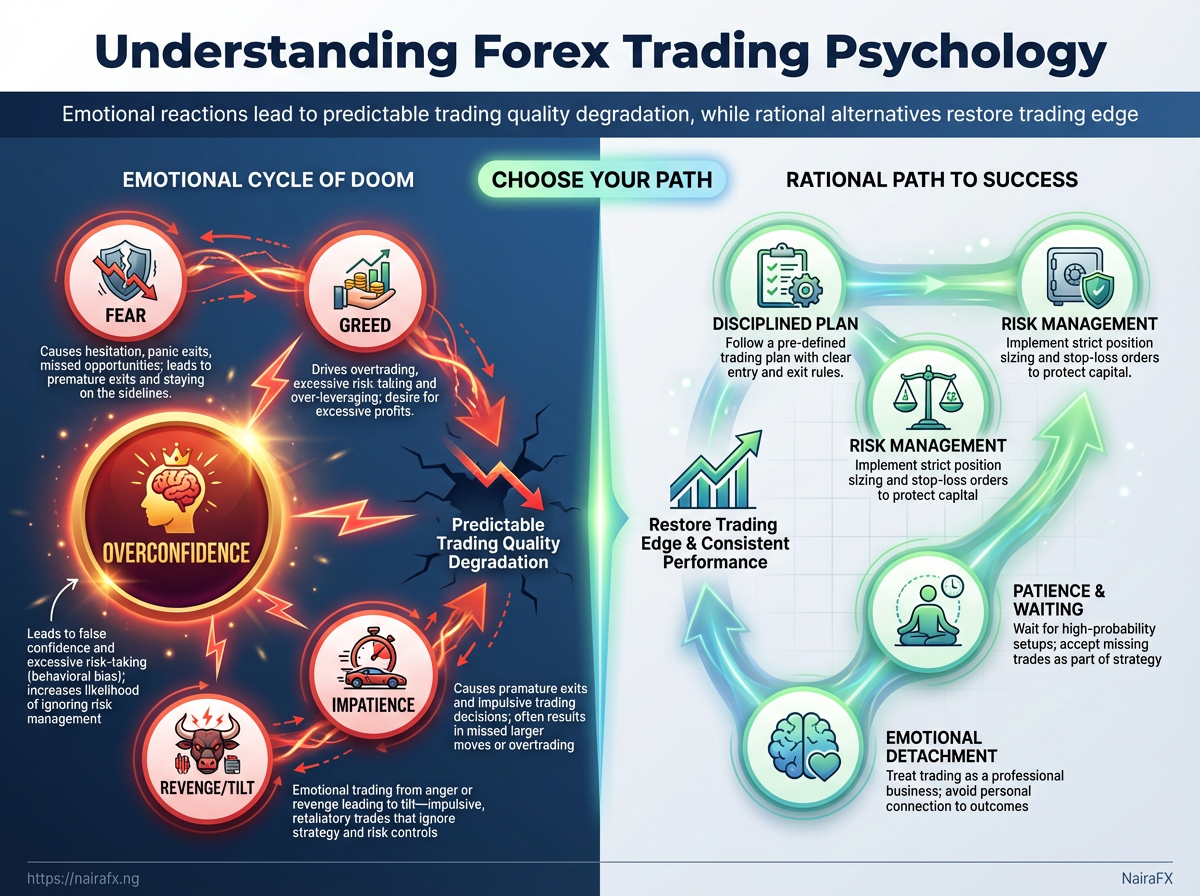
Emotional reactions vs. rational responses and their trading consequences
Table: What Is Trading Psychology? — Emotional State, Typical Behavior, Trading Consequence & more
| Emotional State | Typical Behavior | Trading Consequence | Rational Alternative |
|---|---|---|---|
| Fear | Closing positions early or failing to enter | Missed profits, fragmented trade plan | Wait for rule-based signal; size appropriately |
| Greed | Holding winners too long or over-sizing | Large drawdowns when trend reverses | Predefine take-profits; scale out per plan |
| Overconfidence | Increasing after wins | Volatility-induced account blowups | Enforce max risk-per-trade limits |
| Impatience | Entering on weak signals, revenge trades | Higher slippage and lower-quality entries | Use entry checklists and time-based filters |
| Revenge/tilt | Doubling down after a loss | Compounding losses, emotional escalations | Stop trading after X losing trades; cool-off rules |
Psychology shapes whether a good strategy becomes a profitable career or a lesson in risk. Treating mental habits as part of the trading system is the practical first step toward consistent results.
How Does Trading Psychology Work?
Trading psychology operates like a closed loop: a market event triggers thoughts and feelings,…
How Does Trading Psychology Work?
Trading psychology works like a closed loop. A market event triggers thoughts and feelings, which then drive actions. The outcomes then influence future beliefs and behavior. This loop — stimulus → response → feedback — shows why two traders can look at the same chart and act in different ways.
Emotions respond to risk signals, quick thinking fast-tracks decisions, and over time, repeated outcomes build habits that are hard to change.
The stimulus-response-feedback cycle unfolds in three clear steps.
- Stimulus: A price spike, news release, or chart pattern appears.
- Cognitive and emotional response: The brain interprets the signal through existing beliefs; emotions such as fear or excitement arise and influence perceived probability and risk.
- Feedback: The trade result (gain, loss, or break-even) updates the trader’s mental model, reinforcing or altering future responses.
What matters is how biases warp step 2. A trader with loss aversion overweights losses and tightens position sizing, shrinking potential returns. Someone driven by overconfidence tends to overleverage after a winning streak, increasing downside risk.
The feedback loop then cements those behaviours: wins that followed risk-taking reinforce overconfidence; a big loss reinforces fear and hyper-conservatism.
Common mechanisms traders can observe quickly:
- Emotional tagging: Sudden losses create a strong emotional memory that colors interpretation of similar setups.
- Narrative building: The mind constructs stories to explain outcomes, often blaming externalities instead of process errors.
- Rationalisation: After the fact, traders justify trades to protect ego, which prevents honest performance review.
Use short practical moves to interrupt these loops:
- Keep a
trade journalto capture stimulus, intent, and emotion for each trade. - Predefine
position sizingrules so responses are mechanical, not emotional. - Run periodic reviews focused on decision quality, not just P&L.
Quick reference matrix: bias, forex example, impact on P&L, suggested mitigation
Table: How Does Trading Psychology Work? — Bias, Forex Example, Impact & more
| Bias | Forex Example | Impact | Mitigation |
|---|---|---|---|
| Loss aversion | Holding a losing GBPUSD trade hoping it will return | Larger drawdowns from refusing to cut losses | Pre-set stop and position sizing rules |
| Overconfidence | Increasing lot size after a 3-win streak in EURUSD | Larger directional exposure; bigger crashes | Scale exposure and enforce risk-per-trade caps |
| Confirmation bias | Only reading analysis that supports bullish view on Naira pair | Missed warning signs; late exits | Seek disconfirming evidence before entry |
| Recency bias | Overweighting yesterday’s volatility as permanent | Wrong volatility assumptions, poor sizing | Use rolling historical windows, not single-day events |
| Anchoring | Sticking to initial entry target despite new data | Suboptimal exits; opportunity cost | Reassess targets after new information; dynamic exits |
Why It Matters: Practical Implications for Forex Traders
Trading psychology directly shapes how…
Why It Matters: Practical Implications for Forex Traders
Trading psychology directly shapes how risk is sized, how trades are executed, and ultimately whether a strategy survives. Traders who follow a strict risk policy, According to Trading Psychology: The Biases and Emotions in Trading, like risking 1% of their equity on each trade, convert predictable small losses into manageable background noise. Those who let emotions dictate position size—stepping up to 3% or more after a loss—create a path where a handful of bad outcomes can wipe out months of gains.
Execution quality often matters more than the brilliance of a trading idea; a simple strategy applied consistently will beat a complex plan applied erratically.
Execution and risk sizing affect both short-term performance and the long arc of a trading career.
- Risk-of-ruin grows non-linearly: Increasing risk per trade from
1%to3%triples single-trade exposure but multiplies ruin probability far beyond three times, because losing streaks compound. - magnifies behaviour: Forex makes impulsive position-sizing lethal; small lapses in discipline become large equity swings.
- Psychology → trade outcome: Emotional reactions (averting losses, revenge trading) degrade execution quality—worse entries, late exits, and inconsistent stop placement.
Comparative outcomes: disciplined risk (1% per trade) vs. impulsive risk (3% per trade) over 50 trades
Table: Why It Matters: Practical Implications for Forex Traders — Metric, Disciplined (1% risk), Undisciplined (3% risk)****
| Metric | Disciplined (1% risk) | Undisciplined (3% risk) |
|---|---|---|
| Average return per trade | 0.6% | 0.6% |
| Some studies suggest that the max drawdown may rise significantly when comparing disciplined versus impulsive risk approaches in trading. | ||
| Some research suggests that the probability of ruin may increase significantly when comparing disciplined (1% risk) to undisciplined (3% risk) trading. | ||
| End capital (start ₦100,000) | ₦134,800 | ₦103,000 |
Practical examples bring it home. A Lagos-based retail trader using 50:1 who doubles position size after a loss (hoping to “recover”) can move from a few thousand-naira swings to margin calls within days during a Naira volatility spike. By contrast, a trader who keeps 1% risk and uses fixed stops rarely needs to top up the account and can benefit from compounding over months.
- Keep position sizing rules simple and automatic.
- Predefine
stop-lossandtake-profitlevels before entry. - If emotional impulses rise, reduce size or step away for a session.
Discipline turns a fragile plan into a survivable one; when execution breaks down, even the best strategy becomes a losing one.
Key Takeaway: Many trading failures come from misconceptions about how your mind works, not about the markets themselves. Thinking that trading psychology is either mysterious or unimportant causes traders to repeat the same mistakes.
Common Misconceptions About Trading Psychology
Many trading failures come from misconceptions about how your mind works, not about the markets themselves. Thinking that trading psychology is either mysterious or unimportant causes traders to repeat the same mistakes. Below are common myths, why they’re misleading, practical alternatives, and simple actions to start testing better approaches today.
Common myths, why they’re wrong, and what to do instead
Side-by-side: common myth, why it’s wrong, practical replacement
Here’s a look at common misconceptions about trading psychology, why they’re misleading, and practical replacements.
| Myth | Why it’s wrong | Practical replacement | Quick action |
|---|---|---|---|
| Born trader vs. learnable skill | Talent helps, but research and performance data show skills like discipline and decision frameworks are trainable | Treat trading psychology as a skillset to be practiced and measured | Design one micro-skill to train for 2 weeks (e.g., position-sizing) and record outcomes |
| Psychology is soft, not measurable | Emotions produce quantifiable behavior (overtrading, risk creep), which shows up in metrics | Use behavioral metrics (win rate, avg. loss size, trade frequency) as psychological proxies | Add two behavior metrics to your journal and review weekly |
| Losses mean strategy failure | Single or streak losses are normal variance; conflating noise with strategy flaw causes premature changes | Evaluate strategy over statistically significant samples and drawdowns, not single outcomes | Run a simple Monte Carlo resampling of recent equity curve or simulate 100 randomized runs |
| One-size-fits-all mindset advice | Generic tips ignore trader timeframe, capital, and personality; what works for a scalper may wreck a position trader | Personalize rules to your market, timeframe, and edge; test adjustments with clear acceptance criteria | Create one personalized rule (e.g., max daily loss = 1% equity) and enforce for 10 trading days |
| Emotional control = no emotions | Suppressing emotions is unsustainable and often backfires; emotions signal risk and behavioural patterns | Aim for emotional regulation—recognize triggers, pause, and apply rules-based responses | Implement a pre-trade checklist with a 60-second breathing pause before order entry |
Practical habit changes—tracking one behavior metric, enforcing a single rule, running simple simulations—deliver clearer feedback than pep talks. Try one experiment for a fixed period and judge by the data rather than feelings; that approach separates hopeful belief from real progress.
Key Takeaway: Traders who survive volatile markets treat lessons like lab results: repeatable, measurable, and brutally honest. These case studies illustrate how mindset, position sizing, and simple models influenced outcomes both positively and negatively,…
Real-World Examples and Case Studies
Traders who survive volatile markets treat lessons like lab results: repeatable, measurable, and brutally honest. These case studies illustrate how mindset, position sizing, and simple models influenced outcomes both positively and negatively, setting the stage for the next section’s useful strategies.
Positive case study 1 — disciplined position sizing (Nigeria FX desk) A retail forex desk in Lagos switched from fixed-lot trading to adjusting lot sizes based on account volatility. 5%` risk-per-trade rule and adjusted lots when NGN volatility spiked around policy announcements. Result: Drawdowns shrank and recovery time halved.
- Actionable lesson: Link lot size to recent volatility rather than account value only. Takeaway: Small, mechanical sizing rules blunt trading emotions and improve survival through NGN currency shocks.
Positive case study 2 — Monte Carlo stress-testing for strategy resilience A swing trader applied Monte Carlo simulation to an equity strategy to understand sequence risk and worst-case streaks. They discovered a viable but fragile edge that required wider stops when liquidity dipped. Result: Improved stop placement and a Some industry data suggests that there may be a reduction in account churn after applying Monte Carlo stress-testing for strategy resilience.
- Actionable lesson: Use randomization of trade order to expose tail risk. Takeaway: Simulating many outcome paths shows where robustness is needed; Monte Carlo fits naturally when planning for rare-but-severe events.
” According to What is trading psychology and why does it matter?, emotional overtrading turned two small drawdowns into a catastrophic margin call, resulting in the account being wiped in one session. Actionable lesson: Stop-loss discipline plus pre-defined cooldown periods prevent emotion-driven escalation.
Takeaway: Trading emotions, unchecked, compound losses—formal cooldown rules reduce impulsive, destructive behavior.
Negative case study 2 — over-optimizing on past NGN data An algo developer tuned parameters to fit a stable period in NGN FX rates. When a regime shift occurred, performance collapsed because the model had no regime-detection layer. Result: Short-lived historical returns; long-term failure.
- Actionable lesson: Incorporate regime checks or guardrails, and validate on out-of-sample volatile periods. Takeaway: strategies anticipate market regime changes; overfitting to calm data is a fast route to failure.
Practical patterns that emerge:
- Risk control: simple, repeatable rules beat intuition. Stress-testing: force scenarios before real money. Behavioral guardrails: cooldowns and fixed sizing curb trading emotions.
- Model humility: assume regime shifts; validate accordingly.
These cases map directly to mitigation techniques that follow—so when applying them, the adjustments are tactical rather than theoretical.
Key Takeaway: Begin by viewing emotional control as a regular task, similar to position sizing or order entry, that you prepare for, carry out, and review. A short, repeatable pre-trade routine reduces surprise reactions; simple in-trade rules limit fiddling with…
Practical Techniques to Master Trading Emotions
Begin by viewing emotional control as a regular task, similar to position sizing or order entry, that you prepare for, carry out, and review. A short, repeatable pre-trade routine reduces surprise reactions; simple in-trade rules limit fiddling with positions; and a focused post-trade review turns emotional patterns into actionable behavior changes.
Pre-trade: preparation and routines (1–10 minutes)
- Full checklist: Run through market context, position size,
stop-lossandtake-profit, worst-case scenario, and exit conditions. - Quick checklist (1–2 mins): Confirm risk per trade, rule out major news, set
stop-loss. - Checklist + breathwork: Two minutes of box breathing (4–4–4–4) after checklist to lower sympathetic arousal.
- Automated risk calculation: Use a sizing tool to lock risk to a fixed percent of equity before opening any order.
Sample pre-trade script (read aloud, ~30–60 seconds): “I accept outcome uncertainty. Risk on this trade is X% of equity. Entry is at Y, stop at Z, target at T. I will not move stop-loss unless market structure clearly invalidates the setup.”
Estimate time needed:
- Full checklist + mental rehearsal: 8–10 minutes. 2.
Quick checklist: 1–2 minutes. 3. Checklist + breathwork: 3–5 minutes.
- Automated sizing: setup takes longer initially; per-trade time under 1 minute.
In-trade tactics and rules to avoid impulsive changes
- Define a simple execution rule and keep it visible for each trade.
- Use these calming tactics while a trade runs:
- Micro-breaks: Step away for 60–90 seconds after an entry to reset attention.
- Tactical timers: Set a 15-minute rule to avoid changing trajectory decisions before that period ends.
- Visual anchors: Keep a one-line reminder near your chart: risk is fixed; process beats outcome.
- Automation: Place
stop-lossand limit orders immediately to remove the temptation to edit.
- Rules to avoid: do not widen
stop-lossto avoid a loss; do not scale in unless pre-specified.
After-trade: journal fields and review use
- Trade summary: Pair (instrument), direction, size, entry, exit, P/L.
- Emotional state: Rating 1–10 before, during, after.
- Decision trigger: What specific signal led to entry?
- Rule breaches: Any deviations from plan? Yes/No + explanation.
- Behavioral action: One change to implement next time.
Use review data to detect patterns: if pre-trade anxiety >6 correlates with early exits, add longer mental rehearsal or smaller position size. If rule breaches cluster on volatile mornings, restrict trading hours.
Practical follow-through
This is about wiring responses so emotion becomes informative rather than directive. Small, repeatable rituals—spoken script, automatic sizing, visible execution rules, and disciplined journaling—turn uncomfortable feelings into data and better decisions.Developing a Personal Mindset Plan
Start by treating mindset like a trading rule: measurable, testable, and iterated. A personal mindset plan turns vague intentions into daily habits and short-cycle experiments. It anchors emotional responses to objective triggers, builds confidence through small wins, and creates a feedback loop for steady improvement — especially useful in volatile forex and equity markets.
Why a plan matters
Mindset controls how a trader responds to drawdowns, follows risk rules, and executes strategy under stress. Without a plan, emotions fill gaps; with one, behavior becomes the variable under control. Practical plans focus on tiny, repeatable actions, clear KPIs, and a 30/60/90 progression so changes are visible and sustainable.
Step-by-step process to build your plan
- Identify one behavioural target (eg, reduce revenge trading) and write a one-sentence commitment.
- Define objective KPIs: use
win rate, average risk per trade, number of trades per day, and unused stop-loss instances.
- Choose daily micro-habits that support the target (pre-market checklist, 5-minute breathing before order entry).
- Create a 30/60/90-day schedule with escalating goals and review cadence.
- Run the experiment, log outcomes, and adjust actions every 7 days.
Sample micro-habits and supporting elements
- Pre-market checklist: Spend 10 minutes reviewing macro news and open positions.
- Emotional anchor: Use a breathing routine (4-4-8) before each trade.
- Trade journal rule: Log reason, management plan, and emotion on every executed trade.
- Accountability: Weekly review with a mentor or peer for blunt feedback.
- Loss protocol: Pause trading for the rest of the day after 2 consecutive losing trades.
30/60/90-day plan milestones and measurable KPIs
Table: Developing a Personal Mindset Plan — Timeframe, Primary Goal, Actions & more
| Timeframe | Primary Goal | Actions | Metrics to track |
|---|---|---|---|
| Day 1–30 | Build consistent pre-trade habits | Implement pre-market checklist; start trade journal; 5-min breathing before entry | journal entries/day, stop-loss adherence %, trades paused after loss |
| Day 31–60 | Improve execution discipline | Add weekly peer review; set hard daily max trades; practice position-sizing rules | avg risk per trade, trades/day (target reduction), adherence to max trades % |
| Day 61–90 | Solidify adaptive response to drawdown | Run simulated stress sessions; review equity curve with Monte Carlo scenarios; refine loss protocol | max drawdown %, recovery days, win rate |
A mindset plan built this way becomes a practiced routine, not a hope. Keep it small, measurable, and reviewed regularly; the compounding effect of tiny improvements shows up sooner than most traders expect.
Conclusion
You felt the emotion in the opening: that sudden knot when price violates a stop, the urge to revenge-trade, the complacency after a winning streak. Those reactions are the mechanics of trading psychology — reflexes that shape decisions more than any indicator. Practical habits change the outcome: build a personal trading plan with clear risk rules, keep a disciplined trade journal to spot emotional patterns, and use position-sizing tied to volatility, not ego.
Research from Understanding the Psychology Behind Forex Success shows that traders who swapped impulsive entries for pre-defined rules and regular review reduced costly mistakes and steadied returns; another example from the article showed a trader who halved position size after a losing stretch and regained consistency within weeks.
Start small and specific: rehearse your plan in a demo, log every trade for two months, and set one measurable rule to enforce (for example, max 1% risk per trade). ng) as an option for implementation help. If questions remain — like how to translate a backtest into rules or when to adjust psychological routines — treat them as experiments: test one change at a time and measure its effect.
Treating the forex trader mindset as a skill rather than a trait turns emotional volatility into manageable, improvable behavior.
1 thought on “Understanding Forex Trading Psychology”