

You open a crypto wallet after a long day and the price you tracked all week swings wildly overnight. That gut-sinking moment — wondering whether to sell, hold, or panic — is where most beginners lose money and confidence in cryptocurrency trading.
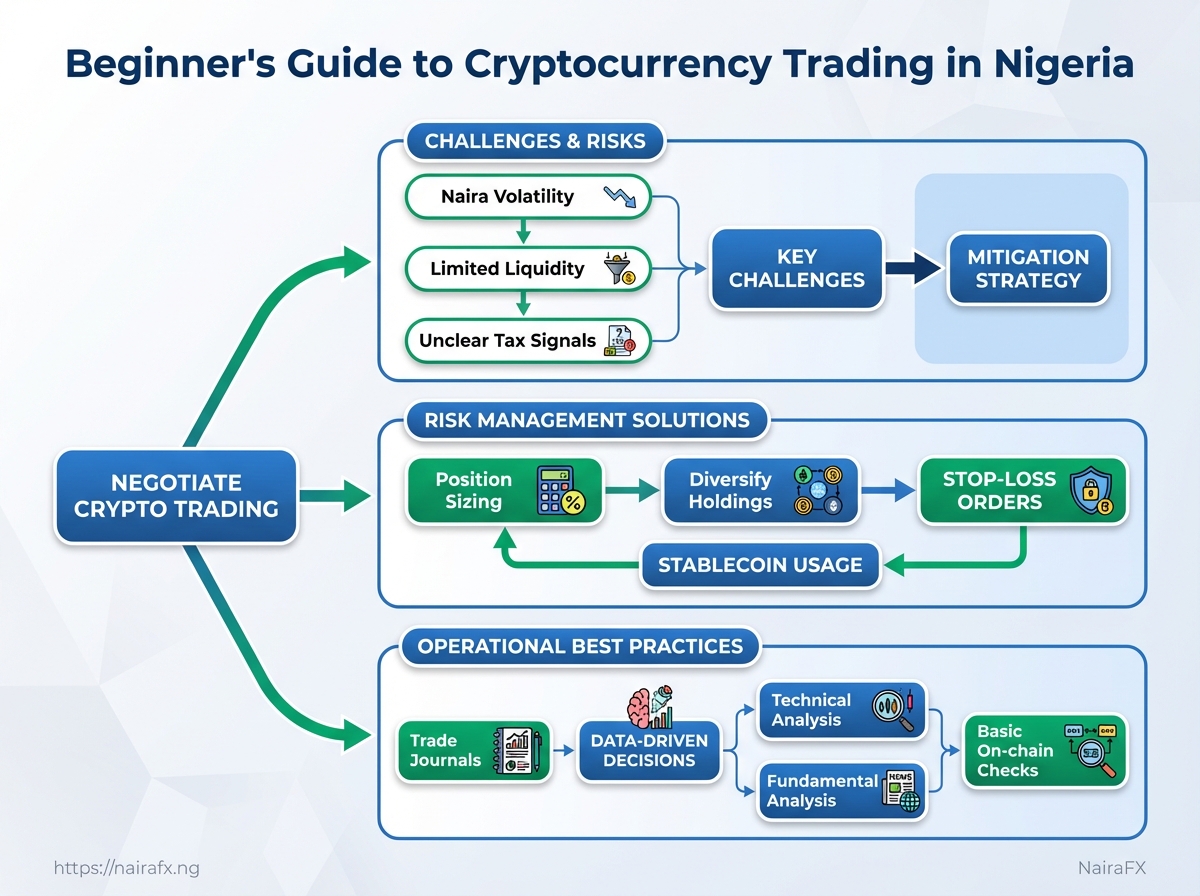
Markets in Nigeria magnify that stress: naira volatility, limited liquidity on local exchanges, and unclear tax signals make risk management non-negotiable. Simple habits — position sizing, trade journals, and basic on-chain checks — prevent rookie mistakes more reliably than chasing the next hot token.
Start with a few concrete practices that protect capital and sharpen decision-making. Clear rules for entries and exits, paired with a realistic view of fees and local market quirks, turn confusing price swings into manageable trading opportunities.
Prepare: Legal, Tax, and Safety Basics for Nigerian Traders
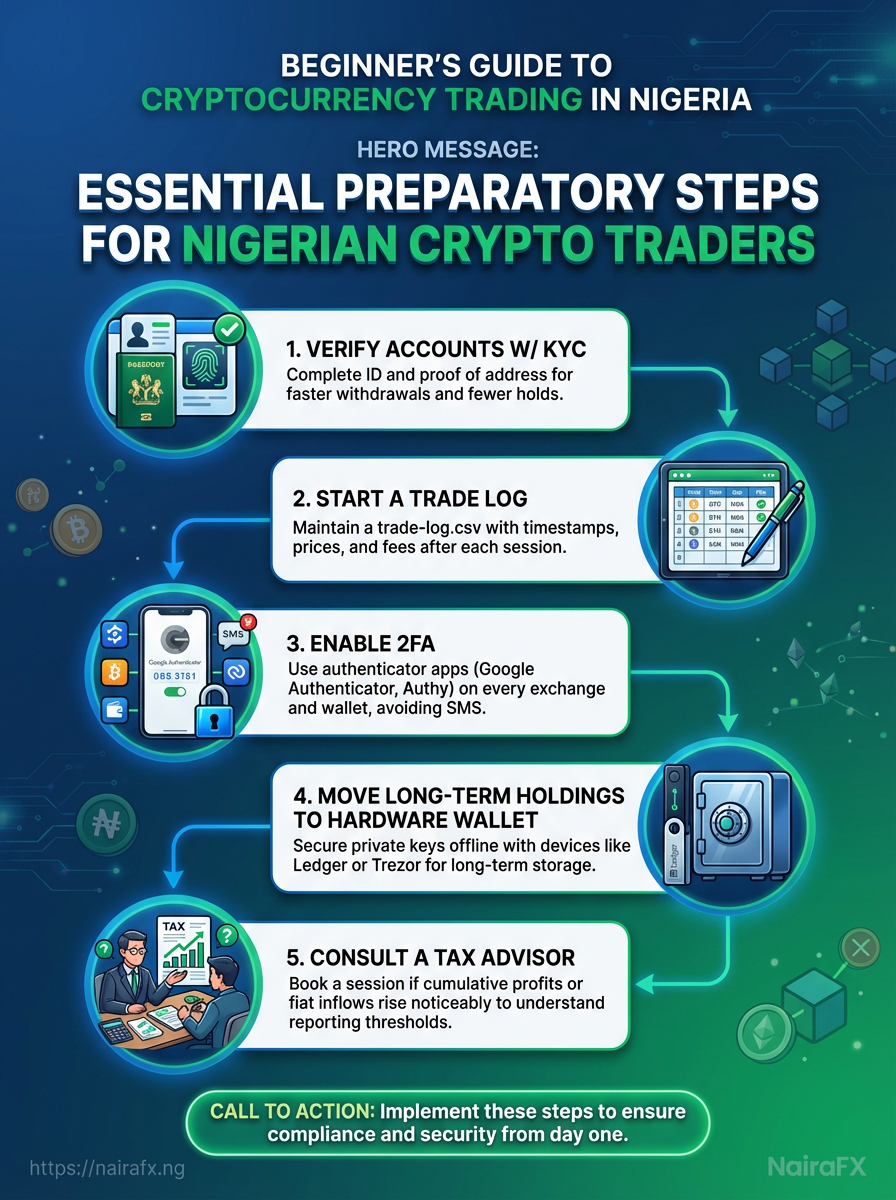
Start by treating compliance and security as part of the trade plan rather than an afterthought. Nigerian regulators and taxation authorities expect clear records, simple KYC for exchanges, and demonstrable steps to secure assets. Missing these basics turns profitable trades into regulatory headaches or, worse, locked accounts and unexpected tax bills.
Why this matters right away
Market access in Nigeria depends on trust: exchanges and payment providers require Know Your Customer (KYC); banks flag unusual flows; and capital gains or forex gains can attract tax scrutiny. Practical early moves reduce friction when scaling, protect savings during platform incidents, and make audits far less painful.Core definitions
KYC verification: Official identity and address checks required by exchanges and banks.
Trade logs (record keeping): Date, asset, volume, price, fees, counterparty, and purpose for every trade.
Two-factor authentication (2FA): Secondary login method—preferably an authenticator app over SMS.
Hardware wallet: Physical device (e.g., Ledger, Trezor) that stores private keys offline for long-term crypto holdings.
Tax professional consultation: Engaging a qualified Nigerian tax advisor when trading profits move beyond routine hobby levels.
Practical checklist and sequence
- Verify accounts with full KYC before funding: faster withdrawals and fewer verification holds.
- Start a
trade-log.csvtemplate and update it after each session; include screenshots for deposits/withdrawals.
- Enable
2FAon every exchange and wallet; avoid SMS where possible.
- Move long-term holdings to a hardware wallet and keep seed phrases offline.
- If cumulative profits or fiat inflows rise noticeably, book a session with a tax advisor to determine reporting thresholds and deductibility.
Tools & routines traders use
- Record keeper: spreadsheet or lightweight accounting app tailored to trading.
- Authenticator:
Google AuthenticatororAuthyapp. - Hardware device: Ledger or Trezor for cold storage.
- Tax contact: chartered accountant familiar with Nigerian tax law.
Checklist of legal, tax and security steps with actionability for beginners
Understand regulation and tax implications in Nigeria
| Action Item | Why it matters | How to do it | Priority |
|---|---|---|---|
| KYC verification | Enables deposits/withdrawals and reduces account holds | Complete ID, proof of address, upload quality photos early | High |
| Record keeping (trade logs) | Needed for tax reporting and audit trails | Maintain trade-log.csv with timestamps, prices, fees, screenshots |
High |
| Enable 2FA | Prevents account takeover | Use authenticator app; back up recovery codes offline | High |
| Use hardware wallet for long-term holdings | Protects against exchange hacks | Buy Ledger/Trezor, transfer long-term assets, store seed securely | Medium-High |
| Consult tax professional if trading profits exceed threshold | Clarifies taxable events and allowable deductions | Engage a Nigerian tax advisor; bring trade logs and bank statements | Medium |
Getting these basics right removes most operational risk and keeps attention on strategy instead of paperwork. Do the small security and record-keeping steps now—they compound into far less stress later.
Choose the Right Platforms and Payment Methods
Start by matching the platform type to the practical problem you need solved: easy NGN on-ramps and liquidity, private token access, or direct local fiat flows. Each route has trade-offs around convenience, cost, custody and regulatory friction — choosing the right one reduces funding headaches and protects capital.
How the main platform types differ
Centralized Exchanges (CEX): Most user-friendly for Nigerians — simple NGN deposits via bank transfer or card, high liquidity, familiar orderbooks, and support for stablecoins like USDT/USDC. Good for fast market access and margin trading. Typical fees are low per trade but expect withdrawal and fiat conversion spreads.Decentralized Exchanges (DEX): Non-custodial and token-rich. Best for accessing new tokens and preserving privacy, but NGN on-ramps are indirect: deposit on a CEX or use P2P to buy stablecoins, then bridge on-chain. Gas fees and slippage can be material.
Peer-to-Peer (P2P) Platforms: Direct NGN-to-stablecoin trades with local buyers/sellers. Ideal when banks block exchange transfers or when you need local payment methods (bank transfer, mobile money). Watch counterparty ratings and escrow terms.
Local OTC Desks: Off-book liquidity for large buys/sells with negotiated spreads. Useful for high-volume traders who need low slippage; expect KYC and bespoke settlement terms.
Non-custodial Wallets (for storage): Not an exchange, but essential for custody after funding. No deposit fees, but you pay network fees when moving assets.
Practical funding steps (typical)
- Create an account on a reputable CEX and complete KYC.
- Deposit NGN via bank transfer or card to the CEX.
- Convert NGN to
USDT/USDCor buyBTC/ETHon the CEX.
- Withdraw stablecoins to a non-custodial wallet or send on-chain to a DEX if needed.
- For P2P: verify counterparty ratings, use escrow, confirm NGN receipt before releasing crypto.
Risk and cost considerations
- Watch spreads: Converting NGN to stablecoins often has hidden spread; compare buy and sell quotes.
- Check withdrawal fees: Network fees and exchange withdrawal charges can eat small transfers.
- Regulatory friction: Banks may impose holds; have alternative P2P routes ready.
Side-by-side comparison of CEX, DEX and P2P for Nigerian beginners to choose the right funding/exchange route
| Platform Type | Ease of Use | NGN Support | Typical Fees | Best For |
|---|---|---|---|---|
| Centralized Exchanges (CEX) | High: guided UX, orderbooks | ✓ Bank transfer, cards, local NGN rails | ~0.05–0.2% trading; withdrawals vary | Fast fiat on-ramp, liquidity, spot/margin |
| Decentralized Exchanges (DEX) | Medium: on-chain knowledge needed | ✗ Indirect (requires on-chain stablecoins) | Gas + slippage (variable) | Access new tokens, privacy, non-custodial |
| Peer-to-Peer (P2P) Platforms | Medium-high: escrowed trades | ✓ Direct NGN person-to-person | Small platform commission; seller markup possible | Local fiat flows, avoid bank restrictions |
| Local OTC Desks | Low: bespoke process | ✓ Bank transfers, telegraphic transfers | Negotiated spread; lower slippage on big trades | Large-volume, low slippage trades |
| Non-custodial Wallets | High for storage; learning curve for transfers | ✗ Not an exchange; holds crypto only | No custody fees; network fees on transfers | Long-term storage, DeFi interaction |
Choosing the right mix of platforms reduces friction and unexpected costs — align the route with how quickly you need market exposure and how much control you want over custody.
Build a Simple Trading Plan and Strategy
Start with a compact, one-page plan that answers: what you trade, why you trade it, how much you risk, and the precise rules you follow for entries and exits. Keep language specific and measurable so decisions become routine instead of emotional.
What to include on one page
Trading objective: Define profit target and performance horizon.Timeframe: Scalp, swing, or positional — choose one primary horizon.
Risk per trade: Percent of account risked when stop-loss is triggered.
Portfolio allocation: How much capital per instrument and overall exposure limits.
Entry rule: Exact setup that must be met before buying or selling.
Stop-loss rule: How the stop is calculated and when it moves.
Take-profit rule: Fixed target, risk-reward ratio, or trailing rule.
Trade sizing method: Position-size calculation using risk and stop distance.
Step-by-step: create your one-page plan
- Decide objective and timeframe.
- Set
Risk per tradeas a percent of capital (example:1%).
- Define
Max daily/weekly drawdown(example:4%daily limit).
- Write concrete entry conditions.
- Specify stop-loss and take-profit mechanics.
- Add rules for trade management and exceptions.
Concrete examples (realistic, actionable)
- Example Objective: Grow capital 20% annually with max drawdown 15% — positional forex focus.
- Example Timeframe: Swing trades, 1–7 days on average.
- Example Risk per trade:
1%of account equity; a ₦500,000 account risks ₦5,000 per trade. - Example Position sizing: Stop at 50 pips; pip value × 50 pips = ₦5,000 → contract size chosen accordingly.
- Example Entry rule: Price breaks above a 21-period EMA with RSI(14) above 50 on a 4-hour chart.
- Example Stop-loss rule: Place stop
1.5× ATR(14)below entry; move stop to breakeven after 0.5× target reached. - Example Take-profit rule: Initial target = 2× risk; switch to trailing stop after first target hit.
Tools & checks
- Backtest quick check: Run a few trades on recent history or use Monte Carlo simulation to see equity-curve variability.
- Checklist: Trade meets entry, risk ≤
1%, position sizing calculated, macro events checked.
A tight, one-page plan turns judgment calls into repeatable actions and protects account equity. Stick to the rules long enough to see if they work, then iterate with disciplined testing.
Basic Technical and Fundamental Tools for Beginners
Start with a small, reliable toolkit: three simple technical indicators to read price action, and three quick fundamental checks to validate why an asset moves. Learning these together reduces guesswork—technicals give timing, fundamentals give context. Below are the practical tools to master first, how to use them together, and a short workflow you can run before placing a trade.
What to learn first (short list)
- SMA/EMA: Moving averages that smooth price; EMA reacts faster to recent moves.
- Relative Strength Index (RSI): Momentum oscillator showing overbought/oversold conditions.
- Volume: Confirms the strength behind price moves; rising volume with price signals conviction.
Team: Strong or transparent leadership increases odds of long-term project survival.
Tokenomics: Supply schedule, inflation rate, and token utility determine long-term value pressure.
Exchange listings / Liquidity: Deep order books and multiple listings reduce slippage and manipulation risk.
Practical example: combining signals
- Look for an EMA crossover (shorter EMA crossing above longer EMA) on the 4-hour chart as a possible entry.
- Confirm momentum with RSI above 50 but not yet overbought (avoid RSI >70).
- Check volume — entry is stronger when volume is increasing on the crossover candle.
- Before executing, run the fundamental quick-check: team credibility, tokenomics (no sudden unlocks coming), and exchange liquidity present.
If technicals line up and fundamentals show positive on-chain news or a solid team update, the trade moves from a technical setup to a fundamentally-backed opportunity.
Quick reference table of technical indicators vs purpose vs signal interpretation for beginners
| Indicator | Purpose | Typical Signal | When to avoid |
|---|---|---|---|
| SMA/EMA | Identify trend direction and dynamic support/resistance | Bullish: short EMA above long EMA; Bearish: opposite | Avoid during sideways chop; whipsaws common |
| Relative Strength Index (RSI) | Measure momentum and possible reversal zones | Overbought: >70; Oversold: <30; cross 50 for momentum | Avoid using alone on low-volume assets |
| Volume | Confirm strength of price moves | Rising volume + price move = conviction | Misleading on low-liquidity exchanges |
| Bollinger Bands | Measure volatility and mean reversion | Squeeze → expansion expected; price touching outer band may reverse | Avoid as sole signal during strong trends |
| MACD | Trend-following momentum and trend change | Signal line cross, histogram turning positive/negative | Lagging indicator; poor in choppy markets |
Putting these tools into a short routine before trades will drastically reduce random entries and emotional mistakes. Use them consistently and they become a disciplined filter, not a crystal ball.
Execute Your First Trades (Step-by-step Walkthrough)
Start with a funded account, a clear trade plan, and the mindset that execution is part mechanics and part discipline. Place the first trade as a repeatable sequence: deposit, confirm, choose instrument, size the position, set protective orders, submit, then monitor and exit. Doing those steps deliberately removes guesswork and keeps losses small while you learn how the market behaves.
Account funded: Ensure cleared deposit and minimum margin requirements are met.
Platform access: Logged into the exchange or broker app and familiar with its order screen.
Trade plan: Entry price, position size, stop-loss, take-profit, and rationale written down.
- Log in and confirm your cleared balance on the exchange or broker.
- Navigate to the market for the asset (example: BTC/NGN or a listed altcoin) and check the live bid/ask spread.
- Choose an order type:
marketfor immediate fills,limitto control entry price, orstop-limitfor conditional orders.
- Calculate position size based on risk — commonly 1–2% of account equity at risk per trade — then convert to asset quantity.
- Enter the order with the chosen size and price, and attach protective orders before submitting.
- Submit the order and verify execution in the trade history or order fills tab.
- Monitor the trade and adjust only when market structure or your thesis changes.
Position sizing example: risking 2% on a ₦200,000 account with a ₦10,000 stop distance means risk per trade = ₦4,000; position size = ₦4,000 ÷ stop distance in NGN per unit.
How to set prudent stop-loss and take-profit orders
Stop-loss: Place it beyond a logical structure point — under a recent swing low for longs, above a swing high for shorts. Keep the value consistent with your risk percentage.
Take-profit: Use a reward:risk rule, commonly 2:1 or 3:1, or scale out in partial exits at key levels.
Common issues and quick fixes
- Order not filling: Cause: limit price too aggressive. Fix: widen price or use a
marketorder if slippage is acceptable. - Wrong size entered: Cause: input units vs. currency confusion. Fix: double-check quantity and preview estimated cost before submit.
- Stop triggered by noise: Cause: stop too tight near volatility. Fix: move stop to a structurally meaningful level and reduce position size to keep risk constant.
Using Monte Carlo or equity-curve review afterward helps evaluate whether your sizing and stop rules are sustainable. Executing trades cleanly turns plans into measurable results — the more disciplined the process, the faster profitable patterns emerge.
Risk Management, Psychology, and Continuous Learning
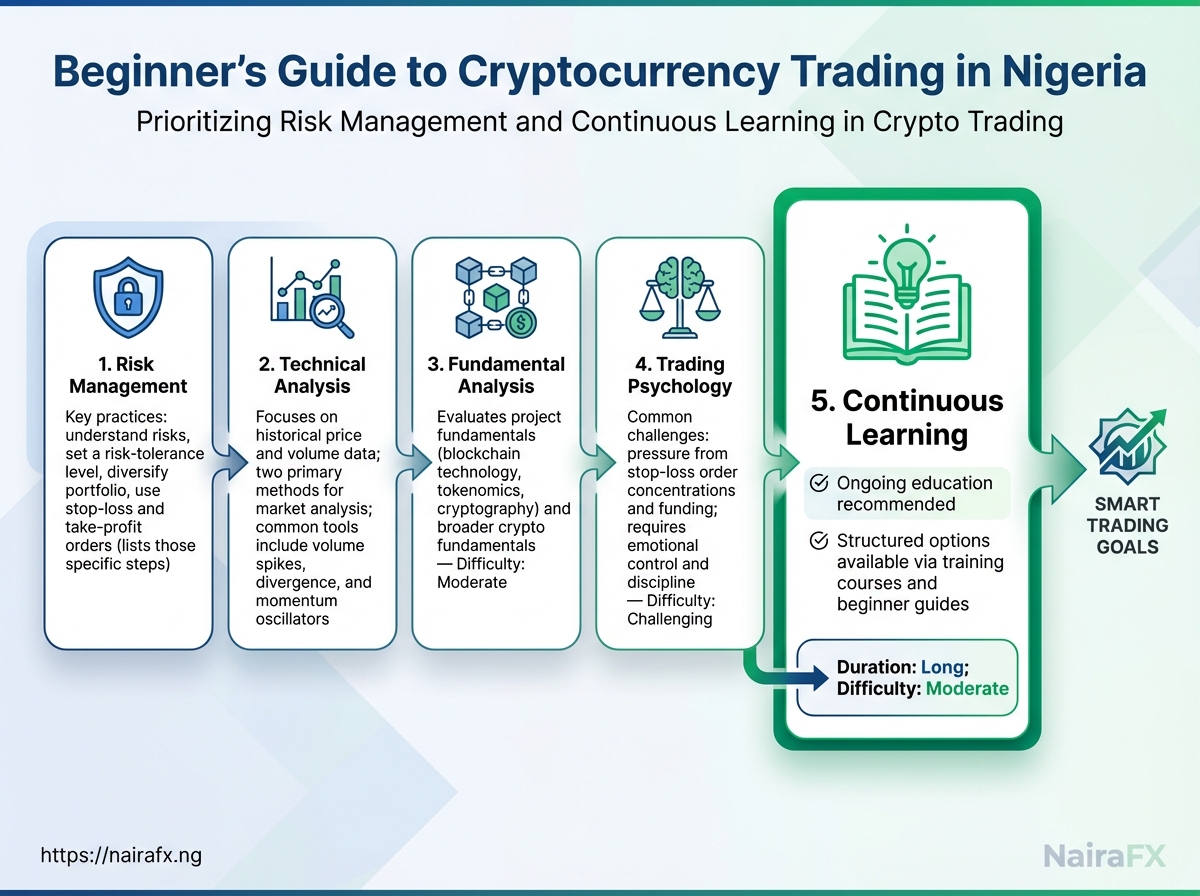
Start by treating risk control and mental habits as non-negotiable routines. Consistent position sizing, disciplined stop-loss execution and a simple learning loop are the safety rails that let profitable ideas compound without getting wiped out by one bad trade.
Position sizing and stop-loss discipline
Position sizing: Decidemax risk per trade before the trade — commonly 1% of equity for beginners, 0.5–2% depending on volatility.
Stop-loss placement: Use structural levels or volatility measures such as ATR rather than guesswork. Place stops where the setup is invalidated, not to “feel safer.”
Risk per day/week: Cap aggregate exposure — for example, stop trading for the day after three consecutive losses or a 3% drawdown. That prevents emotional overtrading.
Practical journaling template
Use a compact, repeatable journal so review becomes frictionless.- Date:
- Instrument / pair:
- Timeframe:
- Entry price / position size:
- Stop / target:
- Rationale: single-sentence setup reason
- Outcome: P/L and emotional state (calm, rushed, bored)
- Lesson: one actionable change for next time
Review journals weekly and mark patterns: recurring mistakes, execution slippage, or size creep.
Training the trader’s mind
- Start each session with a pre-trade checklist: market bias, risk amount, stop, and alternative plan.
- Practice loss acceptance: simulate sequences of small losses in a demo account to build tolerance.
- Use breathing or brief pauses after a loss so impulsive revenge trades are less likely.
Continuous learning — resources & practice methods
- Micro-practice: Backtest one concept for 30 minutes; extract one rule to add to the journal.
- Simulation: Use exchange demo accounts to rehearse order execution and slippage.
- Peer review: Share trades in a focused community for feedback, not validation.
- Periodic audits: Run a Monte Carlo or equity-curve evaluation quarterly to stress-test strategy robustness — services that perform this analysis can reveal hidden risks.
Curated learning resources and tools prioritized for Nigerian beginners
| Resource | Type (book/course/tool) | Why it’s useful | Access (free/paid) |
|---|---|---|---|
| Beginner Trading Book | Book | Foundation on market structure and risk | Paid |
| Free Intro Crypto Course (MOOC) | Course | Hands-on crypto basics and security practices | Free |
| Exchange demo account | Tool | Real-time order practice without capital risk | Free |
| TradingView | Charting tool | Flexible charts, ATR, alerts, community scripts |
Free/$14.95+ |
| Telegram/Discord trading communities | Community | Quick feedback and idea exchange (vet before trusting) | Free |
Maintaining discipline and a learning loop turns luck into repeatable edge — keep the rules measurable, journaled, and reviewed so emotional noise can’t undo good process.
Additional Considerations Specific to Nigeria
Nigeria’s market adds practical frictions that change how trading strategies are executed. Liquidity windows, banking controls, and local counterparty risk mean that a strategy that works on paper needs operational adjustments in practice. Focus on safe on/off ramps, managing naira volatility with stable assets, and building repeatable settlement workflows with trusted counterparties.
Start with trusted counterparties and settlement hygiene
- Use verified P2P counterparties: Prefer traders with long track records, high completion rates, and verifiable feedback. Reputation matters more than slightly better rates.
- Use escrow services where possible: Escrows remove settlement race conditions and are worth a small fee when large sums or new counterparties are involved.
- Confirm identity and limits before trading: Verify KYC steps and daily bank limits ahead of time to avoid failed trades.
Convert exposure to stablecoins to reduce NGN volatility
- Convert to stablecoins: Moving settlement funds to
USDT,USDC, or other stablecoins reduces real-time NGN volatility exposure between trade entry and exit. - Watch on-chain fees and speed: Pick chains and bridges with predictable fees so transfer delays don’t create execution risk.
- Maintain local liquidity buffers: Keep a small NGN float to cover quick exits and bank transfer delays.
Banking limits and alternative on/off ramps
- Map your bank rails. Know per-transaction and daily limits, cut-off times, and reconciliation practices for your banks.
- Set multi-rail payment options. Use at least two banks and one fintech payout method to avoid single-point failures.
- Establish crypto-friendly payrails. Work with fintechs and P2P channels that routinely settle crypto trades to NGN within predictable windows.
Operational safeguards and risk controls
- Automate settlement records: Use spreadsheet templates or lightweight tools to log counterparty, amounts, timestamps, and proof of transfer.
- Stress-test worst-case timelines: Plan for 24–72 hour settlement delays and how position sizing shrinks under those constraints.
- Apply long-term risk tools: Use Monte Carlo-style scenario testing for strategy drawdowns to see how banking friction and conversion lag affect equity curves — a useful place to apply Monte Carlo simulation for trading strategy enhancement.
These practical changes don’t rewrite strategy logic; they make trading repeatable and resilient in Nigeria’s environment. Treat operational setup with the same rigor as your edge — it’s where good P&L survives real-world frictions.
Conclusion
Those gut-sinking moments after a night of wild price swings are normal — the setup in this guide turns panic into a repeatable routine: get legal and tax basics sorted, pick a platform with clear payment rails, practice a simple plan on a demo, and protect capital with strict risk rules. Concrete examples in the article showed how a beginner using a demo account and dollar-cost averaging avoided emotional selling during a volatile week, and how routine position-sizing saved another trader from a large drawdown during a surprise market move.
Before logging back into a live wallet, start with three practical steps:
- Open a demo account and run 10 practice trades to internalize execution and fees.
- Draft a one-page trading plan with entry, exit, and risk per trade.
- Confirm tax and KYC requirements so surprises don’t wipe gains.
For help implementing these steps or comparing local-friendly platforms, see NairaFX for tools and Nigeria-focused guidance. If the next question is “what to do during a flash crash?” or “how much should I risk?” follow the plan: tighten stops, reduce size, and review afterward. Trading becomes calmer and more profitable when preparation replaces panic — start small, learn fast, and iterate.