


A trader can take ten quick entries, feel busy, and still finish the day red.
The problem is not effort; it is the gap between scalping and day trading.
In forex, those styles look similar from the outside and behave very differently under pressure.
Scalping aims for tiny moves and depends on fast execution, tight spreads, and almost no slippage. Day trading holds longer, often from minutes to hours, so the trade has more room to breathe.
That difference changes everything from costs to patience.
The wrong choice can hurt fast.
Under the EU retail CFD rules from ESMA and Commission Delegated Regulation (EU) 2018/796, major FX pairs sit at 30:1 leverage for retail clients, with lower caps on other pairs.
That makes position sizing and margin use matter even more.
This is where many traders get stuck, because the best of the forex trading styles is not the one that sounds sharpest.
It is the one that fits your time, costs, and temperament.
Even day trading strategies that look simple on paper can fall apart once spreads and execution quality enter the picture.
What if the trading style you choose matters more than the strategy itself?
A scalping system can look brilliant on paper and still fail in live trading.
The reason is simple: the style shapes costs, speed, stress, and margin pressure long before the entry signal even fires.
That is why traders compare scalping vs day trading so often.
The strategy may decide when to enter, but the trading style decides whether the setup survives spreads, slippage, and the pace of the market.
For Nigerian traders, that comparison matters even more.
Forex trading styles have to fit real-world conditions like platform quality, broker execution, and leverage limits under the ESMA retail CFD framework, where major FX pairs are capped at 30:1, non-major pairs at 20:1, and exotic pairs at 10:1.
Those caps shape position sizing and margin headroom, which hits scalpers harder because they open and close trades fast and often.
> Scalping usually depends on tiny price moves and many trades per day, while day trading holds positions longer, often from minutes to hours, and closes everything before the session ends.
That difference changes the whole game.
Scalpers need tight spreads, fast fills, and low slippage, so platforms like MT4, MT5, and cTrader often matter as much as the setup itself.
Day traders can usually tolerate a little more movement after entry, which gives their day trading strategies more breathing room.
The comparison also helps traders avoid forcing the wrong personality into the wrong style.
- Cost control: Scalping gets squeezed by spreads and commissions much faster than day trading does.
- Execution needs: If fills are slow, a scalper feels it immediately; a day trader often has more room to recover.
- Risk sizing: Leverage caps and margin use change how many positions you can safely hold at once.
- Platform fit: TradingView is handy for testing ideas, while MT4, MT5, and cTrader are stronger choices when execution and automation matter.
A simple rule helps here: match the style to your attention span, your broker conditions, and your ability to manage risk under pressure.
A strategy can be good and still be the wrong fit if the style works against your account.
That is the real reason the style question comes first.
Get that right, and the strategy finally has a fair chance to work.
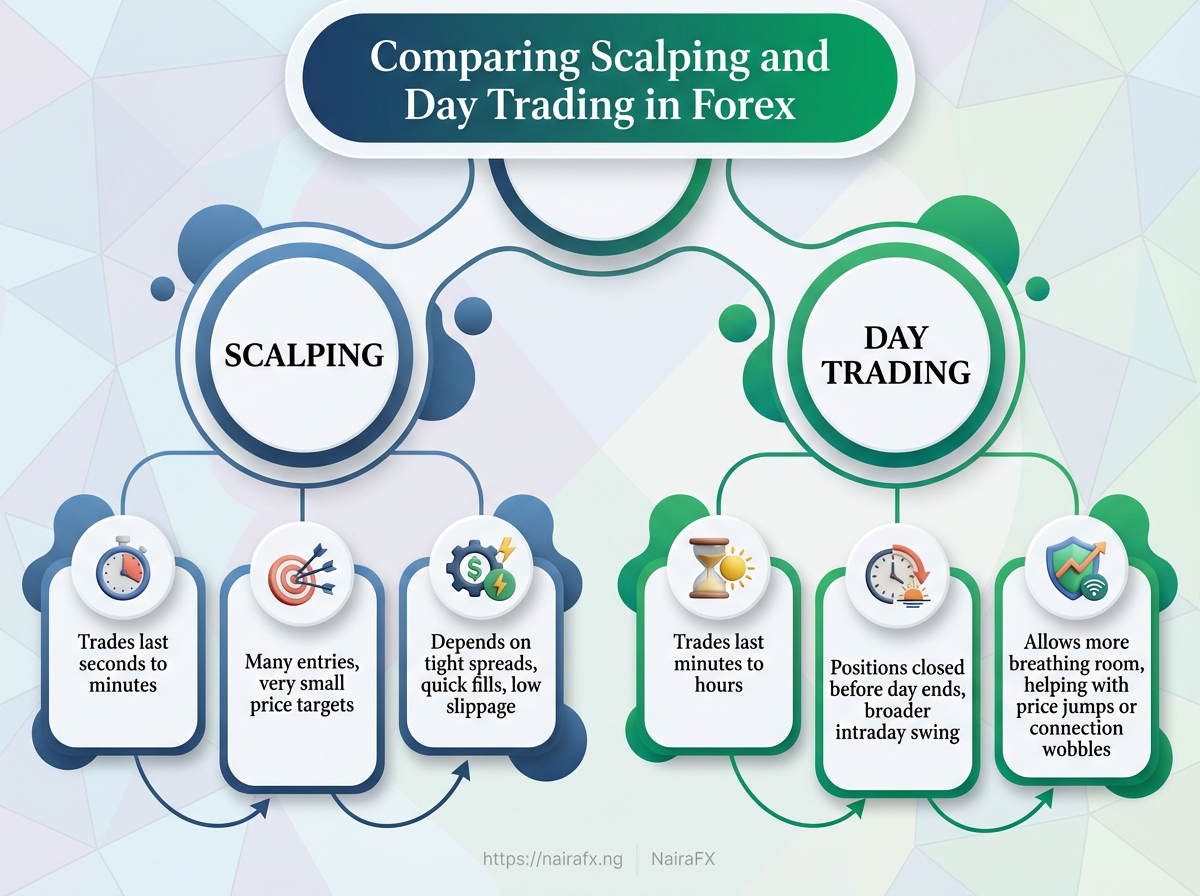
Understanding the basics of each Forex trading style
A trader can be right on direction and still lose money because the holding style was wrong for the setup.
That is why scalping and day trading are not just different speeds; they shape how you read the market, place orders, and manage pressure.
Scalping in Forex means taking very short trades, often just minutes or even seconds, to catch tiny price moves.
The edge comes from repetition, fast execution, and keeping losses small, because spreads, commissions, and slippage eat a bigger slice of profit when each target is narrow.
The chart above gives a quick side-by-side view of the two styles.
It shows the difference in holding time, trade frequency, and decision pace, which is where most traders feel the real gap.
Day trading is calmer on the clock, but not exactly calm in the body.
Positions are opened and closed within the same trading day, usually over minutes to hours, and the focus shifts from micro-moves to cleaner intraday swings.
- Scalping: Many trades, tiny targets, and very tight attention to execution quality. It suits traders who can stay alert and react fast.
- Day trading: Fewer entries, wider intraday targets, and more room for the market to breathe. It suits traders who want structure without staring at every tick.
Regulation also matters here, especially for retail CFD traders in the EU.
As of 2026, the ESMA framework under Commission Delegated Regulation (EU) 2018/796 caps leverage at 30:1 for major FX pairs, 20:1 for non-major pairs, and 10:1 for exotic pairs, so position size and margin headroom are never just afterthoughts.
That rule hits scalpers hard because they often open more trades and recycle margin faster.
It also shapes day trading strategies, because even a slower intraday style still needs enough room for the trade to breathe without forcing an early exit.
Once those basics are clear, the rest of the comparison gets much easier.
The real question is not which style sounds smarter, but which one matches your pace, your costs, and your tolerance for decision-making under pressure.
Key differences between scalping and day trading
A scalper can spend an entire session glued to the screen and still finish with only a handful of points.
A day trader usually has more breathing room, because the trade is meant to survive normal intraday swings instead of every tiny flicker.
That difference changes everything. Time commitment is not just about hours on the chart; it shapes attention, patience, and how quickly a mistake turns expensive.
Trade frequency is the next big split.
Scalping often means repeated entries and exits in quick succession, while day trading leans on fewer decisions and more selective setups.
Risk behaves differently too.
In scalping vs day trading, the shorter style tends to use tighter stops and reacts fast to noise, while day trading can often place stops beyond the noisiest part of the move.
Under the EU retail CFD framework, leverage caps still matter here as well.
Major FX pairs are capped at 30:1, non-major pairs at 20:1, and exotic pairs at 10:1, so both styles have to respect margin limits before they even think about trade size.
Risk exposure and stop-loss behavior
Day trading asks for patience and cleaner setup selection.
The practical trade-off is simple enough.
Scalpers depend more on execution quality, spread costs, and immediate reactions, while day traders can let a setup breathe a little before cutting it loose.
That is why the same pair can feel calm in one style and chaotic in the other.
For traders comparing forex trading styles, the real question is not which method sounds more exciting.
It is which one matches your attention span, your decision speed, and how much heat you can tolerate before closing the trade.
If those three do not line up, the market tends to notice fast.
Which trading style fits your personality and routine?
What if the best trading style is the one you can repeat on a tired Tuesday, not the one that looks exciting on a good day? That question matters more than most traders admit.
Scalping suits people who enjoy fast decisions, constant attention, and a lot of screen time.
The pace is intense, and the feedback comes quickly.
If that energy feels natural, scalping can feel almost mechanical.
Day trading fits traders who want more breathing room.
You still need discipline, but the rhythm is calmer.
A lot of people do better with a few planned day trading strategies than with dozens of rapid entries.
- Choose scalping if you stay sharp under pressure and do not mind many small outcomes piling up through the session.
- Choose scalping if your routine gives you uninterrupted trading windows around the most active market hours.
- Choose day trading if you prefer to map setups in advance, then act only when price reaches your level.
- Choose day trading if you use tools like TradingView to mark alerts and review ideas before the session starts.
- Treat risk tolerance seriously if a string of small losses shakes your confidence, because that is where scalping feels hardest.
Risk tolerance is the real filter here.
A trader who hates frequent stop-outs will usually feel better with fewer, better-planned trades.
Under the EU retail CFD framework, major FX pairs sit at a maximum exposure ratio of 30:1, non-majors at 20:1, and exotics at 10:1, so position size and margin room still matter even when the trade lasts only minutes.
A practical way to decide is simple: look at your calendar, then look at your nerves.
If your day is crowded, day trading is usually the cleaner fit.
If you thrive on fast action and can stay calm while costs and decisions stack up, scalping may suit you better.
Strategy requirements for each style
What if the real edge is not the entry signal, but the conditions around it?
A scalper needs a market that behaves like a clean machine: tight spreads, quick fills, and enough volume to avoid getting chewed up by noise.
A day trader can tolerate a little more room, but still needs a clear intraday story, whether that is a trend, a range, or a fresh news catalyst.
Under the EU retail CFD rules, major FX pairs are capped at 30:1, non-major pairs at 20:1, and exotic pairs at 10:1.
That matters because fast-turnover styles can burn through margin headroom very quickly when the market gets jumpy.
Scalping setups and market conditions
Scalpers usually work best in liquid sessions where price moves cleanly and transaction costs stay small.
The common setups are breakout attempts from tight ranges, pullbacks to short-term moving averages, and quick fades after a failed push through support or resistance.
The market has to cooperate.
If spreads widen, quotes wobble, or slippage starts showing up often, the setup stops being tradable fast.
A tidy 5-minute chart around the London open can be far more useful than a busy chart at a dead hour.
That is why many scalpers care less about prediction and more about session timing, order quality, and whether the market is active enough to pay them for the risk.
Day trading setups and market conditions
Day traders usually need a bigger move and a cleaner reason for price to travel.
Opening range breakouts, trend pullbacks, range reversals, and news-driven continuation moves are the usual candidates.
These forex trading styles also depend on context.
A pair drifting in a tight midday range may be better for a quick fade, while a strong session trend often rewards pullbacks more than chase entries.
Execution still matters, but not with the same pressure as scalping.
A day trader often has more room to let a position breathe, so the setup quality, market structure, and stop placement carry more weight than raw speed.
Indicators and tools traders often use
| Tool or Indicator | Why It Matters | Best For |
|---|---|---|
| Moving averages | They show trend direction and dynamic support or resistance. | Trend pullbacks and breakout confirmation |
| RSI | It helps spot momentum shifts and stretched moves. | Range fades and exhaustion checks |
| MACD | It can highlight momentum changes and trend strength. | Trend continuation and reversal filters |
| Volume analysis | It shows whether a move has real participation behind it. | Breakouts and fakeout checks |
| Support and resistance | These levels frame entries, exits, and stop placement. | Both scalping and day trading |
| Economic calendar | It flags releases that can trigger fast volatility. | News-sensitive day trading strategies |
| ATR | It measures how far price typically moves in a session. | Stop sizing and trade selection |
| Bollinger Bands | They help map expansion, contraction, and mean reversion zones. | Range trading and volatility bursts |
| TradingView alerts | They make it easier to watch levels without staring at charts all day. | Alert-based day trading |
| MT5 strategy tester | It helps check how a rule set behaves on past data. | Testing intraday systems and automation |
Moving averages and RSI help with structure, while volume and the economic calendar tell you whether the move has fuel.
That split matters a lot in scalping vs day trading.
A scalper often lives or dies by execution tools and clean chart levels, while a day trader leans harder on context, momentum, and event timing.
A simple way to think about it is this: the more often you trade, the more your setup needs to survive costs and noise.
The fewer trades you take, the more your setup needs a strong reason to exist at all.
A good plan matches the style, the session, and the toolset.
Miss one of those, and the market usually makes the point for you.
Risk management considerations for volatile markets
What happens when a candle moves faster than your stop can react? That is where scalping becomes unforgiving.
In scalping vs day trading, the fastest losses usually come from spread drag, slippage, and repeated small mistakes rather than one dramatic mistake.
Day trading looks gentler, but it still punishes sloppy risk control.
A position held for hours can unravel if size is too large, a news spike lands at the wrong moment, or the trader starts moving stops after entry.
For Nigerian traders, the safest habit is almost old-fashioned: decide the loss before entering, then respect it.
That matters even more in choppy FX markets, where thin liquidity and sudden dollar moves can turn a good setup into a messy one.
Keep account risk small. A common discipline is risking only a tiny slice of capital on each trade, so a rough morning does not wreck the week.
Treat volatile sessions with caution. Major news releases, rollover periods, and low-liquidity hours can widen spreads and make exits worse than expected.
Use fixed exits, not emotional exits. A stop belongs where the trade idea is invalid, not where discomfort starts.
Size the trade before the signal. A clean entry means very little if the position is too large for the account.
Test the plan under worse conditions. A strategy that survives ideal fills may fail once spreads widen or orders slip.
Respect broker and regulator limits. As of 2026, the EU retail CFD framework still caps major FX pairs at 30:1, non-major pairs at 20:1, and exotic pairs at 10:1; those caps show how quickly borrowed exposure can strain an account.
Build room for errors. In volatile markets, one bad fill is not rare.
The plan should survive several.
A lot of day trading strategies look smart until costs and size get involved.
The traders who last are usually the ones who protect capital first and chase profit second.
Costs, spreads, and broker conditions that matter
What if the broker looks cheap on paper, but every trade leaks value through spread, commission, and slippage?
That happens a lot in scalping vs day trading.
A day trader can sometimes live with a slightly wider spread because the target is larger.
A scalper does not get that luxury.
One extra pip here, one delayed fill there, and the edge starts to vanish.
Execution matters just as much.
A fast market can turn a decent entry into a worse one in seconds, especially when orders sit in a queue or quotes jump around.
That is why serious traders check the fine print on fills, platform stability, and whether the broker actually allows the style they want.
> As of 2026, the EU retail CFD framework still caps leverage at 30:1 for major FX pairs, 20:1 for non-major pairs, and 10:1 for exotic pairs.
Broker features worth checking before choosing a style
| Broker Feature | Why It Matters | Scalping | Day Trading |
|---|---|---|---|
| Low spreads | Smaller round-trip costs protect tiny profit targets | Critical | Helpful, but less decisive |
| Fast execution | Reduces stale quotes and missed entries | Critical | Important |
| Low slippage | Protects expectancy when the market moves quickly | Critical | Important |
| Allowed scalping | Some brokers restrict frequent in-and-out trading | Must be explicit | Usually less sensitive |
| Stable platform | Freezes and disconnects hurt fast trading first | Critical | Important |
| Reliable withdrawals | A clean cash-out process signals trust and discipline | Important | Important |
| Transparent commissions | Hidden fees can wipe out small gains fast | Critical | Important |
| Leverage and margin rules | EU retail CFD caps change position size and headroom | Very important | Very important |
MT4, MT5, and cTrader are useful because they reveal how orders behave in real conditions, while TradingView helps traders test ideas before money is on the line.
The real trick is matching the broker to the pace of the strategy.
A scalper needs the cleanest possible execution path.
A day trader still cares about costs, but has a bit more room to breathe when the trade target is wider.
That is why broker selection is not a side issue.
It sits right inside the trading plan, and it can quietly make or break the result.
How to choose the right style for your goals
A trader who wants fast feedback and tight control usually ends up closer to scalping.
Someone who wants more breathing room and fewer decisions often fits day trading better.
The cleanest way to choose is to match the style to your real target, not the style that sounds impressive on paper.
If your goal is to build consistency with fewer trades, day trading strategies usually make more sense.
If your goal is to practice rapid execution and live inside the spread, scalping vs day trading stops being a debate and becomes a workload choice.
Start with the questions that actually change the result.
How many hours can you sit at the screen? How much noise can you tolerate before you second-guess a setup? And how much margin headroom do you need if you trade retail CFDs under rules like ESMA’s leverage caps of 30:1 on major FX pairs, 20:1 on non-majors, and 10:1 on exotics?
Questions worth answering before you commit
- How often do I want to trade? More trades usually push you toward scalping.
- Can I manage fast execution? If delays annoy you, day trading is usually kinder.
- Do I need wider margin room? Lower leverage can make aggressive intraday trading awkward.
- Am I testing skill or building income? That answer changes the style fast.
A simple way to choose
- Pick your time budget. Less than a few hours a day usually points away from heavy scalping.
- Check your patience level. If small losses irritate you, scalping gets expensive in stress.
- Match style to platform. MT4, MT5, TradingView, and cTrader each help in different ways when you test entries, alerts, and automation.
- Measure trade quality, not excitement. A style that feels busy can still be a poor fit.
When demo testing should happen
Demo testing is most useful before you risk real money, and again whenever your routine changes.
It is especially valuable if you are moving from swing ideas into intraday work, because the pacing feels completely different.
A smart test runs both styles for the same week, using the same pair and the same risk per trade.
That gives you a cleaner read on which one fits your focus, execution, and decision-making under pressure.
The best style is the one you can repeat on an ordinary day, not the one that looks clever in a perfect market.
Once that clicks, the rest gets much easier.
Mistakes traders make when switching between styles
What if the biggest problem in scalping vs day trading is not choosing the “wrong” style, but carrying the wrong habits into the new one?
That happens all the time.
A scalper moves into day trading and still thinks in micro-moves.
A day trader tries scalping and expects the market to give time for every decision.
The result is usually the same: confused entries, messy exits, and a plan that does not match the trade.
The real issue is that forex trading styles demand different rhythms.
A style switch changes everything from how long you wait to how much room a trade needs to breathe.
- Treating scalping like day trading:
If you sit through noise waiting for a “cleaner” exit, the tiny edge often disappears before the trade matures.
- Treating day trading like scalping:
Forcing quick exits because you are used to fast action can turn decent setups into break-even clutter.
- Ignoring cost pressure:
A style that looks profitable in screenshots can fall apart once real execution gets involved.
- Dragging old psychology into the new style:
Day traders often get bored and start forcing trades.
Both problems create bad decisions long before the chart does.
- Switching without a written plan:
Without that reset, traders end up mixing two systems and calling it flexibility.
A simple way to avoid the mess is to test the new style as a full system, not as a mood.
Platforms like MT5 or TradingView make that easier because you can review timing, holding periods, and trade frequency before risking live money.
One useful rule: when you change style, change the whole operating model.
That means position sizing, trade timing, and even your screen habits.
Under the EU retail CFD framework in force through 2026, leverage caps such as 30:1 on major FX pairs also remind traders that margin room is part of the style decision, not an afterthought.
Switching styles works best when the new approach is treated like a fresh job, not a cosmetic tweak.
Clean rules beat quick enthusiasm every time.
Choose the Pace That Fits Your Trading
The biggest lesson in scalping vs day trading is not that one is “better.” It is that the right style has to match your time, costs, and temperament.
A fast scalper can be right on direction and still lose money to spread, slippage, and noise, while a day trader often wins by giving the market more room to breathe.
That is why the stronger forex trading styles usually look boring on paper and disciplined in real life.
The trader who fits their routine, account size, and broker conditions has a real advantage over someone chasing flashy entries.
The same idea showed up in the broker-cost discussion: tiny pricing differences matter far more when you open and close trades all day.
Pick one style and test it properly for 20 trades. Track your average spread, holding time, and worst drawdown, then compare that with your schedule and stress level.
If you want a cleaner way to compare brokers and refine your day trading strategies, tools like nairafx.ng can be a useful next stop.