


There are days when the charts make perfect sense and the trade still feels wrong in your gut, and other days when every losing position looks like a betrayal. That tug-of-war is the practical heart of trading psychology: emotions, bias, and risk tolerance quietly steering decisions while strategy sits on the page. Recognising those moments — the hesitations before entry, the impulse to revenge-trade, the relief that comes with an exiting winner — separates those who stumble from those who build consistency.
Building discipline isn’t a moral project; it’s an engineering problem with human components. It means designing routines that reduce friction, rules that limit catastrophic errors, and mental checks that catch cognitive blind spots before they cost capital. Expect this writing to confront the exact behaviors that blow accounts, show how small changes compound into reliable habits, and give practical ways to make discipline automatic rather than optional.
Executive Summary
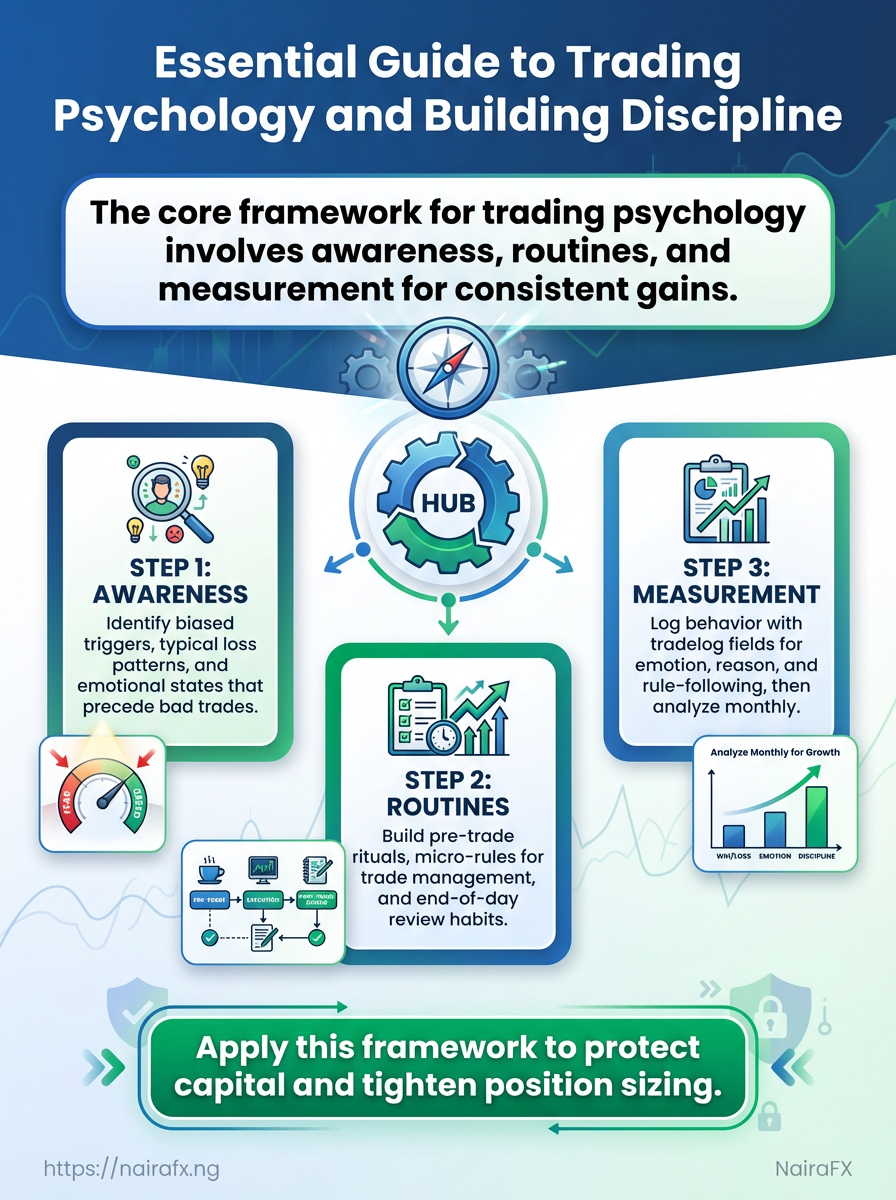
This guide treats trading psychology as the multiplier that turns a good edge into lasting gains. Trading systems, indicators and backtests matter, but mental discipline decides whether those edges get executed consistently. Expect a practical framework that turns awareness into repeatable routines, measures behavior quantitatively, and closes the loop so emotional mistakes shrink and position sizing improves.
What this guide delivers: Practical frameworks: a three-part approach—awareness, routines, measurement—that fits intraday scalpers and position traders alike. Actionable routines: micro-habits and checklists traders can adopt immediately to reduce impulsive entries. Behavioral metrics: simple ways to measure emotional leaks in your trading P&L and equity curve. Tools that scale: how to use Monte Carlo simulation and equity-curve analysis to translate psychological improvements into risk-adjusted performance. * Real outcomes: fewer impulsive trades, clearer position sizing, and more consistent application of your edge.
Core framework (high level) 1. Awareness: identify biased triggers, typical loss patterns, and emotional states that precede bad trades.
- Routines: build pre-trade rituals, micro-rules for trade management, and end-of-day review habits.
- Measurement: log behavior with tradelog fields for emotion, reason, and rule-following, then analyze monthly.
Practical examples and evidence Emotion logging: record a one-word emotional tag before every trade; over one month this reveals repeat triggers. Position-sizing rule: tie max position to the recent average drawdown, then test sensitivity with Monte Carlo runs. Industry writing on trading psychology supports structured routines and measurable discipline; see the Lightspeed practical guide on trading psychology for common mental obstacles and strategies to address them (https://lightspeed.com/active-trading-blog/a-complete-guide-to-trading-psychology). For a beginner-oriented overview of how emotion affects decision-making, consult the HMarkets guide to trading psychology (https://hmarkets.com/learn-to-trade/managing-your-risk/trading-psychology/).
This section sets expectations: follow the framework, keep the measures simple, and let incremental changes compound. The rest of the guide turns these principles into templates, checklists, and examples you can apply this week to protect capital and tighten position sizing.
Foundations of Trading Psychology
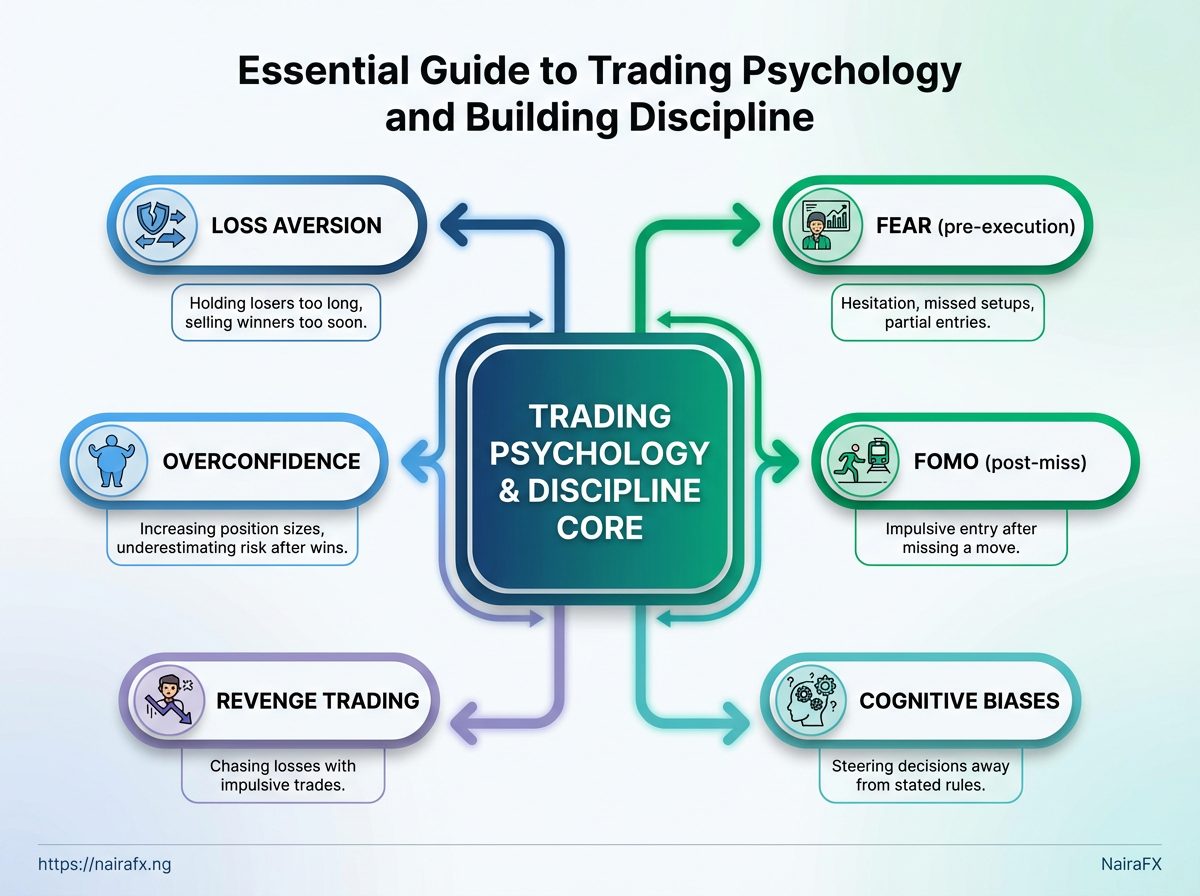
Traders win or lose as much with their heads as with their strategies. At its core, trading psychology explains how emotions, cognitive biases, and habits shape decision-making under uncertainty—often in ways that contradict a trader’s stated rules. Understanding a few core concepts turns vague frustration into actionable fixes that protect capital and sharpen consistency.
Loss aversion: People feel losses more intensely than equivalent gains, which leads to holding losers too long and selling winners too soon.
Overconfidence: Excessive belief in one’s edge after a streak, producing larger position sizes and underestimating risk.
Fear (pre-execution): Anxiety before entering trades that causes hesitation, missed setups, or partial entries.
FOMO (post-miss): The urge to jump into trades after missing a move, often without a plan or edge.
Revenge trading: Chasing losses with impulsive trades to recover quickly, increasing drawdown risk.
How these show up in real trading
- Small, repeated violations: A trader who moves stop-losses after two wins is letting short-term emotions erode a strategy.
- Account behavior drift: Risk per trade quietly grows after a good month—overconfidence at work.
- Execution paralysis: Sitting out clear setups because “this time feels wrong” is fear disguised as prudence.
Simple self-check process (use before each session)
- Write one-line trade plan and max risk for the session.
- Rate current emotion on a 1–10 scale; if above 6, reduce size or skip.
- Log every rule break immediately afterward.
Practical countermeasures that work
- Pre-commit to rules: Use
position-sizingand written entry/exit criteria to remove guesswork. - Small stakes rehearsals: Trial new ideas with micro-lots to reduce emotional load.
- Routine reviews: Weekly equity-curve reviews expose creeping overconfidence or revenge patterns.
Quick reference mapping psychological concepts to trading behaviors and practical countermeasures
| Concept | Definition (1 line) | Trading example | Immediate countermeasure |
|---|---|---|---|
| Loss aversion | Losses felt more intensely than equal gains | Letting a losing position run while taking small profits | Use fixed stop-loss and pre-defined take-profit; automate if possible |
| Overconfidence | Overestimating skill after wins | Increasing position sizes after a winning streak | Revert to risk-per-trade rule; run Monte Carlo tests |
| Fear (pre-execution) | Anxiety that prevents clean entries | Missing high-probability setups | Use checklist and scheduled trade windows |
| FOMO (post-miss) | Urge to enter after missing move | Chasing rallies without plan | Wait for next confirmed setup; set alerts not orders |
| Revenge trading | Impulsive trades to recoup losses | Doubling down after a bad day | Enforce cooling-off period and session loss limit |
Industry guides such as the Lightspeed trading psychology guide and beginner primers like HMarkets’ trading psychology overview provide useful frameworks for these concepts. Practical discipline—written rules, small rehearsals, routine reviews—transforms psychological weaknesses into predictable, manageable parts of the trading process. Keep the focus on behavior you can measure; that’s where improvement actually happens.
Cognitive Biases and Emotional Triggers
Cognitive biases quietly steer otherwise rational traders into avoidable mistakes. Recognizing the usual suspects and inserting short, repeatable checks into pre-trade routines reduces impulsive losses and preserves capital during volatile sessions.
Confirmation bias: Tendency to favour information that supports an existing view. Manifestation: Cherry-picking charts and ignoring contradictory indicators. Mitigation: 1. Force a counter-evidence search; 2. Use a rule that requires at least one opposing indicator before entry. Checklist prompt: “What would disconfirm this trade?”
Anchoring: Relying too heavily on an initial price/level anchor. Manifestation: Sticking to an entry price or target despite new data. Mitigation: 1. Reset anchors each session; 2. Use position-sizing tied to volatility, not entry price. Checklist prompt: “Is my stop based on market structure or my original anchor?”
Recency bias: Overweighting recent moves when forecasting next ones. Manifestation: Extrapolating one strong candle into trending conviction. Mitigation: 1. Compare multiple timeframes automatically; 2. Limit lookback to strategy-defined windows. Checklist prompt: “Does multi-timeframe data support this?”
Gambler’s fallacy: Expecting reversal because a pattern has repeated. Manifestation: Increasing size after a losing streak expecting a win. Mitigation: 1. Enforce fixed risk per trade; 2. Pause after N losses for a review. Checklist prompt: “Am I sizing for probability or for emotion?”
Sunk cost fallacy: Holding losers to justify prior decisions. Manifestation: Refusing to cut losses because of invested time/capital. Mitigation: 1. Predefine stop-losses; 2. Use automated exits or alerts. Checklist prompt: “Would I take this trade today knowing current price?”
Survivorship bias: Learning only from winners and ignoring failed systems. Manifestation: Adopting strategies based on headline successes without failure data. Mitigation: 1. Review full sample performance; 2. Use Monte Carlo or walk-forward tests. Checklist prompt: “Do I have loss samples for this setup?”
> Market practitioners note that simple procedural rules—pre-trade checklists and enforced stops—cut emotional trades significantly (Lightspeed trading psychology guide).
Side-by-side view of bias, trading manifestation, and mitigation steps
| Bias | Trading Manifestation | Immediate Mitigation | Checklist Prompt |
|---|---|---|---|
| Confirmation bias | Selective attention to supportive signals | Pause and seek a disconfirming indicator; require 1 opposing signal | What would disconfirm this trade? |
| Anchoring | Fixation on original price/target | Reset reference levels daily; size by volatility | Is my stop based on market structure? |
| Recency bias | Extrapolating recent moves | Enforce multi-timeframe check; limit lookback | Does multi-timeframe data support this? |
| Gambler’s fallacy | Increasing size after losses | Fixed risk per trade; mandatory cooldown after N losses | Am I sizing for probability or emotion? |
| Sunk cost fallacy | Holding losers to avoid admitting mistake | Predefined stop-losses; automated exits | Would I take this trade today at current price? |
| Survivorship bias | Following only success stories | Review full sample including failures; run robustness tests | Do I have loss samples for this setup? |
Key insight: The table shows that practical mitigations are short, repeatable, and audit-friendly—perfect for converting psychological awareness into disciplined habits. Industry guides and trader education resources reinforce that checklist-driven discipline is far more effective than willpower alone (HMarkets beginner guide, Tradeciety reading list).
Practical habit to add today: build a two-line pre-trade entry in your journal — one sentence that could disprove the trade, and one if-then rule for exit. That single change shifts decisions from emotional reactions to repeatable process.
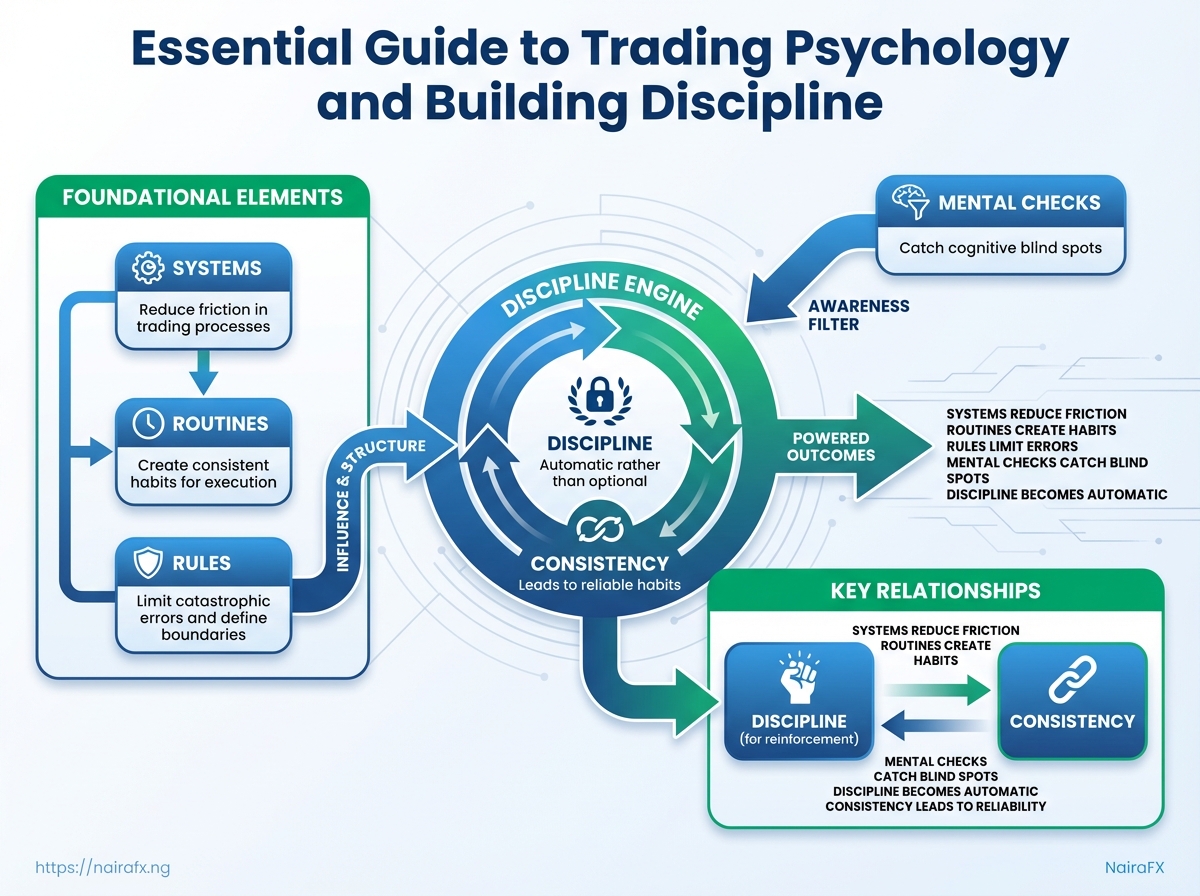
Building Discipline: Systems, Routines, and Rules
Designing an operable discipline system starts with turning vague intentions into specific, testable rules and wiring feedback loops that force honest reflection. Make rules precise enough that you can write a yes/no test for each trade, automate repetitive enforcement where possible, and run short, structured reviews to close the learning loop.
Why specificity matters
Vague rules die under pressure. Replace “trade only high-probability setups” with a clear entry checklist: required indicators, minimum risk-reward, volume threshold, and allowable news windows. When each criterion is binary, backtesting and Monte Carlo robustness checks become possible.
Core components
Discipline system: A documented set of rules and routines that govern trade selection, sizing, exits, and psychological cutoffs.
Routine: A repeated sequence (pre-market checklist, setup scan, post-trade note) that enforces consistency.
Feedback loop: Short, scheduled reviews that convert trade data into actionable changes.
Practical steps to build the system
- Define entry and exit rules on one page.
- Specify position-sizing logic and maximum portfolio risk per day.
- Automate enforcement: alerts,
OCO/ bracket orders,trailstops, and pre-programmed size calculations. - Run a 10-minute daily review and a 60-minute weekly curve check with simple metrics (win rate, avg R, max drawdown).
Automation reduces willpower tax: set alerts for filter breaches, use broker bracket orders to enforce stop and target, and link fills to your journal automatically where possible.
Short reviews build habits: a quick daily note—what triggered the trade, whether rules were followed, emotional state—creates a behavioral dataset that’s actionable in weekly reviews.
Checklist matrix: rule types vs. examples vs. automation tools vs. measurement
| Rule Type | Example Rule | Automation Tool/Order Type | How to Measure |
|---|---|---|---|
| Entry criteria | RSI <30 + price above 20 SMA | Alert on scanner / conditional entry | % of entries meeting both conditions |
| Position sizing | Risk 0.5% equity per trade | Position-size calculator / API order size | Actual risk-per-trade (%) |
| Risk management (stop) | Stop at last swing low | Bracket order / stop-limit | Average R at stop; frequency of stop hits |
| Trade duration | Exit after 5 days if no progress | Time-based order cancel / reminders | % of trades closed by time rule |
| Emotional cutoff | Stop trading after 3 consecutive losses | Session disable / account-level limit | Number of sessions halted per month |
Key insight: defining automation and measurement for each rule removes ambiguity and makes discipline measurable; once measurable, it becomes improvable.
Industry guides on trading psychology reinforce these practices—see the lightspeed overview on trader mental obstacles for practical tactics and tradefundrr’s step-based discipline framework for execution ideas (Trading Psychology: A Complete Guide, Building Trading Discipline: 7 Steps to Master Your Emotions). A short daily routine plus automated enforcement is a small upfront cost that prevents big emotional losses later. Keep the system simple, instrument it, and let the data tell you when to tweak rules.
📝 Test Your Knowledge
Take this quick quiz to reinforce what you’ve learned.
Practical Exercises, Tools, and Technologies
Start by building muscle memory for process and discipline: short, repeatable drills that force decision-making under small stakes are more effective than sporadic long sessions. The exercises below sharpen entry/exit timing, risk control, and emotional awareness; the trade-journal template that follows makes those gains measurable. Practical tools listed after the template are chosen for accessibility to Nigerian traders and for integration into a repeatable workflow.
Practice exercises
1. Micro-session scalping (20 minutes)
- Set a fixed capital slice (e.g., 0.5% of account).
- Use a single instrument and one timeframe (
1mor5m). - Take only setups that meet your checklist; stop after 3 trades or 20 minutes.
- Run 10 simulated trades with
1:1and1:2targets, no real positions. - Track whether position sizing matched the pre-defined risk percent.
- Review mistakes focusing only on risk breaches.
- Before each session, record a 30-second voice note of your emotional state.
- After any loss over your daily limit, re-record and note behavior differences.
- Compare voice notes weekly to detect recurring triggers.
- Take a sample equity curve from backtests.
- Randomize trade sequence
Ntimes to see distribution of drawdowns and streaks. - Use results to adjust position size or stop-loss thresholds.
2. Risk-only rehearsals
3. Emotion check protocol
4. Monte Carlo robustness test (conceptual exercise)
Trade-journal template (copy-pasteable)
Date: Instrument: Timeframe: Direction (Long/Short): Entry price: Stop-loss: Target(s): Position size (% of equity): R:R (Reward:Risk): Setup checklist (tick items): Trade rationale (one sentence): Emotional state pre-trade: Outcome (Exit price / Result): Post-trade notes (what went well / what to change): Follow-up actions (adjust rule, re-test, practice drill):
Tools & technologies — quick rationales
- TradingView: Charting and alerts; great for visual setups and sharing screenshots.
- MetaTrader / cTrader: Execution and order management; common with local brokers.
- Spreadsheet (Google Sheets/Excel): Journal aggregation and performance metrics.
- Monte Carlo tool (client or generic): Strategy robustness—NairAFX’s Monte Carlo simulation can plug directly into equity curves for position-sizing guidance.
- Voice recorder / notes app: Emotional tracking—fast and non-invasive.
Industry reading on trader mindset helps sustain discipline; see the Trading Psychology: A Complete Guide and A Beginner’s Guide to Trading Psychology for frameworks that pair well with these exercises.
These practices convert abstract rules into repeatable habits and the journal makes progress visible—run the drills weekly and let the data steer small rule changes rather than feeling-driven edits.
Measuring Progress and Metrics That Matter
Start by separating what the market tells you from what you do. Performance KPIs measure trading outcomes; behavioral KPIs measure the decisions and habits that produced those outcomes. Tracking both turns vague discipline goals into measurable improvements.
Performance KPIs: Metrics that quantify money, risk and return. Behavioral KPIs: Metrics that quantify adherence to rules, process consistency and psychological states.
Performance vs behavioral KPIs — why both matter Performance tells whether a strategy works financially. Behavior tells whether you can execute the strategy reliably under stress. * Linking them reveals whether P&L swings come from market conditions or execution lapses.
How to calculate core metrics and set cadence 1. Collect trade-level data daily (entry/exit, position size, R, reason). 2. Aggregate metrics weekly for behavioral KPIs and monthly for performance KPIs. 3. Review monthly equity curve and drawdown, then weekly journal for rule adherence.
Simple step-by-step: calculating expectancy (Average R per trade) 1. Compute average win in R units: sum(R for winning trades) ÷ number of wins. 2. Compute average loss in R units: sum(R for losing trades) ÷ number of losses. 3. Expectancy = (Win rate × Avg win) − (Loss rate × Avg loss). 4. Run a monthly cadence and compare rolling 3-month expectancy to prior quarter.
Practical example linking behavior to P&L A trader with Win rate 45% and Avg win 2R, Avg loss 1R has positive expectancy: (0.45×2) − (0.55×1) = 0.35R per trade. If rule adherence drops from 90% to 60% and Avg loss widens to 1.5R, expectancy falls and drawdown rises — behavior change causing P&L deterioration.
Metrics, calculation method, reporting cadence, and target benchmarks
| Metric | How to calculate | Cadence | Reasonable target (example) |
|---|---|---|---|
| Win rate | Wins ÷ total trades | Monthly | 40–60% depending on edge |
| Average R per trade (expectancy) | (Win%×AvgWinR) − (Loss%×AvgLossR) | Monthly | ≥0.2R per trade |
| Max drawdown | Peak equity − trough equity (absolute or %) | Quarterly | <20% for many systems |
| Rule adherence % | Trades that followed documented rules ÷ total trades | Weekly | ≥85–90% |
| Journal entries per week | Number of recorded post-trade notes | Weekly | 3–7 entries |
Key insight: tracking rule adherence and journaling at a weekly cadence reveals behavioral slippage long before it shows in monthly P&L, letting traders fix process leaks proactively.
Behavioral measurement is simple but rarely done well. Industry guides on trading psychology reinforce that disciplined routines — journaling, pre-trade checklists, post-trade reviews — materially improve execution over time (Lightspeed trading psychology guide; HMarkets trading psychology primer). For Nigerian traders in volatile markets, pairing monthly performance reviews with weekly behavioral checks creates a reliable feedback loop. Keep metrics crisp, review them on a fixed cadence, and let the data tell whether the next change needs to be strategy-level or discipline-level.
📥 Download: Trading Psychology and Discipline Checklist (PDF)
Common Mistakes, Recovery Plans, and When to Pause Trading
Most losing streaks come from the same handful of mistakes: oversized position sizes, chasing trades after losses, ignoring stop rules, and trading while emotionally compromised. Fixing those requires concrete, enforceable rules rather than good intentions. Start with a clear pause/reset threshold, an immediate containment sequence, and a staged recovery plan that rebuilds confidence and process fidelity.
Common mistakes and brief definitions
Drawdown: The percentage decline from a trading account’s peak to its trough.
Risk-per-trade: The percentage of account equity risked on a single trade, including stop distance and position size.
Overtrading: Taking excessive trades to recoup losses, often with lower edge setups.
Immediate containment steps (use these the moment losses exceed your rule)
- Stop all new entries and close speculative intraday positions.
- Perform a quick trade journal audit: list the last 10 trades, reasons for entry, outcome, and whether the plan was followed.
- Recompute
risk-per-tradeand effective position sizing; reduce it by 50% for the next 5 traded days. - Reconfirm liquidity and margin constraints with your broker to avoid forced liquidations.
Concrete pause/reset rules traders use
- Hard-drawdown rule: Pause trading for 7–14 days if account equity drops by 10% from peak.
- Daily-loss cap: Stop trading for the day if losses reach 3% of starting equity.
- Consecutive-loss stop: Pause after 5 losing trades in a row and perform a strategy review.
Staged recovery plan to rebuild discipline
- Trade a demo or reduced-size account (20–30% of normal risk) for a minimum of 30 market sessions, tracking win rate and expectancy.
- Revisit edge: run a Monte Carlo or walk-forward check on your strategy; adjust only if results consistently fall outside historical confidence bands.
- Re-establish routine: strict pre-market checklist, written trade plan, and a nightly review slot.
- Gradually scale risk back to normal over 4–8 weeks while meeting performance and process checkpoints.
Industry analysis shows psychology is a central driver of repeated mistakes; practical guides on trading psychology help structure the behavioral side of recovery (see Trading Psychology: A Complete Guide). Using simulation tools like Monte Carlo adds objective discipline to the rebuild phase and is especially helpful for position traders managing larger swings.
Stopping is not failure—it’s a disciplined reset that preserves capital and gives space to fix processes so future profits actually compound.
Integrating Psychology with Strategy and Risk Management
Marrying psychology with strategy and risk controls means designing systems that remove reliance on willpower and make disciplined behavior the path of least resistance. Traders who build these design patterns into their playbook keep emotions from turning small losses into catastrophic decisions, especially in volatile Nigerian FX and equity markets.
How design patterns reduce emotional load
Start by treating psychology as an engineering problem: if your process anticipates predictable emotional reactions (fear after a drawdown, greed after a run of winners), you can bake countermeasures into rules and order types. Industry guides on trading psychology emphasize a toolkit approach — rules, routines, and automation — rather than one-off pep talks or vague discipline goals Trading Psychology: A Complete Guide.
- Rule-based decisions: Concrete entry/exit rules eliminate interpretation at the moment of stress.
- Pre-commitment: Allocating capital into
pre-committed bucketsprevents impulsive reallocation after losses. - Automation: Use
OCO(one-cancels-other) and platform stop orders to enforce stops without manual input.
Quick step-by-step for implementation
- Define
risk per trade(e.g.,1%of equity) and encode it into position-sizing templates. - Create capital buckets: one for live risk, one for exploration (smaller), one for strategy development.
- Automate entry/exit where possible and require manual review only for exceptions.
Design patterns: description, psychological benefit, trade example, implementation tip
Design patterns: description, psychological benefit, trade example, implementation tip
| Pattern | Description | Psychological Benefit | Quick Implementation Tip |
|---|---|---|---|
| Fixed fractional sizing | Risk a fixed % of equity per trade (e.g., 1%) | Limits catastrophic loss and normalizes position size across runs | Set position-sizing script or spreadsheet using risk per trade = 1% |
| Automated stop losses | Platform stops or OCO orders placed with entry |
Removes temptation to move or erase stops during drawdowns | Always place stop with initial order; avoid discretionary stop edits |
| Scaling entries | Enter a position in tranches rather than all-at-once | Reduces anxiety on initial signal and lowers average entry fear | Use 25/25/50 entry splits tied to confirmed pivots |
| Pre-commit capital buckets | Separate funds for core, swing, and exploratory trades | Prevents overleveraging after losses and calms revenge trading impulses | Allocate fixed percentages of account to each bucket and restrict transfers |
| Cooldown rule after loss | Mandatory pause (e.g., 24–72 hours) after a loss exceeding X% | Breaks emotional momentum and improves decision quality | Implement a trade-block flag in journal when loss threshold triggered |
Key insight: These patterns convert emotional weaknesses into structural constraints — traders stop needing to “be strong” and start relying on built-in safeguards that perform under stress.
Practical example: a Nigerian FX position trader who used fixed fractional sizing and automated stops reduced their max drawdown from 18% to 7% over six months by avoiding impulsive position doubling during volatility spikes.
Market resources such as broker order-type docs and trading psychology primers can help map these patterns onto specific platforms. For further reading, consult A Beginner’s Guide to Trading Psychology and curated book lists on trader mindset for deeper technique drills 10 Best Books on Trading Psychology.
Design the process so the system protects you more than your willpower does — that’s how consistent performance survives volatile markets.
Conclusion
Trading is as much about managing
Put the ideas into action with these focused moves: – Keep a one-line trade journal after every session to spot patterns fast. – Automate stop-loss and size rules so discipline survives stress. – Schedule weekly reviews that compare outcomes to your process, not your P&L.
Next steps: pick one of those moves and commit to it for 30 trading days, then review performance and mindset. For practical tools and coaching aligned to Nigerian market conditions, visit NairaFX for strategy-specific resources and setup guides. If questions linger about adapting these routines to your style, start with the journal — it’ll show exactly where to tweak rules and when to pause.