
The hardest part of forex trading is rarely the chart.
It is the moment a trader opens a position too fast, sizes it too large, and calls it “confidence” right before the account takes a hit.
Forex trading mistakes usually look small at first.
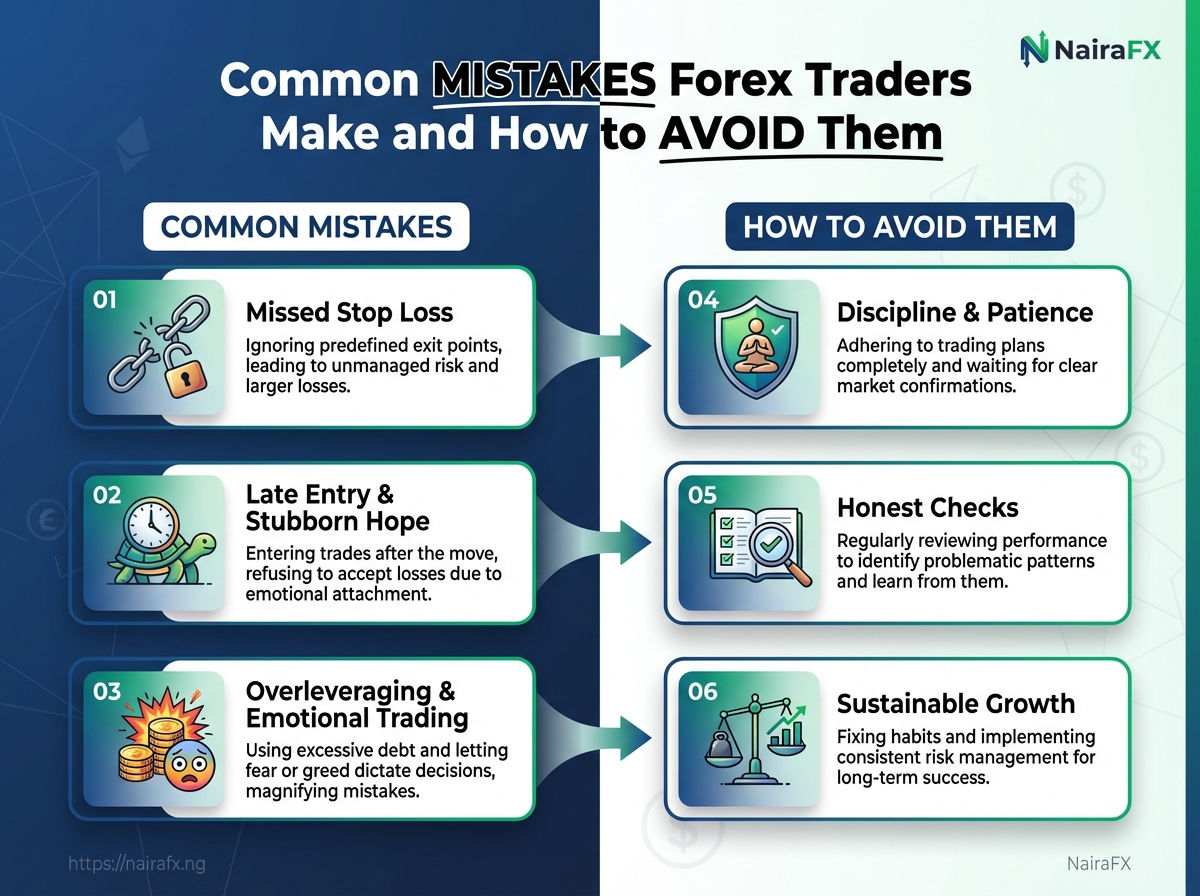
A missed stop loss, a late entry, a stubborn hope that the market will turn around.
Then those little trader errors start stacking up, and the damage feels unfair only because it was avoidable.
That pattern shows up everywhere, from overleveraging to emotional trading.
Research from VT Markets points to emotional decision-making and overleveraging as repeated trouble spots, which is no surprise to anyone who has watched a good setup go bad for the wrong reason.
The real problem is not that traders make mistakes.
It is that many of those mistakes are predictable, and therefore fixable.
Once you can spot the habits that keep pulling accounts off course, avoiding forex pitfalls stops feeling mysterious and starts looking like discipline, patience, and a few brutally honest checks before the next trade.
Quick Answer: Avoid forex trading mistakes by preventing emotional decision-making and overleveraging, which research cited by VT Markets identifies as repeated trouble spots. Build a strict pre-trade risk process that accounts for today’s conditions—volatility spikes, wider spreads, and execution friction—so impatience doesn’t cause oversized entries or missed stops.
Why this matters now: trends and a quick reality check
A trader can be directionally right and still lose money quickly.
Usually, it isn’t because the market suddenly “changed its rules.” It’s because today’s trading environment makes small process failures compound faster—through volatility spikes, wider spreads at key times, and execution friction that turns impatience into measurable damage.
Recent industry write-ups (including VT Markets, DailyForex, FP Markets, and ONSAFX) repeatedly point to the same theme: retail accounts don’t typically fail because traders lack ideas. They fail because risk discipline and decision structure break down under pressure.
For Nigerian traders, that pressure can be amplified by real-world constraints:
- Currency/market noise that makes entries feel urgent
- Execution that can differ from what a backtest assumed
- Variable costs (spreads, slippage, downtime) that punish “in-between” decisions
So the “why now” is simple: avoiding the same costly habits isn’t just about being disciplined—it’s about surviving the current conditions long enough for any edge (even a small one) to matter.
In the next section, we’ll break down the most common capital-draining mistakes—then tie each one to a practical fix you can apply before the next order.
Top trading mistakes that erode capital
Most trading accounts don’t collapse because of one catastrophic call.
They bleed out through repeatable behavior—small choices that look reasonable in the moment, but that quietly change your expectancy.
Below are the most common “capital drains,” along with specific ways to catch them early.
- Overtrading: More trades don’t create more edge—they increase costs (spreads), fatigue, and the odds that you’ll violate your own rules mid-session.
- Poor position sizing: Even a decent setup becomes harmful when size turns routine market movement into account-threatening drawdown.
- Moving stop losses emotionally: Dragging a stop further away (or re-placing it to “give it room” after the trade goes against you) converts a controlled loss into an uncontrolled one.
- Chasing after big wins or big losses: Big wins can trigger overconfidence; big losses often trigger revenge trading—usually by breaking the rule that says “wait for the next valid setup.”
The point isn’t to make trading “less active.” It’s to make it more intentional—so your process, not your emotions, controls how quickly money leaves the account.
Next, we’ll look at strategy and analysis mistakes—cases where the chart looks convincing, but the method can’t survive real market conditions.
Strategy and analysis errors
A setup can look beautiful on paper and still fail in live trading.
That usually happens when the analysis is too neat, too confident, and too divorced from how markets actually move.
The sneaky part is that these are not dramatic mistakes.
They feel smart.
A trader finds one indicator that “works,” tests it on one friendly period, and calls it done.
That is where a lot of forex trading mistakes begin.
Education guides from VT Markets on common forex trading mistakes and ONSAFX on avoiding common forex trading mistakes both point to the same pattern: shallow analysis creates confidence faster than it creates edge.
Relying on one indicator
A single indicator can be useful, but it should never carry the whole decision.A moving average or RSI reading may look clean in one market and fail in another.
The stronger habit is to ask whether price action, trend context, and momentum agree before any trade goes live.
Backtesting only one market mood
A strategy that shines in a trending month can get shredded in a choppy one.That is why backtesting should cover different regimes: trend, range, high volatility, and low volatility.
If a system only works in calm conditions, it is not a strategy yet.
It is a lucky patch.
Overfitting the past
This is the classic “too perfect to be real” problem.Traders keep tweaking parameters until the backtest curve looks gorgeous, then the live version falls apart.
The fix is boring but effective: use out-of-sample testing and keep the rule set simple enough that it makes sense without a spreadsheet babysitter.
Ignoring costs and slippage
A backtest that skips spread, commission, and slippage is a fantasy with charts.Even small costs matter when a strategy trades often.
During fast moves, your fill can be worse than expected, and that tiny gap can erase a thin edge.
> As trading education sources such as DailyForex on common beginner forex mistakes and FP Markets on avoiding big forex losses note, the market punishes neat ideas that ignore execution reality.
A solid system should survive ugly conditions, not just flattering ones.
That is the difference between avoiding forex pitfalls and building something that can actually trade.
Risk management and account preservation
A trading account can survive a bad entry.
It usually cannot survive a day with no rules.
That is why the nastiest forex trading mistakes often start before the first order is placed. ONSAFX’s overview of common forex trading mistakes points straight at poor risk control, while DailyForex’s guide for beginner forex trading mistakes keeps circling back to rule-breaking and stop-loss discipline.
Excessive leverage makes that habit worse.
VT Markets’ breakdown of common forex trading mistakes warns against overleveraging, and that warning matters even more when several positions lean on the same market story.
Correlated trades are the quiet trap.
EUR/USD, GBP/USD, and AUD/USD can all move against one macro view at the same time, so three trades may behave like one oversized bet.
Daily and trade-level risk controls
A clean checklist works better than memory when the session gets noisy.
It gives each trade a gate to pass before money leaves the account.
| Item | Why it matters | Action (Yes/No) | Notes |
|---|---|---|---|
| Confirm daily risk limit | Stops one rough session from turning into a full-week problem | Yes | Set a hard max loss for the day before the market opens |
| Set stop loss and take profit | Defines the exit before emotions get a vote | Yes | Place both orders with the trade plan, not after entry |
| Position size matches risk percentage | Keeps one trade from dominating the account | Yes | Risk a fixed share of equity, not a fixed lot size |
| Check correlated exposures | Prevents several trades from sharing the same risk | Yes | Review currency pairs and the underlying market driver |
| Confirm economic events on the calendar | Avoids surprise volatility around news releases | Yes | Watch central bank events, CPI, and labor data |
| Broker spreads and slippage check | Reveals whether execution costs can distort the setup | Yes | Test during active hours, not only in quiet conditions |
It also makes avoiding forex pitfalls less emotional, because the decision is based on checks, not hunches.
The best accounts are not the ones that never wobble.
They are the ones with enough structure to absorb the wobble and keep trading tomorrow.
Psychology and behaviour traps
A clean setup can still go bad the moment emotion gets involved.
Fear makes traders exit too early, and greed makes them stay in too long, especially after a few lucky wins.
That pattern sits near the center of many forex trading mistakes. VT Markets on common forex trading mistakes and ONSAFX on common forex trading mistakes and how to avoid them both flag emotional decision-making, chasing profits, and overtrading as recurring trader errors.
Confirmation bias is sneakier.
A trader sees one bullish candle, two social posts, and a half-baked reason to ignore the rest, then convinces himself the market “confirms” the view.
Loss aversion adds another layer of pain.
Nobody likes admitting a loss, so traders often keep a weak trade alive far longer than they should, hoping it will “come back” and erase the discomfort.
DailyForex on common forex trading mistakes beginners make and fixes specifically calls out moving stop losses and adding to losing positions, which is exactly where this trap starts.
When emotion starts choosing the trade
The best setups usually fail in messy ways.
A trader gets scared after entry, cuts the trade at the first wobble, then watches price run without them.
Greed does the opposite.
It pushes traders to ignore their own plan because the move looks “too good to miss,” and that is where avoiding forex pitfalls gets harder than it sounds.
Practical habits that keep the brain honest
- Write the reason first. Note the setup, the exit, and the invalidation before clicking buy or sell.
- Force a second view. Look for one strong reason the trade could fail before accepting it.
- Use a cooling-off rule. After a win or a loss, wait a few minutes before the next decision.
- Review only closed trades. This cuts out the urge to defend an open position.
- Track emotional triggers. Mark trades made out of boredom, fear, or revenge, then spot the pattern.
A simple checklist sounds boring.
It works because it slows the mind down just enough to catch trader errors before they become expensive habits.
Good discipline rarely feels dramatic.
It feels steady, and steady is what keeps psychology from running the account.
Tools, workflows and resources
A trader’s edge often hides in the boring setup work.
The right broker, a clean journal, and a reliable calendar do not feel exciting, but they save a lot of pain later.
For Nigerian traders, the broker question is bigger than spreads. Funding method, platform stability, local access, and withdrawal speed matter just as much as pricing.
At NairaFX, we keep our broker reviews focused on those real-world details, because flashy marketing means nothing when an order slips or a payout drags.
The best workflow is simple: pick a broker that fits your trading style, track every trade in one place, and review your calendar before the session starts.
That habit cuts down on trader errors and makes avoiding forex pitfalls a lot less random.
Choosing a broker and platform
Start with execution quality, not just bonuses.
A solid broker for Nigerian traders should offer a platform you can learn quickly, clear order controls, and payment options that actually work from Nigeria.
Look for these basics:
- Regulation and transparency: Check who oversees the broker and how complaints are handled.
- Costs you can see: Spread, commission, swap, and withdrawal fees should be easy to find.
- Platform fit: MetaTrader 4, MetaTrader 5, or cTrader may suit different trading styles.
- Local practicality: Deposit and withdrawal methods matter more than a slick homepage.
That matters because many forex trading mistakes start with a bad operating setup, not a bad idea.
Articles from ONSA FX on common forex trading mistakes and how to avoid them and DailyForex’s guide to beginner trading mistakes and fixes both stress the same thing: poor process decisions tend to snowball.
Essential tools that actually help
A good trade journal catches what memory misses.
Add a tracker, and patterns become easier to spot, especially around overtrading, late entries, and trades taken without a plan.
Use a small stack like this:
- Trade journal: Entry, exit, lot size, setup, result, and a short note on context.
- Performance tracker: Win rate, average reward-to-risk, and monthly drawdown.
- Economic calendar: Central bank decisions, CPI releases, and major payroll data.
- Screenshot archive: Save chart snapshots before and after each trade.
A simple journal also supports better reviews of emotional decisions, which VT Markets highlights in its forex mistake guide.
Setting up a trade journal
A basic journal template takes five minutes to build.
Use columns for date, pair, direction, entry, stop, target, result, and one line on why the trade was taken.
Then add a weekly review column.
That is where the real learning happens.
If a trade was technically fine but badly timed, write that down.
If the setup broke your rules, write that down too.
Small notes beat vague memory every time.
Myths, quick fixes and what actually works
A trader takes one rough week and starts hunting for a magic fix.
That is usually where the damage begins. The market does not reward panic—it rewards repeatable decisions, especially when the urge to “do something” gets loud.
A lot of forex trading mistakes come from believable myths. People think more trades mean more chances, bigger size means faster recovery, or a tighter stop means better control.
In practice, those ideas often create new trader errors instead of solving the old ones.
Myths that sound smart but mislead
- “I need to win it back fast.” That mindset pushes traders into revenge trades and overtrading right after a loss.
- “More indicators will make the chart clearer.” Usually, it just adds noise—conflicting signals delay entries and increase second-guessing.
- “A small stop is always safer.” A stop inside normal noise isn’t protection—it’s often coin-toss risk.
Quick fixes that backfire
- Doubling position size after a loss. That is not recovery; it’s a fast track to deeper drawdowns.
- Moving the stop to “give the trade room.” Sometimes a trade genuinely needs room—but if you only move SL to avoid realizing a loss, you’re replacing a rule with a feeling.
- Adding to a losing position because the setup “still looks good.” That is how a bad read becomes a costly habit.
What actually works
Instead of changing the trade mid-flight, protect the decision system.
- Use the pre-trade gate once—and only once. If the checklist doesn’t pass (see Section 8), you skip the trade. Don’t try to “improve” the setup after you’re already in.
- Keep your risk and sizing rules consistent. Don’t edit them to force a result; let the method prove itself over time.
- Define invalidation before entry and stick to it. Your stop-loss plan shouldn’t be redesigned after price moves.
- When emotions spike after a win/loss, follow the cooling-off habit. Apply the process from Section 9 to prevent impulsive re-entries.
That’s the boring part—and boring is good here. The traders who last are usually the ones who stop chasing quick fixes and start trusting the process.
The Trade That Survives the Month
Most forex trading mistakes look different on the surface, but they often come from the same root: trading without a hard, repeatable risk limit and a consistent decision process.
The fastest way to damage an account is to treat confidence like position size—then let emotion decide what happens next.
Entering too fast and sizing too large rarely feels reckless in the moment; it feels decisive.
But avoiding forex pitfalls starts with slowing down just enough to verify your plan before you place any order.
If you want a sharper way to pressure-test your next decision, do this:
1) Run the pre-trade checklist from Section 8. 2) Confirm the trade matches your stop/invalidation rule. 3) Journal the outcome afterward so you can review closed trades with clearer eyes.
If you want an extra layer of improvement, connect that review with your equity curve and the risk rules you already defined—then adjust only the process, not the trade in the moment.
The goal isn’t to make trading exciting. It’s to make it survivable.