
A single economic event can send Nigerian forex traders scrambling before lunch.
A CBN rate decision, an inflation update, or a surprise policy shift can change the forex market impact almost immediately, and the spread between calm and chaos gets very thin.
That is why trading news matters so much in Nigeria.
When the Central Bank of Nigeria cut the Monetary Policy Rate by 50 basis points to 26.5% in February 2026, markets had to reassess interest-rate expectations, naira demand, and short-term price swings at once, according to African Business.
The move was not just a policy headline.
It became a trading signal.
For many traders, the real challenge is not spotting the headline.
It is judging whether the move has already been priced in, or whether it still has room to push the market harder.
That distinction matters in a market where liquidity can dry up fast and price reactions can look exaggerated.
Nigerian traders also deal with local pressures that make global news feel more intense.
Inflation, exchange-rate changes, and CBN decisions do not sit in separate boxes.
They often collide, and that collision is where the clearest opportunities and the ugliest traps tend to show up.
Quick Answer: Economic events drive Nigeria’s forex swings by shifting traders’ expectations about interest rates, inflation, and naira-linked dollar demand—often moving currency pairs within minutes of a headline. The key for traders is deciding whether the market has already built that expectation into the price (already priced in) or whether the surprise is still likely to extend volatility. Because Nigerian sessions can be liquidity-thin and spreads can widen around major releases, the “right answer” is not just the direction of news—it’s matching your execution plan to the conditions the release creates.
Why do some days feel like the forex market has a mind of its own?
Ever watched a currency pair sit still for hours, then lunge the moment a headline drops? That is usually economic events doing their job.
Interest-rate decisions, inflation releases, GDP updates, and central bank comments all reshape what traders think comes next.
Nigeria feels that pressure fast.
The naira is tied to policy expectations, inflation worries, and dollar demand, so forex market impact shows up quickly when the news changes the story.
A good example came in February 2026, when the CBN cut the Monetary Policy Rate by 50 basis points to 26.5%, after previously holding it at 27.5%, as reported in African Business’s coverage of the CBN and inflation targeting and the CBN’s recap of the 304th Monetary Policy Committee meeting.
That kind of move tells the market that borrowing conditions, growth, and currency demand may all shift.
News releases move currency pairs in minutes because traders price the expectation first, then the result.
If the number surprises the market, algorithms and fast traders hit the order book almost immediately, and the first move can be sharp.
The first few minutes are usually messy.
Liquidity can thin out, spreads can widen, and price can overshoot before calmer minds step in.
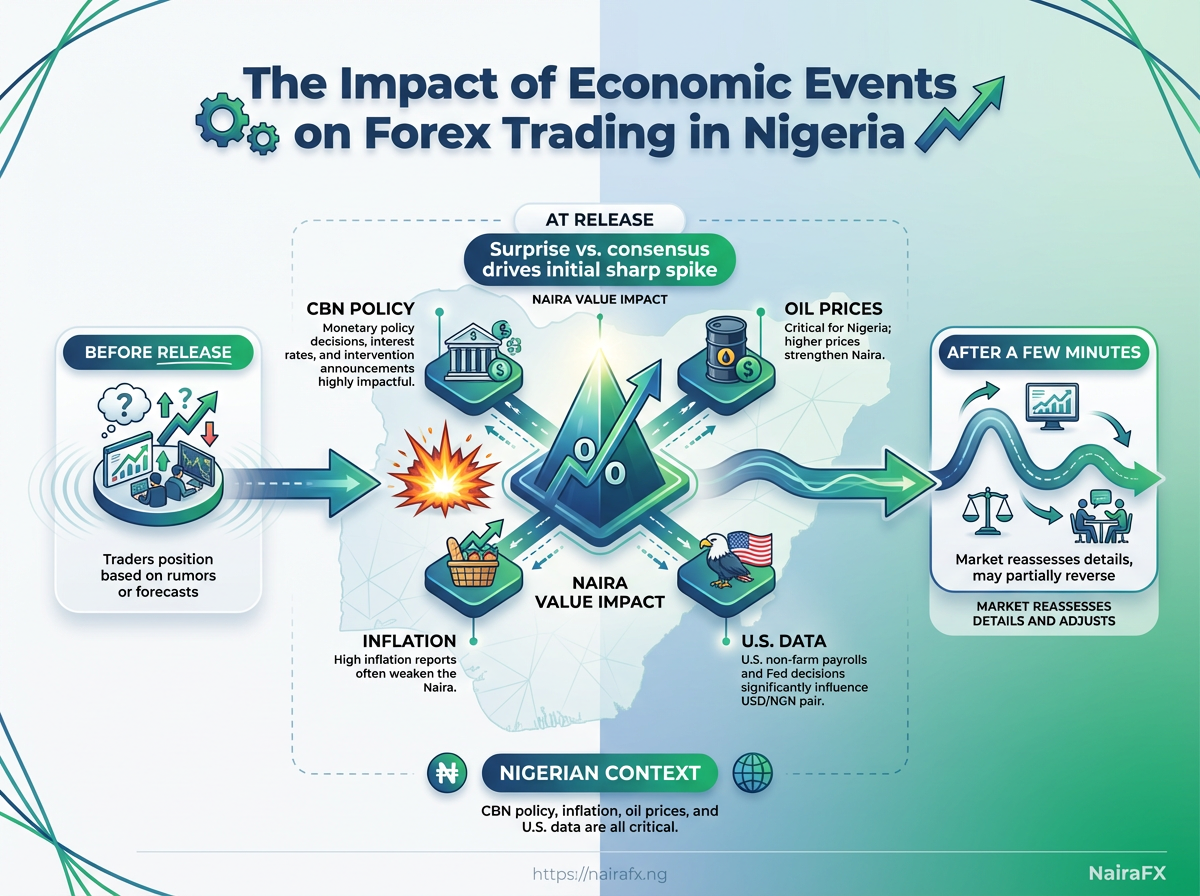
- Before the release: traders position early, often on rumors or forecasts.
- At the release: the surprise versus consensus drives the first spike.
- After a few minutes: the market checks the details and may reverse part of the move.
That is why trading news is less about guessing headlines and more about reading expectations.
PwC’s 2026 Nigeria Economic Outlook keeps pointing to inflation, interest rates, and naira pressure as live risks, not background noise.
The market looks random when the headline hits.
It feels much less random once you know which economic events actually change the price of money.
A jobs report in Washington can move USD/NGN just as fast as a CBN headline in Abuja.
That sounds a little unfair until you remember how much of forex still runs through the dollar.
The events that matter most are the ones that change interest-rate expectations, growth forecasts, or overall risk appetite.
In plain English, that means central bank decisions, inflation prints, GDP updates, jobs data, trade balances, and consumer sentiment.
Central bank meetings sit at the top of the list because they change the cost of money—and the tone behind the decision can move expectations before the next official rate change even happens.
> In Nigeria, official MPC communication can reset expectations for naira trading quickly—sometimes more than the headline rate move alone.
Inflation and GDP follow closely behind.
Inflation tells you whether policy is likely to stay hawkish (and how aggressively the market expects tightening), while GDP shows whether the economy can realistically handle tighter or looser policy.
Employment data, trade balances, and consumer sentiment matter because they reveal momentum before the bigger policy narrative fully updates.
Why U.S. events often matter even when we trade from Nigeria
| Economic Event | Typical Market Impact | Volatility Level | Common Currency Pairs Affected | Why It Matters |
|---|---|---|---|---|
| Central bank interest rate decision | Reprices carry trades and rate expectations | Very high | USD/NGN, EUR/USD, GBP/USD, USD/JPY | Changes yield differentials fast |
| Inflation report | Shifts expectations for future policy | High | USD/NGN, EUR/USD, XAU/USD, GBP/USD | Tells traders whether policy may tighten or ease |
| Non-farm payrolls | Moves the dollar and U.S. rate bets | Very high | EUR/USD, GBP/USD, USD/JPY, XAU/USD | Often triggers the sharpest short-term moves |
| GDP release | Reframes growth and recession risk | High | USD/NGN, EUR/USD, GBP/USD | Affects confidence in the economy’s direction |
| Trade balance data | Signals external demand and currency flow pressure | Moderate | USD/JPY, USD/CAD, EUR/USD, USD/NGN | Shows whether a country is sending or pulling in dollars |
That’s the real trading news filter: not every headline deserves attention, but the ones that change policy odds and rate expectations often do.
Why does a headline feel louder when naira pairs are involved?
Because Nigerian traders are not reacting to news in a vacuum.
You’re dealing with local policy pressure, thinner liquidity at certain hours, and execution that can wobble just when the market gets busy.
When the CBN shifts its policy stance (even without an “exciting” headline style), NGN-linked pairs can reprice fast—sometimes faster than global-market watchers expect—because the naira narrative is tightly tied to expectations around rates, inflation, and dollar demand.
That’s why news spikes often hit Nigerian traders through the mechanics first: spreads widen, liquidity thins, and slippage shows up when fast orders meet a thin order book.
A trader in London might get cleaner fills on the first move; a trader watching USD/NGN (or other NGN-linked pairs) can get a very different outcome, especially when local participation is uneven.
Nigeria’s broader economic conditions also intensify the reaction. When inflation and exchange-rate pressures are already high, traders tend to interpret new releases through a more emotional lens—so small surprises can feel bigger, and normal pullbacks can look like “trend reversals” (until structure confirms or denies it).
Common mistakes show up fast during those moments.
- Chasing the first candle: The first move is often the noisiest one.
- Using market orders blindly: That’s how news slippage turns a decent setup into a bad entry.
- Ignoring spread widening: A clean chart can still hide ugly fill costs.
- Overtrading after one headline: One release rarely explains the whole move.
- Forgetting local timing: If the news hits during low-liquidity hours, NGN-linked behavior can differ materially from “textbook” FX.
The smartest response to economic events is not faster panic.
It’s calmer execution, wider respect for local conditions, and a better read on how trading news reaches the Nigerian market in practice.
Reading the market before and after an economic event
Has the market already done half the work before the headline even lands? That question matters more than most traders admit, because economic events often move price twice: once in the run-up, and again when the number drops.
The first clue is usually price behavior, not the calendar.
If price has been drifting in one direction for hours—especially with widening spreads and weak follow-through on pullbacks—the market may already be leaning hard into a result.
Around major trading news, pre-positioning can make the actual release feel strangely dull at first—then suddenly chaotic when traders realize expectations were wrong.
A good reality check is to compare the chart with expectations, not just the headline.
If price barely reacts before the release and then breaks strongly after it, the surprise likely matters. If price runs hard beforehand and reacts only lightly later, the event may already be largely priced in.
If you’re watching a policy event, the same logic applies: the key question is whether traders were positioned for “the obvious outcome,” or whether the tone shifts forced them to reprice risk.
- First 5 minutes: Watch for the initial spike, but don’t trust it yet. Thin liquidity can exaggerate the move.
- First 15 minutes: Look for direction that survives the first pullback. If price repeatedly fails at the same level, the move is likely weaker than it looks.
- First 60 minutes: Check whether price holds above or below the release zone. A clean retest with strong candles often beats the first burst.
- Confirmation from price action: Wait for structure, not drama. Breakout → retest → continuation usually matters more than the first wick.
That is why the best reaction is not chasing the first candle.
It’s deciding whether the market is confessing, bluffing, or changing its mind.
The fastest way to get clipped by trading news is treating every release like a coin toss.
Some traders hit the button the second the number lands.
Others wait for the first burst of noise to cool down.
Both can work, but only when the plan fits the event, the pair, and your account size.
Nigeria’s risk conditions make that even more important.
In Nigeria, NGN-linked pairs can reprice quickly because policy expectations feed directly into inflation views, interest-rate pricing, and near-term dollar demand. That’s why “small” surprises can trigger big execution and volatility swings—especially when spreads are already elevated.
Pre-news risk checklist
| Checklist Item | Why It Matters | Action to Take Before the Release |
|---|---|---|
| Check the event calendar | You do not want to discover a high-impact release after entering a trade. | Mark the release time, the expected currency pair, and any follow-up speeches or data. |
| Review spread conditions | Spreads often widen right before and during volatile releases. | Compare current spreads with normal conditions and avoid entries if pricing is already messy. |
| Set position size | Oversized trades hurt most when slippage appears. | Reduce lot size so the loss stays small even if the fill is worse than planned. |
| Define stop loss | A vague exit turns one bad spike into a bad day. | Place a stop where the setup is invalid, not where the loss only feels comfortable. |
| Plan exit rules | News trades often move in bursts, not straight lines. | Decide in advance whether you will take partial profit, trail, or close after the first reaction. |
It also keeps you from confusing a sharp move with a clean opportunity.
A trader who follows the list may still lose on the day.
That is fine.
The point is to avoid unnecessary damage from spread jumps, slippage, and emotional chasing.
When staying out is the smarter move
Sometimes the best trade is no trade.
If the market is already stretched, the spread is ugly, and the chart gives no clean invalidation level, sitting out protects capital better than forcing a position.
That is especially true when the event is famous for whipsaws—like a policy surprise or a central bank statement that can be read two different ways.
- No clear edge: Skip the trade when price has already run hard before the release. You are often buying someone else’s reaction.
- Bad execution conditions: Stay flat when spreads widen too much or liquidity looks thin. Poor fills can turn a decent idea into a poor result.
- Emotional pressure: Walk away if you feel rushed, annoyed, or tempted to “make back” a prior loss. That mood usually shows up in the position size.
That discipline matters more on volatile pairs tied to economic events, because the market can move fast enough to punish hesitation and arrogance in the same minute.
Our risk-first approach at NairaFX puts a lot of weight on that simple habit: protect the account first, trade the headline second.
How to build a repeatable news-trading routine
What makes one news day worth trading and another worth ignoring? The traders who stay steady usually have a routine before the headline lands—because their process doesn’t start when volatility already hits.
That matters in Nigeria, where policy shifts can come fast and NGN-linked liquidity can behave unpredictably.
A repeatable routine is less about predicting the outcome and more about preparing how you’ll respond.
Start with the calendar, sort events by likely market impact, and keep your focus on the pairs that actually fit your setup.
A small, disciplined watchlist beats chasing every shiny headline.
- Check the calendar at the same time. Spend five quiet minutes each morning scanning today’s releases, central bank events, and speeches.
- Tag the events that matter. If you trade USD/NGN, local policy items (MPC updates, inflation prints, major FX-related statements) and key dollar drivers belong at the top.
- Keep your watchlist tight. Three to five pairs is enough for most traders, because a smaller list makes trading news easier to read.
- Record the first reaction. Note the initial move, whether there was a reversal, and whether spreads widened or liquidity thinned after the release.
- Review the same event next time. Compare your notes with similar economic events and look for repeat behavior—not one-off noise.
That review step is what turns news trading from “reacting” into “improving.”
The routine itself is simple.
The hard part is doing it the same way every day—until your reaction to economic events feels calm and repeatable.
What to Do Before the Next Rate Decision
The biggest lesson here is simple: economic events do not move price on their own; the surprise does.
When traders in Nigeria get caught out, it is usually because the market had already priced in one outcome and the data, policy note, or central bank tone landed somewhere else.
That is why the forex market impact can feel brutal in the first few minutes and strangely calm again once the dust settles.
Think about a CBN decision or an inflation release.
The chart often looks chaotic at first, but the real story is in expectations, positioning, and how quickly trading news changes those expectations.
Once you start reading the market that way, the spikes stop looking random and start looking like reactions with a rhythm.
Mark the next two economic events on your calendar today, then write down your plan before they arrive: what you will trade, what you will not trade, and how much risk you are willing to take.
If your process still feels shaky, build it around smaller size and stricter rules first; that is where consistency usually starts.