

If your entries aren’t the real issue, it may be the way your trades change when the market gets noisy.
That’s where many Nigerian traders get trapped—because the moment conditions shift, you start reacting instead of executing.
A trading plan gives each trade a job, so emotions stop doing the talking.
A good plan matters even more in forex where spreads widen and news moves prices fast. When discipline is tested every week, “winging it” stops being a strategy and starts being a habit.
A forex trading strategy without clear rules for risk, timing, and exits usually turns into guesswork dressed up as confidence.
The hardest part of how to create a trading plan is not writing it down.
It is building something you can follow on a bad day, after a loss, or when the market looks too tempting to ignore.
That means rules that fit your account size, your schedule, and the way you actually trade.
A solid plan does not need to be fancy.
It needs clear entry rules, exit rules, risk limits, and a review routine that keeps you honest.
Get those parts right, and trading starts feeling less like a gamble and more like a process.
Quick Answer: Build your forex trading plan by turning your trade into repeatable rules: a clear entry trigger, fixed stop-loss and take-profit/exit logic, and position sizing that caps damage before you click buy or sell. For Nigerian traders, set your stop-loss level first, then calculate lot size so each trade risks a small, fixed amount (e.g., 0.5%–1% of your account) to reduce the temptation to “fight the loss.” Decide in advance when you stop trading for the day (for example, 2% down or three consecutive losses) and review results on a set schedule using rule compliance from your journal—not market mood.
In Nigeria’s forex market, your biggest edge often isn’t a fancy indicator—it’s the ability to stay consistent when conditions get uncomfortable.
A trading plan turns random entries into repeatable decisions, which matters when spreads widen and news hits fast.
A good plan forces clarity on entries, exits, position size, and risk.
That same structure—rules you can execute the same way under stress—is highlighted in resources like TradeLocker’s 2026 guide to creating a trading plan, Traders Mastermind’s step-by-step template, and Forex Trade Lab’s 2026 forex plan example.
Once those rules exist, impulse trading starts looking expensive very quickly.
Nigeria adds its own pressure. Spread costs can bite harder on smaller accounts during volatile sessions or around major U.S. releases like CPI or Non-Farm Payrolls.
Add emotional trading after a losing streak, and even a solid forex trading strategy can fall apart without discipline and hard stop limits—which is why MH Markets’ 2026 forex risk management playbook puts position sizing and emotional control at the center of the process.
Here is the change that usually shows up first:
- Fewer revenge trades: A plan makes it harder to double down after a loss.
- Cleaner entries: You stop chasing candles that already moved.
- Tighter risk control: Each trade has a preset stop and size.
- Better review habits: You can see whether the strategy works, instead of guessing.
Once those habits settle in, the trading day feels less chaotic.
That matters in Nigeria, where traders may face sudden volatility, thin liquidity at awkward hours, and a market mood that changes before lunch.
Discipline does not make trading easy.
It makes the work survivable, repeatable, and far less random.
And in forex, that boring consistency is usually where the real progress starts.
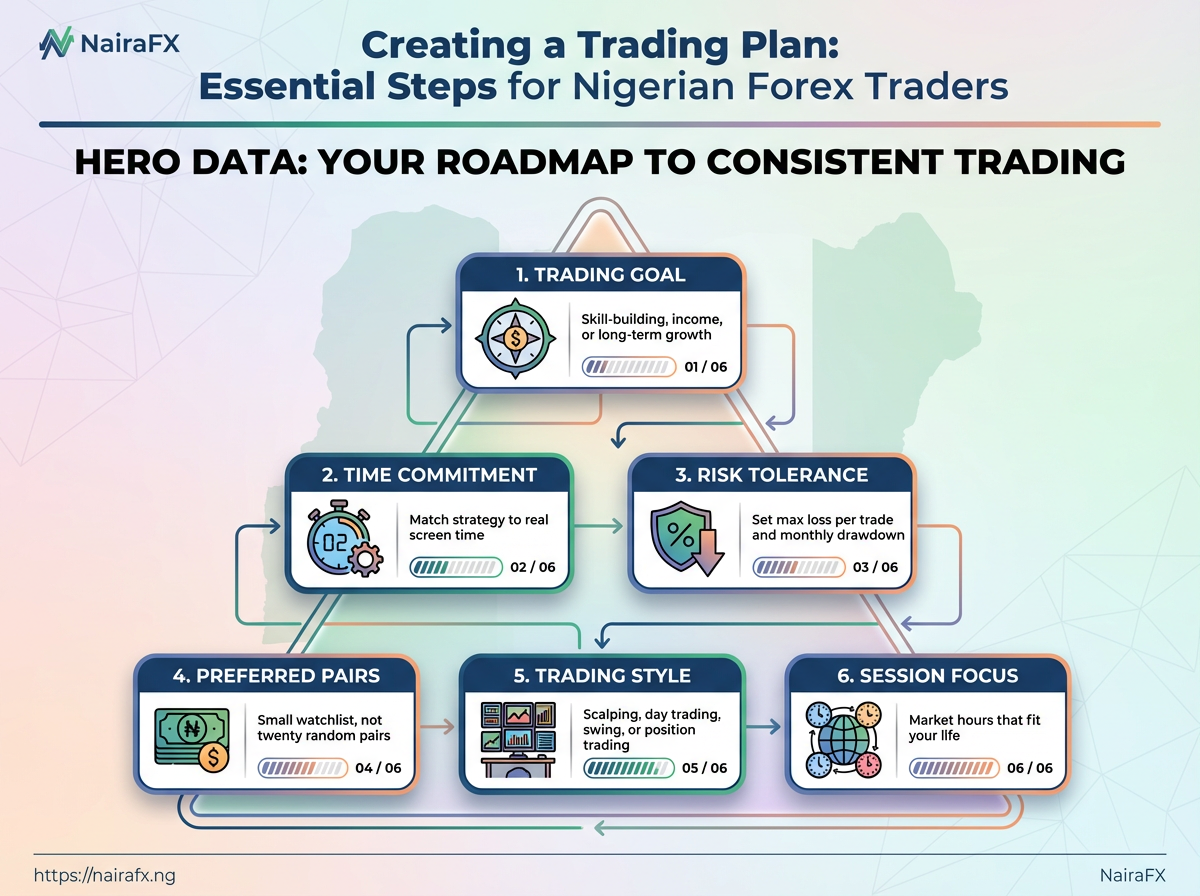
Define Your Trading Foundation Before You Write Anything Down
A trading plan falls apart fast when it is built on fantasy.
A trader who works long hours cannot copy a full-time scalper’s routine and expect it to stick.
That mismatch is where most bad habits start.
Before writing entries or exits, lock down the shape of your trading life.
That means your goal, your schedule, your risk limit, and the market you actually understand.
Guides from TradeLocker’s 2026 trading plan guide and Traders Mastermind’s step-by-step plan template both put those basics first for a reason.
Set the frame before the rules
A trader in Abuja who can only check charts at night should not build around five-minute setups.
A trader with a tiny account should also be honest about drawdown limits before chasing aggressive targets.
MH Markets’ 2026 risk management playbook makes the same point through position sizing, leverage control, and stop-loss discipline.
- Trading goal: Define whether the aim is skill-building, income, or long-term growth.
- Time commitment: Match the strategy to your real screen time, not your wishful thinking.
- Risk tolerance: Set a maximum loss per trade and a hard monthly drawdown limit.
Choose a market you can actually follow
EUR/USD may move smoothly, while GBP/JPY can feel like a scooter on a wet road.
That matters because your trading style should fit the pair’s behavior, not just its popularity.
Forex Trade Lab’s 2026 plan template shows how pairing goals with a specific market and routine keeps the plan usable.
- Preferred pairs: Pick a small watchlist, not twenty random pairs.
- Trading style: Decide between scalping, day trading, swing trading, or position trading.
- Session focus: Choose the market hours that fit your life and your setup.
Trust a tight toolkit
Too many platforms create confusion.
A cleaner setup usually means one charting platform, one broker, one economic calendar, and one review method.
Strategy guides, including the ANU trading strategy guide, keep coming back to the same basics: clear entry rules, stop-loss rules, and trade tracking.
- Charting platform: Use the one you already know well.
- Data sources: Trust a calendar, spread data, and broker pricing you can verify.
- Review tools: Keep a simple journal or spreadsheet for every trade.
A solid foundation makes the rest of the trading plan easier to write and even easier to follow.
Once these choices are fixed, the rest stops feeling like guesswork.
Build the Core Rules of Your Trading Plan
A trading plan gets real the moment it starts saying “yes” and “no” with confidence.
That is where most traders wobble.
They have a strategy idea, but no exact trigger for entry, no hard stop, and no rule for walking away.
A rules-based setup is the difference between a forex trading strategy and a random mood swing with charts attached.
The cleanest plans usually cover four things: entry, exit, risk, and no-trade conditions.
That structure shows up again and again in TradeLocker’s 2026 trading plan guide and ForexTradeLab’s 2026 trading plan template example.
MHMarkets’ 2026 forex risk management playbook goes even harder on sizing, stop-loss rules, and discipline, which is exactly where many accounts survive or die.
If the market is noisy, your rules need to be louder.
Core rule checklist
| Trading Plan Area | What to Define | Example Rule | Why It Matters |
|---|---|---|---|
| Entry trigger | The exact signal that allows a trade | Buy only after a bullish close above the breakout level and a retest holds | Keeps entries consistent |
| Exit trigger | The condition that closes the trade | Exit at the target, at the stop, or if price closes back inside the prior range | Prevents hesitation |
| Stop-loss distance | How far price can move against you | Place the stop below the nearest swing low or 1x ATR, whichever is tighter |
Caps damage fast |
| Risk per trade | How much of the account is on the line | Risk 0.5% to 1% of account equity per trade |
Protects capital during losing streaks |
| Maximum daily loss | When trading must stop for the day | Stop after 2% down or three losing trades |
Blocks revenge trading |
| Trade review rule | How every trade gets recorded | Log entry, exit, reason, and result right after the trade | Makes patterns obvious |
It is the way the table forces one decision at a time.
That is how to create a trading plan that still works when price starts moving fast, spreads widen, or you feel the urge to “just give it one more candle.”
No-trade rules matter just as much.
If your setup needs momentum, skip choppy ranges.
If a major news release can rip through your stop, stay flat.
If you are already down for the day, the market can wait.
That discipline is the difference between a plan that looks smart and one that survives contact with reality.
At NairaFX, that is the kind of structure we care about most: clear rules, clean execution, and fewer emotional detours.
Make Your Plan Fit Real Trading Conditions
A trader can have a solid setup and still get knocked off course by a dead phone signal, a failed deposit, or a broker that does not support local payment flow.
That is why a trading plan has to fit the way you actually trade, not the tidy version you wish you had.
The best plans leave room for friction.
TradeLocker’s 2026 guide on com/forex-trading/how-to-create-a-trading-plan/”>how to create a trading plan puts clear goals, risk rules, and execution tools at the center, and that matters even more when your trading day includes Nigerian realities like unstable internet or slow funding.
Build rules for local friction
A plan should say exactly what happens when the connection drops.
If you cannot monitor a trade properly, reduce size, skip the trade, or switch to a slower setup that does not need constant screen time.
Funding and broker access need their own rules too.
If deposits take time, keep a buffer in the account so you are not forced into a weak entry just because money arrived late.
That lines up with the practical risk focus in MHMarkets’ 2026 forex risk management playbook, especially around position sizing and emotional control.
Treat calendar risk like a separate market
Major news changes the game fast.
Rate decisions, inflation releases, and U.S. labor data can turn a calm pair into a whip saw in minutes.
A simple rule set keeps things clean:
- Before big news: no new trades within your chosen blackout window.
- During high-volatility sessions: cut size or wait for the first spike to pass.
- During low-liquidity periods: avoid thin conditions unless your strategy is built for them.
- After the move: record whether the setup still matched your rules, not just whether price ran.
That habit matches the structure used in Forex Trade Lab’s 2026 trading plan template and example, where routine and review sit beside entries and exits.
Keep the journal simple enough to use
A trade journal works when it takes less than a minute to fill in.
Use fields like date, pair, setup, entry, exit, risk, emotion, and result.
If the note section is too long, nobody keeps it up.
A clean record shows patterns faster than memory ever will, and that is where a trading plan starts paying rent.
A plan that survives bad internet, busy news days, and awkward funding delays is a real plan.
One that only works on calm days is just a wish with neat formatting.
Confidence in trading doesn’t come from motivation—it comes from proof.
That’s why testing comes before comfort.
A forex trading strategy that survives trend weeks, range-bound weeks, and ugly fake breakouts is worth far more than one that only looks good on paper.
Backtesting works best when your rules stay frozen.
Keep the same entry trigger, stop, target, and session filters, then run them across enough trades to show a real pattern.
If the setup only works after you start “adjusting” it mid-test, the issue is usually that the plan is too loose—not that the market is too wild.
The numbers matter more than the mood after a winning streak.
Win rate, risk-to-reward, drawdown, and rule compliance tell you whether the trading plan is repeatable or just lucky.
That kind of rules-based review shows up again and again in com/forex-trading/how-to-create-a-trading-plan/”>TradeLocker’s 2026 trading plan guide and Traders Mastermind’s 2026 step-by-step guide, because disciplined plans beat gut feel over time.
What matters most isn’t collecting more trading ideas—it’s having a trading plan you can execute consistently when conditions get stressful, liquidity thins out, or emotions rise.
You’ve already defined the essentials earlier in the article—your entry/exit rules, your risk limits, and your no-trade conditions (including journal-based rule compliance). Now the real work is integration and review.
Before your next trade:
- Confirm your entry trigger and what would invalidate it (follow your Section 6 rules, not a fresh impulse).
- Confirm your position size and stop logic from your risk limit.
- Confirm your “no-trade” filters (daily loss stop and any news blackout) are still active.
After a testing period, don’t rewrite your personality mid-week. Review what your journal and backtest show (win rate, drawdown, and rule compliance), then adjust only what the data supports—small parameter changes are fine, but keep the core rule structure consistent and re-test.
That’s how your plan stays boring and reliable—the kind of consistency that usually delivers progress in the Nigerian forex environment where volatility and execution friction are part of everyday trading.