

The worst trade is often not the first one.
It is the one that comes after a sharp loss, a missed entry, or a sudden spike in confidence.
That is where trading psychology stops being theory and starts hitting your account.
A tired forex trader mindset can turn a normal setup into emotional trading, where fear, impatience, and revenge take the wheel.
Most traders do not fall apart because they cannot read a chart.
They fall apart because they cannot stay calm when money is moving fast and the market refuses to behave.
According to Schwab’s trading psychology guide, recovering from a big loss starts with rebuilding discipline and lowering the emotional heat around the next decision.
That matters because stress changes how people judge risk, and it makes good rules feel optional.
The real challenge is not feeling emotions.
It is noticing them early enough to stop them from shaping the trade.
Once that starts to click, discipline feels less like punishment and more like protection.
Quick Answer: Trading psychology is what determines whether you execute your plan consistently—especially when emotions spike around entry timing, stop placement, and holding decisions. Your goal isn’t to eliminate fear or greed; it’s to catch the moment they start pushing you to break your rules (late entries, widened stops, early exits, or oversized recovery trades). A practical way to apply this immediately: run a 60-second pre-trade reset (state check → confirm entry/stop/target → size the trade based on risk), then commit to a post-trade review that records what you felt and what rule you followed. If you want discipline you can repeat, focus on process checkpoints, not outcomes.
Why emotions matter more than most traders think
A good plan can still fail—because the trade doesn’t happen inside a spreadsheet. It happens inside your stress response.
In Forex, your trading psychology is the part of your forex trader mindset that decides whether your rules survive once money is involved. Emotions don’t sit outside the chart: they influence your entry, your stop, your exit—and even your position size.
Research and practitioner guides keep circling back to the same point: your mental state changes decision quality fast, which is why Global Banking & Finance’s review of the decision-making side of trading psychology matters so much, and why Share Wealth Systems’ guide to disciplined trading mindset shifts says many losses come from mindset, not charts.
Fear, greed, and impatience show up in ordinary ways:
- Fear: you hesitate on a valid entry, then chase price after it has already moved.
- Greed: you hold a winner too long, hoping for “just a bit more,” then give back the gain.
- Impatience: you take a low-quality setup because sitting still feels uncomfortable.
- Panic after loss: you widen a stop or double size to win the money back fast.
Volatile markets make these mistakes louder. Big candles, sudden spreads, and headline spikes push traders into snap decisions—especially when they’re already frustrated or overconfident.
That’s also why Schwab’s guide on recovering from big losses focuses on rebuilding discipline after a blowup rather than rushing into the next trade.
Once stress rises, the brain starts treating normal market noise like danger.
A simple example makes it obvious.
A trader plans a 30-pip stop before a news release, but a fast wick hits the chart—and fear whispers to move it “just this once.” That tiny break in discipline is often where the real damage starts.
A steady forex trader mindset doesn’t mean feeling nothing. It means noticing the emotion before it turns into a bad decision—especially when the market is moving fast and you feel like you have to do something.
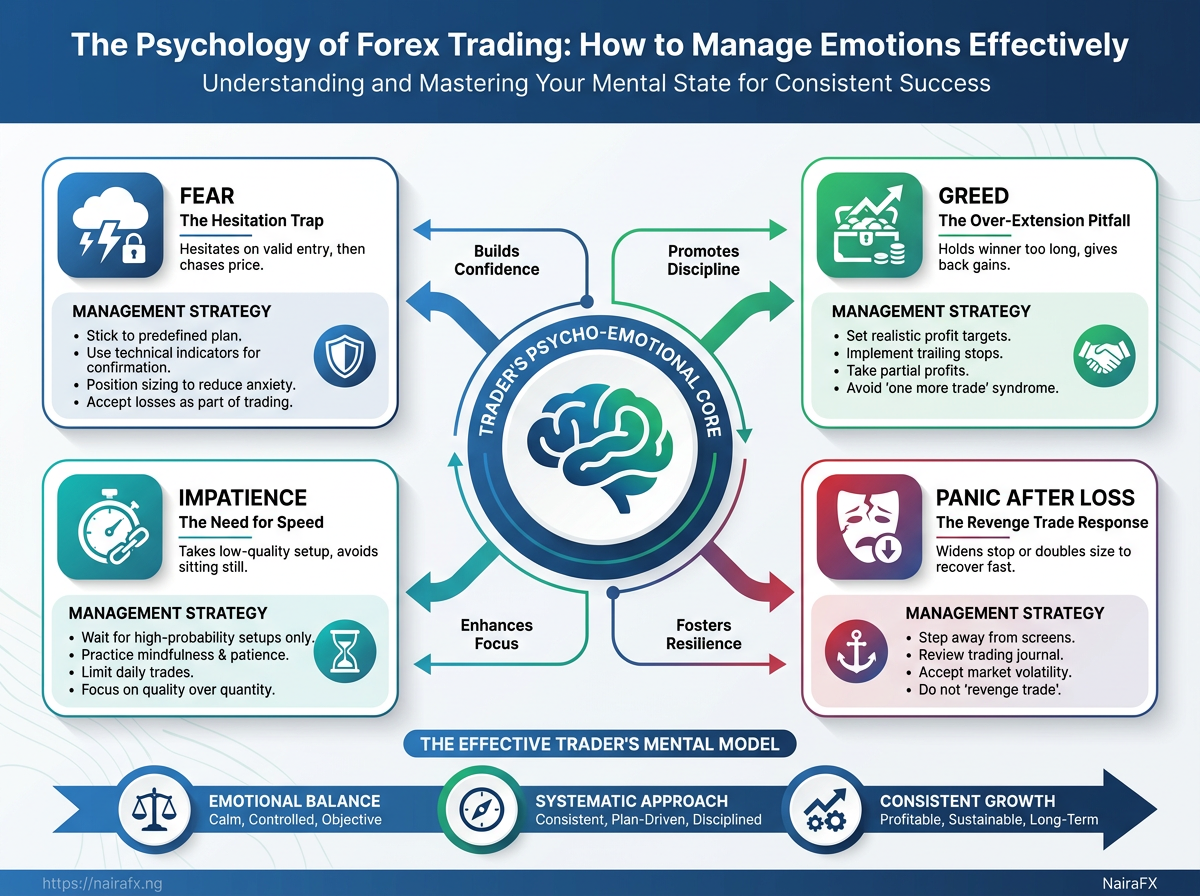
The most common emotional traps in Forex trading
Most emotional damage in Forex doesn’t come from one massive mistake. It comes from the tiny decision you justify in the moment—usually seconds after a loss, or right after you see “proof” that you’re right.
Emotional trading rarely feels emotional while it’s happening. It often feels justified, urgent, even clever.
Revenge trading shows up right after a loss, when the mind wants to “get it back” immediately.
Schwab’s guide on recovering from big losses notes that a bad drawdown can push traders into stress-driven decisions that weaken discipline and make the next trade even worse (Trading psychology after big losses).
Overconfidence is the mirror image. A winning streak can make you loosen risk limits, widen stops, or start treating luck like skill.
That trap sits right at the center of a shaky forex trader mindset—and it’s one reason disciplined traders care so much about process over emotion (Trading mindset shifts for disciplined traders).
Common emotional traps in Forex
| Emotional trap | What it looks like | Why it happens | Better response |
|---|---|---|---|
| Revenge trading | Jumping back in fast after a loss | Ego pain and the urge to “win it back” | Step away, review the loss, and wait for the next valid setup |
| Overconfidence | Increasing size after a win streak | Recent wins feel like proof of mastery | Keep fixed risk per trade and stick to your plan |
| Fear of missing out | Entering late because price is moving fast | Watching others catch a move triggers panic | Accept missed trades; wait for your own setup |
| Hesitation | Watching a valid entry and freezing | Fear of being wrong or losing again | Pre-write entry rules and place alerts, not impulsive clicks |
| Premature exit | Closing early at the first bit of profit | Relief feels better than patience | Use target rules and trail stops only when your plan says so |
Trade Ideas and Audacity Capital both point out that fear and greed distort decision-making, which is why traders end up chasing moves or sitting on their hands (Trading emotions and disciplined decisions, Emotional control in trading success).
Premature exits are sneakier. A trader feels relief after locking in a tiny gain, then watches price run without them. That habit hurts especially in Forex, where small wins can look safe but still damage expectancy over time.
The cleaner move is boring—which is exactly why it works.
How to spot your own emotional triggers
Ever notice how one tiny miss can wreck a perfectly good trading day?
That is usually the first clue.
Emotional triggers in trading psychology are rarely mysterious; they tend to show up in the same situations again and again.
After a loss, during a fast move, or right after scrolling a few too-perfect profit screenshots, the emotional trading script starts running.
Market volatility is a big one.
When candles move fast, many traders stop thinking in probabilities and start thinking in rescue mode.
Schwab’s guide on trading after losses makes the same point: the recovery is mental as much as financial, because a sharp hit can keep affecting judgment long after the trade is closed (Schwab on recovering from big trading losses).
Social media adds another layer.
Seeing other people post wins can nudge a trader into comparison, impatience, or revenge entries, even when the setup is weak.
Research on trading behavior keeps showing that emotional state changes how risk feels in the moment, which is why a steady forex trader mindset matters as much as chart reading (Global Banking & Finance review of the decision that shapes every trade).
A simple self-check helps because triggers are easier to catch in sequence than in the moment.
- Name the trigger. Was it a loss, a missed entry, a sudden spike, or social pressure?
- Name the feeling. Was it anger, urgency, fear, or the itch to get even?
- Name the impulse. Were you about to size up, move a stop, or jump in late?
- Name the rule you may break. If the answer is not clear, the setup is probably not ready either.
A trader who writes this down for two weeks usually sees a pattern fast.
The same market event keeps producing the same bad reaction, and that is the real emotional trigger, not the candle itself.
Once that pattern is visible, trading gets less random.
And that is where emotional discipline starts to feel practical instead of poetic.
Building a stronger Forex trader mindset
There’s a moment in every active trading day where you either follow your process—or you let your mood steer.
What blocks that “follow the plan” switch is rarely missing knowledge. It’s the habit of letting the day’s emotions leak into a decision that should be controlled by rules.
A stronger forex trader mindset starts with one boring but powerful rule: entries and exits belong to your system, not your feelings.
Research on trading psychology keeps pointing to the same problem: mental state shapes decision quality, and emotion makes risk feel different depending on the moment, as noted in Global Banking and Finance’s piece on how mental state shapes every trade and Trade Ideas’ trading psychology guide.
That sounds simple until the market starts moving fast. Then patience becomes a real skill, not a nice slogan.
In a practical sense, patience means waiting for your setup to be complete, accepting that some days produce no trade at all, and understanding that being early often costs more than being wrong.
The easiest way to build that discipline is to make expectations realistic.
A good month does not mean every trade works, and a losing streak does not mean the method is broken.
Schwab’s guide on recovering from big losses makes a similar point: after a blowup, traders need to rebuild trust in process before they can trust their gut again.
- Use a pre-trade rule set: Only enter when the setup, risk level, and exit plan are already defined.
- Separate outcome from quality: A losing trade can still be a good trade if it followed your rules.
- Expect drawdowns: Build emotional room for losing periods so one bad week does not turn into revenge trading.
- Wait for confirmation: Patience protects capital better than constant action.
- Measure process, not pride: Review whether you followed rules, not whether you felt “right.”
A simple example helps.
Imagine a trader in Lagos sees a clean breakout, but the candle hasn’t closed, volatility is expanding, and the stop is too wide for the account. The mature move is to pass—not force a trade just to feel active.
That is where real trading psychology shows up.
A strong forex trader mindset doesn’t chase certainty; it respects rules, tolerates discomfort, and keeps patience on the payroll.
Practical habits that help control emotions
A trader can have a solid setup and still sabotage it in thirty seconds.
That usually happens when trading psychology gets ignored at the exact moment it matters most.
The habits that help are not flashy.
They are boring on purpose, which is exactly why they work.
Start with a short pre-trade routine that you do the same way every session.
A trader who checks market structure, risk, and mood before clicking the mouse is less likely to drift into emotional trading.
Charles Schwab’s guidance on recovering from trading blowups also leans on this idea: calm the system first, then trade with discipline instead of panic (Trading Psychology: Recovering From Big Losses).
Build a repeatable pre-trade reset
Treat the routine like a seatbelt.
It is not there to make you smarter; it is there to keep one mistake from turning into five.
- Check your state: Notice whether you are rushed, angry, tired, or distracted.
- Review the plan: Confirm entry, stop, target, and session limit.
- Set the risk first: Decide the amount before looking for a trade.
- Wait one minute: A small pause cuts down impulse clicks.
Journal the feeling, not just the trade
A spreadsheet with entries and exits is useful, but it misses the real story.
The emotional part often shows up in the notes you skip.
Trade psychology sources keep returning to the same point: fear and greed bend decisions, even when the chart looks fine (Trade Ideas on trading psychology and emotional control).
Record the pressure you felt before entry, after a loss, and after a win.
- Mood before entry: Calm, eager, irritated, or distracted.
- Reason for the trade: Clear setup or revenge impulse.
- Body signals: Tight jaw, fast heart, fidgeting, or relief.
- Post-trade reaction: Did you respect the plan or chase?
Keep one loss small enough to ignore
A tiny loss feels almost insulting, and that is the point.
If a single stop-out shakes your confidence, the position was too large.
That is where the forex trader mindset gets practical.
Research and trader education pieces keep showing that mental state shapes decision quality, especially under pressure (The One Decision That Quietly Shapes Every Trade).
When the risk is modest, you can think clearly after a loss instead of spiraling.
A good rule is simple: size each trade so the worst-case loss feels routine, not personal.
That keeps discipline intact, which is the real edge.
A calm routine, honest notes, and sane risk limits do more for trading performance than most people admit.
Once those habits stick, the chart gets easier to read because your head is finally quieter.
Risk management habits that protect your mindset
Risk management isn’t just about surviving financially—it’s about preventing emotion from taking over the next click.
When your risk rules are clear, a bad trade stops feeling like an emergency. Fear can’t easily hijack your decisions, and greed has fewer opportunities to “justify” breaking the plan.
Position sizing and stop-loss rules do more than protect capital. They also protect your trading psychology by making every trade feel smaller, cleaner, and easier to accept when it fails.
That matters because fear and greed distort decisions fast, especially when size is too large, as noted in Trade-Ideas’ 2025 guide to trading psychology and emotional control.
Consecutive losses are where many traders slip. After a rough stretch, the goal is not to win it back quickly—it is to keep your process intact, which matches Schwab’s advice in its guide to recovering from big losses.
A steady forex trader mindset comes from refusing to make the next trade emotional.
Pre-trade and post-trade risk checklist
| Checklist item | Why it matters | Status |
|---|---|---|
| Trade size matches account risk | Keeps a single loss from feeling dangerous and helps you stay calm. | Pass before entry |
| Stop-loss is set before entry | Removes panic decisions after price starts moving. | Pass before entry |
| Entry reason is written down | Forces a clear plan instead of a vague hope. | Pass before entry |
| No trade if conditions are unclear | Protects you from emotional trading when the setup is messy. | Review first |
| Review is done after the session | Turns every trade into feedback instead of frustration. | Complete after close |
After a losing streak, the smartest move is usually smaller size, fewer trades, and a clean review.
That aligns with the idea that mental state shapes each decision, which is why Global Banking and Finance’s piece on the one decision behind every trade hits so close to home.
The checklist works because it makes discipline visible. If a rule is skipped often, that is not a character flaw—it is a process leak that needs fixing.
A calm risk routine keeps your head clear when the market gets noisy.
A simple routine Nigerian traders can use in active markets
Ever watched EUR/USD or GBP/JPY move so fast that your chart feels late to its own party? That is exactly when a trader needs a routine, not more excitement.
Active markets punish vague habits.
A clean routine gives the forex trader mindset something steady to lean on when spreads jump, candles stretch, and decisions start getting sloppy.
Before the market opens
A good start is boring, and that is a compliment.
Check the calendar, mark the sessions you care about, and decide which pair deserves your attention before the first click.
Keep it simple:
- Scan the news: Look for high-impact releases that can widen spreads or spike slippage.
- Set one focus pair: Pick a single pair or setup type instead of hunting everything.
- Write your stop condition: Decide in advance what makes you sit out entirely.
During the session
When price starts moving quickly, the worst move is usually the second one.
Spreads can widen around news, fills can get messy, and that is when emotional trading sneaks in dressed as “quick thinking.”
Research on trading psychology keeps pointing to the same thing: emotional state shapes decisions far more than most traders admit, and fear can slow entries while greed pushes overreach.
Schwab’s guide on recovering from big losses also stresses rebuilding discipline through calm, repeatable actions, not rushed reactions (Trading Psychology: Recovering From Big Losses), while Phemex’s 2026 guide on trading psychology makes the same case about fear and greed under pressure (Crypto Trading Psychology: Master Your Mindset for 2026).
A simple live-market rule set helps:
- Pause after fast candles: Wait for the next candle to close before acting.
- Check spread first: If the spread is ugly, skip the trade.
- Use a time cap: If you stare too long, your judgment gets noisy.
- Take one clean setup: No revenge entries, no “make it back” trades.
After the market closes
The best traders do not just log trades.
They also log behavior.
A two-minute review works well: did you follow the plan, did you chase price, and did you stop when conditions turned messy? That habit matters because trading psychology is not only about handling stress in the moment; it is also about spotting the patterns that keep repeating, as noted in articles from Global Banking and Finance Review on the decision that shapes every trade and Trade Ideas on understanding emotions in trading.
Stop trading for the day when you hit three things: your daily loss limit, two impulsive entries, or one moment where you feel you are forcing trades.
That is not weakness.
That is structure doing its job.
A routine like this keeps your market day cleaner, especially when price gets loud.
We keep coming back to that because active markets reward traders who know when to act, and just as importantly, when to sit still.
How trading psychology fits into a long-term learning path
You can improve your strategy and still feel inconsistent. That usually happens because your execution is outgrowing your mindset habits.
A stronger trading psychology process should grow at the same pace as your strategy itself.
A clean forex trader mindset isn’t built in one burst of motivation. It gets shaped the same way a solid trading method gets shaped: through testing, review, correction, and repetition.
Research on trading behavior keeps pointing to the same idea, including discussions from Global Banking and Finance on the mental state behind every trade and Trade Ideas’ 2025 guide on emotions and decision-making.
Mindset work should move with strategy testing
A backtest can show that a setup has edge, but it can’t tell you whether you’ll respect that edge on a bad day.
That gap is where emotional trading sneaks in.
The practical answer is to test your behavior the same way you test entries and exits. If you are refining stop placement, position sizing, or session timing, your discipline needs the same attention.
Otherwise, the strategy matures faster than the trader using it.
What to review every week
A weekly review works best when it’s boring and honest.
No drama. No heroic self-talk.
Just a clear look at what happened, why it happened, and what changed in your behavior.
- Rule breaks: Track every trade that ignored the plan, even if it won.
- Emotional heat: Note when fear, boredom, or revenge thinking showed up.
- Recovery time: Measure how long it took to reset after a loss or mistake.
- Trade quality: Separate valid setups from impulse clicks.
- Routine consistency: Check whether your prep was done before the session started.
That kind of review keeps trading psychology tied to real behavior, not vague motivation.
It also makes progress visible, which matters more than most traders admit.
How this fits the wider learning path
This section sits neatly beside risk habits, emotional triggers, and market routines because all of them feed the same long-term goal: steadier decisions under pressure.
Schwab’s guide on recovering from big losses makes the same point in practical terms, especially after a rough spell.
The real work is not just bouncing back. It is learning to come back with better judgment.
That’s how the series connects: one idea builds on the next until the forex trader mindset becomes part of your process, not a side project.
At NairaFX, that is the kind of learning path we want traders to keep coming back to.
Trading Calm When the Market Gets Loud
Remember: trading psychology isn’t about having no emotions—it’s about preventing emotion from rewriting your rules.
When fear, greed, or frustration starts nudging you toward a late entry, a stop you ‘intend to move,’ or a trade you’re taking just to feel active, treat it as a signal to pause and verify your setup.
Use one simple loop every session:
Before: state check + confirm your entry/stop/target and position size. During: if conditions change (spread spikes, candle timing is wrong, volatility jumps), delay—don’t improvise. After: note the trigger, the feeling, and whether you followed the rule.
That loop is how you protect both capital and judgment—day after day—until disciplined execution becomes automatic.