

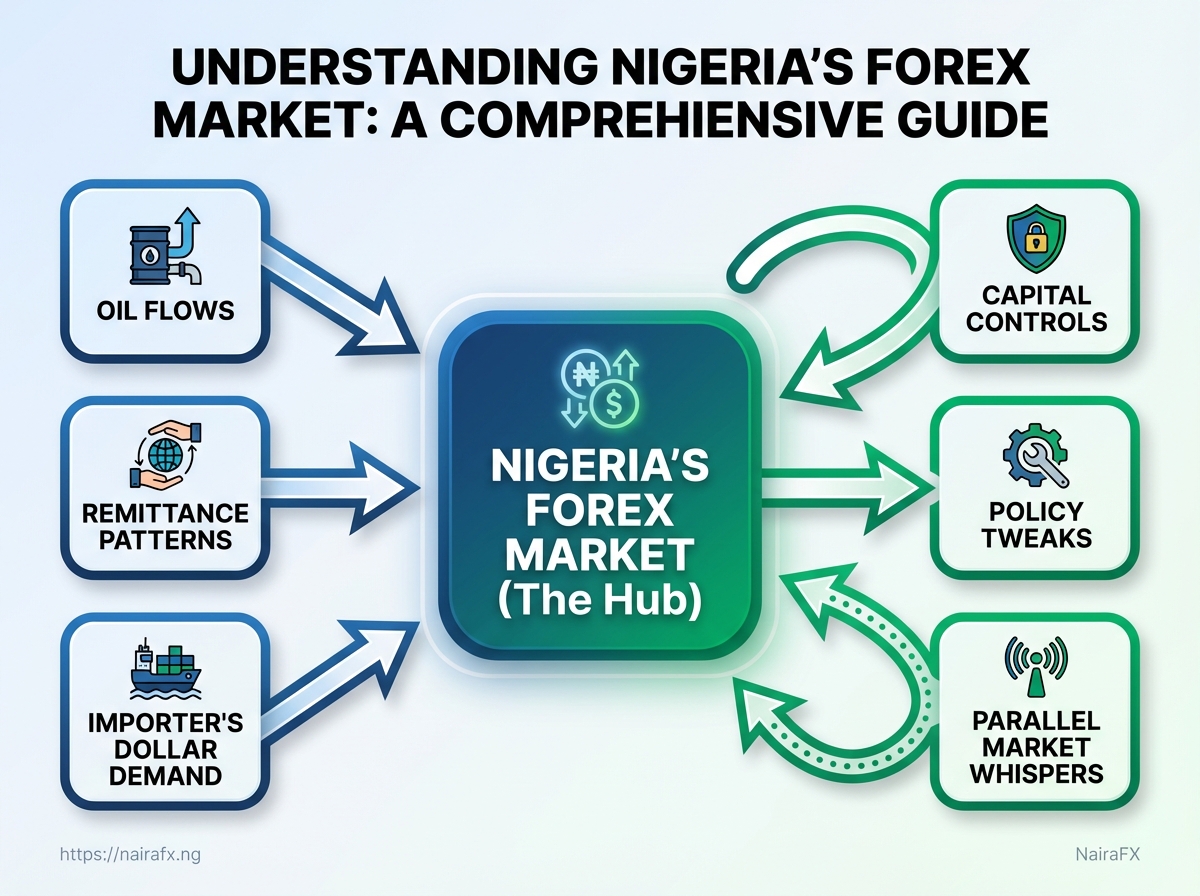
Most traders in Lagos and beyond know the sting of waking to a surprise naira move that erases overnight profits. The causes feel scattered: a policy tweak, an importer’s dollar demand spike, or whispers from the parallel market — all feeding volatility in the Nigerian forex market that can punish indecision and reward preparation.
Understanding which signals matter and which are noise separates gamblers from consistent traders. This introduction pulls together how capital controls, oil flows, remittance patterns and simple domestic data act as local economic indicators forex traders actually use to set risk, size positions, and choose strategies. Read with the posture of a trader who refuses to be surprised again.
Nigeria’s Forex Market: Structure and Participants
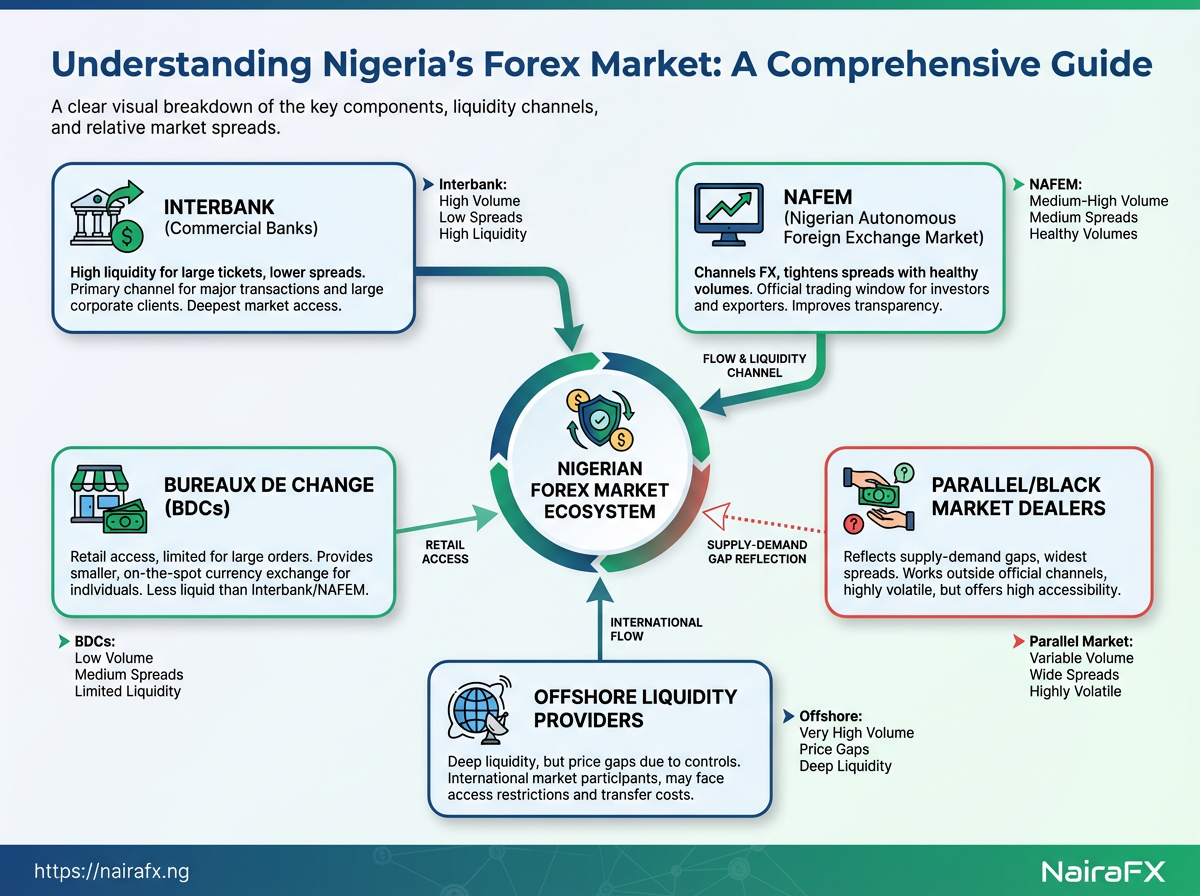
Nigeria’s FX market is multi-layered: an onshore interbank core where commercial banks and large corporates trade, parallel segments including bureaux de change and the parallel (black) market, and offshore liquidity providers that introduce global pricing dynamics. Price moves come from whoever supplies or removes the largest amounts of usable liquidity at a given moment — banks, exporters/importers, large corporates, and offshore market makers.
Interbank liquidity: This is where the Central Bank of Nigeria (CBN) and major commercial banks concentrate FX flow. The CBN sets official policies and publishes daily rates, while banks execute large client flows and manage corporate FX needs. Industry documentation on the liberalised market and official windows explains the interbank framework and role of policy CBN foreign exchange market overview.
NAFEM / Investor-Exporter Window: The Investors & Exporters FX window (NAFEM) channels FX from exporters and investors into the onshore market and can tighten spreads when volumes are healthy. Practical mechanics and eligibility details are covered by market operators FMDQ explanation of NAFEM.
Bureaux de Change (BDCs): BDCs provide retail access and smaller-ticket liquidity, often quoting tighter turn-around for cash needs. They bridge retail demand and formal liquidity but are limited when large orders hit the market.
Parallel/black market dealers: These dealers reflect immediate supply-demand gaps created by onshore FX controls. Real-time indicators from platforms like AbokiForex show how parallel market rates diverge from official ones during stress AbokiForex parallel market rates.
Offshore liquidity and pricing gaps: Offshore market makers and international banks provide deep liquidity, but currency controls and settlement frictions mean that offshore mid-market prices (mid-rate) often differ materially from onshore executable rates. Traders should monitor both onshore CBN rates and offshore mid-market pricing (e.g., global FX quotes) to understand potential slippage and execution risk. The CBN also publishes daily NFEM rates for comparison CBN daily rates.
How these segments affect execution in practice:
- Order hits interbank — execution quality depends on bank counterparty limits and NAFEM depth.
- Large client flow — may move official spreads and attract offshore liquidity.
- Controls tighten — parallel market widens and retail slippage increases.
Side-by-side comparison of market participants and their impact on pricing, liquidity, and access for Nigerian traders
| Participant | Typical liquidity contribution | Access for Nigerian retail traders | Impact on spreads/slippage |
|---|---|---|---|
| Interbank (commercial banks) | High for large tickets; provides settlement | Indirect via bank FX desks | Lower spreads on big trades; slippage on thin windows |
| Retail brokers (local & offshore) | Medium; aggregated retail flow | Direct (local brokers) and via offshore accounts | Variable spreads; offshore brokers may show tighter mid-rate but higher funding friction |
| Bureaux de Change (BDCs) | Low–medium for cash needs | Direct walk-in access | Narrow for small cash trades; wide on large conversions |
| Parallel/black market dealers | Variable, often responsive to demand | Direct but informal; higher counterparty risk | Widest spreads; large slippage during stress |
| Institutional / hedge funds | High, lumpy liquidity | No direct access for most retail traders | Can tighten liquidity when active; may cause abrupt price moves |
Understanding who supplies liquidity and when they withdraw it helps shape practical execution tactics and realistic expectations about spreads and slippage on any trade.
Regulation, Compliance, and Broker Selection in Nigeria
Regulation shapes what’s practical for a Nigerian forex trader: who can accept your naira, how easily you repatriate profits, and which brokers actually operate within local rules. The Central Bank of Nigeria (CBN) sets the macro rules around foreign exchange flows and capital controls, while market infrastructure such as the NAFEM window governs how exporters and investors access FX liquidity. Traders need to treat regulation as an operational constraint, not just legal paperwork — it directly affects funding, execution, and risk management. See the CBN overview of the foreign exchange market and the FMDQ explanation of the NAFEM mechanics for specifics.
Regulatory framework and practical compliance
Central Bank of Nigeria (CBN): The CBN regulates payment flows, licensing of local FX services, and issues circulars that affect transfers, dollar sourcing, and settlement timelines. CBN FX Market background
NAFEM / Investors & Exporters Window: This market segment influences access to onshore dollars for corporates and eligible investors, and shifts liquidity between official and parallel channels. FMDQ NAFEM explainer
Common compliance requirements change how accounts are funded:
- KYC & AML: Brokers will require documentary KYC aligned to Nigerian standards; local banks add their own due-diligence before processing funding.
- Source-of-funds declarations: Expect questions and possible delays when converting or sending large naira sums to foreign brokers.
- Repatriation constraints: Capital controls or FX scarcity can delay or restrict withdrawals in USD; hedging and local settlement options matter more in practice.
Capital controls and repatriation rules change risk profiles by adding liquidity and timing risk to exits. Hedging strategies that work in developed markets may fail if withdrawals require onshore conversion or if the NAFEM window is thin.
Broker selection checklist for Nigerian traders
Choose brokers with these practical checks in mind:
- Regulatory status: Verify regulated jurisdiction and whether they accept Nigerian clients.
- NGN funding/withdrawals: Prefer brokers with local naira rails or reliable local payment partners.
- Execution & spreads: Low latency execution and transparent spreads directly affect strategy slippage.
- Customer support availability: Local-hours support reduces resolution time for funding/withdrawal issues.
- Client protections: Segregated accounts, negative balance protection, and transparent margin rules.
Feature matrix to score brokers on the 10-point checklist for Nigerian traders
| Feature | Why it matters | What to verify | Red flag example |
|---|---|---|---|
| Regulatory status | Legal oversight, dispute recourse | Check regulator license pages and business address | Broker claims “global license” but no public regulator listing |
| NGN funding/withdrawals | Ease and cost of moving naira | Local payment rails, bank partners, withdrawal time | Only accepts wire transfers in USD; no naira option |
| Execution model & spreads | Slippage, strategy viability | ECN/STP vs market maker, average spread data | Consistently wide spreads during active sessions |
| Customer support availability | Resolving funding issues fast | Local hours, Nigerian phone number, WhatsApp support | Support only via email with 72-hour response |
| Client account protections | Safety of funds and downside control | Segregated accounts, negative balance protection | No segregation, unclear custody arrangements |
Key Local Economic Indicators and How to Trade Them
Local macro surprises move the Naira more than global sentiment most of the time. Watch four indicators closely — inflation, FX reserves, trade balance, and crude oil receipts — because each directly alters liquidity, interest-rate expectations, and the CBN’s likely interventions. A disciplined approach treats each release as a probability event: estimate impact, size exposure, and protect with stop rules when CBN action is probable.
Summarize each indicator with release frequency, typical market impact, and where to get the data
| Indicator | Release frequency | Primary data source | Typical FX market impact |
|---|---|---|---|
| Inflation (CPI) | Monthly | Nigerian Bureau of Statistics (NBS) | Higher-than-expected CPI → weaker Naira, raises rate-hike probability; lower CPI → easing pressure on Naira |
| Forex reserves | Daily / Monthly snapshots | Central Bank of Nigeria (CBN) daily rates & market page | Reserve declines → reduced CBN ability to defend FX → volatility spike; increases → reduced premium on USD |
| Trade balance | Monthly / Quarterly | NBS trade statistics; customs reports | Widening deficit → persistent FX demand pressure; surplus → structural relief for Naira |
| Crude oil receipts (dollars inflow) | Monthly / Quarterly | NNPC releases & Ministry of Finance reports | Timely oil-dollar inflows smooth FX liquidity; delays create short-term Naira squeezes |
| Monetary policy decisions (CBN MPC) | Bi-monthly (approx.) | Central Bank of Nigeria (CBN) announcements | Rate hikes → stronger short-term Naira via higher yields; cuts → potential outflow risk for FX positions |
rates expectations and pushes hedgers into longer-term USD cover. Reserve draws that show up in CBN reports mean the central bank is burning buffers — that often precedes either tighter FX windows (NAFEM/IFEM activity) or unscheduled market interventions (FMDQ overview of NAFEM). Oil receipts create predictable windows: when exporters remit promptly, liquidity improves and the parallel market premium narrows; when receipts lag, expect the opposite.
Practical approach:
- Model expected release vs consensus.
- Size positions for surprise scenarios.
- Use
stop-lossbased on expected CBN intervention ranges. - Hedge larger exposures with forward contracts when oil receipts look uncertain.
Watching these indicators in tandem reduces false signals and gives clearer entries during fast moves. Trade with position sizing that reflects the CBN’s visible capacity to intervene and the timing of oil-dollar flows.
Practical Forex Trading Strategies for Nigerian Traders
Practical trading in Nigeria needs to marry macro awareness with tactics that survive wide spreads and occasional liquidity gaps. Start by treating Naira exposure as a portfolio risk: decide whether the goal is to hedge transactional FX risk or to take a directional macro view. Use liquid instruments where possible — FX forwards, offshore CFDs, or exchange-traded options — and size positions conservatively when local liquidity or capital controls increase execution risk. On shorter timeframes, prefer setups that tolerate spread and slippage: longer candles, confirmation filters, and trading in defined liquidity windows around major markets.
Backtest and forward-test with real spread and slippage assumptions so strategy metrics match live conditions.
Macro-driven strategies and hedging Naira exposure
Directional macro bets work when policy or balance-of-payments trends are clear and positions can be held through volatility. Hedging is preferable for transactional exposure or balance-sheet protection.
- Use
FX forwardsor deliverable forward contracts where available for firm hedges against payables/receivables; check counterparties and tenor liquidity. - CFD hedges: offshore CFDs replicate spot exposure without physically moving currency; they help when local capital controls make transfers costly.
- Options basics: buying puts (for exporters) or calls (for importers) limits downside while keeping upside optionality; premiums must be weighed against volatility.
- Sizing guidance: Scale hedges to the cash-flow need. For directional trades, risk no more than 1–2% of trading capital per trade when liquidity is constrained.
Market reference: the Central Bank of Nigeria maintains FX market structure notes and daily rates useful for macro context (CBN FX Market).
Technical and intraday strategies adapted for local spreads
Hunt setups that tolerate spread and slippage.
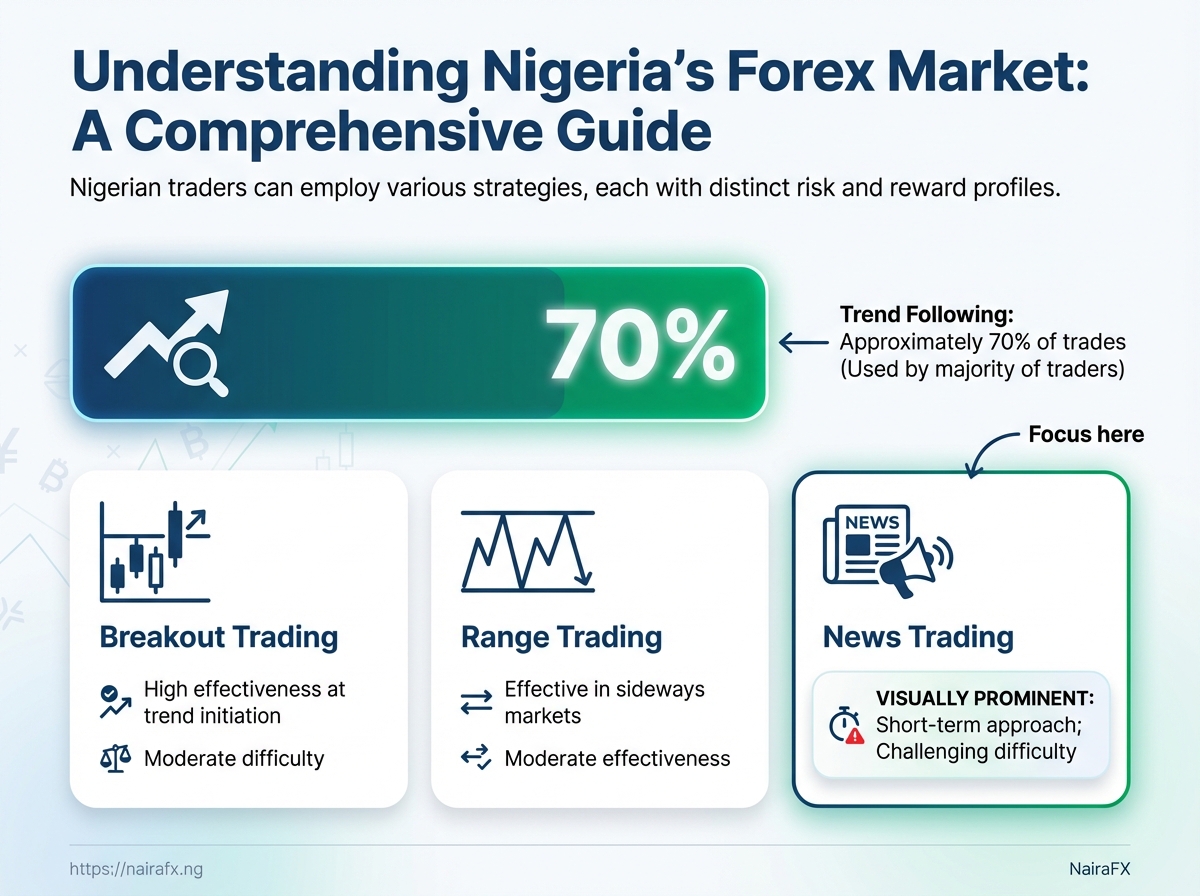
- Prefer trend-following on daily charts — fewer trades, less sensitivity to spread.
- Breakout strategies on 1H/4H with confirmation (volume, retest) to avoid false moves caused by illiquid spikes.
- Mean-reversion on tight intraday ranges only when spreads are narrow and during high-liquidity windows.
- Define liquidity windows (e.g., London open, NY overlap).
- Backtest using historical spread snapshots and execution slippage.
- Forward-test on a small live size, track slippage separately.
Technical setups with timeframe, risk profile, and spread tolerance to help traders pick suitable strategies
| Strategy | Timeframe | Risk tolerance | Spread/slippage sensitivity |
|---|---|---|---|
| Trend-following (daily) | Daily | Medium–High | Low sensitivity — few trades, wide stop buffers |
| Breakout (1H/4H) | 1H/4H | Medium | Medium sensitivity — require retest confirmation |
| Mean-reversion (intraday) | 5m–1H | Low–Medium | High sensitivity — needs tight spreads |
| Event-driven (news releases) | Minutes–Hours | High | Very high sensitivity — expect slippage |
| Carry/interest-rate differential | Weeks–Months | Low–Medium | Low sensitivity — long horizons mitigate spreads |
Testing strategies with realistic costs and using CBN daily rate data for macro checkpoints keeps performance expectations grounded. Trading this market well means protecting real-world cash flows first, speculating second.
Risk Management and Local Market Considerations
Position sizing, stop placement and contingency planning must reflect Nigeria’s market structure: wider spreads, deposit/withdrawal friction, and occasional FX policy shifts. Use volatility-adjusted position sizing with conservative caps, widen initial stops to survive local spreads, but shrink position sizes so single losses don’t blow the account. Run worst-case scenarios before you trade — stress-test the equity curve for simultaneous adverse moves, remittance delays, and funding freezes.
Practical setup
- Volatility-adjusted sizing: Calculate position size using recent ATR (14) and limit risk per trade to
0.5–1%of usable capital. - Wider stops, smaller lots: Use a wider stop in pips relative to international markets, then reduce lot size so dollar (or naira) risk stays capped.
- Conservative risk caps: Hard daily loss limit of 2% and monthly drawdown stop of 8–12%.
- Contingency liquidity buffer: Keep 10–20% of trading capital in readily withdrawable accounts to handle transfer delays.
Position-sizing step-by-step
- Calculate recent volatility with
ATR(14)and convert to pips.
- Choose a stop distance that accommodates local spreads.
- Compute position size so
position_risk = account_balance risk_percent.
- Reduce size if funding channel or remittance risk is elevated.
Operational risks — funding, transfers and third-party exposure — are the most frequent source of execution failure for Nigerian traders. Common friction points include deposit/withdrawal delays, payment-provider outages, BDC fraud, and sudden regulatory FX constraints. Trusted banking relationships and verified payment channels reduce friction; diversify rails so one frozen provider doesn’t stop trading.
Counterparty risk: Exposure to unregulated BDCs or unknown PSPs increases fraud and settlement risk.
Funding continuity: Maintain at least two funding / withdrawal options and a separate emergency naira wallet for margin calls.
Operational risk matrix: risk, likelihood, impact, mitigation steps
| Operational Risk | Likelihood (Low/Med/High) | Potential Impact | Recommended Mitigation |
|---|---|---|---|
| Deposit/withdrawal delays | High | Missed margin calls, forced liquidations | Use bank-verified rails; pre-fund accounts; hold 10–20% liquidity buffer |
| Payment provider downtime | Med | Trade execution gaps, funding inability | Maintain two providers; monitor uptime pages; automated fallback transfers |
| Counterparty insolvency | Med | Loss of deposited funds, legal disputes | Use regulated brokers/banks; limit exposure; vet counterparty credit |
| Regulatory FX restrictions | High | Restricted remittances, exchange-rate shocks | Track CBN advisories (CBN NFEM rates); hedge using NAFEM where possible |
| BDCs / parallel market fraud | High | Scam losses, incorrect rates | Avoid unverified BDCs; cross-check with Aboki Forex; use documented receipts |
Combining disciplined, volatility-aware sizing with operational redundancies preserves capital and trading continuity in Nigeria’s fast-moving environment. Keep processes simple, test them under stress, and make funding redundancy as much a part of your strategy as stop placement.
Trading Tools, Data Sources, and Technology Stack
Top traders pick tools by how reliably they execute, how close the data matches live market conditions, and how repeatable their backtests are. For Nigerian forex traders that means prioritising platforms with low-latency execution, NGN-friendly funding paths, robust charting, and automation/backtesting that can model local spreads, slippage, and funding delays. Below are practical checks and examples to make technology choices work for volatile local markets.
Platform feature checklist for Nigerian traders
- Execution latency: Prefer platforms with co-located servers or VPS options for automated strategies.
- NGN funding support: Confirm whether the broker accepts naira deposits via local transfers, Naira wallets, or FMDQ/NAFEM settlement channels.
- Charting & indicators: Look for multi-timeframe, tick-level data and custom script support.
- Automation/backtesting: Ability to run tick-level backtests, Monte Carlo resampling, and forward-walk analysis.
- Reporting & compliance: Exportable equity curves, trade-level P&L, and local tax-ready statements.
Where to source timely local economic data and reserve figures
- Central Bank rates and FX windows: The Central Bank of Nigeria publishes daily NFEM/FX rates; refer to the CBN daily rates page for official figures CBN daily FX rates.
- NAFEM/FX windows context: Use FMDQ documentation for details on the Investors and Exporters FX window FMDQ NAFEM FAQ.
- Market colour: Combine official data with market-watch tools like Aboki Forex for parallel market signals Aboki Forex.
How to simulate realistic trading conditions for backtesting
- Calibrate your backtests using tick-level spreads and slippage derived from a broker’s historical fills.
- Inject funding delay scenarios to emulate NGN deposit/withdrawal latency.
- Run Monte Carlo resampling on equity curves to estimate variability and tail risk (this is where Monte Carlo simulation shines for robustness testing).
Trading platforms by execution, NGN funding support, charting, and automation capabilities
| Platform | Execution model | NGN funding support | Automation/backtesting |
|---|---|---|---|
| MetaTrader 4/5 | Broker-mediated ECN/STP (retail-focused) | ✓ via brokers that accept NGN (bank transfer/wallet) | Built-in strategy tester (tick-level in MT5), MQL automation |
| TradingView | Cloud charting, broker-connected execution | ✗ platform-level NGN; brokers plugged in may support NGN | Pine Script strategies (paper trading; limited tick backtests) |
| Broker proprietary platform | Varies (often ECN/STP or market maker) | ✓ Commonly supports NGN deposits directly | Varies (some offer built-in backtest/automation) |
| cTrader | ECN/STP; low-latency routing | ✓ via supported brokers | cAlgo/cTrader Automate with tick-based backtests |
| API-based custom stacks (REST/WS) | Direct broker APIs, FIX for institutional | ✓ if broker supports NGN accounts | Full custom backtesting with tick replay (user-built) |
| Interactive Brokers (TWS) | Smart-routing, global liquidity | ✗ NGN funding limited; needs currency conversion | Advanced API, historical tick data, Python/R support |
| NinjaTrader | DMA/retail routing (futures/FX via brokers) | ✗ platform-level NGN; brokers may enable | Advanced strategy analyzer, tick replay |
| QuantConnect | Cloud backtesting, multi-asset | ✗ NGN funding not native | LEAN engine, tick-level backtests, research notebooks |
| Thinkorswim | Broker-specific routing (US-focused) | ✗ NGN funding not supported | Strong charting, limited FX retail automation |
Picking the right stack changes how quickly a strategy moves from idea to live edge. Choosing platforms and data feeds that model local funding and execution realities saves painful surprises when trading live.
Tools, Resources, and Continuing Education
Reliable tools and a compact cheat sheet make the difference between reacting to volatility and trading it with conviction. Below are practical resources, quick formulas, and a short continuing-education plan tailored for traders operating in the Nigerian forex landscape. Use the cheat sheet for intraday decisions, and the resources for confirmation and deeper study.
Essential resources (data sources, platforms, educational materials) with short descriptions and why each is useful for Nigerian traders
| Resource | Type (data/platform/education) | Purpose | How to use it |
|---|---|---|---|
| Central Bank of Nigeria (CBN) | Data / Official rates | Official daily FX rates, policy announcements, FX market structure notes | Check daily NFEM rates and policy circulars at https://www.cbn.gov.ng/rates/ExchRateByCurrency.html and https://www.cbn.gov.ng/intops/FXMarket.html before placing large trades |
| Nigerian Bureau of Statistics (NBS) | Data / Economic indicators | CPI, GDP, trade balance, employment — on-chain indicators for local currency pressure | Monitor monthly CPI/GDP releases to anticipate inflation-driven FX moves; use NBS releases to adjust macro exposure |
| TradingView economic calendar | Platform / calendar | Consolidated macro calendar, event impact filtering, alerts | Use the calendar to time positions around rate decisions and major data; set alerts for high-impact events |
| Broker liquidity & spread pages (local & global brokers) | Platform / market data | Live spreads, swap rates, liquidity notices — practical execution details | Compare live spreads and slippage during volatile hours; prefer brokers that publish historical execution stats |
| Local FX news outlets & market commentary (e.g., Aboki Forex, FMDQ analysis) | News / commentary | Real-time local market colour, parallel market rates, NAFEM flows | Cross-check parallel market moves on https://abokiforex.app/ and institutional window mechanics at https://fmdqgroup.com/faqs/what-is-the-investors-exporters-fx-window/ |
| XE mid-market rates | Reference / global rates | Global mid-market benchmark for USD/NGN comparisons | Use as an external sanity check on cross-market pricing: https://www.xe.com/en-us/currencyconverter/convert/?Amount=1&From=USD&To=NGN |
Quick reference cheat sheet (formulas & checklist)
- Conversion baseline: Use CBN NFEM closing rate as reference; compare to local parallel rate for premium/discount.
- Position sizing (simple): Risk per trade = Account equity × % risk. Size = Risk / (entry − stop)
- Volatility filter: If pip move > 1.5× average 20-day ATR, reduce target multiples and widen stops.
- Monitoring checklist: Daily: CBN rate, NBS releases, broker spreads at market open, high-impact events on TradingView calendar.
- Read the CBN NFEM rates each morning and flag any regime changes.
- Build a watchlist of 3 currency pairs tied to Nigeria (USD/NGN, EUR/NGN, GBP/NGN).
- Backtest simple rules around NBS CPI releases using 1-year hourly data.
- Subscribe to one local commentary feed (Aboki/FMDQ) and one execution-focused broker update.
Continuing education
- Short-term: Follow weekly webinars from TradingView and broker execution reports.
- Medium-term: Study Monte Carlo strategy robustness to volatility shocks (Monte Carlo simulation helps stress-test position sizing and equity curves).
- Long-term: Track academic and industry research on emerging-market FX dynamics and incorporate lessons into risk frameworks.
Treat the cheat sheet as a living tool: update it when policy, liquidity, or your account size changes, and keep one execution-focused broker and one local commentary feed as daily habits.
Conclusion
You now have a clearer view of how the Nigerian forex market moves — from policy shifts and importer-driven dollar demand to the ripple effects of inflation and oil receipts — and how those forces shape practical forex trading strategies Nigeria-based traders use every day. Recall the Lagos intra-day trader who combining a macro calendar watch with tighter stop placement preserved capital during a sudden naira slide; and the exporter who hedged receipts after tracking Central Bank guidance. Those examples show the value of watching local economic indicators, choosing regulated brokers, and pairing strategy with strict risk controls.
Take these concrete next steps to turn insight into results:
- Build a simple calendar that flags CBN announcements and major macro releases (the CBN exchange rates and FX market pages are useful references: Exchange Rates, FX Market Overview).
- Backtest one strategy on local-session data for at least three months before using real capital.
- Use a trusted source for live Nigerian market reads — platforms like NairaFX market insights can speed setup and monitoring.
Start with those steps, keep position sizes conservative, and let the pattern of local economic indicators guide entries. Consistent attention to risk management will make sudden naira moves manageable rather than catastrophic.