

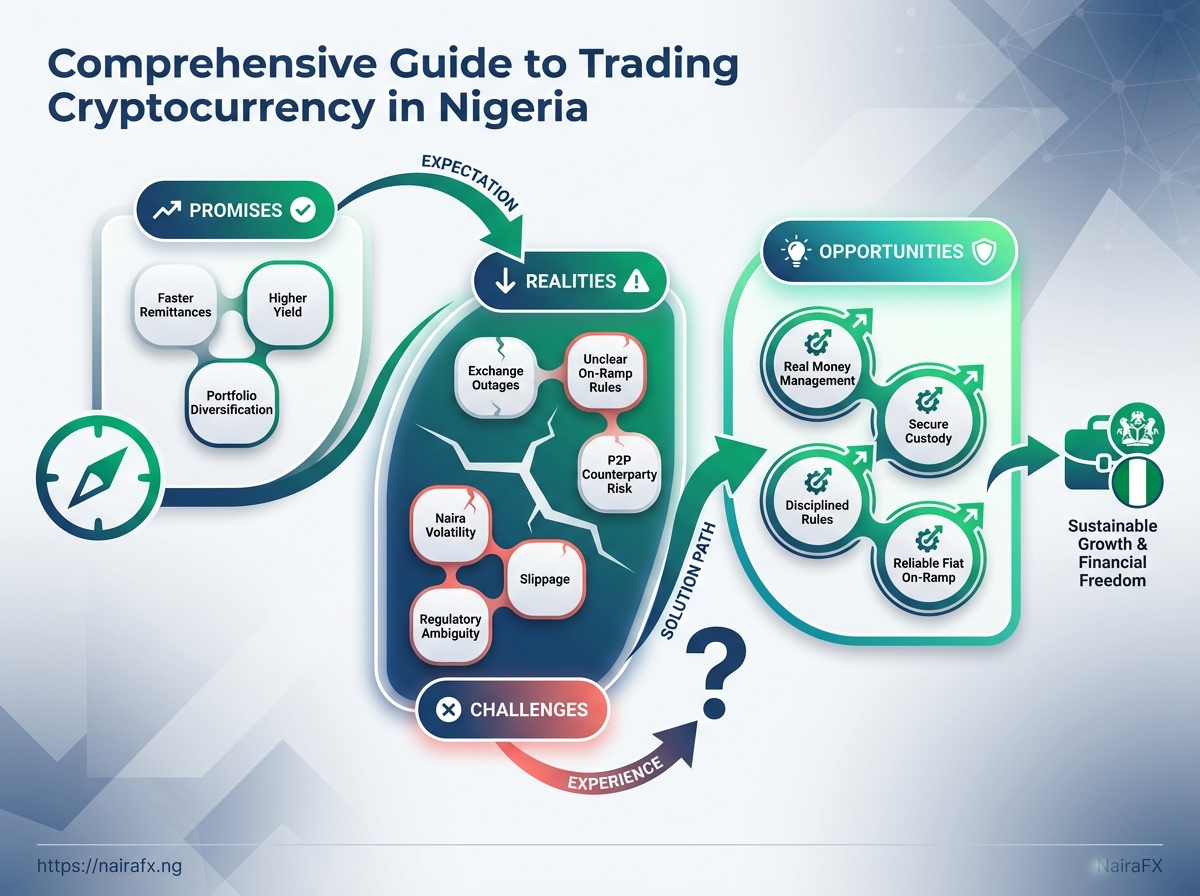
Most Nigerian traders recognise the same late-night ritual: refreshing prices on multiple apps, refreshing bank transfer confirmations, and recalculating slippage because the Naira slipped again. The promises of cryptocurrency—faster remittances, higher yield, portfolio diversification—collide with exchange outages, unclear on‑ramp rules, and P2P counterparty risk.
Trading profitably here depends less on secret indicators and more on practical controls: real money management, secure custody, disciplined entry and exit rules, and reliable fiat on‑ramp strategies. This introduction spotlights the real obstacles traders face in Nigeria and the concrete, tactical thinking that turns volatility from threat into opportunity.
Regulation, Compliance, and Risk Considerations
Regulation around retail trading and forex in Nigeria is active, evolving, and deserves attention before placing capital at risk. Brokers, payment channels, and traders operate under a mix of Central Bank of Nigeria guidance, securities law, and AML/CFT requirements. That means trading strategies must be built not only to manage market risk but also to reduce exposure to regulatory and compliance failures that can freeze funds, trigger investigations, or create reputational damage.
Regulatory landscape and practical implications
- Regulatory fragmentation: Multiple authorities influence trading activity — central bank rules on foreign exchange flows, the Securities and Exchange Commission’s oversight of capital markets actors, and customs/tax regulators on cross-border transfers.
- License and counterparty checks: Trading through licensed brokers reduces legal risk; unregulated venues increase the chance of fund recovery issues.
- AML/CFT obligations: Know-your-customer requirements affect onboarding, deposit/withdrawal speed, and acceptable payment routes.
- Reporting and record-keeping: Maintain searchable trade logs, bank records, and correspondence to satisfy enquiries or audits.
- Policy change risk: Sudden currency controls or payment restrictions can force rapid adjustments to position sizes and exit plans.
Immediate compliance actions for traders
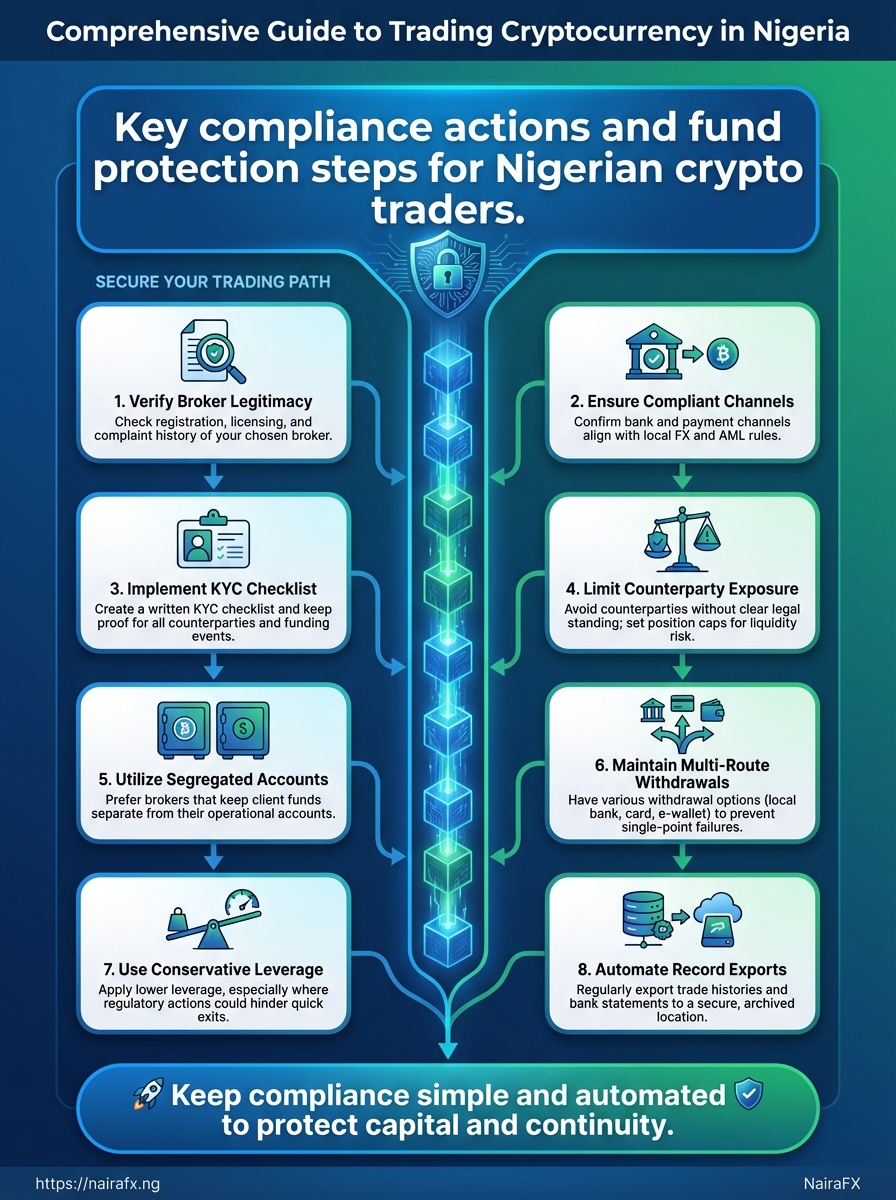
- Verify the broker’s registration, licensing status, and complaints history.
- Ensure
bankand payment channels used for funding are compliant with local FX and AML rules.
- Implement a written KYC checklist and retain proof for each counterparty and funding event.
- Limit exposure to counterparties without clear legal standing and set position caps sized for liquidity risk.
How to protect funds and reduce regulatory risk exposure
- Segregated accounts: Prefer brokers that keep client funds segregated from operational accounts.
- Multi-route withdrawals: Maintain alternate withdrawal methods (local bank, card, e‑wallet) to avoid single-point failures.
- Conservative leverage: Use lower leverage where potential regulatory action could prevent quick exits.
- Automated record exports: Export trade histories and bank statements weekly to a secure archive.
Monte Carlo simulation for trading strategy enhancement: Use scenario testing to model regulatory shock events and their impact on drawdown and liquidity.
Practical vigilance — checking licenses, keeping tidy records, and stress-testing strategies for policy shocks — turns abstract regulatory risk into manageable operational steps that protect both capital and continuity. Keep compliance simple and automated where possible so regulation rarely becomes the reason a good trade goes wrong.
Choosing the Right Platforms and Tools
Picking the right exchange, broker, or wallet changes how strategies perform more than most traders realise. Match platform strengths to your style: scalp on low-latency venues, hold positions on platforms with strong custody and fiat rails, and use deep-book exchanges for large-size trades. Below are practical ways to evaluate platforms and the concrete checklist to run through before committing capital.
Start by assessing liquidity and slippage risk. Look at order book depth during your target trading hours and simulate typical ticket sizes to estimate expected slippage. Market makers and institutional sections reduce slippage for large orders; retail-only venues often widen effective spreads when volatility spikes.
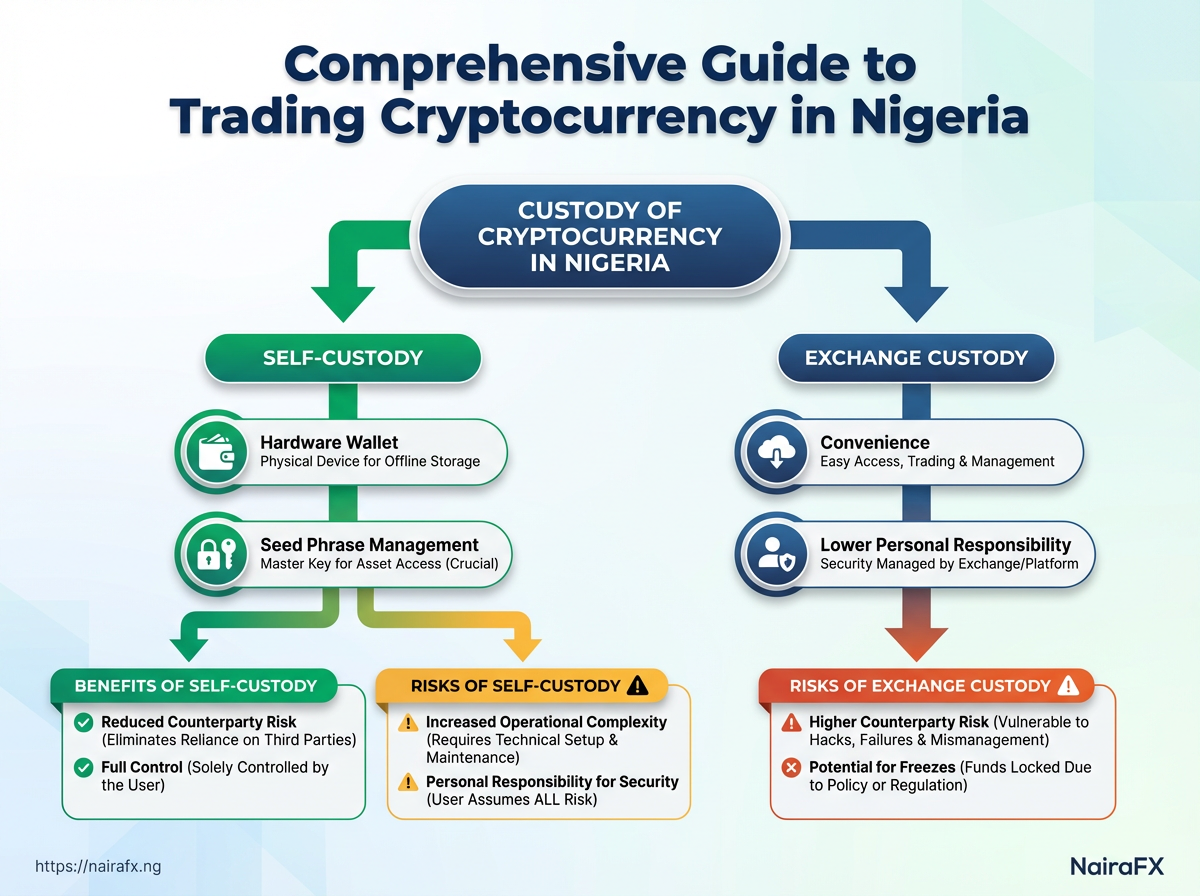
Assess custody and wallet choices based on control and threat model. Self-custody (hardware wallet, seed phrase) reduces counterparty risk but adds operational risk (lost seed). Custodial solutions offer convenience and insurance options, but check terms and insolvency protections.
Platform Evaluation Checklist (practical steps)
- Check real-world liquidity
- Pull 5–10 recent order books at your target times.
- Calculate slippage for your typical order size versus displayed depth.
- Review fee structure
- Compare maker/taker and withdrawal fees across fiat and crypto rails.
- Test fiat on/off ramps
- Verify deposit/withdrawal times, KYC timelines, and partner bank limits.
- Confirm security posture
- Look for cold storage ratios, proof-of-reserves, and recent audit disclosures.
- Evaluate customer support and dispute processes
- Try live chat with a low-value test ticket and note response time.
Quick signals to watch: rapid spread widening during local market events, frequent API downtime, and opaque custody terms.
Side-by-side comparison of platform attributes and how they map to trader needs (e.g., low fees for high-frequency, deep liquidity for large-size traders)
| Feature | Why it matters | Ideal for (trader type) | Risk/Tradeoff |
|---|---|---|---|
| Liquidity & order book depth | Reduces slippage on large orders | Institutional/large-size traders | May have higher KYC and capital limits |
| Fees & fee structure | Impacts net returns for frequent trading | High-frequency and active day traders | Low fees can come with lower support |
| Fiat on/off ramp availability | Ease of converting in/out local currency | Position traders who need deposits/withdrawals | Bank partnerships may change rapidly |
| Security & custody options | Protects assets from hacks and insolvency | Long-term holders and hedgers | Self-custody increases operational risk |
| Customer support & service levels | Resolves issues and prevents downtime losses | New traders and high-volume accounts | Premium support often costs more |
Security choices and measured slippage tests prevent ugly surprises once real money is at stake. Make platform selection an active part of strategy design, not an afterthought.
Trading Strategies and Tactical Approaches
Start with simple rules and tighten them as experience grows. A clear playbook removes emotion from entry and exit decisions, keeps risk predictable, and makes adapting to local constraints (fiat access, limited exchanges) straightforward. Below are practical strategy playbooks that scale from beginner to advanced, with explicit risk parameters and position-sizing examples for Nigerian account sizes.
Dollar-cost averaging (DCA)
Definition: Steady purchases at fixed intervals to reduce timing risk.
- Rules: Buy a fixed naira amount weekly/monthly; convert into stablecoin or crypto pair.
- Risk parameters: Set a maximum allocation of
5–20%of total capital. - Position-sizing example: With ₦200,000, allocate ₦10,000 per week for 20 weeks.
- Adaptation when fiat access is constrained: Use P2P on local-friendly exchanges, buy stablecoins first if on-ramp is limited.
Swing trading
Definition: Capture multi-day to multi-week trends using technical setups.
- Rules: Enter on pullbacks to support or moving average confluence; target
2:1reward:risk. - Risk parameters: Risk
1–2%of account per trade. - Position-sizing example: For ₦500,000 account, risking
1%→ risk per trade = ₦5,000. If stop-loss = 4% from entry, position size = ₦125,000 exposure. - Local adjustment: Prefer pairs with high local liquidity; avoid thinly traded tokens that widen spreads.
Day trading / scalping
Definition: Short intraday trades aiming for small, frequent gains.
- Rules: Use tight stops, predefined session hours, and avoid major news events.
- Risk parameters: Risk
0.25–0.5%per trade; max daily drawdown2–3%. - Position-sizing example: ₦300,000 account,
0.5%risk = ₦1,500; if stop = 0.5%, position = ₦300,000. - Constraint workaround: If exchange margin is limited, reduce leverage and trade more liquid pairs.
Arbitrage / P2P arbitrage
Definition: Exploit price inefficiencies across exchanges or P2P spreads.
- Rules: Automate alerts, account for fees and slippage, execute with capital spread across platforms.
- Risk parameters: Low directional risk; operational risk from execution delays.
- Practical tip: Keep fiat and crypto split across platforms to speed settlement.
Stablecoin hedging
Definition: Move to stablecoins or local fiat when volatility rises.
- Rules: Hedge when volatility index or local macro signals spike; preserve dry powder.
- Risk parameters: Allocation depends on risk tolerance; common range
10–50%. - Local note: Use stablecoins with strong on/off ramps in Nigeria (P2P liquidity matters).
Map strategies to trader profiles, time commitment, risk level, and required tools
| Strategy | Trader profile | Time commitment | Risk level | Required tools |
|---|---|---|---|---|
| Dollar-cost averaging (DCA) | Beginner, long-term | Low (minutes/week) | Low | Exchange with P2P, stablecoin wallet |
| Swing trading | Intermediate | Medium (hours/week) | Medium | Charting platform, order types, liquidity checks |
| Day trading / scalping | Advanced, active | High (hours/day) | High | Low-latency exchange, hot wallet, trade journal |
| Arbitrage / P2P arbitrage | Advanced, ops-focused | Medium-high | Low-medium (execution risk) | Multiple exchanges, monitoring bots, fiat accounts |
| Stablecoin hedging | All profiles (when needed) | Low | Low | Stablecoin custody, reliable on/off ramps |
A disciplined playbook—clear entry/exit rules, strict risk per trade, and practical position-sizing tied to real naira amounts—reduces guesswork and keeps emotions in check. Applying these templates while prioritizing liquidity and access to reliable P2P channels makes them realistic for traders operating in Nigeria.
Managing Capital, Taxes, and Safe Custody
Start by treating capital management, tax readiness, and custody as one integrated system: how much risk you take, how you store assets, and how you document everything determine whether a strategy survives a drawdown or an audit.
Practical allocation frameworks (examples)
- Conservative — 20/30/50: Reserve: 50% cash/stable assets; Liquidity: 30% short-term tradable positions; Growth: 20% higher-risk trades. Best for capital preservation and tight cash needs.
- Balanced — 10/40/50: Reserve: 50% cash/stable assets; Active trading: 40% diversified positions; Opportunistic: 10% concentrated or leverage plays. Works for steady growth with room to exploit setups.
- Aggressive — 5/30/65: Reserve: 35% cash/stable assets; Active trading: 30% positions with defined risk; Speculative: 35% high-volatility exposure. Suitable when time horizon is long and risk tolerance is high.
Capital-sizing tip: run position-sizing through a Monte Carlo simulation (client services like Monte Carlo analysis can speed this) to understand worst-case drawdowns across allocation mixes.
Stepwise custody checklist
- Choose primary storage: purchase a reputable hardware wallet (keep vendor receipts).
- Implement
multisig: distribute signing power across at least three devices or trusted parties.
- Create air-gapped backups: generate seed phrases on an offline device and store them in at least two geographically separate, fire-resistant locations.
- Encrypt and document recovery steps: write procedure, responsible persons, and emergency contact protocol.
- Test restores annually: perform a full recovery test to validate procedures without exposing keys publicly.
s for common custody elements
Hardware wallet: A physical device that stores private keys offline to minimize hacking risk.
Multisig: A signing requirement where multiple keys approve a transaction; reduces single-point failures.
Air-gapped backup: A backup created and stored on a device never connected to the internet.
Tax-awareness actions
- Maintain transaction-level records: export trade logs, timestamps, counterparty details, and fiat equivalents.
- Keep receipts and invoices: proofs for deposits, withdrawals, and fee payments.
- Separate accounts: use dedicated bank accounts or wallets per strategy to simplify tracing.
- Engage a tax professional: consult someone familiar with Nigerian tax law and cross-border crypto/tax issues.
- Automate where possible: use portfolio tools that produce audit-ready reports and CSV exports.
A sensible custody posture paired with disciplined recordkeeping makes audits manageable and prevents operational losses. Tight capital rules and clean tax records keep optionality alive when markets swing.
Technology, Indicators, and Backtesting
Reliable crypto trading decisions start with the right toolkit and a defensible backtest. Use robust, well-documented software for data, analysis, and execution; treat indicators as hypotheses rather than gospel; and design tests that reflect how a strategy would actually behave in live markets.
Toolkits and practical setup
- Data fidelity: Prefer exchange-native OHLCV plus orderbook snapshots where possible; aggregate multiple sources for redundancy.
- Reproducibility: Use version-controlled code (
git) and fixed random seeds for simulations. - Execution parity: Mirror live execution constraints (latency, fees, minimum sizes) in backtests.
Which indicators tend to work in crypto
- Momentum indicators: Good for trending altcoins — RSI and MACD often highlight continuation but lag in choppy markets.
- Volume-based indicators: On-chain volume and exchange flow metrics can outperform price-only signals for major coins.
- Volatility filters: ATR and realized volatility shine for sizing and stop placement in crypto’s jumpy regime.
- Market-structure tools: Support/resistance, order book imbalances, and VWAP are useful for intraday and liquidation-sensitive strategies.
How to run a defensible backtest
- Define objective metrics (Sharpe, max drawdown, net return) and a hold-out period.
- Clean and align data — remove duplicated ticks, adjust for forks/token rebrands, and normalize timestamps.
- Implement realistic transaction costs and slippage models tied to observed liquidity.
- Use
walk-forwardor rolling-window validation to test stability across regimes.
- Record every run (parameters, seed, dataset) and compare performance across multiple market conditions.
Common backtesting mistakes and avoiding overfitting
Overfitting: Tuning many parameters to one historical period → enforce parameter parsimony and validate on unseen time windows.
Lookahead bias: Using future knowledge in signal computation → ensure all features exist at decision time.
Survivorship bias: Testing only assets that survived → include delisted or low-liquidity assets where relevant.
Data-snooping: Repeatedly searching for profitable rules on the same dataset → allocate a strict out-of-sample test set and limit hypothesis tests.
Over-optimization: Complex rules that don’t generalize → prefer simpler rules that match a plausible economic rationale.
Quick reference of tools/platforms for charting, backtesting, and data sources with pros/cons
| Tool | Primary use | Pros | Cons | Free/Paid |
|---|---|---|---|---|
| TradingView | Charting, strategy scripting | Excellent charts, Pine script, social ideas | Limited tick-level backtests | Free / Paid ($14.95+/mo) |
| Backtrader (Python) | Strategy development & backtesting | Flexible, open-source, community | Manual data plumbing for exchanges | Free |
| CCXT | Exchange API connector | Wide exchange support, unified API | No backtesting logic, rate limits | Free |
| CoinGecko / CoinMarketCap | Market data & API | Broad free endpoints, market coverage | Rate limits on free tiers | Free / Paid |
| Glassnode | On-chain analytics | On-chain metrics, institutional dashboards | Paid for advanced metrics | Free tier / Paid |
| Nansen | Wallet-level analytics | Smart money tracking, token labels | Expensive for retail | Paid |
| Kaiko | Institutional market data | High-quality tick and trade feeds | Enterprise pricing | Paid |
| CryptoCompare | Market & aggregated data | APIs, historical time series | Some datasets gated behind pay | Free / Paid |
| P2P exchange dashboards | Local liquidity signals | Useful for regional fiat flows | Fragmented, variable quality | Mostly Free / Exchange fees |
A defensible testing setup reduces surprises when markets move. Treat indicators as tools to test, not guarantees, and make reproducibility and realism the cornerstones of every experiment.
Practical Workflows: From Onboarding to Execution
Start with a tightly defined onboarding checklist so execution never depends on memory. A clean handoff from account setup to live trading prevents avoidable errors, speeds settlement, and keeps disputes rare. The workflow below turns onboarding into a repeatable, auditable process and pairs it with an end-to-end execution checklist, practical P2P safeguards, and straightforward post-trade reconciliation steps.
Account Verification: Proof of identity, proof of address, and linked bank account confirmed.
Access Controls: Two-factor authentication enabled and role-based permissions set.
Funding Limits: Daily and per-trade limits agreed and configured.
End-to-End Trade Execution Checklist
- Prepare trade ticket: confirm instrument, direction, size, and
order_type(market/limit).
- Verify counterparties: check KYC match, payment rails, and known reputation.
- Confirm available margin/cash: ensure required free balance covers trade + fees.
- Execute order: place via chosen venue, log
order_id, execution timestamp, and executed price.
- Capture proof of payment: save payment confirmation, screenshots, and any transaction reference.
- Notify counterparty: send execution notice with
order_idand expected settlement window.
- Record trade in ledger: update internal systems with P&L stub and risk limits impact.
- Start settlement timer: note expected settlement time and assign reconciliation owner.
P2P Transaction Best Practices and Dispute Avoidance
- Confirm identity: Always match account names, BVN (if applicable), and bank name before funds move.
- Time-box payments: Use narrow payment windows (e.g., 15–30 minutes) and require immediate confirmation.
- Use unique references: Require the payer to include a predetermined unique reference in the transfer description.
- Hold policy: For new counterparties, route funds through a short-term escrow or intermediary until trust established.
- Conversation record: Keep chat logs or email trails to resolve ambiguities quickly.
Monitoring and Reconciliation Steps After Execution
Trade Confirmation: Automatically generate a confirmation and send to both parties.
Cash Reconciliation: Reconcile bank/in-app balances against trades every business day.
Exception Management: Flag mismatches >₦1,000 (or configurable threshold), escalate within 1 business hour.
Audit Trail: Retain order_id, timestamps, payment receipts, and communications for at least 12 months.
Operational workflows sometimes need stress-testing. Running Monte Carlo simulations on execution latency and slippage helps quantify the tail risk and can guide funding limits or timeout policies. Following these routines reduces disputes, speeds settlement, and makes performance problems visible before they erode capital.
Common Pitfalls and How to Avoid Them
Start by treating trading like a risk-control exercise, not just a profit hunt. Traders who survive volatile markets consistently make fewer high-impact mistakes: they control leverage, lock down custody, price-in fees and spreads, vet P2P counterparties, and keep clean records. Overleveraging erodes capital in a handful of bad ticks; sloppy custody practices turn temporary outages into permanent losses; ignoring spreads and withdrawal fees quietly makes profitable strategies unprofitable. Practical fixes are straightforward and repeatable — set position-size rules, use hardware or multi-signature custody, include fees in backtests, choose vetted P2P platforms, and maintain timestamped trade logs.
Those steps reduce surprise risk and make post-mortems useful.
Common red flags for scams and social engineering show up early: urgent withdrawal requests, offers that bypass platform controls, poorly documented counterparties, or pressure to “just try a small amount.” Treat every unusual request as an authentication and audit problem. Use 2FA, whitelisted addresses, and test transfers before moving meaningful funds. When uncertainty remains after those checks, escalate to a professional adviser or compliance specialist — the cost of a quick consult is tiny compared with a full account breach.
Practical checklist:
- Set a max leverage cap: Never risk more than 1–2% of capital on a single trade.
- Use proper custody: Prefer hardware wallets or multi-sig for significant holdings.
- Include fees in models: Backtest with spreads, slippage, and withdrawal fees.
- Vet P2P partners: Require ID, on-chain proof, and small test trades.
- Keep immutable records: Timestamped trade logs and screenshots for audits.
Top Mistakes and Practical Fixes
| Common mistake | Typical consequence | Quick mitigation | When to consult a professional |
|---|---|---|---|
| Overleveraging | Rapid margin calls and wiped accounts | Set fixed max leverage, use stop-loss, size positions to risk % of capital |
After repeated near-misses or >20% drawdown |
| Weak custody practices | Stolen funds during outages or phishing | Use hardware wallets, multi-signature, cold storage for long-term holdings | When holding >6 months of salary-equivalent funds |
| Ignoring spreads and fees | Strategy profitability evaporates | Backtest with realistic spreads/slippage; include withdrawal fees | If real returns differ >2% from backtests |
| P2P counterparty risk | Fraud, chargebacks, or identity spoofing | Insist on ID checks, small test transfers, escrow services | After dispute history or large transactions |
| Poor recordkeeping | Cannot audit losses or prove tax positions | Use timestamped logs, export trade history regularly | When preparing audits or tax filings |
These practices cut down tail risks and make it possible to learn from every trade rather than get wiped out by one. Consistent discipline buys optionality; that’s what keeps traders in the game.
Quick Reference Cheat Sheet and Resources
Start trading sessions with a short, repeatable routine that keeps focus and reduces mistakes. A reliable pre-session checklist saves time and prevents emotional trades when markets move fast.
- Pre-session checklist (do this every session):
- Market snapshot: Check macro news and any overnight price gaps.
- Liquidity check: Confirm spreads and order book depth on your main pairs.
- Position limits: Set max exposure and per-trade risk in
nairaor % of equity. - Watchlist: Review 3–6 priority instruments, mark set-ups and invalidation points.
- Orders ready: Pre-fill limit/stop levels; use
OCOwhere supported. - Journal note: One-line thesis per planned trade and exit criteria.
- Risk control: Ensure protection (stop-loss, trailing rules) is active.
- Tech check: Confirm platform connection, VPN (if needed), and wallet access.
Categorized and scannable resource table for tools, data sources, and advisory services
| Resource | Type | Why it matters | Cost |
|---|---|---|---|
| TradingView | Charting & scanning | Industry-standard charting, alerts, Pine-script strategies | Free tier; Pro from ~$14.95/mo |
| CoinGecko | Market data & research | Fast token data, historical metrics, liquidity snapshots | Free |
| Chainalysis (reports) | Blockchain forensics & reports | Useful for macro risk research and compliance trends | Paid reports; enterprise pricing |
| Ledger / Trezor | Hardware wallets | Cold storage for private key security | Hardware from ~$59–$200 |
| P2P exchange dashboards (Local) | Price discovery & counterpart access | Tracks local spreads and volume for Naira P2P markets | Free; platform fees apply |
| Binance Research | Market reports & analysis | Regular token research and market structure notes | Free |
| Glassnode | On-chain analytics | Advanced metrics for supply/flow analysis | Free tier; paid plans from ≈$29/mo |
| NairaFX Monte Carlo service | Strategy risk modelling | Simulate drawdowns and probability-adjusted returns | Custom pricing (service-based) |
| CBN / FIRS guidance pages | Regulatory & tax reference | Official stances that affect compliance and reporting | Free public guidance |
Where to get legal or tax help in Nigeria
Tax advisor: A tax practitioner familiar with digital assets can help classify income and advise on FIRS obligations.
Legal counsel: Use a lawyer with fintech/crypto experience to interpret CBN advisories and draft KYC/AML procedures.
Compliance consultants: For exchanges and high-volume traders, periodic audits or a retained compliance service reduces regulatory surprises.
This cheat sheet and resource set keeps trades sharper and compliance straightforward, so time at the desk becomes productive instead of reactive.
Conclusion
Trading in Nigeria’s choppy FX and crypto markets demands a blend of rules, tools, and discipline: align with regulation and compliance, pick platforms that match your execution and custody needs, backtest strategies against realistic slippage and spreads, and protect capital with clear risk limits. Remember the trader who shifted from manual fills to automated order routing—trade execution improved and drawdowns shrank—and the saver who moved idle holdings into cold custody after a reconciliation lapse; both changes came from small, practical fixes that compound. If compliance feels daunting, focus first on documented processes and a single regulated counterparty; if technology feels overwhelming, start with one reliable backtest framework and expand.
Practical next steps: run a controlled paper-trading experiment, cap exposure with hard stop-and-size rules, and document your onboarding and custody checklist. For implementation support or deeper templates and workflows, explore resources at NairaFX. Curious about taxes or which indicators actually improve edge? Revisit the tax and backtesting sections, then test answers with small samples before scaling.
Take one action this week—set a firm position-size limit or automate one routine task—and build from there.