

The first problem for many traders is not entry signals.
It is the habit of clicking buy or sell because a chart moved fast.
That is why beginner forex strategies work best when they are simple, rule-based, and boring enough to repeat.
In starting forex trading, the goal is not to predict every move.
It is to survive enough trades to learn what actually works.
The forex market is huge.
The BIS measured average daily turnover at $7.5 trillion in April 2022, which tells you two things right away: there is plenty of liquidity, and careless trading gets punished quickly.
Even the basics matter more than most people expect.
A pip is usually 0.0001 on major pairs and 0.01 on JPY pairs, while the spread is the cost you pay before a trade can even breathe.
Add leverage, and a small mistake can become a big one very fast.
Good forex trading for novices usually starts with clear entry rules, a fixed stop-loss, and position size based on risk, not excitement.
Demo trading and backtesting help strip out guesswork before real money enters the picture.
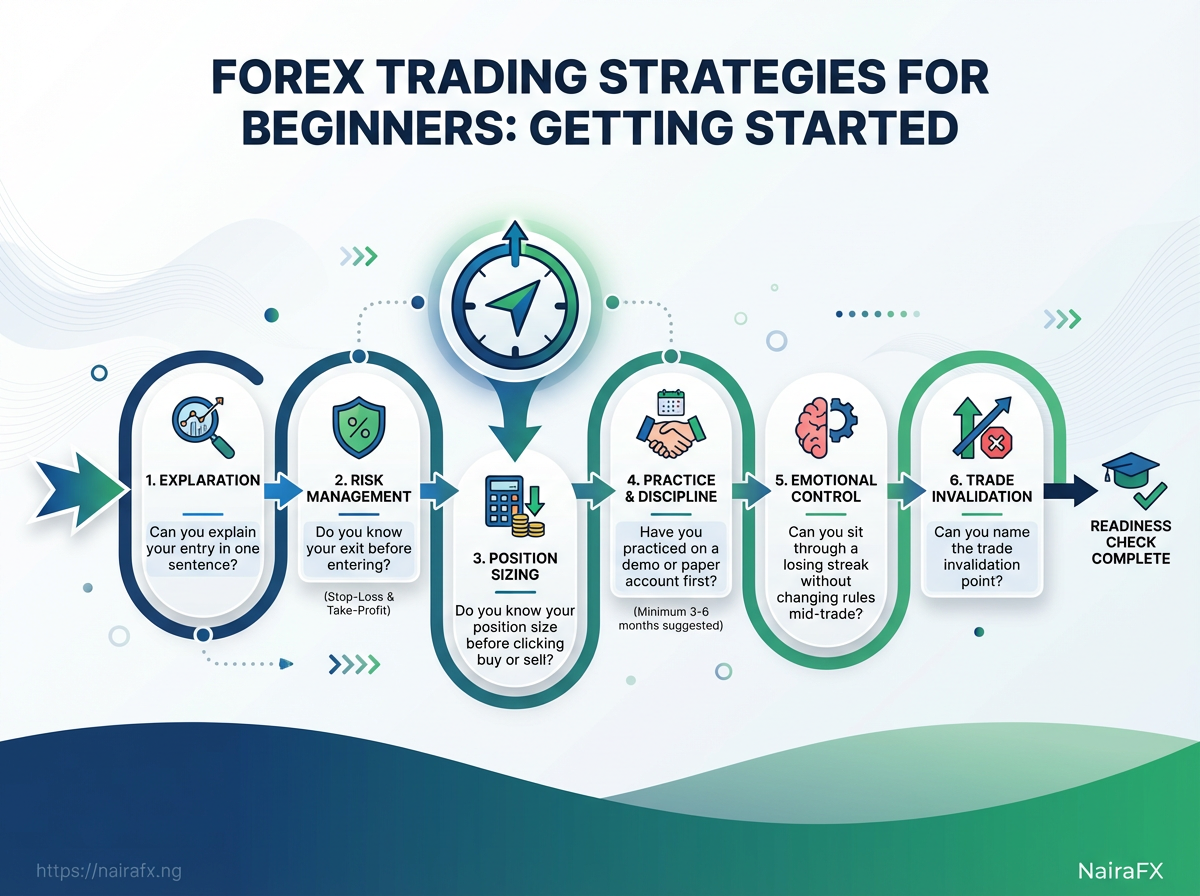
Start here: Are you ready to trade?
What if the hardest part of starting forex trading is not the chart, but your own readiness? A lot of beginners get pulled in by fast moves, then discover that spread costs, leverage, and shaky discipline are the real pressure points.
That matters even more in volatile markets.
The FX market is huge — the BIS reported average daily turnover of $7.5 trillion in April 2022 — but size does not protect a small account from bad habits.
So the first job is simple: check whether you are actually set up for trading, not just excited about it.
Good beginner forex strategies work best when the person using them has a plan, a cushion, and enough patience to follow rules.
- Can you explain a pip clearly? For most major pairs, a pip is
0.0001; for JPY pairs, it is usually0.01.
- Do you understand the spread? If you do not know your entry cost, you do not know your break-even point.
- Can you place a stop-loss every time? No stop, no trade. That rule saves beginners more than any signal.
- Do you know how much you can lose per trade? A fixed risk limit keeps one mistake from wrecking the account.
- Have you tested a simple plan on demo? Paper trading on MT4 or MT5 helps expose sloppy execution before real money is involved.
- Can you watch the market without chasing every candle? If not, volatility will eat your discipline alive.
- Are you trading with money you can afford to learn with? Rent money and trading money should never sit in the same mental bucket.
Early challenges are usually boring, which is exactly why they hurt.
Beginners in forex trading for novices often misread leverage, widen stops after entry, or jump between systems before one has a fair test.
Range markets, breakouts, and trend setups all look easy until spread costs and whipsaws show up.
A minimum setup keeps the noise down.
- Account: A live or demo account with a regulated intermediary in your jurisdiction.
- Capital: Enough to risk small, fixed amounts without panic.
- Time: A daily window for charts, trades, and review.
- Mindset: Treat the first months as training, not income.
- Platform: MT4 or MT5 for charting, orders, and basic testing.
If most of those seven checks are no, wait a little longer.
Starting forex trading goes much better when the foundation is quiet, practical, and honestly unglamorous.
Forex basics every beginner must know
A forex quote looks simple until the numbers start moving against your size.
One pip, one lot, one spread, and one bad leverage choice can change the whole trade.
That is why forex trading for novices starts with structure, not signals.
Currency pairs show what you are buying and selling, pips measure small price moves, lots set trade size, and leverage decides how much pressure your account is carrying.
A practical example helps.
In most major pairs, 0.0001 is one pip, while JPY pairs usually use 0.01.
So if EUR/USD moves from 1.0800 to 1.0810, that is 10 pips, and your profit or loss depends on the lot size you chose.
Pairs matter first. You are always trading one currency against another, such as EUR/USD or GBP/JPY.
The first currency is the base, and the second is the quote.
Pips are the language of movement. They help you measure stop-loss distance and reward.
That matters more than guessing direction.
Lots decide your exposure. A standard lot is much larger than a mini or micro lot, so beginners usually need smaller sizes while learning.
Leverage is a double-edged tool. It can make a small account feel active, but it also magnifies losses fast.
A tiny move in the wrong direction can trigger a margin problem if risk is too high.
Trading hours matter just as much.
In Nigerian time, the quieter Asian session often starts the day, then liquidity usually improves when London opens, and it often gets livelier again during the London-New York overlap.
That overlap is where many beginners see tighter spreads and cleaner price movement.
Costs also change the math.
The spread is the gap between bid and ask, so every trade starts slightly behind.
Some brokers also charge commission, and overnight rollover can add or subtract money if you hold a position past the daily cutoff.
For anyone building beginner forex strategies, the habit to form early is simple: check the pair, the pip value, the session, and the full trade cost before pressing buy or sell.
Platforms like MetaTrader 4 or MetaTrader 5 make those numbers visible, which helps when you are still learning the ropes.
- Start with major pairs. They usually move more cleanly than thin, noisy crosses.
- Keep lots small. Micro sizes reduce damage while you are still learning.
- Trade the active hours. Better liquidity often means fewer nasty surprises.
- Count all costs. Spread, commission, and rollover all eat into edge.
Getting those basics right makes starting forex trading far less chaotic.
Once the market’s structure makes sense, the rest becomes easier to test with discipline.
Choosing a beginner-friendly trading strategy
What if the best first strategy is not the flashiest one, but the one you can follow on a dull Tuesday without second-guessing yourself?
That matters because beginners usually fail from inconsistency, not lack of intelligence.
A simple rule set beats a clever idea that changes every time the chart wiggles.
For most people starting forex trading, the safest path is a strategy with clear entries, clear exits, and a pace that fits real life.
Trend-following, range trading, breakout trading, and scalping all work in different conditions, but they do not ask for the same personality.
Quick comparison of beginner-friendly strategies
| Strategy | Typical timeframes | Skill level required | Pros | Cons | Best market condition |
|---|---|---|---|---|---|
| Trend-following | 4H to daily | Low to moderate | Clear direction, easier rule-making, less screen pressure | Late entries can happen, drawdowns may last longer | Strong directional moves |
| Range trading | 1H to 4H | Low to moderate | Simple support and resistance logic, frequent repeatable setups | Breakouts can trap traders, needs discipline near boundaries | Sideways, quiet markets |
| Breakout | 15M to 4H | Moderate | Captures momentum early, easy to define invalidation | False breaks are common, timing matters | Expanding volatility, news follow-through |
| Scalping | 1M to 15M | High | Many opportunities, fast feedback | Stressful, costs matter more, requires sharp execution | Very liquid sessions with tight spreads |
It gives the chart time to prove itself, which helps when emotions run hot.
Range trading fits traders who prefer structure.
If you like clear ceilings and floors, this style feels natural, especially when the market is stuck in a box.
Breakout trading works better for people who want action but still want rules.
Scalping, by contrast, is the least forgiving of the four.
It asks for speed, focus, and low friction, so it is rarely the best first step for forex trading for novices.
If a strategy matches your schedule, you are far more likely to stick with it.
That is the real test.
A two-hour evening review pairs well with trend-following or range setups, while scalping usually demands attention you may not want to give.
A practical way to choose is simple: pick one style, write the rules, and test it on a demo account before risking cash.
That keeps the learning curve honest and stops random clicking from passing as a trading plan.
A clear strategy beats a busy one every time.
The best beginner forex strategies are the ones you can repeat cleanly, even when the market is behaving badly.
Risk management: protect your capital first
What happens when a clean setup still loses? In forex, that is just part of the game.
The market is huge.
The Bank for International Settlements put average daily FX turnover at $7.5 trillion in April 2022, which tells you liquidity is deep but outcomes still depend on discipline.
Traders who last usually decide their risk before they decide their entry.
For starting forex trading, three rules do most of the work: cap the cash you risk on any one trade, place the stop where the idea is truly wrong, and stop trading once drawdown reaches your personal limit.
Small accounts need this even more, because one oversized position can undo a week of careful work.
A simple setup for forex trading for novices is fixed-fraction risk.
If a $200 account risks 1%, that is $2 on the trade, not a cent more.
From there, position size comes from the stop distance, so the trade fits the account instead of bullying it.
Copy-ready risk checklist
| Checklist item | When to use | Why it matters | Quick action |
|---|---|---|---|
| Define risk per trade (%) | Before every entry | Keeps one loss from doing real damage and stays far below full-Kelly aggression | Start with 0.5% to 1% of account equity |
| Calculate position size | After the stop is chosen | Matches your size to the amount you can afford to lose | Use risk amount ÷ stop distance and round down |
| Set stop loss and take profit | Before clicking buy or sell | Forces the trade to have a planned exit, not an emotional one | Put the stop where the setup is invalid |
| Log the trade in a journal | Right after entry and exit | Shows whether the problem is the setup, size, or execution | Record pair, size, stop, result, and note |
| Review after 10 trades | After a small batch | Reveals drawdown creep before it gets serious | Compare average loss, win rate, and equity curve |
| Respect a max drawdown cap | When losses start to stack | Prevents revenge trading and protects the next round of trades | Pause trading if equity drops past your limit |
It also keeps the account alive long enough for the edge to show up.
Here is the part many new traders miss: the best trade plan can still fail if size is too large.
A practical rule is to stop and review after a 10% drawdown in a small account, then cut size until the equity curve flattens again.
That review gets easier when the numbers are in front of you.
Tools such as nairafx.ng are useful for equity-curve review and risk evaluation when the goal is staying honest with the data.
Protecting capital is not glamorous, but it is what gives every other edge a chance to work.
Keep the risk small, keep the stop logical, and let the account survive long enough to learn.
How to craft entry, exit, and trade-management rules
What if the best trade is the one you can explain in one breath? That simple test saves a lot of beginners from messy decisions, especially when starting forex trading and every candle looks urgent.
Good rules do not need to be fancy.
They need to answer three questions before money is at risk: when do I enter, when do I get out, and what happens if price moves my way? That structure matters even more for forex trading for novices, because vague plans usually turn into emotional clicks.
The cleanest beginner forex strategies often start with one signal, one stop, and one job for the trade.
If the setup cannot survive that level of clarity, it is not ready yet.
- Moving average cross: Use a faster average crossing a slower one as a direction filter, then wait for price to stay on that side before entering. It is not perfect, but it keeps you from fighting the trend.
- Support or resistance bounce: Mark a level that price has respected more than once, then look for a clear rejection candle near it. A bounce trade should fail fast if the level breaks cleanly.
- Breakout confirmation: Enter only after price closes beyond a key high or low, not just during the spike. That extra step filters out plenty of fake moves.
Exits need the same discipline.
A trade can move from hopeful to harmful if you let it drift, so write down the stop before entry and decide in advance how you will trail it.
One practical method is to move the stop to breakeven only after price has covered the original risk, then trail it below fresh swing lows in an uptrend or above swing highs in a downtrend.
For a visual, imagine a breakout on EUR/USD: price closes above resistance, the entry goes in on the next pullback, the stop sits just below the broken level, and profit is taken in two parts as the move extends.
That chart should make the whole process feel less abstract.
You can see where the idea started, where it failed if needed, and how the stop changed as the trade breathed.
A rule set like this keeps the trade from becoming a guess.
It also makes review easier, because every win and loss can be checked against the same playbook.
Build a beginner trading plan and test it
A trading plan that fits on one page usually beats a fancy one nobody follows.
That matters even more when starting forex trading, because beginners often confuse activity with progress.
For forex trading for novices, the plan only needs four moving parts: strategy, rules, risk, and routine.
If one of those is missing, the plan leaks.
A simple example helps.
A beginner might decide to trade a trend-following setup only, risk a fixed amount per trade, check the charts at the same two times each day, and stop after three losing trades in a row.
Put the plan on one page
Strategy: Pick one beginner forex strategy, not three.
A moving-average trend approach, a range setup, or a breakout plan is enough for now.
Rules: Write the exact trigger, stop, and exit conditions in plain English.
If two people can read it and get the same trade, the rule is clear enough.
Risk: Define the maximum amount at risk before the trade opens.
Tie position size to the stop-loss distance, not to hope.
Routine: Set the time, market, and chart timeframe you will use.
Consistency makes testing much cleaner.
Test it without code
Manual backtesting is slower, but it teaches you the market fast.
Open historical charts, move candle by candle, and mark every trade that matches your rules.
A spreadsheet keeps the test honest.
Log the pair, date, setup, entry, stop, exit, result in pips, and one note on whether the trade followed the plan.
- Choose one pair: Use a liquid pair like EUR/USD or USD/JPY.
- Mark the rule set: Write the setup on paper first.
- Scroll through history: Record every valid trade, not just the winners.
- Review the pattern: Look for repeat mistakes, weak exits, or poor timing.
Watch the process on chart
The cleanest way to learn is to watch one strategy played out bar by bar.
A screen-recorded walkthrough of manual backtesting on historical charts makes the process feel concrete instead of theoretical.
That kind of walkthrough is useful because it shows where rules break down in real market conditions.
It also helps you spot the difference between a solid setup and a lucky one.
If the plan survives a few weeks of paper testing, it is ready for the next stage.
If it does not, the problem usually sits in the rules, not the market.
Measure performance and improve your strategy
A trader can be right more than half the time and still bleed money.
That usually happens when winners are small, losses are large, or both.
That is why win rate alone is a trap.
For beginner forex strategies, the real picture comes from four numbers: win rate, risk-reward, expectancy, and drawdown.
Track the numbers that tell the truth
Win rate shows how often your trades finish in profit.
It matters, but only as part of the bigger picture.
Risk-reward compares what you risk on a trade with what you expect to make.
A system that wins less often can still work well if the average winner is much larger than the average loss.
Expectancy is the average amount you expect to gain or lose per trade over time.
A simple formula is ((win rate x average win) - (loss rate x average loss)).
Drawdown shows how far your equity falls from a peak.
If your account drops hard on a normal losing streak, the strategy may be too aggressive for real life.
A lot of forex trading for novices gets messy because traders focus on the last trade instead of the pattern across many trades.
That is how random noise starts looking like a “system.”
Run a 30-trade review, not a gut check
Thirty trades is enough to reveal habits without pretending you have a full scientific sample.
It is also short enough to finish before boredom or revenge trading wrecks the process.
Use a simple journal in MT4, MT5, or even a spreadsheet.
Record entry, exit, pair, setup type, stop size, result, and whether you followed your rules.
- Group the trades by setup, pair, and session.
Look for one style that performs better than the rest.
- Check rule quality before profit.
A losing strategy that follows rules cleanly is easier to fix than a profitable mess.
- Compare averages, not single trades.
One lucky winner means almost nothing.
Ten trades in a row tell a much better story.
- Mark the leaks.
Common problems are late entries, oversized positions, and exits that move on emotion.
Pause before the damage spreads
If drawdown is rising fast, or if expectancy stays negative after a clean 30-trade run, pause the strategy.
That pause is not failure.
It is damage control.
Change one thing at a time.
Tighten a stop, adjust the entry filter, or reduce position size.
Then run another 30 trades and compare the new numbers with the old ones.
That habit keeps starting forex trading from turning into guesswork.
It also gives every strategy a fair test before real money takes the hit.
Build the habit before the trade
The part worth remembering is simple: the market does not reward excitement, it rewards discipline.
For beginner forex strategies, the boring stuff matters most — fixed risk, clear exits, and a plan you can repeat without guessing.
That is what turns starting forex trading from a lucky click into a process you can trust.
The example from the risk section still holds up well.
A trader who risks too much on one idea can be right more often than wrong and still lose money, while a trader who keeps losses small can survive long enough for the edge to show itself.
That is why forex trading for novices should lean hard on trade management and equity-curve review, especially in a market that can swing fast on news and sentiment.
Write one trading rule today. Make it specific: one pair, one setup, one stop-loss rule, one profit target, and one maximum daily loss.
Then test it on a small sample of trades and see whether the numbers support the habit, not the hope.
If a second opinion on broker quality or market context would help, tools like NairaFX can be a useful place to compare notes before the next trade.