
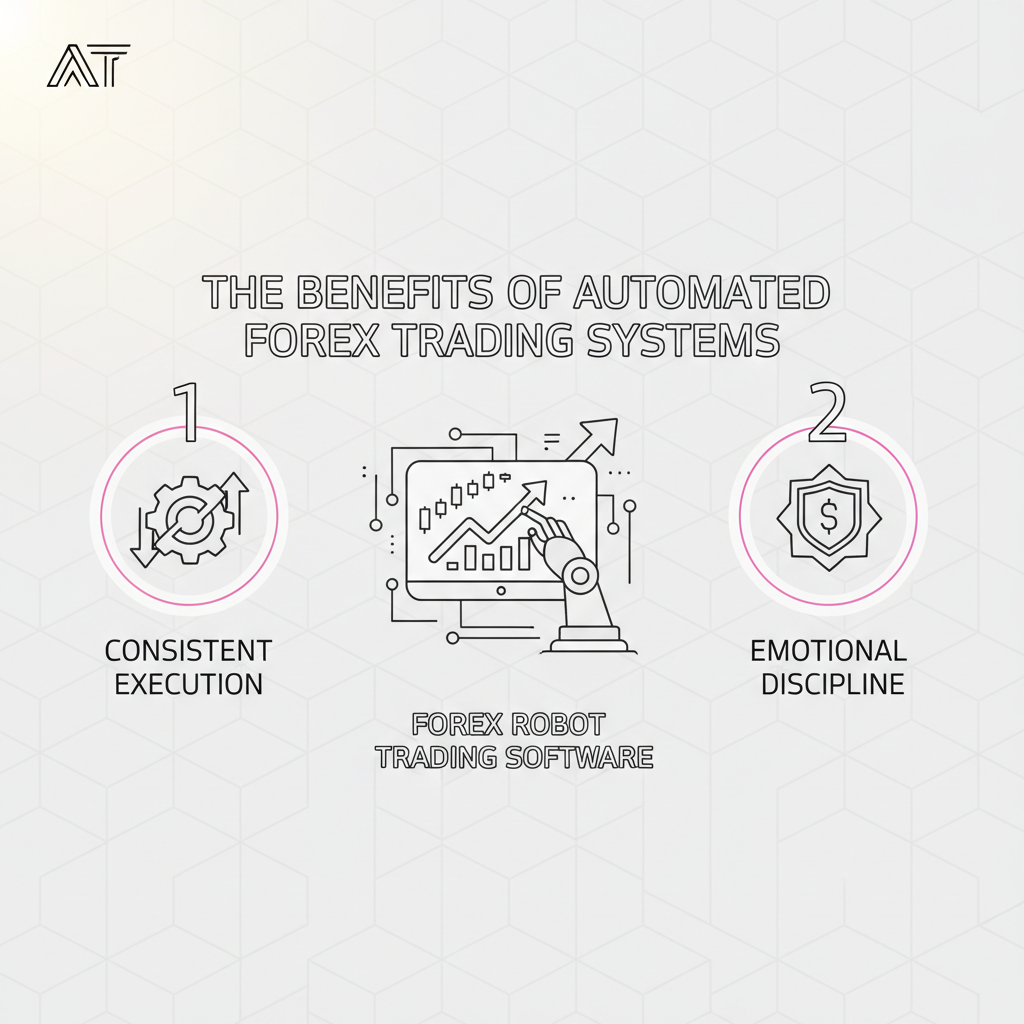
The hardest part of trading is not finding a setup.
It is watching a good setup appear, then vanish while you are asleep, at work, or just a little too slow on the trigger.
That is where automated trading forex starts to make sense.
A rule-based system can watch the market, place trades, and manage exits without the mood swings that usually creep into manual decisions.
The appeal is bigger than convenience.
The global FX market averaged $7.5 trillion in daily turnover in April 2022, according to the BIS Triennial Survey, and that kind of pace rewards speed, discipline, and constant attention.
That is also why forex trading robots keep getting attention from traders who are tired of revenge trades, late exits, and inconsistent position sizes.
The real trading software benefits show up when rules are followed the same way every time, even on a messy day.
Still, automation is not magic.
Slippage, spread changes, broker rules, and weak internet can turn a good idea into an expensive lesson if the system is careless.
What Automated Forex Trading Systems Are and How They Work
Ever wondered how a trade can fire while the trader is asleep, at work, or stuck in traffic? That is the basic appeal of automated trading forex systems.
At heart, these systems are rule-following programs.
They watch the market, compare price action to preset conditions, and place trades without needing a person to click every button.
The FX market is a huge place for that kind of machinery.
The BIS Triennial Survey reported $7.5 trillion in average daily global FX turnover in April 2022, which helps explain why speed, consistency, and nonstop monitoring matter so much.
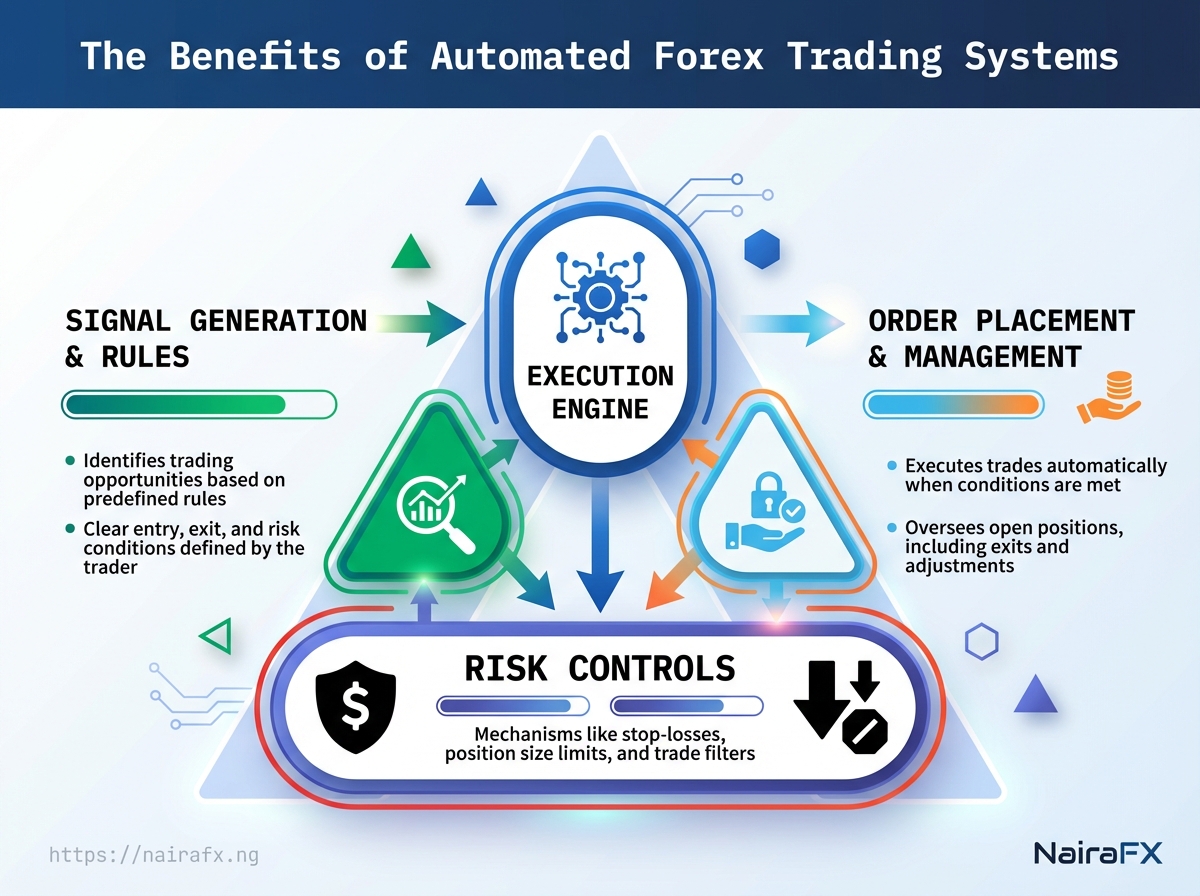
A working system usually has three parts:
- Rules: clear entry, exit, and risk conditions.
- Execution engine: the platform or API that sends orders.
- Risk controls: stops, size limits, and trade filters.
A forex trading robot does not “think” like a human trader.
It reads code, checks live prices against that code, and acts when the setup matches.
On MetaTrader 4, that logic usually sits inside an Expert Advisor written in MQL4.
MetaTrader 5 does the same job with MQL5, while cTrader Automate uses C# for strategy logic.
Interactive Brokers’ trading APIs can do something similar by connecting custom software to brokerage execution.
That diagram should feel simple on purpose.
Strategy rules come first, then signal generation, then order placement, and finally trade management.
It also shows why automation fits best inside a larger plan, not as a magic shortcut.
A robot can enforce discipline, but it still needs a trader to define the edge, set risk limits, and decide when the strategy no longer fits market conditions.
That is where the real trading software benefits show up.
Automation can help reduce emotional mistakes, keep position sizing consistent, and keep a strategy running through the 24/5 FX week, but it still faces slippage, spread changes, and broker execution quirks.
Used well, it acts like a tireless assistant.
Used badly, it just makes bad rules repeat faster.
Why Automation Appeals to Strategic Traders
Why do disciplined traders still build systems after they already know the chart? Because strategy breaks down fastest when a real position is on the line.
That is where automated trading forex starts looking attractive.
A well-built system follows rules the same way on Monday, Tuesday, and during the messy middle of a volatile session.
Emotion is the first thing it strips out.
No hesitation on entries, no revenge trades after a loss, no last-minute “maybe this one will bounce” guesswork.
The appeal is even clearer in a market that barely sleeps.
The BIS Triennial Central Bank Survey reported $7.5 trillion in average daily global FX turnover in April 2022, which shows how much price action and liquidity move through the market every day.
In that kind of environment, traders using forex trading robots or other rule-based systems want execution that stays steady when the market gets noisy.
Another reason is consistency across conditions.
A strategy coded in MetaTrader 4 (MT4), MetaTrader 5 (MT5), or cTrader Automate can apply the same logic during quiet Asian hours, fast London moves, or choppy news periods.
That matters because many manual traders change behavior when spreads widen or candles get wild.
A few advantages stand out:
- Less emotional drift: Orders follow pre-set rules, not mood swings or gut feel.
- More consistent execution: Entries, exits, and sizing stay tied to the plan, even when the chart looks ugly.
- More time for thinking: Research, trade review, and market planning get the attention they usually deserve.
- Cleaner risk control: Stops, size limits, and cooldown rules can be built into the system.
That time saving is underrated.
A trader who is not glued to every tick can spend more energy on review, journaling, and finding better setups instead of babysitting one position.
There is a catch, of course.
Automation does not erase slippage, spread changes, broker rules, or platform downtime.
Good trading software benefits come from discipline in design, not from a magical button.
For traders who want structure more than excitement, automation feels less like a shortcut and more like a way to protect the plan.
And in a market this large, that steadiness can be worth a lot.
Core Benefits of Automated Forex Trading Systems
Ever seen a clean setup disappear before your mouse click lands? That is where automated trading forex setups earn their keep.
In a market that reached $7.5 trillion in average daily turnover in April 2022, speed and consistency are not nice extras.
They matter.
The first obvious win is execution speed.
Forex trading robots can place an order the moment preset conditions appear, which helps in fast-moving pairs where a few seconds can change the entry price.
That matters on platforms like MetaTrader 4, MetaTrader 5, and cTrader Automate, where rule-based execution removes the lag between decision and action.
The second win is stamina.
FX runs almost around the clock from Sunday to Friday, and no trader stays sharp for every session.
Automation can watch the market through Asian drift, London volatility, and New York overlap without getting tired, bored, or distracted by lunch.
Then comes discipline.
A system does not second-guess itself after two losses or chase a candle out of frustration.
That kind of emotional distance is one of the real trading software benefits, especially when a strategy depends on strict entries and exits.
Risk control that stays consistent
| Automation Feature | What It Does | Trading Benefit | Best Use Case |
|---|---|---|---|
| Rule-based entry | Places trades only when preset conditions are met | Reduces impulsive entries | Trend-following strategies |
| Stop-loss placement | Attaches a stop at order time | Caps downside without manual intervention | Breakout and swing systems |
| Take-profit placement | Closes trades at a predefined target | Locks in gains before emotions interfere | Mean-reversion systems |
| Position sizing rules | Calculates lot size from account equity or fixed risk | Keeps each trade within defined risk | Any repeated-entry strategy |
| Max open trades | Limits simultaneous positions | Prevents overexposure during volatile runs | Grid and portfolio systems |
| Loss cooldown | Pauses new trades after a losing streak | Reduces revenge trading and overtrading | New or unstable strategies |
| Trailing stop logic | Moves the stop as price moves favorably | Protects profit while leaving room to run | Trend-following setups |
| Session filters | Trades only during chosen market hours | Avoids thin-liquidity periods and poor fills | London/New York session systems |
| Spread filter | Blocks entries when spreads widen too far | Avoids expensive entries during spikes | Scalping systems |
| Equity stop | Stops trading after a set daily loss or drawdown | Prevents one bad day from becoming a bigger one | Live accounts with strict limits |
The strongest forex trading robots are not just fast; they are picky, disciplined, and boring in the best way.
They keep risk rules in place when a human trader would be tempted to “just take one more trade.”
That steadiness is the real edge.
When the market gets noisy, the system keeps doing the same job the same way.
How Automated Trading Can Help Nigerian Traders in Volatile Markets
What happens when price jumps five minutes after a big headline, and you are nowhere near the screen? That is where automated trading forex setups start to earn their place.
A good system does not panic.
It follows pre-set rules for entries, exits, and position size, even when spreads widen or candles get messy.
That matters in fast markets because the trader is no longer trying to react in real time with shaky judgment or delayed clicks.
It also brings order to noisy news days.
Instead of guessing whether a central bank comment, oil move, or dollar burst will stick, the strategy only acts when its conditions line up.
That is one of the clearest trading software benefits: the plan stays the same when the room gets loud.
- Sudden swings: A robot can close trades, trail stops, or skip new entries when volatility jumps past a set threshold.
- Noisy news flow: It can wait for confirmation rules instead of chasing every headline or social media rumor.
- Busy or unstable schedules: It keeps running when a trader is sleeping, commuting, or dealing with patchy power.
The bigger advantage for Nigerian traders is simple.
Many trading opportunities do not wait for a stable schedule, a perfect office setup, or a quiet evening.
Platforms like MT4, MT5, and cTrader Automate handle these rule sets well, and brokers with API access, such as Interactive Brokers, make the execution side more flexible for builders who code their own logic.
On a demo account, a trader can watch a robot handle a news spike without freezing up or doubling down out of frustration.
The demo clip below shows that kind of setup in action during a volatile session.
It is a useful way to see how a forex robot behaves when the market speeds up and the clock is not on your side.
For traders dealing with power cuts, unstable internet, and packed schedules, this is where automation becomes practical, not flashy.
It does not remove risk, but it helps the plan survive the kind of chaos that manual trading often stumbles over.
What to Check Before Using a Forex Trading Robot
Would you trust a robot with real money before checking whether it understands the rules of the road?
That question matters, because not every system sold as automated trading forex is built the same way.
A serious setup should tell you exactly how it makes decisions, whether it runs as an MT4 Expert Advisor, an MT5 EA, a cTrader Automate strategy, or something connected through the Interactive Brokers Trading API.
The rules need to be plain.
In automated trading forex, vague logic is a warning sign, especially when the backtest looks polished but the inputs are hidden.
Execution deserves the same scrutiny.
The BIS Triennial Survey reported average daily global FX turnover at $7.5 trillion in April 2022, and that scale is exactly why spreads, slippage, and broker fill quality matter so much.
Broker notes and reviews on https://nairafx.ng can be useful when you are comparing those execution details.
Risk controls should read like a seat belt, not a sales pitch.
Good forex trading robots define stop-loss rules, trade frequency limits, and drawdown caps before the first live trade ever lands.
Red flags worth checking
If those pieces are missing, the equity curve is just decoration.
For Nigerian traders, the real test is whether the robot still behaves when spreads widen, fills slow down, or the platform connection blips.
That is where real trading software benefits show up, not in the demo screenshots.
A careful check takes minutes, not days, and it saves a lot of expensive curiosity.
The best forex trading robots are the ones that stay understandable when the market stops being polite.
Limits, Risks, and Common Misunderstandings
Can a forex robot really “think” for you? Not quite.
It can follow rules fast, but it still has no feel for regime shifts, broker quirks, or the messy parts of live markets.
That matters more than people admit.
The FX market is huge — the BIS Triennial Survey reported average daily global turnover of $7.5 trillion in April 2022 — yet size does not make every strategy safe.
In a market that liquid, small execution mistakes can still add up fast.
A lot of automated trading forex setups look brilliant in backtests because the past is tidy.
Live trading is not tidy.
A clean equity curve in MetaTrader 4, MetaTrader 5, or cTrader Automate can hide fragile assumptions, especially when spreads widen or fills slip.
- No robot replaces market judgment: A system can obey an entry rule, but it cannot tell you when a central-bank comment changes the mood. Manual context still matters when headlines, local liquidity, or broker execution conditions shift.
- Overfitting is the sneaky one: A strategy can be tuned so tightly to past data that it learns noise instead of structure. In plain English, it performs beautifully on history and then falls apart once the live market stops looking like the test set.
- Manual review still earns its keep: Even good forex trading robots need human checks for drawdowns, order quality, and rule drift. A weekly review of trades, spreads, and rejected orders often catches problems before they become expensive habits.
- Execution risk never disappears: Slippage, changing spreads, broker policies, and connectivity problems can distort results even when the logic is solid. Automated systems reduce emotional mistakes, but they do not erase platform or broker risk.
- Risk controls need supervision: Stops, sizing rules, and trade limits only help when they are implemented correctly. A broken input, a coding bug, or a bad parameter can turn “protection” into exposure.
A useful habit is to treat automation as a disciplined assistant, not a replacement brain.
Platforms like https://nairafx.ng can help traders think more carefully about risk, testing, and broker choice before trusting any live setup.
That mindset keeps the trading software benefits real and grounded.
Robots can execute the plan, but the trader still has to understand the plan.
How to Build a Practical Approach to Automation
A practical automation plan starts with restraint, not ambition.
In a market that recorded about $7.5 trillion in average daily FX turnover in April 2022, the scale is massive, but your first job is still simple: prove that your system behaves well before real money touches it.
That is why a demo account comes first.
It lets you see whether your rule set actually works inside live market conditions, including spreads, execution delays, and platform quirks, without paying for mistakes.
Start on demo, then narrow the gap
Demo trading should not feel like a toy.
Treat it like a rehearsal with a scorecard.
- Run the exact rule set: Use the same entries, exits, lot sizes, and risk caps you would use later. If the demo version is “loosely based” on the real plan, the results will mislead you.
- Set sane targets: Aim for consistency in execution before chasing a big win rate. A system that loses less often on bad weeks and keeps drawdown controlled is usually more useful than one flashy month.
- Track the conditions: Note spreads, session times, and any platform interruptions. Forex trading robots often look best in clean backtests, then behave differently when real market noise shows up.
Give the system a scorecard
Goals work best when they are boring and specific.
A practical target might be a modest win rate, a drawdown ceiling you can actually sleep with, and a rule that the strategy must behave similarly across several weeks.
That last part matters more than most traders admit.
A strategy that only looks good in one perfect stretch is not a strategy yet; it is a lucky screenshot.
- Review weekly and monthly: Weekly reviews catch execution drift fast. Monthly reviews show whether the edge is real or just random noise.
Keep a human journal beside the automation
A trading journal still matters when the orders are machine-made.
Record why the system was turned on, what changed, and whether you overrode any rule.
That extra layer helps separate system problems from operator problems.
It also makes the real trading software benefits easier to measure, because you can see whether automation improved discipline or just shifted the mistakes around.
A clean routine beats a clever one.
Start in demo, measure only what matters, and keep notes that a future-you can actually read.
Turning Automation Into a Trading Discipline
The smartest use of automated trading forex is not to chase constant signals.
It is to turn a solid plan into consistent action, especially when emotion, fatigue, or fast-moving markets get in the way.
That is why forex trading robots only work well when the rules behind them are realistic, tested, and built for the market you actually trade.
The biggest point to remember is simple: automation amplifies whatever you feed it.
A well-built system can catch a setup while you are asleep, but a loose system can also repeat mistakes with machine-like speed.
That matters even more for Nigerian traders, where volatility, spreads, and broker quality can change the outcome long before a trade reaches target.
The trading software benefits are real when they protect discipline, save time, and make risk easier to measure. Before putting any robot live, test it on a demo account or with very small size and check how it behaves during drawdowns, news spikes, and quiet sessions. If you want a deeper look at strategy testing, risk control, and broker research, resources like nairafx.ng can be a useful place to start today.