

What usually kills a Forex account isn’t that your entry was “wrong”—it’s that your loss handling wasn’t defined.
A Forex risk management plan acts like the rules of the road: it tells you exactly how much you can lose, where the trade is invalid, and when you must step away.
With no boundaries, a small execution problem (widening spreads, slippage, or a quick news spike) can push you into over-sizing, late exits, or “one more trade” thinking.
When you do have a plan, emotions still show up—but they can’t change the numbers. Your position sizing, stop placement, and exposure stay tied to logic, not pressure.
That’s especially important in fast-moving forex conditions where spreads widen and price can shift quickly. Risk control won’t remove uncertainty, but it keeps uncertainty from becoming account damage.
Quick Answer: An effective Forex risk management plan turns uncertainty into fixed rules. It defines: – Loss limits (risk per trade plus daily/weekly caps) – Position sizing (so your lot size matches your stop distance and the account size) – Exit logic (clear stop-loss placement based on structure, plus take-profit aligned to a risk-to-reward target) – Execution/pause rules (how you handle spread/slippage and when you stay flat around high-impact news) The goal is simple: even if the market moves against you, your plan controls the damage and keeps your decision-making consistent.
What if your best trade still loses money because the risk plan was weak?
A perfect entry can still derail your week.
The market doesn’t care that the setup looked clean. If your position is too big, your stop is too wide (or placed emotionally), spreads widen, or a news event moves price faster than your execution, a trade that looked controlled on paper can turn messy in seconds.
That’s where a Forex risk management plan earns its value: it doesn’t predict outcomes—it limits damage and stops one mistake from turning into a chain reaction.
A strong plan helps you:
- prevent a single loss from becoming a loss of focus,
- stay consistent even when conditions get ugly,
- and keep your account alive long enough for your edge to matter.
For example, even if you correctly read GBP/USD ahead of a central bank event, oversizing can make a small execution problem (like slippage) far more damaging than the chart movement you expected.
So the real question isn’t “Was the prediction right?” It’s “Was the risk framework robust enough for that environment?”
Next, you’ll define the exact boundaries—risk-per-trade, daily/weekly limits, allowed instruments/hours, and how you handle news—so every trade starts with the same damage control logic.
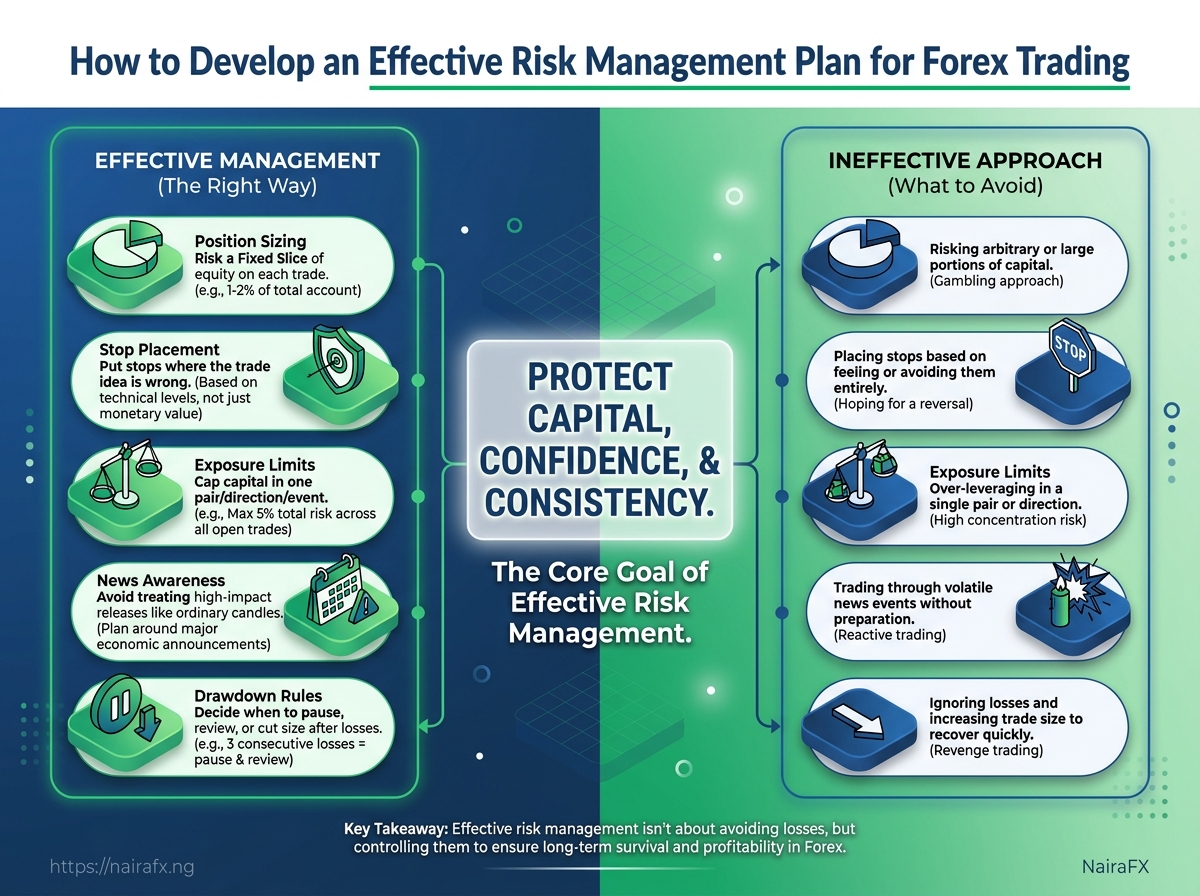
Start with the core rules of your trading risk mitigation framework
A trader can be right on direction and still get wiped out by sloppy rules.
That usually happens when the plan starts with entries instead of boundaries.
A proper Forex risk management plan begins before the chart even matters.
It sets the damage limit first, then decides which setups deserve attention at all.
That order saves a lot of grief.
It also makes developing a risk management plan feel less like guesswork and more like a set of hard guardrails you follow every day.
Trading rules checklist
| Risk Rule | What It Means | Example |
|---|---|---|
| Risk per trade | Decide the most you can lose on one position without hurting the account. | Risk 1% of a ₦500,000 account, so the max loss is ₦5,000 on that trade. |
| Maximum daily loss | Set a hard stop for the day so one bad stretch does not turn into revenge trading. | Stop trading after losing 3% of equity in a session. |
| Maximum weekly loss | Limit damage across several sessions, not just one day. | Pause new trades after a 5% weekly drawdown. |
| Allowed instruments | Trade only the markets you understand well enough to assess properly. | Focus on major FX pairs and skip thin, unpredictable exotic pairs. |
| Trading hours | Define the hours when you are sharp and when spreads are usually manageable. | Trade only during London and New York overlap if that fits your strategy. |
| News trading rules | Decide whether you will trade around major announcements or stay out. | Avoid opening new positions 15 minutes before CPI or central bank decisions. |
| Correlated exposure cap | Do not stack several trades that all depend on the same currency or theme. | Treat EUR/USD and GBP/USD as linked risk, not two separate bets. |
| Consecutive loss stop | Step away after a run of losses so emotions do not take over. | Stop after three losses in a row and review the setup quality. |
A trader who knows the daily cap, weekly cap, and allowed instruments has fewer chances to improvise badly.
They also make trade selection cleaner.
When the market is messy, your framework already says no, which is often the smartest trade of the day.
A good framework also respects changing conditions.
Quiet ranges, fast breakouts, and news-heavy sessions all demand different behavior, so your rules should name the environments you will trade and the ones you will skip.
The real win here is consistency.
Once these limits are fixed, every entry gets judged by the same standards, and that is where trading risk mitigation starts paying off.
Build the plan around each trade, not just the account
A 50-pip setup needs a different plan than a 15-pip scalp, even if both come from the same Forex risk management plan.
That is where many traders slip: they size every position the same way, then act surprised when one trade hits harder than the rest.
Each setup should carry its own math.
The account matters, of course, but the trade itself decides the stop distance, the lot size, and the exit target.
Position size should come first. If you already know how much of the account you are willing to lose, the lot size becomes a math problem, not a guess.
That keeps trading risk mitigation tied to exposure, not emotion.
A simple way to think about it is this: if the stop is wider, the position must be smaller.
If the stop is tighter, the position can be a little larger, but only if the setup still makes sense structurally.
Structure should set the stop-loss. Put the stop beyond the price level that proves the idea wrong, not at a number that merely feels comfortable.
A stop tucked inside random market noise usually gets clipped for no good reason.
> When the stop belongs to the chart, the trade has room to breathe. When it belongs to fear, the trade usually dies early.
The take-profit should also be planned before entry, not improvised after price starts moving.
A target that matches your risk-to-reward rule forces discipline, because the trade either offers enough room or it does not.
For example, if the stop risks 40 pips, a 1:2 target needs 80 pips of realistic space ahead.
If the next resistance sits only 35 pips away, the setup is weak, no matter how good the entry looks.
That is why developing a risk management plan works best trade by trade.
The account sets the ceiling, but the setup decides the size, stop, and target.
For traders building a trading risk mitigation routine, this habit removes a lot of noise.
We keep coming back to the same idea: one clean plan per trade beats one vague rule for the whole account.
Match your risk plan to the realities of the Nigerian trading environment
A clean trading plan can fall apart fast when the real world gets messy.
In Nigeria, that often means wider spreads, shaky internet, power cuts, and brokers that do not behave the same way during fast markets.
That is why developing a risk management plan has to account for local conditions, not just chart patterns.
A Forex risk management plan that looks perfect on paper can still fail if execution slows down during a news spike or your platform freezes at the wrong moment.
The smartest trading risk mitigation approach starts by assuming friction will show up.
That means planning for worse spreads, slippage, and a few ugly moments when you cannot react as quickly as you want.
Compare common risk controls in different market conditions
| Risk Control | Best Used When | Main Benefit | Main Limitation |
|---|---|---|---|
| Fixed lot sizing | You want simple, repeatable execution in calm markets | Easy to apply and keeps decision-making quick | Ignores changing volatility and account growth |
| Percentage risk model | You want each trade to risk the same share of equity | Keeps losses proportional as account size changes | Position size can still feel too large in high volatility |
| Volatility filter | Price is moving erratically or spreads are widening | Helps avoid entries during unstable conditions | Can reduce trade frequency and miss valid setups |
| News pause rule | Major data releases or central bank events are near | Protects against sharp whipsaws and surprise gaps | Can keep you out of strong breakout moves |
| Daily loss cap | You have had a rough session or several losses in a row | Stops emotional revenge trading and damage spirals | Requires discipline when the market still looks tempting |
| Trailing stop | A trade has moved in your favor and momentum is still alive | Locks in profit while leaving room for continuation | Can be hit too early in noisy conditions |
During quiet hours, fixed sizing or a percentage model may be enough.
Around major news, though, a volatility filter or news pause rule usually makes more sense.
Power and internet issues deserve the same respect.
A trader using a mobile hotspot, backup device, and pre-set exits is simply trading with fewer weak points than someone hoping the lights stay on.
A solid plan also changes with the session.
London open, New York overlap, and major red-news releases all demand different limits on spread, size, and patience.
At NairaFX, we treat those local frictions as part of the trade, not an afterthought.
That is where a real trading risk mitigation plan starts to feel useful instead of theoretical.
Track performance so the plan improves over time
A trading plan only starts earning its keep after a few dozen trades.
That is when the habits show up, including the sloppy exits, the revenge trades, and the moments when a clean setup turns ugly because risk rules slipped.
A good journal turns those messy patterns into something you can actually fix.
When we talk about developing a risk management plan, this is the part many traders skip, then wonder why the same mistake keeps coming back in different clothes.
The useful part is not just recording wins and losses.
It is comparing drawdown, win rate, and risk-to-reward ratio together, so the whole Forex risk management plan tells a clear story instead of three separate ones.
Use the journal like a mirror
A trading journal should catch repeated risk mistakes, not just entry ideas.
If the same error shows up three times in two weeks, that is a system problem, not bad luck.
That is where trading risk mitigation gets practical.
You are no longer guessing whether your plan is too loose or too tight, because the journal shows the pattern in black and white.
- Repeated overrisking: Position size creeps up after a few wins, then one loss wipes out the progress.
- Early exits on winners: The setup works, but profits are cut too soon, which weakens the risk-to-reward profile.
- Holding losers too long: The stop is there on paper, but the journal shows it is being ignored in real trading.
Read the numbers together
A strong win rate can still hide a weak plan.
A trader might win 65% of the time and still lose money if the average loss is much larger than the average gain.
That is why win rate should never be read alone.
Pair it with max drawdown and risk-to-reward ratio, then check whether the equity curve rises steadily or spikes up and down like a broken metronome.
Watch for aggression signals
Certain metrics usually shout before the account does.
If max drawdown keeps deepening, the plan may be too aggressive.
If average position size keeps rising while the equity curve stays flat, something is off.
If your losing streak is normal but the account feels fragile, the risk per trade is probably too high for the strategy.
A few simple checks help:
- Drawdown grows faster than equity: The plan is taking too much heat.
- Losses cluster after size increases: Position sizing is drifting beyond the script.
- Good setups fail to recover losses: Risk is eating the edge before it can compound.
The best plans are not the ones that look perfect on day one.
They are the ones that improve because the journal keeps telling the truth.
A trading plan becomes truly useful only after you can follow it when you’re tired, rushed, or dealing with messy conditions.
That’s why you need a weekly routine—not just a set of rules. Your job is to make the right decision the easiest decision.
Here’s a simple weekly loop you can run every week:
- Run a pre-trade checklist before every entry.
- Review the week at the same time each week.
- Look for patterns, not isolated losses.
- Trim the rules until they’re easy to execute.
A checklist that takes seconds is the one you’ll actually use—on good days and rough ones. If you can follow it when conditions are uncomfortable, you can scale from there.
What is the 3 5 7 rule in forex?
The 3-5-7 rule is not defined in the provided risk management content. What is emphasized instead is a structured Forex risk management plan with predefined risk-per-trade limits, clear stop-loss placement, and rules to stay flat during high-impact events to prevent one bad trade from triggering a chain reaction.
What is the 3 6 9 rule in trading?
The 3-6-9 rule is not specified in the provided material. The content focuses on practical risk controls: decide a maximum you can lose per trade, set hard boundaries for exits, apply daily/weekly caps, and account for real-world execution issues like wider spreads and slippage during fast news-driven moves.
What is the 3 5 7 rule in risk management?
The provided material does not state a “3-5-7 rule” for risk management. It instead teaches a guardrail-based approach: set your damage limit first, then size the position mathematically based on stop distance, and use conditions to pause trading when volatility or execution risk (spreads, slippage, platform freezes) rises.
What is the maximum drawdown in forex?
A specific maximum drawdown percentage is not given in the provided content. Rather than quoting a number, the guidance is to control drawdown by limiting damage per trade (risk-per-trade), using daily/weekly caps, and preventing oversized or emotionally placed stops from turning a single loss into multiple losses.
What is the best trading strategy in 2026?
The content does not name a “best trading strategy” for 2026. It focuses on what makes any strategy survivable: a repeatable risk management plan, position sizing based on each trade’s stop distance, predefined exits, and friction-aware rules for conditions common in Nigeria such as wider spreads, power cuts, and slippage during news spikes.
The Trade That Survives the Week
The strongest lesson here is simple: a good entry means very little if the risk plan is sloppy.
In a fast market, the real danger is not one bad trade, but the way that trade pushes you into revenge entries, wider stops, and bigger losses.
A solid Forex risk management plan keeps that chain from starting in the first place.
That was the point of thinking trade by trade instead of staring only at the account balance.
When position size, stop loss, and daily loss limits are set before the order goes in, trading risk mitigation stops being a mood and starts being a habit.
In the Nigerian market, where spreads can widen and news can move price hard, that habit matters even more.
Write your one-page risk plan today. Set your maximum risk per trade, your daily limit, and the exact rule for when you stop trading for the day.
Then review your last 10 trades and check whether the plan was followed before the market was blamed; that review often reveals more than a dozen new indicators ever will.
If that process feels harder than it should, our own risk management and equity-curve review work can help sharpen the edges.