


A trade can look perfect at entry and still go badly by noon.
That is usually where risk management forex stops being theory and starts saving accounts.
The trap is leverage.
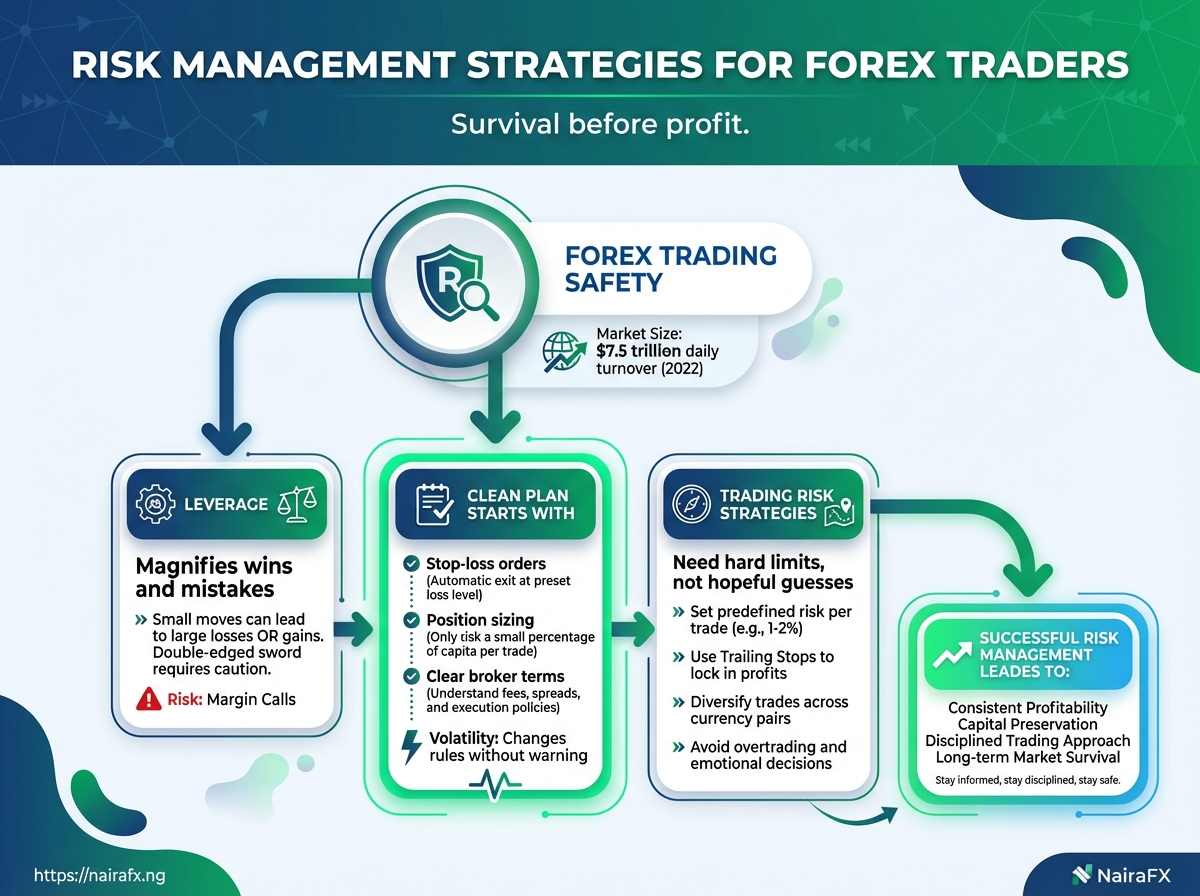
It turns small price moves into big wins, but it also magnifies every mistake, especially when spreads widen or news hits fast.
In the forex trading safety conversation, that matters more than entry signals, because survival comes before profit.
Even the biggest market in the world can bite.
The BIS reported average daily FX turnover at $7.5 trillion in 2022, yet deep liquidity does not stop sudden dislocations, slippage, or ugly gaps.
That is why trading risk strategies need hard limits, not hopeful guesses.
A clean plan usually starts with stop-loss orders, position sizing, and a clear view of broker terms.
It also means respecting the difference between calm markets and the moments when volatility changes the rules without warning.
Why Risk Management Matters More Than Market Predictions
A trader can be right about direction and still lose money fast.
That happens when the position is too large, the stop is vague, or the broker setup leaves too much room for slippage.
Risk management forex is really about survival first.
It sets the rules for how much can be lost on one trade, how the trade gets cut if it goes wrong, and how much exposure a trader can carry before the account starts to wobble.
That matters even more in FX, where conditions can change in a blink.
The BIS reported average daily global FX turnover at $7.5 trillion in 2022, which shows how deep the market is, but depth does not stop sharp dislocations.
ESMA’s retail CFD rules also show how seriously regulators treat loss control, with leverage caps such as 30:1, 20:1, and 10:1 for different FX pairs.
- Position size: Keep each trade small enough that one bad move does not damage the whole account.
- Stop-loss use: Define the exit before entry, so the loss stays bounded instead of growing quietly.
- Margin awareness: Know how much room the trade needs, especially when volatility jumps.
Even strong trade ideas fail without this shield.
A clean setup on the chart can still hit spread widening, slippage, or a sudden news spike.
Nigerian traders often make the same three mistakes when they rush.
They risk too much on the first few trades, they widen stops after entry, and they treat a winning streak like proof that discipline is optional.
The chart below shows where that process usually breaks.
It traces a trade from setup to exposure, then to the point where risk control either saves the account or lets the loss run.
Pay attention to the decision points, not just the entry signal.
That is where forex trading safety lives, and it is where most trading risk strategies either hold up or fall apart.
A trade does not need to be perfect.
It needs to be controlled.
That habit protects capital when the market gets noisy, which it always does eventually.
Core Risk Management Strategies Every Trader Should Use
What actually keeps one bad trade from wrecking a month? Usually, it is not some fancy indicator.
It is a set of dull, disciplined rules that cap damage before the market has a chance to get clever.
In practice, the strongest trading risk strategies are simple enough to repeat on a tired Tuesday.
They also fit real-world forex trading safety better than the “I’ll just watch it closely” approach, which tends to age badly.
On global FX markets, where daily turnover was about $7.5 trillion in 2022 according to BIS data, speed and liquidity do not save sloppy execution.
Position sizing comes first.
A fixed percentage model keeps one trade from becoming an emotional disaster, which is why many traders cap risk at a small slice of equity and keep that number unchanged after losses.
Tools such as https://nairafx.ng often frame this around Nigerian market conditions, where spread changes and broker terms can make oversized trades feel even heavier.
Stop-loss placement needs structure, not hope.
If the level is below recent support for a long trade, or above recent resistance for a short one, it has a reason to exist.
That matters more than placing a stop at some random round number because it “feels safe.”
A trade should also earn its place on the screen.
If the upside is too small compared with the risk, the setup is probably just noise dressed up as opportunity.
ESMA’s retail CFD leverage caps, such as 30:1 for major FX pairs and lower limits for smaller pairs, exist for a reason: leverage makes weak decisions expensive very quickly.
Daily risk control methods
| Risk Method | Best Used For | Main Benefit | Common Mistake | Example Use Case |
|---|---|---|---|---|
| Fixed percentage risk per trade | All trading styles | Protects the account from oversized losses | Changing the percentage after losses | Risking 1% on each trade |
| Stop-loss orders | Intraday and swing trades | Limits downside on every position | Placing stops too close to entry | Setting a stop below recent support |
| Risk-to-reward filter | Strategy selection | Helps avoid low-quality trades | Taking trades with poor upside potential | Only entering at 1:2 or better |
Stop-loss placement keeps the chart honest.
The risk-to-reward filter keeps your trade list honest, which is often the hardest part.
A lot of traders want more signals when they really need more restraint.
The cleaner habit is to check each trade against these three controls before clicking buy or sell.
That is where consistent risk management forex practices start looking less like theory and more like survival.
How to Build a Personal Trading Safety Plan
What happens when a trade setup looks perfect and still goes sideways fast? That is usually the moment a safety plan earns its keep.
A good forex trading safety plan is not about predicting the next move.
It is about making sure one messy session does not spill into the rest of the week.
The best plans are boring on purpose.
They set a daily loss limit, a weekly risk cap, and clear rules for how much of the account can go on one trade.
That matters even more in FX, where the BIS reported $7.5 trillion in average daily turnover in 2022.
Huge market, yes.
Calm market, not always.
Daily and weekly limits keep emotion out. A daily loss cap stops revenge trading after a bad start.
A weekly cap gives you room to step back before small mistakes turn into a full-blown account problem.
Risk should fit the account, the pair, and the style. A position trader holding longer swings needs a different safety margin than a fast intraday trader.
A volatile pair also needs more breathing room than a quiet one.
Journals expose the habits that hurt. If the same mistake keeps showing up, the problem is rarely the market.
It is usually a rule that sounds good on paper but breaks under pressure.
A simple pre-trade risk checklist
| Check Item | Why It Matters | Pass/Fail | Notes |
|---|---|---|---|
| Entry level is clear | Prevents emotional entries | Pass if the exact price or condition is written down before the order; fail if you are chasing the candle. | Note the setup quality and whether the trigger is still valid. |
| Stop-loss is placed | Defines maximum loss | Pass if the stop sits in the order plan before entry; fail if you plan to “watch it closely.” | Record the stop location and the reason for it. |
| Risk size fits account rules | Protects capital | Pass if the lot size stays inside your preset risk cap; fail if the size feels “too good to miss.” | Write the risk amount in account currency. |
| Reward potential is strong enough | Supports better trade selection | Pass if the target still makes sense after costs; fail if the upside barely covers the risk. | Note the target zone and the reward-to-risk logic. |
| Market volatility is understood | Helps avoid bad sizing | Pass if recent movement matches your plan; fail if the pair is moving far wider than usual. | Check whether the stop needs more room. |
| News risk is checked | Reduces gap and slippage surprises | Pass if major releases are known; fail if you forgot the calendar. | Mark high-risk times before entry. |
| Correlated exposure is reviewed | Stops hidden overexposure | Pass if you are not stacking the same bet across similar pairs; fail if several trades move together. | Note related pairs or indices. |
| Broker conditions are acceptable | Protects execution quality | Pass if spreads, margin, and order rules are known; fail if the setup depends on perfect fills. | Record any broker quirks or limits. |
After a few weeks, you start seeing patterns like oversized entries on Fridays or sloppy trades taken right before news.
That is where risk management forex becomes real, because it starts changing behavior instead of just decorating a notebook.
The best trading risk strategies are simple enough to repeat when you are tired.
If a trade does not pass the checklist, it is not a no forever.
It is just a no for now.
Tools, Habits, and Examples That Make Risk Control Easier
Why does the same trade feel safe on Tuesday and reckless on Friday?
A lot of it comes down to tools and timing.
A lot size calculator strips out guesswork, because it turns account size, stop distance, and acceptable loss into a position size you can actually live with.
A written trading plan does the same thing for decisions.
It stops the usual drift into “just this once” thinking, which is where a lot of forex trading safety habits quietly fall apart.
Make the numbers do the work
A trader with a $1,000 account and a 2% risk cap is not “feeling cautious.” They are setting a hard ceiling of $20 before the trade even starts.
That matters more than most people think.
The BIS Triennial Survey reported average daily global FX turnover at $7.5 trillion in 2022, which tells you the market is deep, but not smooth.
Deep markets can still whip around during headlines.
- Lot size calculator: Sets position size from risk, not emotion.
- Trading plan: Fixes entry, stop, target, and what invalidates the setup.
- News calendar: Keeps you from opening fresh risk right before a major release.
- Broker rules check: Helps you understand spread changes, margin changes, and execution conditions.
> ESMA’s retail CFD rules still point to leverage caps of 30:1 for major FX pairs, 20:1 for non-major pairs, and 10:1 for exotic pairs, which shows how seriously regulators treat retail loss control.
Treat news days differently
A payroll release or central bank statement can turn a calm chart into a mess.
Stops may slip, spreads can widen, and fills can arrive far from the price you expected.
That is why trading around scheduled news needs a different playbook.
Many traders either reduce size, wait for the first move to settle, or skip the setup entirely.
A safer EUR/USD example
Picture a trader planning EUR/USD before the London session.
The safer version uses a small position, a pre-set stop beyond a real chart level, and a target that makes sense relative to recent movement.
The riskier version is easy to spot.
Bigger size, no fixed stop, and a hope-driven entry right before a surprise ECB headline.
A practical routine looks like this:
- Check the calendar for news within the next few hours.
- Measure the stop distance before entering.
- Use the lot size calculator to match the stop to account risk.
- Confirm the trade still makes sense if spread widens.
- Walk away if the setup depends on luck.
That is the difference between a trade and a gamble.
Good trading risk strategies do not remove uncertainty, but they make it much easier to survive it.
How to Keep Improving Without Taking Bigger Risks
Why do some traders get better and somehow get more fragile at the same time? Usually, they start adding size before the edge is real.
The safer path is boring, but it works.
Review losses, measure whether the setup still has value, then improve one small decision at a time.
That matters even in a market as deep as FX.
The BIS put average daily global turnover at $7.5 trillion in 2022, but deep liquidity does not erase slippage, gaps, or bad habits.
Treat every loss like a note, not a verdict
A losing trade should answer a few simple questions: Was the setup valid, was the exit plan followed, and did the market change fast? If those answers are clear, the loss becomes useful data instead of emotional fuel.
That mindset keeps forex trading safety intact.
It also stops the ugly spiral where one bad trade turns into another because the account feels “due.”
- Check the setup first: Was the trade taken for a real reason, or just because price moved?
- Check the execution second: Did the stop, entry, or position size drift from the plan?
- Check the market third: Was there a news spike, spread jump, or sudden volatility shift?
Prove the strategy before adding size
A strategy is not ready for bigger size just because it had two nice weeks.
It needs a track record across different conditions, including dull ranges and fast breaks.
That is where risk management forex becomes practical.
Tools such as https://nairafx.ng can help traders stress-test ideas with Monte Carlo simulation before they scale up.
- Track expectancy: Look at average win, average loss, and how often the setup works.
- Watch drawdown: A profitable method can still be unusable if the equity dips too deep.
- Increase slowly: Raise size only after the strategy survives enough trades to mean something.
Win with small repeatable decisions
Consistency usually comes from tiny choices done well, not from one brilliant trade.
The trader who uses the same entry filter, the same risk cap, and the same review routine tends to stay steadier.
This is the quiet side of trading risk strategies.
It is less glamorous than finding the next big setup, but it protects capital while the edge matures.
- Use one checklist: Keep entries and exits tied to the same process.
- Keep a trade log: Write down the reason for entry, exit, and emotion.
- Standardize review time: Look at trades at the same time each week.
Improvement without bigger risk is a patience game.
The account usually grows faster when the process gets tighter, not when the position size gets reckless.
Trading With Guardrails, Not Guesswork
The smartest traders do not try to predict every move.
They build guardrails that keep one bad session from turning into a blown account, and that is where risk management forex becomes the real edge.
A solid plan with position limits, stop losses, and a clear daily loss cap protects both capital and confidence when the market gets messy.
That mattered most in the earlier example of a trade that looked perfect at entry and still went wrong by noon.
Price action can change fast, especially when leverage is doing the heavy lifting, so forex trading safety is less about being right and more about surviving long enough to stay in the game.
Strong trading risk strategies do not remove losses, but they make losses small enough to recover from without panic.
Set one hard rule today: decide the maximum amount you can lose on a single trade and on a single day, then write it down.
If you want a deeper look at how Nigerian traders can stress-test those rules against real market conditions, tools like nairafx.ng can be a useful place to explore.
The best next move is simple: review one open or planned trade and check whether it still fits your risk limits before you place another order.