
A bad entry is annoying.
A bad position size can wipe out a week, especially when the market moves fast and your account has no room for error.
That is why so many common forex mistakes are not about bad luck.
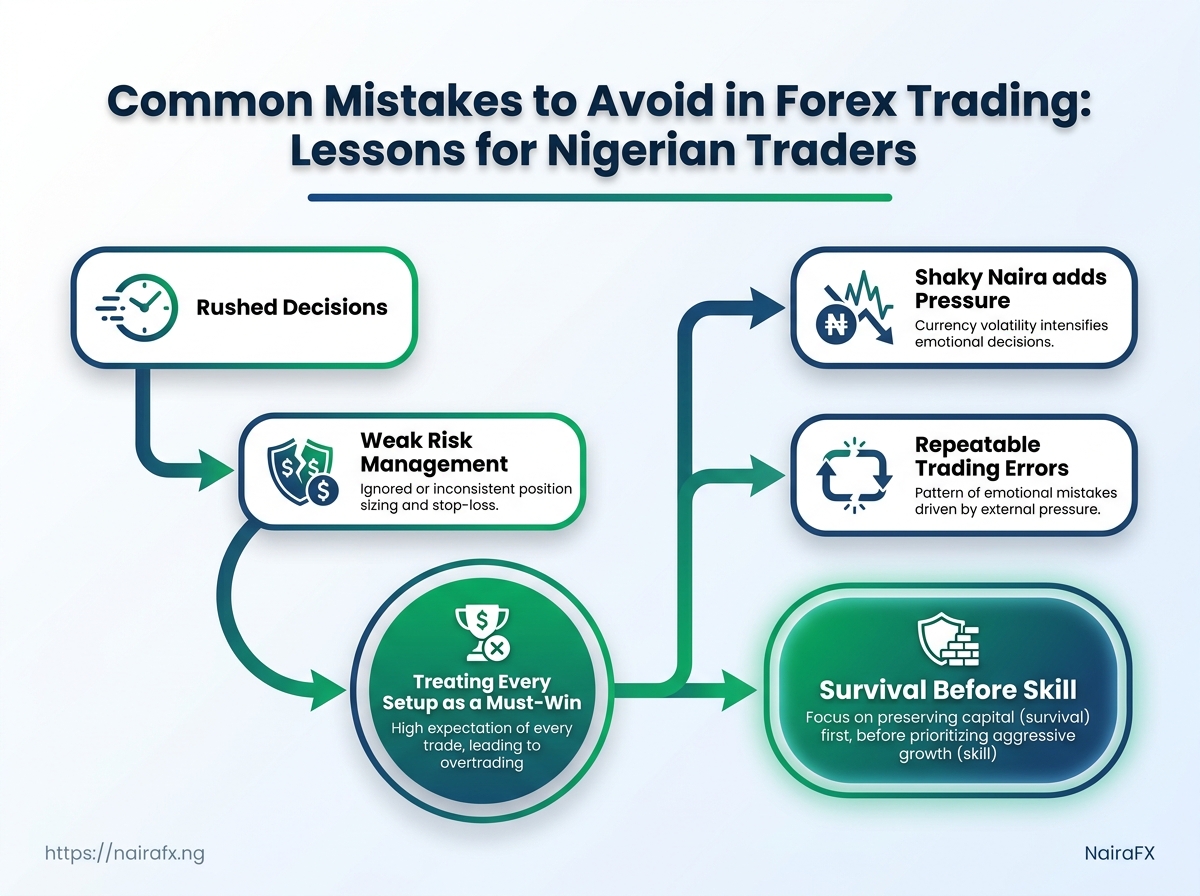
They usually come from weak risk management, rushed decisions, and a habit of treating every setup like it must work.
Nigerian traders feel this even more when the naira is shaky, emotions run hot, and the urge to “make it back” creeps in.
The painful part is that most trading errors are repeatable.
A trader opens too large, skips a trading plan, or ignores the cost of spreads and slippage, then calls it a bad month instead of a bad habit.
Those forex trading lessons matter because survival comes before skill.
Once the account stops bleeding from avoidable mistakes, patience, discipline, and cleaner decision-making finally have room to do their job.
Quick Answer: Avoid common forex mistakes by using a written trading plan and fixed risk management—risk a small, pre-set amount per trade (and respect your daily loss limit), because in a volatile market small execution issues can cascade into multiple losses. Nigerian traders should also control emotions (avoid doubling down or skipping stops), track every trade in a journal, and account for local conditions like wider spreads, sudden news moves, and broker execution quality before entering.
Why Forex Mistakes Hurt Nigerian Traders More Than They Think
A small trading error can feel harmless at first—and painful later.
In a volatile market, that initial slip often grows because losses stack faster than most beginners expect.
For Nigerian traders, the pressure is even sharper.
The naira’s swings, sudden news moves, and wide spreads on some pairs can turn a normal trading error into a painful account drawdown before you get a second chance.
The expensive part is not always the first loss. It is the follow-up move: doubling position size, chasing price, or skipping a stop because the trade “has to come back.” That pattern shows up again and again in common forex mistakes, especially when risk rules are loose.
Guidance from IconFX on beginner forex trading mistakes and MultiCharts on beginner trading mistakes both point to the same basic rule: keep position sizes small and risk only a predefined, limited amount per trade.
Unreliable education makes that worse.
A lot of trading content online teaches entries before risk, profit targets before planning, and confidence before discipline. That creates traders who can spot a setup but cannot survive a losing streak—exactly how trading errors keep repeating.
> As DailyForex’s breakdown of beginner forex trading mistakes notes, beginner errors usually fall into mindset, strategy, and planning gaps.
That matters in Nigeria because many traders are learning from clips, screenshots, and half-finished Telegram tips.
If the lesson is shallow, the mistake becomes a habit.
A simple example shows the damage.
Imagine a trader risking too much on a single GBP/USD setup, then trying to recover after one loss with a larger second trade. The market only needs one sharp move to turn a small error into a week of frustration.
The real danger is not the mistake itself. It is the education that never teaches how to stop making the same one twice.
Mistake 1: Trading Without a Clear Plan
A trade without a plan usually starts with a feeling, not a reason.
The chart looks “ready,” the market feels busy, and a click happens before the idea is tested.
That sounds harmless until the same trader changes rules mid-trade. Entry moves around. Stops get widened. Profits get grabbed too early because the trade no longer has a script.
According to DailyForex’s breakdown of common Forex trading mistakes, strategy and planning mistakes sit right alongside mindset errors in the beginner pile.
Other beginner guides make the same point, with Forex Beginner Hub’s 2026 guide to beginner Forex mistakes calling out rushed decisions and poor structure as repeat offenders.
What it looks like during a normal trading day
A trader checks the market before breakfast, enters on a random candle, then spends the rest of the day hoping it “comes back.” By lunch, another setup appears, so they jump in again without checking whether the first trade even fit their idea.
That pattern is the real problem. It creates trading errors that feel like separate events, but they usually come from one missing piece: no written plan.
- Random entries: The trade starts because price moved fast, not because a setup was confirmed.
- Moving exits: Stop-loss and take-profit levels change after the trade opens.
- Mixed signals: One trade follows a rule, the next follows a hunch.
A simple plan that keeps trades honest
A useful plan does not need to be fancy. It just needs to answer the same questions every time.
- Define the setup clearly. Name the exact pattern, level, or signal that earns an entry.
- Set the exit before entry. Decide the stop-loss and target before money is on the line.
- Fix the risk first. Decide a maximum account risk you will not exceed (use the limit from your risk rules—don’t improvise when the trade is live).
- Write one rule for no-trade days. If the setup is weak, the best trade is often no trade.
That kind of structure turns scattered action into actual forex trading lessons.
It also makes common forex mistakes easier to spot before they turn expensive.
Mistake 2: Risking Too Much on a Single Trade
An oversized position is the kind of mistake that looks harmless right up until it isn’t.
One loss becomes a dent, then a headache, then a week of damage that forces emotional trading decisions.
That is why overleveraging sits near the top of most common forex mistakes lists, alongside poor risk control and weak discipline.
Beginner education from IconFX on beginner forex trading mistakes and MultiCharts on beginner trading mistakes both point to the same old lesson: keep risk small enough that a bad trade stays ordinary.
In a volatile market, especially when spreads widen or price jumps around news, a big position does not just magnify profit.
It magnifies every trading error, including the urge to move a stop, widen a loss, or chase the money back.
A quick sizing check before entry
| Risk Habit | Safe Practice | Danger Signal | Why It Matters |
|---|---|---|---|
| Position size | Size the trade so a stop-out hurts a little, not a lot. | Using the same lot size on every setup, no matter the stop distance. | One oversized trade can erase several good decisions. |
| Stop loss placement | Place the stop where the trade idea is invalidated. | Moving the stop farther away just to “give it room.” | Bigger stops usually mean bigger losses and weaker discipline. |
| Risk per trade | Keep risk around 1%–2% of account equity. | Risking a chunk of the account on one idea. | Small losses are easier to recover from than deep holes. |
| Account exposure | Keep total open risk low across related trades. | Loading up on several similar currency pairs at once. | Correlated positions can all fail together. |
| Maximum daily loss | Set a hard daily loss limit before the session starts. | Trying to win it back after the limit is hit. | A daily cap stops one bad stretch from becoming a spiral. |
That consistency matters, because the rule is not fancy.
It just keeps a normal losing streak from turning into a capital problem.
The trade size should answer one question: can this account survive the loss without drama? If the answer is no, the position is too big, no matter how good the setup looks.
Good forex trading lessons are often boring at first.
They also save accounts, which is the part most traders learn the hard way.
Mistake 3: Letting Emotions Control Trade Decisions
A clean setup can still fall apart the moment emotion gets a vote.
Fear makes traders hesitate, enter late, or bail out at the first normal pullback.
Greed does the opposite.
It pushes chase entries, oversized expectations, and the classic “just one more trade” move after a loss.
These trading errors show up in the same places again and again: entries, exits, and revenge trades.
That is why this sits near the top of the common forex mistakes list.
Beginner trading guides keep circling back to mindset problems for a reason, from DailyForex’s breakdown of beginner Forex mistakes to Forex Beginner Hub’s 2026 guide on emotional trading errors.
Fear usually shows up at the entry button.
A trader sees the setup, then waits too long because the market feels “too fast,” only to buy or sell after the best price is gone.
Greed shows up at the exit.
A winning trade starts to run, then the trader refuses to take profit because the chart looks irresistible.
Revenge trading is the ugliest version of both emotions combined, because it tries to heal a bruise with another punch.
- Use a pre-trade pause. Wait 60 seconds before entry and check whether the setup still matches your rules.
- Write the exit before entry. Greed loses power when the profit target and stop are fixed in advance.
- Set a daily stop point. Once the session limit is hit, walk away and protect your account from emotional damage.
- Name the feeling out loud. “I’m angry” or “I’m chasing” is often enough to interrupt the impulse.
- Review the last three trades only. That small sample makes patterns obvious without turning the day into a post-mortem.
- Reduce size after a loss. Smaller exposure cools the urge to win it back immediately.
- Keep a one-line journal. Record the trigger, the emotion, and the rule that got bent.
Disciplined traders are not emotionless.
They just refuse to let a hot feeling make a cold decision.
That habit turns painful forex trading lessons into something useful instead of expensive.
Mistake 4: Ignoring the Trading Journal
The same trade can teach two completely different lessons.
One trader writes it down, spots the pattern, and stops repeating it.
Another shrugs, moves on, and makes the same trading error next week.
That is why a trading journal matters so much in forex trading lessons.
Without records, memory gets lazy fast.
A losing entry gets blamed on the market, while the real problem — bad timing, weak setup quality, or a rushed exit — stays buried.
This is a classic trap in common forex mistakes. Beginners often sit in the same loop: poor decision, emotional reaction, repeat.
Articles from DailyForex on common Forex trading mistakes beginners make and how to fix them and Forex Beginner Hub’s 2026 guide to beginner mistakes in forex trading both point to the same problem set — weak planning, emotional decisions, and misreading outcomes.
A journal breaks that cycle because it turns a vague memory into evidence.
Once the trade is on paper, the pattern gets harder to deny.
What to record after every trade
A useful journal does not need to be fancy. It needs to be honest, fast, and detailed enough to explain why the trade happened.
- Entry reason: Write the setup, the market condition, and the trigger that got you in.
- Risk size: Note the position size and capital exposed—specifically whether you followed your pre-set risk limit.
- Exit reason: Record whether you exited by plan, fear, target, or a sudden impulse.
- Emotional state: Mark whether you felt calm, rushed, angry, bored, or overconfident.
- Post-trade note: Add one sentence on what should change next time.
Why the record matters more than the result
A winning trade can still be a bad trade. A losing trade can still follow a solid process.
That is why the journal should track decisions, not just profit and loss.
If a trader keeps losing after news-driven entries, the journal shows the habit. If stop losses keep moving, the journal exposes it.
The lesson becomes visible instead of imagined.
The habit is simple, but it changes everything. Write the trade down while it is still fresh, and the market starts teaching clearer forex trading lessons.
Mistake 5: Chasing Signals Without Testing Them Properly
A copied trade can look brilliant for one week and useless the next.
That usually happens because the signal was never tested across different market conditions, different sessions, or even different spreads.
A lot of common forex mistakes start there.
Traders see a winning setup, copy it fast, then discover it only worked when the market was trending hard or when news flow was quiet, which is exactly the kind of pattern break DailyForex’s breakdown of common forex trading mistakes warns about.
The market does not stay polite.
A signal that works on EUR/USD during London hours can struggle badly during thin liquidity, wider spreads, or a sharp news spike on a Nigerian trading day.
> A useful test should be small enough to survive mistakes. Guides from MultiCharts on beginner trading mistakes and IconFX’s beginner forex trading mistakes guide both point to the same old rule: keep risk tiny, often around 1–2% per trade, while you learn whether the edge is real.
- Write the rules down exactly.
- Test across different market moods.
Run it through quiet weeks, volatile weeks, and news-heavy periods.
- Compare demo results with live conditions.
Live trading adds spread, slippage, and hesitation, which often expose weak forex trading lessons fast.
- Track expectancy, not just win rate.
Check drawdown, average reward-to-risk, and how the signal behaves after three or four losses in a row.
- Use a small sample before scaling.
A few dozen trades usually tell a far more honest story.
A signal earns trust only after it survives changing conditions.
If it breaks the moment the market shifts, it was never a strategy, just a lucky screenshot.
Mistake 6: Ignoring News, Spreads, and Broker Conditions
A clean chart can still be a bad trade if the market is about to lurch on news.
That is one of the more expensive common forex mistakes, because the entry looks fine right up until spreads widen, fills slip, or price gaps through your stop.
This is where many trading errors start to stack.
The setup is fine.
The market conditions are not.
Broker education guides keep pushing the same lesson: a trade is not just about direction, but also timing, costs, and execution quality.
That planning gap shows up in beginner-failure guides and trading-mistake roundups from DailyForex’s breakdown of common forex trading mistakes, MultiCharts’ guide to beginner trading mistakes, and Forex Beginner Hub’s 2026 mistake guide.
How market news and trading costs change the trade
| Factor | Trade-Ready Condition | High-Risk Condition | Best Response |
|---|---|---|---|
| Major news release | No major event nearby, and price has settled after the release | High-impact news is minutes away, or the first reaction is still chaotic | Wait for the initial spike to cool before entering |
| Spread widening | Spread is close to the pair’s normal range | Spread jumps far above normal, especially on news or rollover | Skip the entry if costs eat too much of the edge |
| Low liquidity session | The pair is active during a major session, with steady order flow | Thin trading during late New York, early Asia, or holidays | Trade only when the market has enough depth |
| Broker execution quality | Fast fills, low slippage, and clear pricing | Requotes, delays, or partial fills keep showing up | Test the broker with small size before serious entries |
| Weekend exposure | Position is planned with gap risk in mind | A big event is pending before the market closes | Reduce exposure or close before the weekend |
That is especially true around high-impact releases, when spreads and slippage turn a decent setup into a messy fill.
Before entering, Nigerian traders should check the event calendar, the current spread, the session liquidity, and the broker’s execution quality.
That quick scan catches a lot of forex trading lessons the hard way.
- News risk: Check whether a central bank decision, inflation release, or jobs report is due soon.
- Spread check: Compare the live spread with what is normal for that pair.
- Session check: Avoid thin markets when the pair is sleepy.
- Broker check: Watch for delays, requotes, and strange fills before sizing up.
The market does not care how good the setup looked five minutes ago.
If the conditions are ugly, patience is usually the cheaper trade.
Mistake 7: Switching Strategies Too Quickly
A strategy that gets dumped after three losing trades never has a fair chance to breathe.
That is how a lot of common forex mistakes snowball: the trader never learns whether the problem was the method, the execution, or just a rough market stretch.
The real damage is invisible at first.
Every switch resets the clock, muddies the data, and turns trading into a guessing game instead of a repeatable process.
A 2026 guide on beginner mistakes notes that rushing the learning process and misreading outcomes are both classic traps, while DailyForex separates beginner trading errors into mindset and strategy-planning problems rather than one-off bad luck Forex Beginner Hub’s 2026 guide to beginner mistakes and DailyForex’s breakdown of common Forex trading mistakes.
Why strategy-hopping slows real progress
The market does not care that a new setup looks exciting.
If the rules keep changing, there is no stable sample to learn from, and no honest way to compare results.
It also creates a nasty habit.
Traders start blaming the strategy for losses that were actually caused by late entries, sloppy exits, or changing too many variables at once.
- One method, one dataset: Keep the core rules fixed long enough to see patterns in your trades.
- Too many moving parts: New indicators, new timeframes, and new entry rules all at once make feedback useless.
- False confidence spikes: A fresh system often feels better simply because it is new, not because it is better.
When to stick, and when to adjust
Stick with a method when the losses are random, the rules are being followed, and the setup still makes sense in the current market.
If the same failure keeps showing up in the same place, that is usually a clue, not a disaster.
Adjust when the market regime changes or the rules no longer match what price is doing.
A trend system can struggle in a choppy range, and a range strategy can get mauled when momentum takes over.
- Keep the method if the trade plan is clear and the errors are coming from execution.
- Adjust one variable if the same weakness appears across different trades.
- Retire the method if it fails after honest testing in more than one market condition.
- Do not rebuild everything after one bad week. That is just panic wearing a technical hat.
The best forex trading lessons come from staying consistent long enough to learn something useful.
Once the data starts telling the same story over and over, then it is time to change the strategy, not the mood.
Lessons Nigerian Traders Can Apply Immediately
A trader who finishes Friday without notes usually starts Monday with the same mistakes.
That is why the fastest progress comes from simple habits, not heroic trades.
Common forex mistakes usually cluster around mindset, planning, and risk control, according to DailyForex’s guide to beginner trading errors.
Once those three areas are cleaned up, the account often feels less chaotic almost immediately.
The safest habit is boring. Risk stays small, entries stay deliberate, and every trade gets a post-mortem.
That lines up with risk-control guidance repeated in IconFX’s beginner forex trading mistakes guide and MultiCharts’ list of beginner trading mistakes.
A short checklist for the next trade
Keep it tiny. If a setup fails this checklist, the trade does not deserve your money.
- Entry reason: Write one sentence on why the trade exists.
- Risk cap: Keep the loss within your predefined per-trade risk limit.
- Stop location: Place the stop before clicking buy or sell.
- News check: Avoid obvious event risk and thin liquidity windows.
- Broker conditions: Confirm spreads and execution look normal.
That checklist helps traders avoid the usual traps without overthinking them.
It also forces a pause, which is often enough to stop emotional entries, one of the most common forex trading lessons worth learning early.
A weekly review routine that actually gets done
Sunday night works well because the market is quiet and the mind is less reactive.
Start with the trades that followed the plan, then compare them with the ones that drifted off course.
Mark three things: whether the setup was valid, whether the risk matched the plan, and whether the exit matched the original idea.
Then sort every trade into one of three buckets.
- Good setup, bad outcome
The market just did market things.
- Bad setup, good outcome
- Good process, sloppy execution
The goal is not perfection. It is pattern recognition.
A few honest reviews each week teach more than ten random trades ever will, and that is where real forex trading lessons start paying rent.
What Protects a Trading Account
The biggest lesson here is not that traders stop making mistakes.
It is that repeated common forex mistakes become expensive fast in a market that already punishes impatience, poor timing, and weak risk control.
One oversized trade, one ignored spread, or one emotional revenge entry can undo a week before you even notice the pattern.
The traders who survive usually do the boring things well.
They size positions before the chart gets emotional, write down why a trade exists, and check whether a signal still holds up after news or wider broker conditions.
That is the difference between random trading errors and real forex trading lessons that build staying power.
Start today with one habit you can repeat without hesitation: reduce your risk per trade to a level you can live with, then log the next ten trades honestly.
If a stricter framework would help, our risk management and equity curve review approach fits that kind of discipline, but the first move is simple.
Pick one mistake from this list, fix it for a week, and let the market prove how fast small discipline starts to pay.