

What if the platform’s “small frictions” are what actually drain your edge? A few pips lost to wide spreads, slow fills, or awkward withdrawals can turn a good setup into a frustrating one.
For Nigerian traders, forex platforms have to do more than display charts and open trades.
They need to handle local payment realities, unstable internet, sharp price moves, and the kind of market conditions that punish hesitation.
That is where a proper trading software review matters.
The real question is not which app looks popular, but which one stays fast, fair, and dependable when your money is on the line.
The best trading platforms usually stand out in boring ways: clear pricing, stable execution, sensible risk tools, and support that does not disappear when something breaks.
Those details sound plain until a trade slips, a deposit stalls, or a withdrawal takes longer than expected.
Quick Answer: Choose a forex platform using a quick test path: safety first, then cost math, then live-feel execution. 1) Safety/authorization: Confirm the broker/platform is properly authorized for the products you’ll trade. 2) Access in Nigeria: Deposit and withdrawal from the same rails you’ll actually use—watch for delays, unclear fees, and support responsiveness. 3) Execution under stress: Only after the above, test execution quality during active hours (track spreads, fills, and order behavior when prices move fast). If the platform fails any step—especially withdrawals or execution during volatility—don’t “buy” the strategy with a shaky venue.
What if the platform you choose matters more than the strategy you trade?
A clean strategy can still leak money—if the platform mishandles your execution. Spreads can widen at the wrong moment, orders can slip, or the app can freeze exactly when price starts moving fast.
For Nigerian traders, the first filter is not fancy indicators.
It is whether the platform is legal to access, reliable to fund, and stable enough to execute without drama.
Forex trading is legal in Nigeria, but broker access and authorization still matter, especially when OTC products are involved, as noted in Forex Brokers’ 2026 Nigeria broker guide and this Nigeria forex legality explainer.
That is why platform choice can shape results before your strategy even gets a chance.
A position trader using slow execution or unreliable funding rails will feel the damage immediately—and even a disciplined risk plan gets tested harder when the platform itself is shaky.
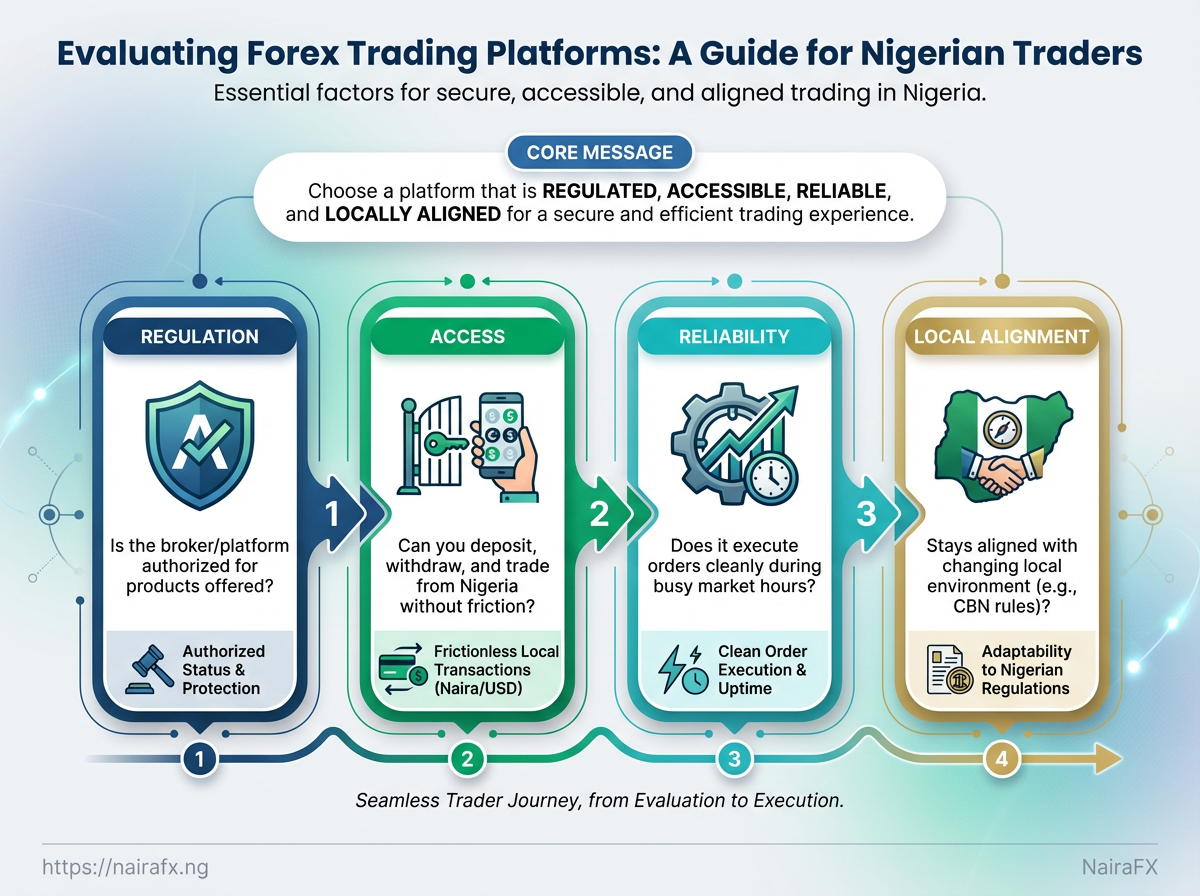
A quick way to judge any forex platforms list is to ask three things first:
- Regulation: Is the broker or platform clearly authorized for the products it offers?
- Access: Can you deposit, withdraw, and trade from Nigeria without constant friction?
- Reliability: Does it execute orders cleanly during busy market hours, or does it stumble when volatility jumps?
There is also a bigger Nigeria-specific angle.
In 2026, the CBN approved weekly foreign currency sales of up to $150,000 to each licensed BDC operator—a reminder that access rules keep changing. Traders need platforms that stay aligned with the local environment, not one step behind it.
Reuters covered that shift in its report on Nigeria’s central bank foreign currency sales to retail FX channels.
This section sits near the start of our trading education series at NairaFX because platform checks come before strategy tweaks.
If the rails are weak, even the best trading plan spends too much time fighting the venue instead of the market.
The cheapest-looking account can become the most expensive once you add everything that happens after you fund.
For Nigerian traders, compare trading costs as a full journey: fund → trade → hold → withdraw—not just spreads on the homepage.
Forex trading may be legal in Nigeria, but broker access sits inside a real regulatory frame, so pricing alone is never a safe reason to open an account.
Comparing trading costs without getting fooled
The best trading platforms make pricing easy to inspect.If the fee page feels slippery, the account often is too.
> A broker can advertise “low spreads” and still be expensive once commissions, swaps, and funding/withdrawal charges are added.
| Cost factor | What it means | Why it matters for Nigerian traders | Questions to ask |
|---|---|---|---|
| Spread | The gap between buy and sell price | Your first built-in trading cost and it can widen when liquidity thins | Fixed or variable? Typical range on major pairs? |
| Commission | A separate charge per trade or lot | Low-spread accounts may become costly once commission is added | Charged per side or round turn? |
| Deposit fee | Cost of funding the account | Cards, transfers, and currency conversion can add friction | Do they charge deposits? Who pays payment-rail fees? |
| Withdrawal fee | Cost of taking money out | Critical when profits are small | Free withdrawals, or thresholds/tiers? |
| Inactivity fee | Charge for dormant accounts | Pauses happen; fees can silently erode capital | After how long, and how much? |
| Swap/overnight fee | Cost of holding positions past rollover | Position traders can lose more here than on entry spread | Long/short swap rates for your pairs? |
Before you commit, ask one simple question: Would this account still feel dependable on a busy day? If the answer is unclear, keep shopping.
Features that matter most for active Nigerian traders
For active traders, the real test starts the moment you need to enter, adjust, and exit fast. That is where the best trading platforms separate themselves from the pretty ones.
For active traders, charting is not decoration.
It has to support quick reads, clean execution, and enough control to manage risk without fumbling through menus.
That matters even more in Nigeria, where forex trading is legal but brokers offering OTC forex products still need proper authorisation, according to the Forex Brokers 2026 Nigeria guide.
A solid trading software review should therefore look beyond the homepage and into the parts you use every day.
Charts that keep up with the trade
A good charting setup should feel fast, flexible, and uncluttered.
If it takes too long to switch timeframes or place a stop, the platform is getting in the way.
Look for these features first:
- Multi-timeframe charts: You should move from the 5-minute chart to the daily view without losing your setup.
- Common indicators and custom overlays: Moving averages, RSI, MACD, Bollinger Bands, and drawing tools should be easy to add and save.
- Trade management tools: One-click trading, bracket orders, trailing stops, and partial closes—so you can act when the market moves quickly.
- Alert support: Price alerts and indicator alerts help when you cannot stare at the screen all day.
Account size and funding matter too
A platform can have beautiful charts and still be a bad fit if the account structure is awkward.
Active traders should check whether the broker offers the right account type for their style, not just the lowest headline deposit.
Some accounts suit smaller starting balances, while others are built for tighter control or higher-volume trading.
The deposit method should also match how you actually move money—whether that is bank transfer, card, or another local option the broker supports.
Payment convenience is where many platforms disappoint
A fast deposit means very little if withdrawals turn into a support-ticket marathon.
Local FX access and payment rails can change, so payment checks deserve attention—but the best way to verify is to review the broker’s latest account terms and withdrawal policy, and confirm processing windows in writing.
- Match deposit and withdrawal methods: Platforms that let you withdraw through the same route you funded with are usually easier to live with.
- Check processing times in writing: Same-day deposits are nice, but withdrawal windows tell you more about real service quality.
- Test a small withdrawal first: A tiny payout reveals more than a glossy promo page ever will.
- Confirm local banking support: Look for clear support for Nigerian banks, local settlement rules, and fee disclosure before funding a larger account.
That is the part many traders skip, then regret later.
A platform that handles charts well, fits your account size, and moves money cleanly usually earns its place fast.
How to read a trading software review without getting misled
The most polished review can still be the least useful one. That happens all the time with forex platforms—especially when the review sounds confident but never shows how the software behaves under pressure.
Nigeria’s FX rules and broker access can shift, so a review written like it never changes is already suspicious. ForexBrokers.com’s Nigeria guide and Nigeria-specific broker guidance both point to the same reality: local traders need current, grounded checks, not marketing gloss.
The easiest way to spot bias is to notice what a review leaves out.
If it praises “fast execution” but skips spreads, support hours, withdrawal rules, and app stability, it is selling mood, not evidence.
Real user feedback helps fill those gaps.
One complaint can be noise, but repeated comments about login problems, delayed withdrawals, or slow support usually tell a more honest story than any ad copy ever will.
- Praise without specifics: “Best platform ever” means little if no fees, dates, or conditions are named.
- Missing negatives: A review that never mentions weak spots is usually written too close to the seller.
- Outdated screenshots or dates: Old details matter less when broker terms and local rules keep changing.
- Only five-star echoes: Mixed feedback is more believable than a wall of perfection.
A simple checklist for comparing two platforms side by side
| Evaluation area | Pass or fail | Notes | Priority level |
|---|---|---|---|
| Regulation and oversight | Pass only if the broker is properly authorised for the service offered | Check current licensing, not just brand claims on the homepage | High |
| Pricing clarity | Pass only if spreads, commissions, swaps, and withdrawal fees are stated plainly | Vague “from” pricing is a red flag | High |
| Charting and analysis tools | Pass only if tools work smoothly in demo and live testing | Look for stable indicators, clean order tickets, and usable timeframes | Medium |
| Mobile app quality | Pass only if the app is current, stable, and well rated by real users | Repeated crash reports matter more than glossy screenshots | High |
| Funding and withdrawals | Pass only if deposit and withdrawal steps are clear, with realistic timelines | Hidden delays often show up in user reviews first | High |
| Customer support | Pass only if support responds within a sensible time and solves issues | Test live chat, email, and help pages before funding | Medium |
| Risk controls | Pass only if stop-loss, alerts, and account protection tools work as expected | Good controls matter when the market turns fast | High |
If one platform scores well on paper but users keep complaining about withdrawals or app bugs, trust the pattern, not the headline.
That same habit saves time when comparing forex platforms.
Read the claims, then hunt for what the writer avoided saying.
Choosing the best trading platform for your trading style
The best platform is not the flashiest one—it’s the one that matches how long you keep trades open.
That question saves a lot of regret.
A beginner usually needs clarity and training wheels.
A swing trader needs clean charts, alerts, and patience-friendly order tools.
A day trader wants speed, stable execution, and fewer distractions.
In Nigeria, the legal and regulatory side also matters.
Forex trading is legal, but brokers offering OTC forex products must be authorised, according to ForexBrokers’ 2026 guide to forex brokers in Nigeria.
Local funding conditions can shift too, which is why the CBN’s 2026 moves on retail FX liquidity deserve attention, as reported by Reuters.
The smartest trading software review is the one that matches your routine, not someone else’s excitement.
A clean platform for a beginner can feel painfully slow to a scalper, and a pro-level setup can overwhelm someone still learning position sizing.
Questions to ask before you fund a live account
| Trader type | Most important features | Common pain point | Platform fit |
|---|---|---|---|
| Beginner | Demo account, simple order screen, clear education, transparent fees | Too many buttons and hidden charges | Clean interface with guided learning and low friction |
| Swing trader | Daily and weekly charts, alerts, watchlists, pending orders | Weak chart tools or poor mobile sync | Stable charting and reliable price alerts |
| Day trader | Fast execution, one-click trading, tight spreads, news calendar | Lag, slippage, and cluttered screens | Low-latency platform built for quick entries and exits |
| Scalper | Very low spreads, stable pricing, depth of market, fast order routing | Spread spikes and broker restrictions | Broker-friendly setup that allows rapid trade turnover |
| Risk-focused trader | Stop-loss control, margin alerts, position sizing, account analytics | Ignoring drawdown until damage is done | Platform with strong risk controls and clear reporting |
Swing traders should care more about chart quality than speed alone.
Day traders need the opposite balance, and scalpers need to test execution conditions relentlessly before sending real money.
That’s why a live deposit should come after demo testing, not before it.
The right match feels boring in a good way.
It removes friction, keeps risk visible, and lets your trading style do the work it was meant to do.
The platform you pick should protect your process, not just make charts look good.
A practical way to wrap it up is to reuse the article’s framework:
- Costs: confirm spreads/commission/swaps and withdrawal charges (Section 5).
- Execution & reliability: test how fills, stability, and the app behave when conditions get fast (Section 3/5).
- Feature fit: match charting, order tools, and risk controls to your trading style (Section 6/9).
- Review skepticism: apply the “spot bias” checklist when you read broker/UGC reviews (Section 8).
If the platform consistently passes those checks, it’s not just promising—it’s usable, even when real money is on the line.