

A trade can look beautifully balanced on paper, then two currency pairs move in the same direction and quietly double the trading risk.
That is the part many traders miss: currency correlations can turn a sensible-looking setup into an oversized bet without changing a single stop loss.
Forex correlations describe how pairs move in relation to each other.
According to Dukascopy, the relationship is statistical, not random noise, and tools like Myfxbook’s correlation meter show values from -100% to +100%.
That matters because a “diverse” book of trades is not always diverse.
Long EUR/USD and long GBP/USD can behave like cousins at the same family gathering, while some pairs offset each other far better than traders expect.
The real danger is confidence built on the wrong assumption.
When currency correlations shift, exposure changes with them, and so does the size of the damage when volatility hits.
A trader who understands that relationship sees trading risk more clearly, especially when positions stack up across related pairs.
Quick Answer: Currency correlations tell you how closely two forex pairs tend to move together (often shown as -1 to +1 or -100% to +100%). When you open multiple positions that are positively correlated, you can accidentally build one larger bet—even if each trade’s stop-loss looks reasonable in isolation. For example, holding long USD/JPY and long USD/CHF can increase your effective USD-exposure because both positions often react to the same broad “USD strength vs. rate/risk sentiment” environment. Before you add the second trade (or call it a “hedge”), do a quick correlation check in a tool (e.g., Myfxbook/Mataf/Dukascopy or your own spreadsheet) and then adjust your plan by reducing lot size or tightening the portfolio risk so total loss stays within your limit.
What Currency Correlations Mean in Forex Trading
Two pairs can look separate on a chart and still be dancing to the same drum.
That happens because both pairs may share a common currency, like the U.S. dollar, or react to the same macro news at the same time.
In forex, currency correlations describe how one pair tends to move compared with another.
The relationship is usually shown on a scale from -1 to +1, or -100% to +100%, depending on the tool, which is why sources like Myfxbook’s Forex Correlation tool and Dukascopy’s explanation of forex correlation pairs are so useful.
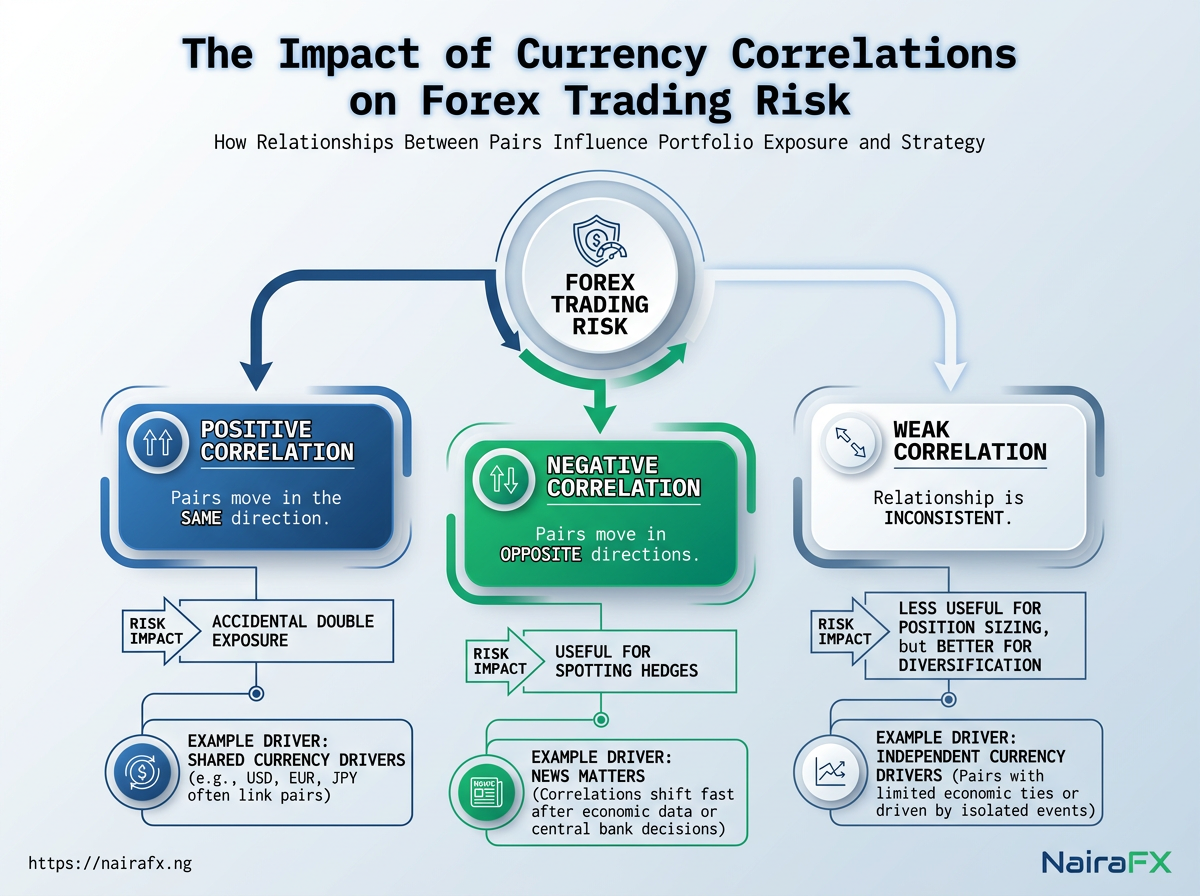
Positive correlation means two pairs often move in the same direction.
Negative correlation means they often move in opposite directions.
Weak correlation means the relationship is messy, inconsistent, or too small to trust for serious trade decisions.
Here’s the practical part.
A trader who buys two highly positive pairs may think they have two different positions, but the trading risk can be almost the same trade twice.
That is why correlation checks matter before stacking positions or hedging.
- Positive correlation: Two pairs usually rise and fall together. A strong positive reading can create accidental double exposure.
- Negative correlation: One pair often moves the other way. Traders use this to spot crude hedges or conflicting setups.
- Weak correlation: The pairs do not stay in sync. That relationship is less useful for position sizing, but sometimes better for diversification.
- Shared currency drivers: If both pairs contain USD, EUR, or JPY, the shared leg often drives the link. That is common on major pairs.
- News matters: Correlations can shift fast after central bank decisions, inflation data, or risk-off sentiment. A number that looked clean last week may already be stale.
The safest way to use Forex correlations is to treat them like a risk filter, not a trading signal.
Check the relationship, keep your chart simple, and ask one blunt question: am I opening a fresh idea, or just repeating the same exposure with a different pair?
That habit saves headaches fast.
It also keeps the focus on the trade itself, instead of getting lost in a wall of numbers.
How Correlations Change Trading Risk
Why does a tidy two-trade plan sometimes explode into one oversized bet?
That happens when the positions are tied together by currency correlations.
A long EUR/USD trade and a long GBP/USD trade may look like separate ideas, but both are really bets against the dollar.
If the dollar suddenly strengthens, both can slide at the same time and turn a normal loss into a messy drawdown.
Live tools like Myfxbook’s forex correlation page and Dukascopy’s forex correlation guide make that connection easy to see.
Their value is simple: they show when two trades are quietly acting like one.
> Correlation runs from -100% to +100%, so two pairs can move together, move apart, or barely relate at all.
That matters because trading risk is not just about entry quality.
It is also about how much of the same market idea sits in the book.
Mataf’s correlation tool even frames correlation as a way to evaluate the risk of a position mix, which is exactly where many traders get caught out.
Same setup, very different exposure
| Trade setup | Related currency pairs | Correlation effect | Risk impact | Example outcome |
|---|---|---|---|---|
| Long EUR/USD + long GBP/USD | EUR/USD, GBP/USD | Often move in the same direction when the U.S. dollar drives the market | Higher combined exposure to one dollar view | A sudden USD rally can hit both positions together |
| Short EUR/USD + short GBP/USD | EUR/USD, GBP/USD | Same theme, reversed direction | Losses can stack faster if the dollar weakens instead of strengthening | Two stops may trigger in the same move |
| Long EUR/USD + long AUD/USD | EUR/USD, AUD/USD | Positive correlation often appears during broad USD trends | Drawdown can deepen when the dollar reverses sharply | Both trades can slip in the same session |
| Long EUR/USD + short USD/CHF | EUR/USD, USD/CHF | Often moves in opposite directions | Lower net directional exposure | One leg can soften the pain of the other |
| Long EUR/JPY + long GBP/JPY | EUR/JPY, GBP/JPY | Shared yen pressure can pull both pairs together | Concentrated yen risk | A risk-off yen surge can pressure both trades |
It is to read them properly.
When two trades point at the same macro driver, they deserve to be sized like one bigger position, not two separate ideas.
Used well, Forex correlations can also calm a portfolio down.
That is why we watch them closely before adding a second trade, especially when the market is already jumpy.
How to Read Currency Correlations Before Opening a Trade
Are you really opening two separate trades, or just stacking the same market bet twice? That question matters most when both positions react to the same driver—like a broad USD move or the same risk-on/risk-off mood.
A fast way to check is to start with your most-used pairs first, not the newest setup you want to trade. Tools like Myfxbook’s real-time forex correlation tool show relationships from -100% to +100%, while Mataf helps you compare how currencies move across combinations.
In markets that shift quickly, older correlation assumptions can stop matching what you see today. So treat correlation as something you verify, not something you set once and forget.
Simple correlation checklist before entry
| Check | Why it matters | Yes or no |
|---|---|---|
| Are the pairs linked to the same base or quote currency? | Shared currency exposure can make two trades move together. | Yes / No |
| Could both trades react to the same news event? | One headline can hit both positions at once. | Yes / No |
| Would both losses happen at the same time? | This tests whether your “diversification” is real or just cosmetic. | Yes / No |
| Does this trade fit my total risk limit? | Correlated positions can push your total exposure higher than planned. | Yes / No |
If both positions tend to break under the same conditions, your account is carrying more trading risk than the chart suggests.
That’s why a quick pre-entry review is a habit worth keeping: it catches hidden overlap before the market pulls the same lever twice, and it keeps Forex correlations from quietly sneaking extra risk into a plan that looked clean on paper.
Risk Management Strategies for Correlated Trades
Two clean setups can still turn into one messy risk.
That happens when both trades are tied to the same market driver, so one shock hits both at once.
The safest move is to size the pair as a cluster, not as separate ideas.
If you are long EUR/USD and GBP/USD, the dollar is doing most of the heavy lifting in both trades, so each leg should usually be smaller than a standalone setup.
Correlation tools such as Myfxbook’s Forex Correlation page and Mataf’s Forex Correlation tool make that shared exposure easier to spot before entry.
Correlation itself is just the statistical relationship between pairs, and it runs on a scale from -100% to +100% in those tools.
A simple rule helps: set a total risk cap for the whole group.
If your normal trade risk is 1%, you might decide that all related euro-dollar and pound-dollar positions together can never exceed that amount, even if each chart looks excellent on its own.
That matters even more around big releases.
A 2026 guide from FXNX on forex correlation relationships warns that old pair relationships can go stale fast, especially when policy shocks and fresh macro data hit the market.
- Shrink each leg: If two trades share the same currency driver, cut position size on both sides instead of treating each one as fresh risk.
- Cap the cluster: Decide the maximum combined loss for all related trades before entry, then stick to it even if the setups look “too good.”
- Avoid news pileups: Do not load up on correlated pairs right before CPI, central-bank decisions, or NFP. One surprise can whip every related trade at once.
- Plan stops as a group: A stop on one position should not ignore the pressure on the rest of the book. If one leg fails, the surviving leg may still need a tighter exit.
- Review after entry: If one trade moves sharply against you, the original correlation may no longer be the real issue. The market driver has probably changed, and the rest of the basket needs a fresh look.
That is the approach we favor at NairaFX: think in portfolio terms, not ticket terms.
Correlated trades behave best when the risk plan is shared from the start.
What Nigerian Traders Should Watch in Volatile Markets
In Nigeria, risk isn’t only about price moves—it’s also about how quickly your market narrative changes. When naira pressure rises, your trading conditions often shift at the same time: spreads widen, liquidity thins, and your ability to enter/exit cleanly can deteriorate.
That’s where currency correlations become more than a concept. In volatile periods, relationships between pairs can tighten (or snap) as the same macro driver dominates multiple markets—especially the USD.
The correlation link that matters for you (not just “USD moves”)
Watch for situations where your different trades are all reacting to the same underlying shift, such as:- A USD liquidity / dollar-strength move that impacts USD-priced assets.
- A global risk-off shift that drives safe-haven demand and changes how quickly pairs trend or reverse.
- Local USD sentiment (via naira weakness) that pushes traders toward the same “safe” trade directions across multiple instruments.
Correlation tools are useful here because they help you spot when your positions are no longer behaving independently.
A different real-world way to spot overlap
Suppose you trade EUR/USD because it looks strong versus the dollar, and you also trade XAU/USD (gold) because it appears stable or supportive in your timeframe.During USD-driven moves, you may notice both trades start reacting to the same driver:
- EUR/USD can weaken when USD strength accelerates.
- XAU/USD often trends differently than FX—but in many sessions it still becomes tightly linked to the same “dollar strength + risk sentiment” environment.
The lesson: even when one trade is “FX” and the other is “not an FX pair,” your exposure can still be correlated through the macro driver.
Practical checks Nigerian traders can apply
- Start with your actual pairs, then add the dollar question: for every open position, ask “what happens if the USD narrative flips this session?”
- Re-check correlation right before entries: volatile regimes can make yesterday’s correlations feel outdated.
- Treat correlation spikes as a sizing signal: if multiple positions begin moving together more than usual, reduce lot sizes or pause new entries until the regime stabilizes.
- Reprice stops with portfolio context: wider stops may be reasonable in volatility, but only if your total portfolio risk cap still holds.
One common mistake is assuming naira volatility is a local problem that only affects USD/NGN. In practice, it can coincide with (and amplify) broader dollar- and risk-sentiment dynamics that make correlations tighter across several of your trades.
Currency correlations are the quiet reason “two separate trades” sometimes behave like one larger position.
The most useful takeaway is not to avoid correlated markets—it’s to treat correlation as a changing condition. Before the next entry, compare what you already hold, confirm the pairs still co-move in today’s regime, and then cap risk at the portfolio level (not per ticket).
After the trade starts, don’t assume the original correlation stays valid. If price action begins to move differently than expected, update your assumptions and re-check your exposure instead of letting the old correlation story guide your next add/remove decision.
1 thought on “The Impact of Currency Correlations on Forex Trading Risk”