

One sharp move in a major pair can wipe out several careful wins.
That is usually when traders realize their account was leaning too heavily on one idea.
Forex diversification is not about spraying money across random trades.
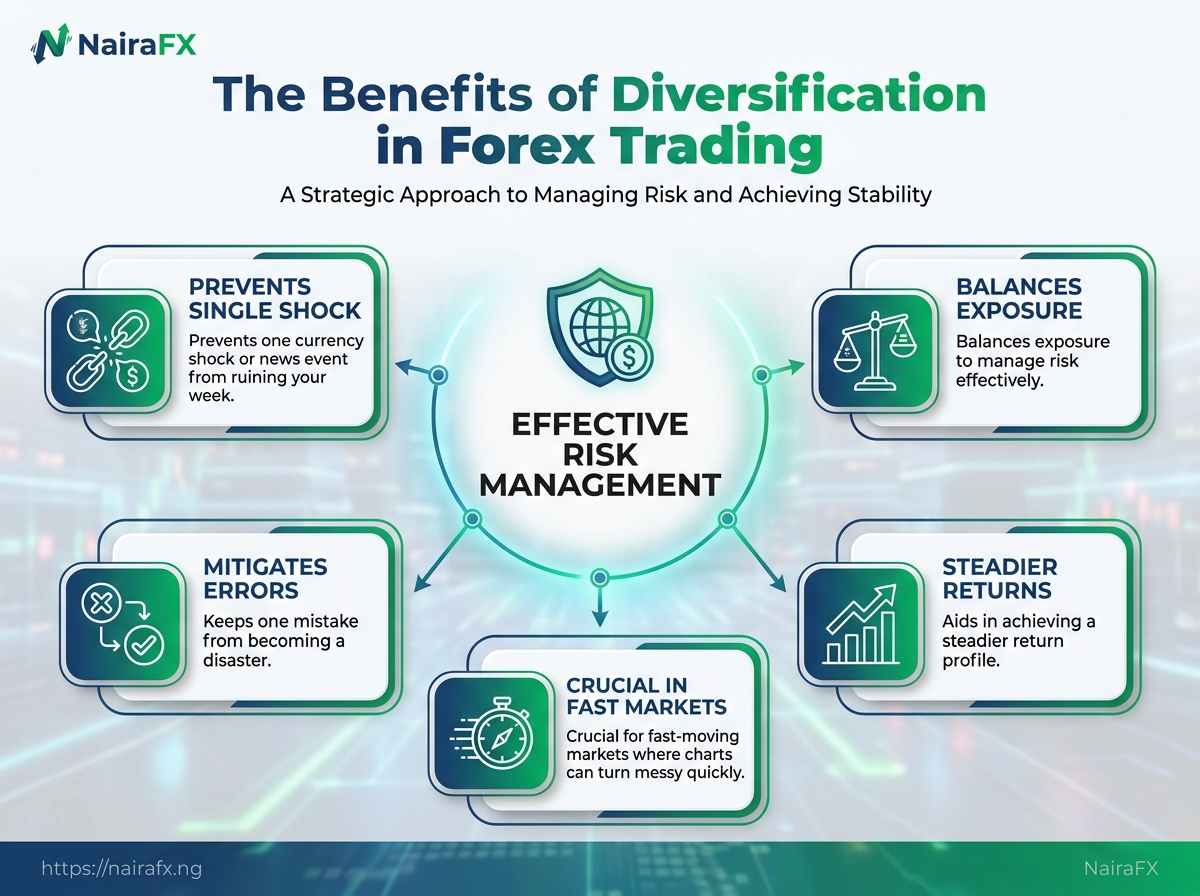
It is about diversifying trades so one currency shock, one news event, or one bad setup does not decide the whole week.
Research from Forex.com notes that spreading risk can create a steadier return profile, which is exactly why seasoned traders treat concentration as a hidden enemy.
That matters even more in fast-moving markets.
A clean chart can turn messy after a rate decision, a surprise inflation print, or a sudden risk-off mood, and the trader who loaded up on one direction feels it first.
The real risk management benefits show up when exposure is balanced with purpose.
Good diversification does not kill conviction; it keeps one mistake from becoming a disaster, and that is a very different game.
Quick Answer: Forex diversification works when you reduce sensitivity to the same driver cluster, not when you trade more symbols. Quick test (2 minutes): 1) Label each open position by its main mover (e.g., USD rate expectations, risk-off/risk-on mood, oil impulse, or local policy/news impact). 2) Count how many positions share the same label. 3) If 2+ positions share one driver, treat them as one exposure and keep the total risk for that cluster inside your risk plan (instead of pretending each pair is “independent”). A simple rule: correlation is just the math version of driver overlap—use it to confirm the clustering you already suspect, then size so one shock can test your process, not wipe your week.
Why Forex Diversification Matters When Markets Move Fast
Why do some traders get knocked flat by one sharp move while others stay in the game? The difference is usually not luck.
It is usually Forex diversification done with discipline.
Diversification in forex is not random trade placement.
It means spreading exposure across currency pairs, trade setups, and time frames that do not all react the same way to the same shock.
A basket of trades still needs a logic behind it, because two dollar-heavy pairs can behave like twins when volatility spikes.
That matters even more in Nigeria, where sharp currency swings can turn a normal trade into a stressful one fast.
If a trader is concentrated in one direction, one pair, or one market story, a surprise policy move, oil shock, or dollar demand surge can hit every open position at once.
According to Forex.com’s portfolio diversification guide, spreading risk across positions helps create a steadier return profile.
And Alpen Partners’ 2026 note on global diversification makes the same point from another angle: relying on one outcome is where trouble starts.
> ScienceDirect research on diversification and exchange rate exposure found that diversification can help reduce exchange-rate exposure for firms with international operations.
- Less single-pair damage: One bad move does not have to punish the whole account.
- Cleaner risk management benefits: Different pairs and setups often react to different news, which softens the blow from one market event.
- Better trade selection: Diversifying trades forces a trader to think in probabilities, not impulses.
- Smoother equity swings: A more balanced book usually makes drawdowns easier to absorb and review.
The real win is simple.
Diversification does not remove risk.
It stops one crowded idea from becoming a full-blown account problem, and that is a huge edge when markets move fast.
How Diversifying Trades Supports Better Risk Management
A trade can be technically correct and still bruise your account.
That usually happens when two “different” positions are really one bet—because they respond to the same driver. When that driver turns against you, your stops and position sizing are forced to absorb more than you planned.
That’s why Forex diversification matters at the trade level, not only in theory.
Pair correlation and account exposure
| Pair type | Typical market behavior | Risk level | Best use case | Example pairs |
|---|---|---|---|---|
| Highly correlated pairs | Often move in the same direction because they share the same major driver (commonly USD moves or the same risk mood) | Higher concentration risk | Only when you deliberately keep size small and limit simultaneous exposure | EUR/USD, GBP/USD, AUD/USD, NZD/USD |
| Moderately correlated pairs | Sometimes move together, but can diverge when local data, central-bank language, or regional flows change | Medium risk | Useful when you want additional exposure without fully repeating the same bet | EUR/USD, USD/CAD, GBP/JPY, AUD/JPY |
| Less correlated pairs | Tend to react to different central banks, regions, and market themes | Lower overlap risk | Better for spreading exposure across different sources of movement | EUR/GBP, USD/JPY, USD/CHF, CAD/JPY |
So the real risk-management move is this: diversify the drivers your trades depend on, then size each position so that any one mistake stays within your planned loss.
Also remember: correlation is not permanent. Review your open positions regularly—what looked diversified last month can become overlapping when market conditions change.
Practical Ways to Diversify Without Confusing Your Strategy
Think of diversification as variety in what makes your trade move, not just variety in tickers.
If multiple positions depend on the same underlying shift (the same central bank expectation, the same risk-off impulse, or the same USD momentum), you may be “diversified by name” while still concentrated by exposure.
A practical mix to consider is:
- Pair (what currency exposure you’re really holding)
- Time frame (how long your setup needs to work)
- Style (trend vs mean-reversion, momentum vs pullback)
Example: a trend setup and a mean-reversion setup can coexist more cleanly when they don’t require the same immediate market behavior to win.
A simple everyday checklist
| Checklist item | Yes/No | Why it matters |
|---|---|---|
| Are my open pairs highly correlated? | Yes | If they move together, you may be repeating the same bet. |
| Is my risk per trade within plan? | Yes | Diversification won’t fix oversized position sizing. |
| Does this setup repeat an existing exposure? | Yes | “Different pairs” can still equal the same hidden risk. |
| Have I checked the main news drivers? | Yes | Big events can move several trades at once. |
| Does this trade fit my account size? | Yes | Smaller accounts need fewer, cleaner exposures. |
The best diversification feels almost boring: your plan stays clear, your exposure stays readable, and your account isn’t ambushed by one headline.
Common Diversification Mistakes Traders Should Avoid
Ever seen a “diversified” book blow up on one move? That usually means the spread looked wider than it really was.
The most common mistake is overtrading too many pairs without a rule set.
A stack of random entries feels active, but it often turns into noise, poor execution, and bad exits.
Research on diversification keeps saying the same thing: spreading risk helps, but only when the positions are chosen with some discipline behind them, not just because the chart looked interesting that day. Forex.com’s guide on portfolio diversification and Saxo’s risk management overview both stress that balance matters more than sheer count.
The next trap is treating different pairs as different risk when they move together. EUR/USD, GBP/USD, and AUD/USD can look distinct on the screen, but one strong dollar move can drag them in the same direction.
That is why diversification across pairs is not the same thing as diversification across exposures.
Alpen Partners’ 2026 diversification note makes the same point in a broader portfolio context: concentration hides in plain sight.
Then there is the news problem. Ignoring one event that hits several positions at once is a classic way to turn a calm day into a mess.
A U.S. CPI release, a Federal Reserve decision, or a sharp risk-off headline can hit multiple USD pairs in the same minute, which is why correlation checks and a calendar matter more than guesswork.
- Too many pairs, no process: Trade fewer setups with clear entry, exit, and size rules.
- False diversification: Check whether pairs share the same currency driver before opening both.
- News blind spots: Mark high-impact events that can move several open trades together.
- Clustered exposure: Limit how much of the account depends on one currency theme.
- No exit plan: Define what happens if correlated pairs start failing together.
A cleaner approach is boring, and that is usually a good sign.
Forex diversification only works when the trades are truly different, not just different-looking.
A Simple Diversification Framework for Strategic Traders
What happens when one idea starts carrying the whole account? That is usually the moment a smart trading plan turns into a fragile one.
A cleaner framework starts with one core strategy and then adds small variations around it.
Keep the main setup familiar, then test one change at a time: entry timing, session filter, pair selection, or stop placement.
That keeps the logic clean and makes it easier to see whether the new idea truly adds value or just adds noise.
Diversification works best when it stays intentional.
Forex.com notes that diversification can support a steadier return profile, while Alpen Partners points out that spreading exposure across currencies and regions reduces reliance on any single outcome in 2026 Forex.com’s guide on portfolio diversification Alpen Partners’ 2026 outlook on global diversification.
For strategic traders, that means building a small family of related setups, not collecting random trades.
Reviewing exposure once a week keeps the book honest.
If one pair, one setup, or one risk bucket starts dominating results, trim it before it shapes your whole equity curve.
Saxo’s risk guide makes the same basic point: spreading exposure reduces the damage from any single weak spot Saxo’s diversification risk management guide.
A simple operating rhythm looks like this:
- Start with one anchor setup. Trade your best-known pattern first, then add a small variation only after it proves itself over several weeks.
- Cap weekly concentration. If one pair or idea contributes too much to profit or loss, scale it back before it becomes the whole story.
- Track by pair, setup, and risk level. Separate the numbers so hidden clustering does not sneak past you.
- Rebalance every week. Shift size away from crowded exposures and toward the parts of the book that still behave independently.
That kind of discipline is the real edge in Forex diversification.
It keeps diversifying trades useful instead of messy, and it makes risk management benefits show up in the equity curve rather than in theory alone.
At NairaFX, that practical discipline matters more than cleverness.
A simple framework, reviewed often, usually beats a complicated one that nobody can read after a bad week.
Diversification only helps when it actually reduces overlap risk—the kind where multiple positions get hit by the same underlying move.
Before you add anything new, do this in one pass:
- Identify your likely dominant driver(s) for the week.
- Check how many of your trades would be affected together if that driver turns.
- Reduce the overlap first (size down, remove redundancy, or pause correlated setups), then add only what improves true independence.
If your pre-trade checklist is the filter—rather than hope—you’ll protect your account, keep better data from your trades, and stay consistent enough to let your edge compound.