
A single oversized trade can wipe out a month of steady progress.
That is why a Forex risk management strategy matters more than a flashy entry signal.
Most traders obsess over finding the perfect setup, then guess at risk.
A solid risk management plan asks a harder question: how much can be lost before the account starts bleeding?
That thinking turns stop-losses, position sizing, and risk-reward into one system instead of three separate ideas.
According to Axon Markets, capital protection stays front and center because a trade only matters if the account survives long enough for the next one.
The pressure gets worse when price moves fast and spreads widen.
In those moments, the market does not care how confident the entry felt a minute earlier.
The real goal is simple.
Keep one bad trade from becoming a bad week, then keep a bad week from becoming a ruined account.
Quick Answer: If your next loss suddenly costs more than planned, what will keep your account from taking permanent damage? Start with a written rule that limits risk before you enter: (1) define your invalidation level (where the setup is proven wrong), (2) place the stop accordingly, (3) calculate position size from that stop distance so the dollar risk stays consistent, and (4) verify the trade still clears your risk-to-reward threshold. Then—especially in fast moves—make the sizing reactive to execution reality: when spreads widen, stops must sit farther away, so reduce lot size to keep the same per-trade risk. This turns “risk control” into a routine you can follow even during volatile sessions.
Why Forex Risk Management Matters More Than Entry Signals
A good entry can still turn into a bad week.
In volatile conditions—news spikes, session shifts (like London open), and thinner liquidity near the close—your setup quality becomes just one factor. The bigger factor is what happens if you’re wrong: how large the loss can be, and exactly what condition proves the idea is no longer valid.
That’s why risk control is the real edge. A Forex risk management strategy answers questions that entry signals can’t:
- Where does the trade idea break? (the invalidation level)
- How much loss is “acceptable” if price reaches that point?
- Does the expected reward justify the defined risk?
Volatility also changes execution. When spreads widen or stops must be placed beyond a key invalidation level, the stop distance often grows. Once the stop distance grows, keeping the same lot size would increase dollar risk—so your position size has to adjust to keep risk consistent.
Finally, planned invalidation and pre-set loss limits protect decision-making. If you know in advance what “wrong” looks like, you don’t improvise under pressure. You act on the plan—because the plan already decided the consequences before the trade started.
Risk management isn’t a separate task from trading. It is what determines whether your next trade can still exist when the market moves fast.
Core Elements of an Effective Forex Risk Management Strategy
What actually keeps a forex account alive after a rough week? Not a lucky entry.
It is the part most traders rush past: a risk plan that knows the size of the loss, the point where the setup is wrong, and the profit target that makes the trade worth taking.
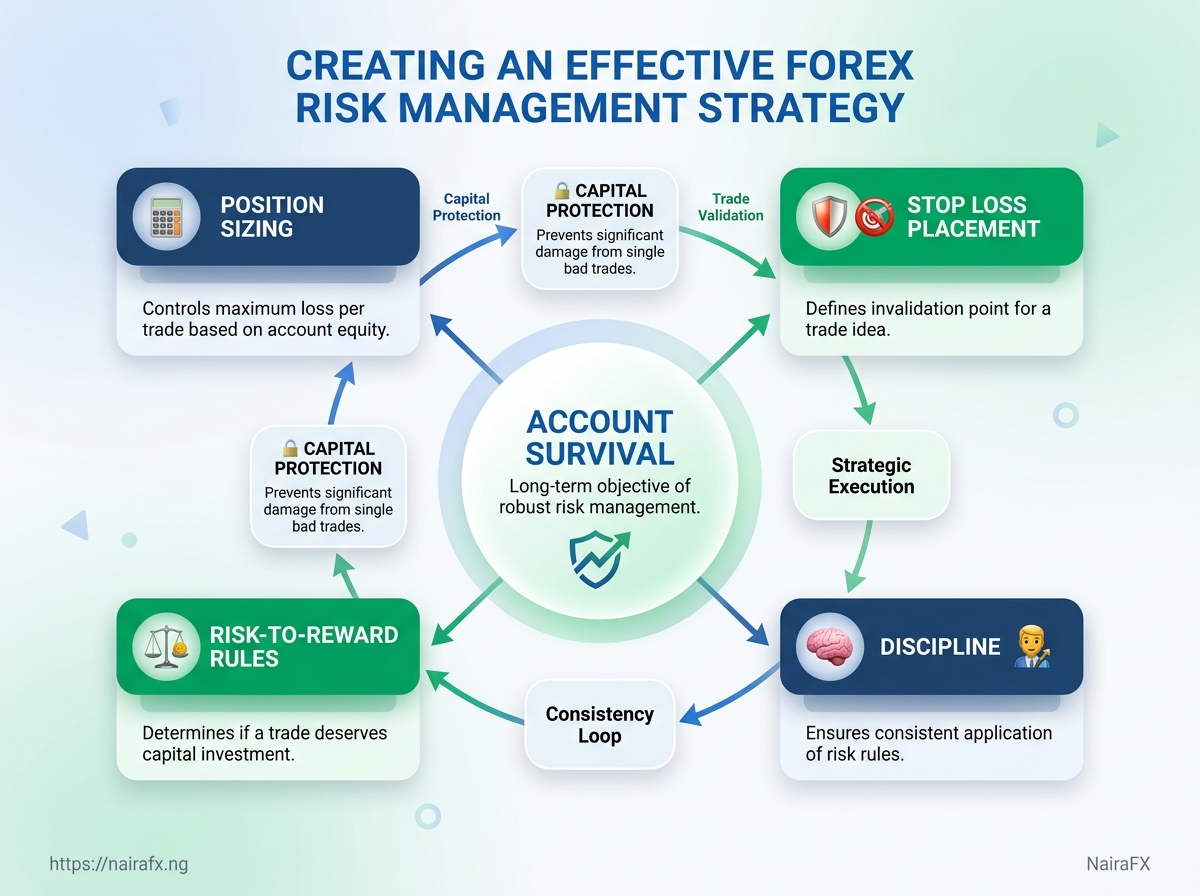
The three pieces work together. Position sizing controls how much damage one trade can do, stop loss placement defines when the idea is invalid, and risk-to-reward rules decide whether the trade deserves capital in the first place.
Broker education still points traders toward small fixed risk per trade and disciplined reward targets. Axon Markets’ risk management guide advises never risking more than 2% per trade, while TradeTaurex’s 2026 forex risk management tips and TradeZella’s risk management guide both reinforce the same idea: the account risk comes first, then the lot size follows from the stop distance.
Trade-by-trade risk control checklist
| Risk control item | What to check | Why it matters |
|---|---|---|
| Risk per trade | Fix risk at 1% to 2% of account equity. On a $10,000 account, that means $100 to $200 maximum loss. | Keeps one bad trade from doing real damage. |
| Stop loss distance | Place the stop beyond the setup’s invalidation point, not at a random round number. | Stops should reflect the trade idea, not hope. |
| Lot size | Use Position Size = Account Risk / Stop Loss Value. A wider stop means a smaller lot size. |
Keeps dollar risk steady across different setups. |
| Trade reward target | Aim for at least 1:2 risk-to-reward. If risk is $100, the target should be around $200 or more. | Gives the strategy room to survive normal losing streaks. |
| Maximum daily loss | Set a hard daily cap and stop trading once it is hit, even if the next setup looks “perfect.” | Prevents emotional trading after a bad run. |
The lot-size line is the one traders often miss, because the stop and the size have to move together.
A 20-pip stop and a 60-pip stop cannot carry the same position size without changing the dollar risk.
That simple adjustment is what keeps a forex risk management strategy consistent on calm days and ugly ones.
The reward rule matters just as much.
A trader can be wrong often and still stay afloat if the math stays clean, and that is where discipline starts paying rent.
How to Build a Risk Management Plan Step by Step
A trade can be right and still hurt badly if the size is wrong.
That is why a Forex risk management strategy works best as a written plan, not a mood-based decision at the chart.
The cleanest plans start with three things: a hard cap per trade, a daily loss limit, and a rule for when to stay flat.
Industry guides keep circling the same idea for a reason: risk should be fixed before entry, and position size should flow from that limit, not from confidence in the setup. Axon Markets’ risk management guide and TradeTaurex’s forex risk management tips both reinforce that style of discipline.
- Set your risk ceiling first.
Many traders stay in the 1% to 2% range per trade, and that keeps one bad idea from becoming a bad week.
- Size the trade from the stop-loss.
That matches the standard sizing logic described in TradeZella’s risk management guide and SIFX’s position sizing overview.
- Write skip rules before the market opens.
Good plans protect you from your worst impulses, not just bad charts.
Example trade size by account balance
| Risk per trade | Example account balance | Maximum loss per trade | Use case |
|---|---|---|---|
| 1% | $1,000 | $10 | Conservative start, high discipline |
| 2% | $1,000 | $20 | Common standard for active traders |
| 3% | $1,000 | $30 | Only for traders with a tested edge |
| 5% | $1,000 | $50 | Aggressive, usually too hot for most accounts |
If your stop is wide, your position must shrink; if your stop is tight, your size can grow a little.
The same logic applies to daily limits.
A trader who quits after hitting the line usually keeps the account alive longer than the one who keeps “just one more”ing the market.
A simple written plan is enough to make better decisions faster, and that fits the kind of risk control we care about at NairaFX.
Once the rules are fixed, the market gets a lot less emotional.
Managing Risk in Volatile Markets Like a Nigerian Trader
Ever had a clean setup turn ugly five minutes after entry?
That happens when the market moves faster than your plan.
For a Nigerian trader, the pressure is not just on the chart.
It is also in the spread, the time of day, broker execution, and the extra noise that comes with funding delays or a shaky connection.
Volatility is not the enemy by itself.
Uncontrolled exposure is.
That is why many 2026 risk guides still keep risk near 1% to 2% per trade and tie position size to stop distance, not emotion, as outlined in Axon Markets’ risk management guide and TradeZella’s 2026 trading risk guide.
News can make that gap between plan and reality ugly fast.
A CPI release, an NFP print, or a central bank surprise can push price through a stop before the platform fills it, and the damage can be worse when liquidity is thin.
That is why fixed risk and clear exits matter so much in TradeTaurex’s 2026 forex risk management tips.
For local trading conditions, timing is half the battle.
London-New York overlap usually gives cleaner fills than quiet late-session hours, while spreads often widen when liquidity dries up or news hits the tape.
- Trade the active hours: Fewer surprises usually show up when the market is busy.
- Check spreads before entry: A wider spread quietly changes your real risk.
- Shrink size before major news: A smaller position gives slippage less room to hurt.
- Treat gaps as real risk: Stops can slip, especially in fast markets.
- Exit when conditions change: A good trade idea can still become a bad trade setup.
A simple rule helps here: if the market feels rushed, your sizing should slow down.
If execution looks sloppy, the trade is already less attractive, even before price moves.
That discipline is what keeps a Forex risk management strategy useful when the market gets wild.
The traders who survive those sessions are usually the ones who respect liquidity first and pride second.
Common Risk Management Mistakes Traders Should Avoid
Why do some traders keep getting the same bruises, trade after trade? It is usually not bad luck.
It is the habit of bending the plan the moment emotions kick in.
A solid Forex risk management strategy only works when the rules stay fixed under pressure.
The moment a trader starts freelancing with stops, size, or borrowed setups, the account starts paying for it.
Moving a stop loss out of fear is one of the fastest ways to turn a manageable loss into a messy one.
Traders often tell themselves the market only needs “a little more room,” but that extra room usually comes straight from the account.
Risk control only works when the stop is placed before entry and left alone unless the original trade idea changes.
> A position size should match the stop distance, not the trader’s mood. Guides from com/blog/risk-management-protect-trading-capital”>Axon Markets on protecting trading capital and TradeTaurex’s 2026 forex risk management tips both stress fixed risk per trade and proper position sizing.
Risking more after a winning streak feels harmless right until the market reminds you it does not care about confidence.
A trader who risks 1% per trade can survive a rough patch far better than one who jumps to 4% because the last three trades went well.
That kind of size creep is how a decent month gets handed back in a week.
Copying a strategy without checking its risk rules is another quiet account killer.
A system may look great on social media, but it might use wider stops, smaller size, different session timing, or a very different reward target.
If the risk math does not match your account and broker conditions, the strategy is basically wearing someone else’s clothes.
- Fear-moving stops: Keep the original stop unless the trade setup truly changes.
- Post-win size creep: Hold position size steady after wins.
- Blind strategy copying: Check stop distance, position size, and reward ratio before using anything live.
A practical habit helps here: write the risk rules beside every trade idea, not inside your head.
That simple step catches most emotional mistakes before they become expensive ones.
The traders who last are not the ones who never feel fear.
They are the ones who stop fear from making trading decisions.
How to Review and Improve Your Risk Management Plan
When was the last time your risk plan failed in a calm market, not a wild one? That is usually where the real problems show up.
A Forex risk management strategy should be checked against actual trade history, not just the rules you wrote when you felt disciplined.
Start with the numbers that tell the truth.
Track drawdown, win rate, and average loss over a meaningful sample of trades, then compare them with the risk you planned to take.
If your average loss keeps creeping higher than expected, your position size or stop placement is probably drifting, even if your entries look decent.
A clean way to review is to pair your trading log with one simple formula.
TradeZella’s risk management guide uses Position Size = Account Risk / (Entry Price - Stop Loss Price), which makes it easy to see whether your size still fits your stop.
SIFX also makes the same point in its position sizing overview: once stop distance changes, the trade size has to change too.
Then look at fit, not just performance.
If your rules demand frequent intraday attention, but you trade best with patience, the plan is fighting your style.
That mismatch often shows up as missed exits, rushed entries, or rules you keep “adjusting” on the fly.
A practical monthly review can stay simple:
- Drawdown check: Compare your worst equity drop with the maximum you planned to tolerate.
- Win-rate check: See whether your edge still works after slippage, spread, and real execution.
- Average-loss check: Confirm losses stay close to the size you intended, not bigger.
- Style check: Ask whether the plan matches how long you can realistically hold trades.
- Size check: Recalculate risk when account balance changes, even after a good run.
Account size changes matter more than many traders admit.
A $2,000 account and a $3,000 account should not use the same fixed trade size if the plan is percentage-based.
Market conditions change too, so a Forex risk management plan that worked during quiet sessions may need tighter rules when volatility expands.
Axon Markets’ risk management guide also reinforces a hard ceiling many traders use: keep per-trade risk low, and make the stop-loss distance part of the sizing decision.
That habit keeps the plan honest when conditions shift.
A good review does not make the plan more complicated.
It makes it more exact, which is what keeps a trading account standing after a rough stretch.
How do stop-loss placement and position sizing work together?
Stop-loss placement and position sizing must be linked as one system, not handled separately. The stop-loss defines the invalidation level and the exact stop distance, and position sizing then converts that distance into a fixed dollar or percentage loss you’re willing to take. With this setup, your account risk stays controlled even when price volatility increases.
What risk-to-reward rule should I use to decide if a trade is worth it?
Use a predefined risk-to-reward check that compares your defined loss (to the stop/invalidation point) versus your defined reward (profit target). A trade is only worth capital if the expected reward justifies the defined risk before you enter. This keeps decisions rule-based, instead of guessing after the entry.
How do I adjust lot size when volatility widens my stop distance?
Reduce your lot size when volatility widens your stop distance to keep account risk consistent. Because the stop distance grows, holding the same lot size would increase the potential loss beyond your plan. A disciplined approach ties position size directly to stop distance rather than emotion or confidence.
What should a risk management plan include (per-trade cap and daily limit)?
A risk management plan should include a hard cap per trade, a daily loss limit, and a clear rule for when to stay flat. Many traders keep risk around 1% to 2% per trade and ensure position size is determined by stop distance, not mood. The plan should also define the invalidation level and profit target so the setup and the risk controls stay consistent.
Which common mistakes break a Forex risk management strategy?
The most common mistakes are bending the rules under emotion and breaking the stop/size plan after entry. Moving a stop loss out of fear is one of the fastest ways to turn a manageable loss into a messy one, and freelancing with stops, sizing, or borrowed setups undermines the entire system. When risk controls aren’t fixed before entry, oversized losses can wipe out progress.
The Trade Is Not the Point; the Risk Is
A clean entry can still fail badly if the risk is sloppy.
That is why a solid Forex risk management strategy matters more than a perfect signal, especially when the market is moving fast and the account is small enough to feel every mistake.
The most useful habit from this article is simple: protect capital first, then think about profit.
A trader in a volatile Nigerian market who risks too much on one position can undo several careful wins in one afternoon, while a smaller, planned risk keeps the account alive long enough for effective strategies to work.
Write the loss before you write the trade. Set one fixed risk limit, place the stop where the idea is invalid, and check whether the position still makes sense if the trade moves against you immediately.
If the plan needs a second set of eyes, that is where our risk review work can help, including equity-curve checks and Monte Carlo simulation for strategy stress-testing.
For most traders, though, the best move today is even simpler: open your journal, review one live setup, and make sure your next trade follows a real risk management plan before you click buy or sell.