
A trade that looked safe at 9:00 a.m. can feel very different by closing time when spreads widen, funding costs shift, or a rule changes the way orders are handled.
That is the part many traders miss: Forex regulations do not just sit in the background; they can shape execution, costs, and the kind of trading risk you actually carry.
In Nigeria, that matters even more because the market moves under changing rules and fresh guidance from the Central Bank.
According to The Guardian Nigeria, the new FX operational guidelines took effect on June 1, 2026, which is a good reminder that the rulebook can change faster than many charts do.
When traders ignore the impact of regulations, they often mistake compliance issues for “bad luck.” A delayed transfer, a rejected deal, or a tighter dealing window can quietly turn a planned position into a messy exposure.
That is why regulation is not a side topic.
It is part of the risk itself, and in forex, risk is never just about price.
Quick Answer: Forex regulations shape the risk you actually take by setting broker conduct rules, client-funds safeguards, dispute handling, and how pricing/execution are allowed to work. For Nigerian traders, guidance and compliance expectations can shift quickly, so re-check how spreads, quoting, leverage/margin rules, and withdrawal timelines behave after regulatory updates. Verify the broker’s licensing properly (legal entity + regulator + active status + what permissions they have), confirm protections like client-funds segregation and clear complaint/dispute processes, and check execution/dispute records to reduce hidden costs and compliance-driven account issues.
What Forex Regulations Actually Do for Traders
Would you place a trade if the rules could change after your money is already on the line? That is exactly why Forex regulations matter before we ever click buy or sell.
They set the guardrails around pricing, broker conduct, client funds, and complaint handling.
In Nigeria, that guardrail has become more visible in recent 2026 guidance from the CBN (and related circulars), with a stronger push toward a unified framework and stricter compliance, according to Guardian coverage of the new FX operational guidelines and the CBN’s public materials.
That kind of structure does not remove trading risk.
It does make the risk easier to see.
Pricing is where traders feel the difference fast.
A legal update on Nigeria’s foreign exchange rules notes that FX pricing should be market-determined (not fixed in a way that leaves no room for transparent quote mechanics). This can help reduce hidden markups and vague quoting—see the [Simmons & Simmons update on foreign exchange regulations in Nigeria].
- Trust: Licensed firms answer to a regulator, so there is a real paper trail behind the trade.
- Transparency: Market-based pricing makes it easier to spot bad quotes, surprise fees, and sloppy execution.
- Dispute handling: When something goes wrong, regulated records give traders evidence instead of guesswork.
* Trading risk: Regulation does not kill market swings, but it can reduce counterparty and settlement surprises.
- Accountability: Under the CBN foreign exchange code, principals can take on credit and market risk on a client order—so confirmations and records matter (per Chambers’ analysis of the CBN Foreign Exchange Code).
That is the real job of regulation.
It does not promise a winning trade.
It makes the market more legible, and that alone saves traders from a lot of expensive mistakes.
The Main Types of Forex Regulations We Should Know
A broker’s license badge can look reassuring at first glance, but the real story sits in the details.
Some regulators act like heavyweight gatekeepers.
Others mostly keep records and file paperwork.
That difference changes trading risk fast, especially when money gets stuck, complaints start, or a broker’s website says one thing and the legal entity says another.
Nigeria’s own FX rulebook is a good reminder that regulation is not static.
The CBN’s circulars and the new FX framework landing in June 2026 show how quickly market rules can shift for banks, dealers, and end users alike, especially when compliance expectations tighten CBN circulars and FX notices and the June 2026 FX operational guidelines update.
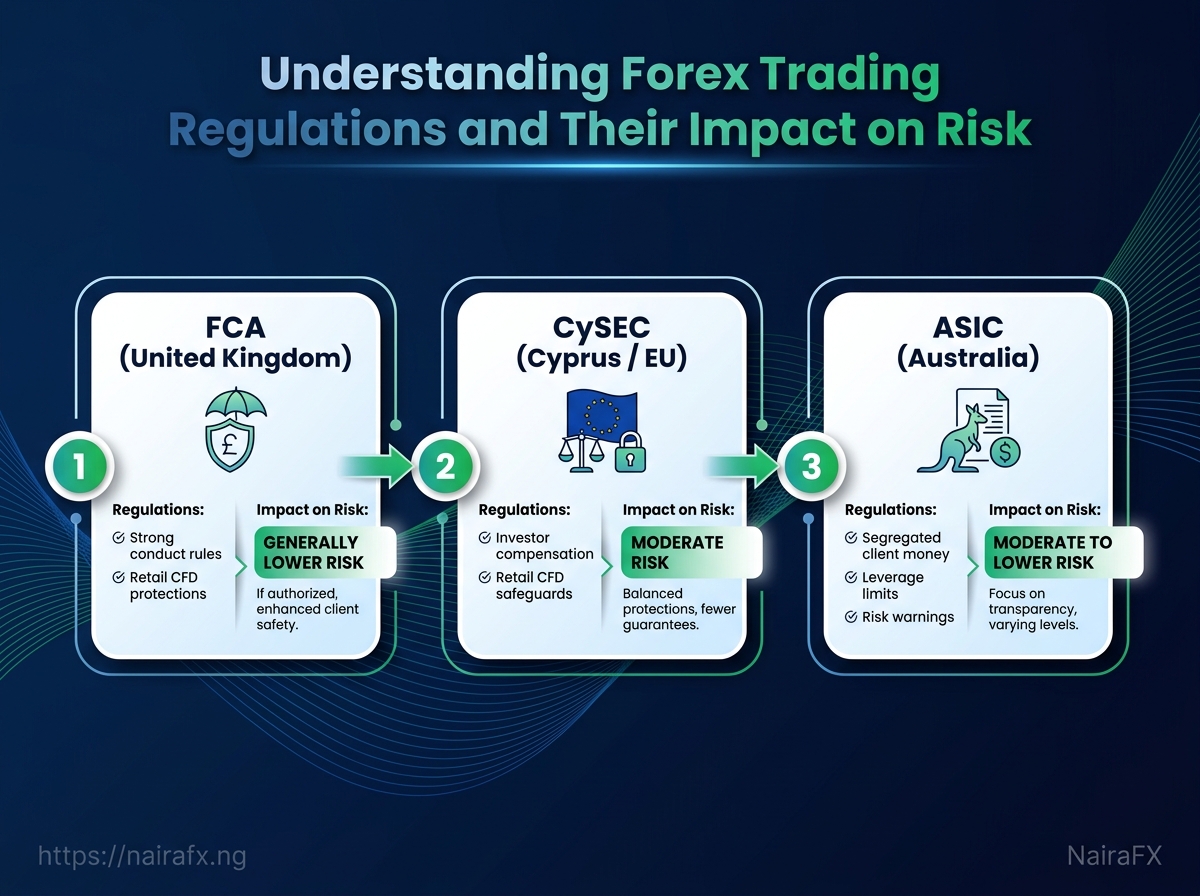
Major regulators at a glance
The stricter the regulator, the more likely you get segregation, reporting, and real oversight.
Chambers’ review of the CBN foreign exchange code also shows how principal risk and market conduct rules matter once a firm is actually taking the other side of a client order Chambers on the new CBN foreign exchange code.
A broker website can say “licensed” and still leave room for confusion.
The trick is to ask: licensed by whom, for what service, and under which legal entity?
- Licensed usually means the named entity is supervised by that regulator.
- Registered can mean a much lighter touch, sometimes with limited investor protection.
- Authorized for CFDs or derivatives is not the same as authorization for every forex product.
- Parent-company licensing does not always cover the offshore company opening your account.
Offshore registrations carry more risk when the regulator has weak enforcement, no meaningful compensation scheme, or little appetite for cross-border disputes.
That is where the trading risk gets sneaky, because the platform may look professional while your practical protection is paper-thin.
For Nigerian traders, this matters even more when deposit methods, withdrawal timing, and dispute handling already face local friction.
A clean license claim is nice; a real supervisory framework is better.
How Regulations Directly Affect Trading Risk
A broker can fail even when the trade idea was solid.
That is where counterparty risk bites: your profit depends on the other side staying alive long enough to settle the deal.
Nigeria’s FX rulebook matters here because the moving parts keep changing.
The CBN’s RSS circulars page shows how active the update cycle is, and The Guardian’s report on the new FX operational guidelines notes that the 2026 manual took effect on June 1.
Segregation is the quiet hero in this story.
If client money sits in separate accounts, a broker’s own debts are less likely to drag trader deposits into the mess.
Imagine a Lagos trader who wires funds on Monday and holds an open position by Friday; if the broker runs into trouble, segregation can be the line between a temporary delay and a nasty fight with creditors.
The same logic applies to execution risk.
A recent Chambers review of the new CBN foreign exchange code and its implications highlights how principals can take on credit and market risks when handling client orders, while Simmons & Simmons’ update on foreign exchange regulations in Nigeria notes that pricing rules have become more market-driven.
That shifts the risk profile from “fixed and predictable” to “you need better controls.”
How leverage and margin rules change the damage
| Rule type | What it does | Risk reduced | Trader trade-off | Example effect |
|---|---|---|---|---|
| Leverage cap | Limits how much exposure a small deposit can control. | Cuts the chance of a fast account wipeout from one sharp move. | Smaller position sizes and slower account growth. | A trader must commit more margin before opening the same trade. |
| Margin close-out rule | Forces positions to close when equity falls too far. | Prevents losses from spiraling deeper during a losing streak. | Less room to “wait it out.” | A weak account gets flattened before the loss snowballs. |
| Negative balance protection | Stops losses from going below zero. | Protects traders from owing money after a violent gap. | Some brokers apply tighter conditions. | A gap move cannot leave the trader with a debt balance. |
| Risk warning disclosure | Forces brokers to spell out how often traders lose money. | Reduces hidden expectations and bad sizing habits. | Fewer glossy promises. | A newcomer sees the danger before funding an account. |
| Segregated client funds | Keeps client deposits separate from company money. | Lowers loss from broker insolvency or misuse of funds. | Slightly more administrative overhead for brokers. | Trader cash is less exposed if the broker collapses. |
Fair enough.
Still, those limits are usually doing the boring but useful job: they make a bad day survivable.
In practice, that is often the difference between a drawdown and a disaster, and that is where forex regulations really change trading risk.
Why Nigerian Traders Feel the Impact More Strongly
Why does the same trading rule feel heavier in Lagos than in London? The answer starts with access.
Nigerian traders often sit farther from the broker, the bank rails, and the dispute process, so every small friction point gets magnified.
That friction became even more visible after the CBN’s new FX manual took effect from June 1, 2026, with tighter compliance and a more unified framework across the market, as reported by The Guardian on the new FX operational guidelines and CBN’s circular updates feed.
When rules shift and payment channels are already imperfect, traders feel the change in real time.
> In 2026, the CBN’s revised FX framework has made compliance and documentation matter more, not less, for market participants. Chambers’ note on the new CBN foreign exchange code
A trader using a cross-border broker may have no local branch to visit, no local help desk to call, and no fast way to sort out a payment issue.
If a deposit stalls or a withdrawal is delayed, the trade plan can fall apart before the chart even matters.
The pressure grows when documentation is weak.
Trade confirmations, payment records, chat logs, and account statements stop being “nice to have” and become the only proof that counts.
That is where trading risk gets ugly, because a good setup can still turn into a fight over paperwork.
- Local access is thinner: Funding and withdrawals often depend on banks, cards, or transfer routes that can slow down without warning.
- Cross-border brokers add distance: Disputes take longer when the broker, the payment provider, and the trader sit in different legal systems.
- Paper trails matter more: Missing records can weaken your position if a broker rejects a claim or reverses a transaction.
- Currency swings hit twice: The naira can move against you before and after the trade, so risk control needs more breathing room.
That is why currency volatility and forex regulations matter together for Nigerian traders.
A position that looks manageable in dollar terms can feel far riskier once you factor in conversion costs, bank charges, and the chance of payment delays.
We keep that reality front and center at NairaFX, because trading risk here is never just about entry and exit.
It is also about the road money has to travel before and after the trade.
How to Check Whether a Broker Is Properly Regulated
A broker says it is licensed.
Fine.
Licensed by whom, exactly?
That is the first question worth asking, because the word regulated means almost nothing without a regulator name, a license number, and a legal entity you can match yourself.
The cleanest check starts with the broker’s full company name, not the glossy brand name on the homepage.
Then go straight to the regulator’s public register and match the details one by one.
If the name, number, jurisdiction, or permissions do not line up, the claim deserves suspicion.
Nigeria’s FX rulebook has also been shifting in 2026, with the CBN’s circulars and guidelines changing the compliance picture CBN circulars RSS feed, while the June 2026 rollout of new FX operational guidelines was widely reported as a fresh compliance move Guardian report on new FX operational guidelines.
A simple verification checklist
Start with the legal entity.
A lot of fake comfort comes from a familiar brand name that is not the licensed company at all.
- Find the exact legal name: Check the footer, client agreement, and terms page for the registered company name.
- Match the license number: Look for a regulator-issued number, then search that number on the official register.
- Confirm the permissions: Some firms are licensed for limited activities only, not for the full services they advertise.
- Check the status: Active, suspended, expired, or revoked matters more than the marketing copy.
- Compare the address: A real firm usually has a matching registered address across the register and legal documents.
Red flags that often show up fast
Unregulated brokers love fog.
They hide behind vague wording, offshore phone numbers, and support chats that dodge simple questions.
- No license number anywhere: That is rarely an accident.
- A different company name in the terms: Brand name and legal entity should not be strangers.
- Clone-firm behavior: They copy the name of a real regulated broker and hope nobody checks carefully.
- Pressure to deposit quickly: Real firms do not need panic-selling tactics.
- Unclear withdrawal rules: If cash-out terms are buried or slippery, trading risk rises fast.
Where to confirm it using official sources
The best habit is boring and effective: verify the broker on the regulator’s own website, not on a review blog or affiliate page.
For Nigerian traders, the CBN’s official circulars feed is the first stop when local FX rules matter.
For overseas brokers, the official registers from regulators such as the FCA, ASIC, and CySEC are the real test, because they show whether the firm is actually authorized and what it can legally do.
A clean license trail should feel plain, not mysterious.
If the paperwork looks messy, that is usually the market telling you to step back before the trading risk gets expensive.
Regulation, Strategy, and Risk Management Work Together
If the broker is cleaner, why does the account still blow up? Because regulation lowers the odds of ugly surprises, but it never decides how much pain a bad trade can cause.
That part still comes down to position sizing, stop-loss placement, and how much of the account sits on the line each time.
Recent FX updates from the CBN are a useful reminder that the ground keeps moving. The CBN’s circulars and FX updates, along with coverage of the operational guidelines and the latest CBN foreign exchange code, point to a market where compliance and execution rules matter just as much as signal quality.
Rules shape the style
Scalpers feel regulation and broker policy first.
When spreads move, execution slows, or holding rules get tighter, tiny profit targets start looking less attractive.
Hedging can also run into account terms or broker-side limits, while high-frequency trading needs very specific order handling to work at all.
Even Simmons & Simmons’ update on Nigeria’s foreign exchange regulations notes changes around spreads and FX handling—details like these matter a lot when a strategy depends on small price differences.
Sizing should adapt to the rulebook
- Keep
risk-per-tradesmall: A safer broker does not make oversized trades safer. - Place stops where the setup fails: Good stops follow market structure, not comfort.
- Scale down when spreads widen: Higher entry costs eat into the trade before it starts.
- Test scalping rules in live conditions: Demo fills often flatter fast strategies.
- Respect hedging and turnover limits: A strategy that needs prohibited behavior is fragile by design.
A strong plan treats Forex regulations, broker rules, and trading risk as one system.
That is where better decisions start showing up on the equity curve.
Building a Safer Trading Setup Around Regulation
Before funding a live account, the real question is not “Is this broker licensed?” It is “Does this setup protect me when the market gets messy, the rules shift, or the payout gets delayed?”
That matters more in Nigeria right now because the regulatory backdrop keeps moving.
The CBN’s recent FX framework and ongoing circulars continue to shape compliance expectations for banks and market participants (see the CBN circulars feed and The Guardian report on the new FX operational guidelines).
Questions worth asking before funding
A broker can look fine on paper and still be a poor fit for your trading risk.
The safer move is to ask questions that connect regulation to your own plan, not just to a license badge.
- Who holds the client money? Segregation, custody, and payout process matter more than shiny marketing.
- What changes when rules shift? A broker that adapts quickly to Forex regulations gives you fewer ugly surprises.
- How are spreads, fees, and execution handled? Nigeria-focused traders should care about pricing behaviour during thin liquidity—especially where the CBN framework increases emphasis on principal risk handling and compliance duties.
- What happens during a dispute? A clear complaint path is a safety feature, not an afterthought.
- Can I withdraw under stress, not just on a good day? That is the real test.
Pairing regulation with a personal risk plan
Regulation lowers the chance of avoidable damage.
Your plan handles the damage that still gets through.
A simple approach works best.
Set a maximum loss per trade, a daily loss cap, and a hard rule for position size.
Then match those limits to the broker’s execution model, because no amount of good policy saves an oversized trade.
Here is the monthly routine that keeps things honest:
- Check the broker’s status. Confirm the licence, website details, and any regulatory updates.
- Review actual fills. Compare expected entry prices with what you received.
- Inspect fees and spreads. In today’s CBN-shaped FX environment, small pricing and compliance shifts can matter—so verify what you’re actually paying, not what the marketing says (see Simmons & Simmons’ update on foreign exchange regulations in Nigeria).
- Audit withdrawals. Test one small withdrawal before trust gets too comfortable.
- Stress-test your exposure. Ask whether one bad week would force bad decisions.
A safer trading setup is boring in the best way.
It catches problems early, keeps trading risk visible, and stops Forex regulations from becoming something you only think about after a loss.
At NairaFX, that monthly habit is the kind of discipline we trust most.
How do Forex regulations affect spreads, quoting, and execution?
Forex regulations directly shape how brokers quote prices and execute orders, which can change your real trade outcome beyond the idea you had at entry. Market conditions like spreads can widen by close, and regulatory rules can also adjust how orders are handled and when pricing must be honored. In Nigeria, compliance expectations can shift quickly after CBN updates, making these effects more noticeable.
What protections do Forex rules provide for client funds in Nigeria?
Forex rules in Nigeria emphasize client-funds safeguards, especially segregation of client money into separate accounts. When trader deposits are kept apart from a broker’s operational funds, the broker’s debts are less likely to pull client balances into insolvency or settlement problems. This reduces counterparty risk even when market rules and execution conditions change.
How does regulation change funding costs or order handling risk?
Forex regulation can change funding costs and order-handling risk by tightening or altering broker conduct and operational rules that affect margin, leverage, and the way trades are processed. That means the same trade can feel “safe” at one time but become different later as spreads widen, funding costs shift, or a rule changes order handling. Constant regulatory updates can therefore increase transparency of risks rather than remove them.
How can a trader check a broker’s license number and legal entity?
A trader should verify a broker’s license by matching the broker’s full company name (not just its brand) against the regulator’s public register. Confirm the license number, legal entity name, jurisdiction, and whether the broker has the correct permissions. If any detail—name, number, location, or authorization—doesn’t line up, the broker’s claims deserve suspicion.
What role do dispute and complaint procedures play in Forex risk?
Dispute and complaint procedures are a core risk-control feature because they define how issues like pricing, execution errors, and withdrawal problems are handled. Nigeria-based traders can feel more risk impact when they are farther from the broker, the bank rails, and the complaint/dispute process, so delays or weak procedures magnify friction. Clear, enforceable complaint paths reduce the chance of hidden costs or unresolved account problems.
Regulation Is Part of the Trade
Remember the practical takeaway: forex regulation doesn’t make trading “safe,” but it changes which risks are reduced and which risks you must manage yourself.
The real test is how the broker handles the pressure points—spreads and execution quality, withdrawals under stress, leverage/margin application, and whether client-funds and dispute records are handled clearly.
So the move is simple and action-focused: verify the broker’s regulator claim using the steps above, then align your position sizing, stop-loss placement, and monthly checks (fills, fees/spreads, and withdrawals) with that broker’s execution reality.
If you want a second layer of judgment, use broker reviews alongside your own risk plan—because in forex, your protection comes from both the rulebook and your process.