
The hardest part of forex is not picking a pair.
It is staring at a losing trade and realizing your hands are shaking.
That reaction tells you more than any indicator ever will. Forex risk tolerance is the point where your money, your nerves, and your judgment all meet.
If that point is too close to your limit, even a solid plan starts to feel unbearable.
A trader with a healthy trading comfort level can take a loss without reaching for panic buttons.
A trader who has not done enough assessing risk often discovers their limit only after real money is on the line.
That usually means smaller sleep, sloppy exits, and decisions made in a rush.
The market does not care how confident you felt yesterday.
It only exposes what you can actually handle today.
That is why risk tolerance is not a personality quiz.
It is a practical check on how much account fluctuation, uncertainty, and pressure you can absorb while still thinking clearly.
Once that becomes honest, position size, stop-loss placement, and trade frequency stop feeling random and start making sense.
Quick Answer: Forex risk tolerance is your personal comfort level with loss, volatility, and uncertainty—specifically, how much pressure you can handle without breaking your rules (like moving your stop or chasing losses). It’s different from risk management: risk tolerance is your emotional/behavioral capacity, while risk management is the rule set that limits damage (position size, stop-loss placement, and exposure limits). If you want to measure it, use the self-check checklist in Section 6 to score how you react to drawdowns—and then translate that result into a plan in Section 8 so your sizing and stops stay consistent in real trading.
Would you still sleep well after three losing trades in a row?
That question matters more than most chart setups. Forex risk tolerance is your personal comfort level with loss, volatility, and uncertainty.
It is not about being fearless.
It is about knowing how much pressure you can handle before you start making sloppy decisions—like moving your stop, lowering your standards, or trading to “feel better.”
It also matters that comfort and competence are not the same thing. A trader can use good assessing risk habits and still be a poor fit for aggressive sizing, while another trader may feel calmer sticking to rules when spreads widen and price gets jumpy.
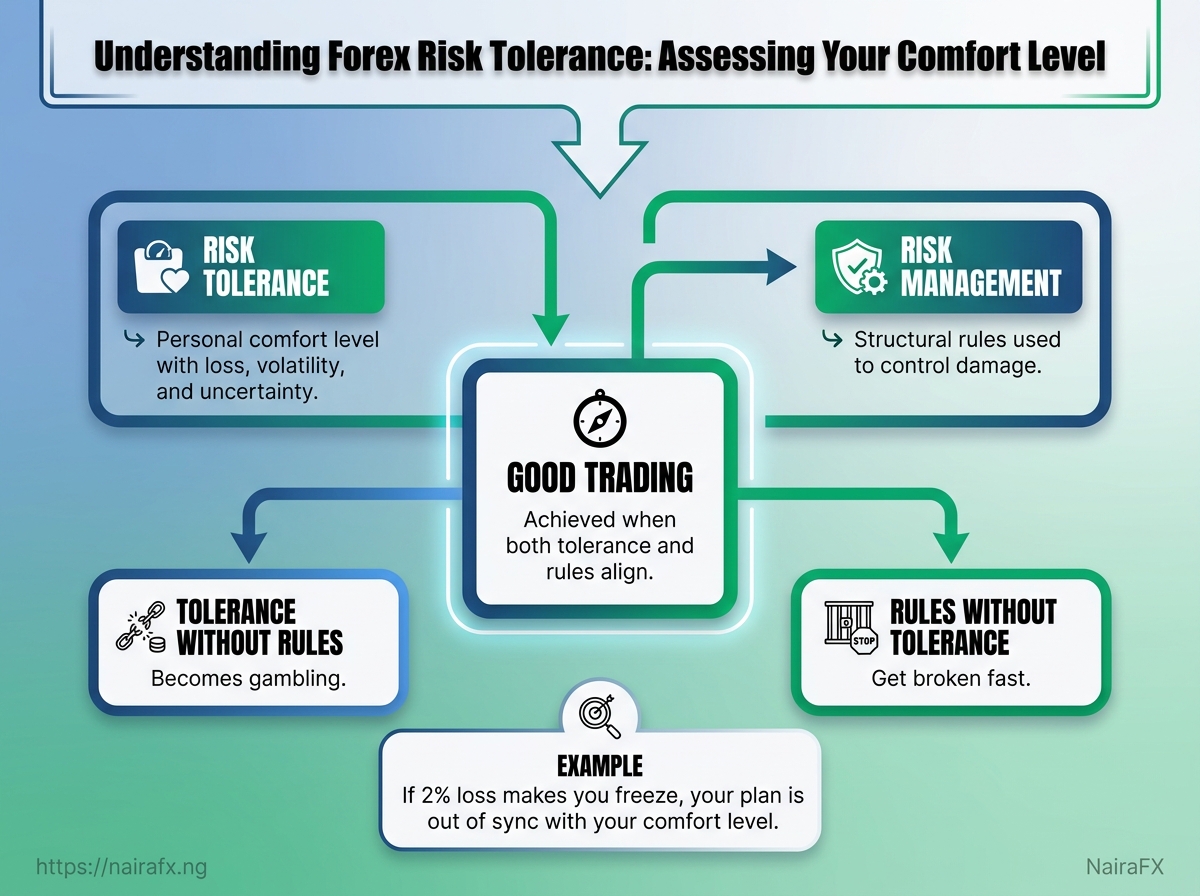
Risk tolerance and risk management are not the same thing.
- Risk tolerance is personal. It reflects how much loss you can stomach without panicking.
- Risk management is structural. It is the rules you use to control damage.
- Tolerance without rules becomes gambling.
- Rules without tolerance get broken fast.
- Good trading happens when both line up.
Think of it like this: if a trade loss makes you freeze, your plan is too large for your current temperament.
The goal is not to label yourself as “strong” or “weak.” The goal is to test yourself honestly before going live.
A demo run, a short journal, and a few weeks of tracking what your emotions do during drawdowns will tell you more than confidence ever will.
Once your comfort level and your rules agree, position size, stop-loss placement, and trade frequency stop feeling random—and start feeling repeatable.
The factors that shape your trading comfort level
A trader with a steady salary can shrug off a rough week.
Someone paying rent from the same account feels every pip differently.
That gap is where trading comfort level really lives.
It is shaped by money pressure, how you handle losses, and how much trust you have in your own process.
Financial pressure changes the picture
When trading capital overlaps with living expenses, every trade feels louder.
An account funded from spare cash behaves very differently from one that pays for food, transport, or school fees.
That is why assessing risk starts with personal cash flow, not just chart setups.
A 2026 guide from com/forex-insights/risk-management-in-forex-trading/”>TradeTaurex on forex risk management and FD Capital’s forex risk management guide both stress capital protection, and the logic is simple: pressure pushes traders to break rules.
A small account can still trade well.
It just needs smaller position sizes and cleaner expectations.
Emotional reaction matters more than most traders admit
Some traders ignore a drawdown for three days.
Others see one red trade and start doubling size to “get it back.” That difference tells you a lot about your real Forex risk tolerance.
MH Markets’ 2026 forex risk management playbook highlights emotional discipline alongside stop-loss rules and position sizing.
BlueGuardian also notes in 2026 that many traders keep per-trade risk around 0.5% to 2%, partly because smaller losses are easier to absorb mentally.
If uncertainty makes you stare at the screen and second-guess every candle, your comfort level is lower than your strategy paper says.
Experience shapes confidence, but only if it is earned
A newer trader often confuses confidence with luck.
A more seasoned trader knows a strategy can be right and still lose on the day.
That is where repetition helps.
The more often you see the same setup behave under different market conditions, the less shocking normal drawdown becomes.
Arincen’s 2026 forex risk management article and BlueGuardian’s risk management guide both point to disciplined sizing and consistency as the bridge between theory and usable confidence.
A trader who has tested a strategy through losing streaks usually tolerates more stress.
Not because losses feel good, but because they feel familiar.
That familiarity is gold.
It turns emotional noise into data, and data is easier to trade.
How to assess your risk tolerance step by step
Before a single naira goes into a live account, the real test is not the chart.
It is your reaction when a trade goes wrong and stays wrong for a while.
Good Forex risk tolerance shows up in ordinary moments.
Do you stay calm after a loss, or start rewriting your whole plan in the heat of the moment?
1.
Start with the money question.
Ask whether a losing streak would dent rent, bills, savings, or sleep.
If the answer feels shaky, your current trading comfort level is probably lower than you thought.
2.
Then test the emotional question.
Imagine three losing trades in a row.
If that thought makes you want to double size, skip rules, or chase back losses, the account is too hot for your nerves right now.
3.
Finish with a behavior check.
Demo trading and a short journal are the fastest way to spot patterns.
The numbers matter, but the notes around them matter even more.
Test your response to losses with a simple self-check
| Assessment Area | What to Ask Yourself | High-Risk Tolerance Signal | Low-Risk Tolerance Signal |
|---|---|---|---|
| Income stability | Can I afford a losing streak without stress? | Yes, with room to spare | No, even a small loss feels heavy |
| Cash buffer | Do I have money set aside outside trading? | Separate emergency savings exists | Trading funds are also life money |
| Sleep reaction | Would a red day ruin my sleep? | Sleep stays normal | I keep replaying the loss |
| Loss size | Can I accept a small planned loss? | A stop-loss feels routine | Any loss feels personal |
| Recovery urge | Do I want to recover losses immediately? | I can wait for the next setup | I feel pushed to trade right away |
| Rule discipline | Can I follow my plan after a hit? | I stick to the plan | I start changing rules mid-trade |
| Position sizing | Does smaller size feel too easy or just right? | Small size feels sensible | I feel tempted to go bigger |
| Journal honesty | Can I write down mistakes without excuses? | Yes, clearly and calmly | I avoid writing down bad trades |
That gap matters, because risk management guidance in 2026 still centers on position sizing, stop-loss discipline, and emotional control, not wishful thinking (Forex Risk Management Playbook 2026, Forex Risk Management Tips to Trade Safely in 2026).
Demo trading makes the picture sharper.
Journal notes show whether your mistakes come from impatience, oversized positions, or simply bad setups, which is why traders who review their logs usually spot the same weak spots again and again.
A useful rule of thumb from risk education is to keep each trade small enough that one loss does not force an emotional reset, with many guides placing per-trade exposure in the 0.5% to 2% range of account equity (How to Manage Risk in Forex: Proven Strategies Every Prop Trader Needs).
When the answers are honest, the rest gets easier.
You stop guessing your risk tolerance and start seeing it.
Does your trading plan feel calm on paper but tense in real life? That gap is usually where traders get into trouble.
A plan only works when the numbers match your nerves.
If a position size makes you check the chart every five minutes, it is too large—no matter how elegant the setup looks.
Instead of copying a generic risk percentage, use what you learned from your own self-check: choose a fixed per-trade risk cap you can tolerate even when the market gets noisy.
The same logic applies to stop-loss placement.
A stop should sit where your trade idea is wrong, but it also has to represent a loss you can accept without revenge trading. If you cannot accept the loss twice in a row (after two similar setups), your size is too big or your stop is too wide.
Use this checklist to match Forex risk tolerance to your plan:
- Position size: Keep the loss small enough that a single trade feels annoying, not personal. If your mood changes for the day, cut the size.
- Stop-loss level: Place it beyond normal market noise, then sanity-check whether you can follow your plan if price taps that stop.
- Trade setup fit: Choose setups that match your patience. A slower pullback system suits a trader who can wait; a faster breakout plan suits someone who can act decisively.
- Timeframe match: A higher-timeframe (4H/daily) approach often fits a calmer comfort level than a one-minute chart.
- Decision rules: Fewer moving parts make better execution—simple entries, fixed risk, and clear exits reduce emotional drift.
A plan that matches your Forex risk tolerance should feel repeatable, not dramatic.
When your risk size, stop, and setup fit together, assessing risk stops being a separate task and becomes part of how you trade.
A trader can feel fearless after three winning trades and still have a very low trading comfort level once money starts moving fast.
That gap catches people all the time in Forex risk tolerance decisions.
The biggest trap is mistaking a hot streak for real stability. Recent wins can make a trader size up too fast, but true comfort under pressure shows up when the market turns ugly and the account stops feeling cooperative.
Another common mistake is copying someone else’s style without checking whether it fits your life.
A trader with plenty of screen time, spare cash, and a steady temperament can survive a method that feels brutal to someone balancing work, family, and a thinner buffer.
That is why assessing risk has to include your actual routine—not just how confident you feel on a good day.
Here are the most frequent judgment errors:
- Confusing confidence with comfort: A few clean wins can make you feel “invincible.” Real comfort shows up when price goes against you and you still follow your plan.
- Sizing up after a lucky streak: A run of profits can hide weak judgment. Use the same pre-set per-trade risk cap you defined earlier—don’t change it based on emotion.
- Copying another trader’s rhythm: A fast scalper’s stress may look manageable from the outside. Inside your own account, the pace may be a terrible fit.
A better habit is to test size, schedule, and patience together—not one at a time.
When those three line up, Forex risk tolerance stops being a guess and starts looking like something you can actually trust.
A sharp move in EUR/USD at London open can feel exciting for about ten seconds.
Then the spread widens, your phone buzzes, and that calm trading plan starts sounding optional.
That is where Forex risk tolerance gets tested properly.
In volatile markets, the issue is not just how much you can lose.
It is how clearly you can still think when price moves fast and your screen stops feeling friendly.
For Nigerian traders, pressure can also be practical:
Internet drops, power cuts, delayed funding, and local timing around news can push a trader out of rhythm.
Market swings can bend discipline
Fast markets can trigger chase behavior. A trader who usually waits for a clean setup may start taking the second entry just because price is moving.Your defense is still the same foundation: enforce your pre-set risk cap, keep your stop-loss rules consistent, and protect decision-making from panic.
> Many guides recommend keeping per-trade risk small—but the real goal is to use your fixed cap from your self-assessment so you can follow the plan during stress.
Build a routine around local realities
A good routine in Nigeria has to survive real life, not just clean backtest conditions.If your chart time clashes with work breaks, unstable data, or market-moving news, your routine needs fewer moving parts.
- Pick fixed check-in times: Review before trading, not while reacting to every candle.
- Pre-set your risk limit: Decide the maximum loss for the session, then leave it alone.
- Use simple session rules: Trade only when power/data/margin are stable enough to avoid rushed exits.
Consistency beats the thrill of speed
Chasing fast results usually turns volatility into a personality test.Steady execution turns it into a business.
That is why beginner guides keep coming back to capital protection first: a modest but repeatable edge usually lasts longer than trying to catch every spike.
A calmer routine also makes assessing your trading comfort level easier, because you are not constantly improvising.
Consistency keeps the account steadier—and in choppy markets, steadier usually wins.
When Your Hands Shake, The Market Has Already Taught You Something
The moment your pulse jumps on a losing trade, your account balance is no longer the main story.
That reaction is the real signal, because Forex risk tolerance lives in your body before it shows up in your spreadsheet.
A trader who knows that difference stops guessing and starts making cleaner decisions.
That is why assessing risk works best when it is tied to real behavior, not wishful thinking.
If a 2% loss makes you close trades too early, your trading comfort level is telling you to shrink size or slow down.
The Nigerian market adds another layer, since sharp moves, news spikes, and liquidity shifts can turn a “small” position into a stressful one very fast.
The smartest move today is simple: open your last three trades, note where stress kicked in, and write down the exact loss size that felt tolerable. Then set your next trade around that number, not around hope. If you want a deeper framework, our risk management work can help shape that into a plan that fits real trading conditions, not imaginary ones.