

Why does a clean forex setup fall apart the moment a news candle hits? The answer is rarely the chart itself; it is market volatility changing the rules under your feet.
A trade can look harmless until a release hits, spreads widen, and the stop gets clipped before price settles.
That is the real impact of volatility on Forex: not just bigger swings, but worse entries, worse exits, and less room for error.
Forex trading volatility matters because price is only part of the risk. Slippage can turn a planned loss into a larger one, especially when liquidity thins out or orders hit a fast-moving market.
That is why serious traders think beyond direction and ask a harder question: how much can the pair move against us, and what will it cost to get out? Once that question becomes part of the routine, volatility stops being a surprise and starts becoming something measurable, planned for, and far easier to survive.
Quick Answer: Market volatility increases Forex trading risk because it changes the conditions your order experiences—not just how the chart moves. In fast or news-driven regimes, liquidity can thin and fills can occur worse than the price you planned, so your real stop/entry cost can differ from “paper” chart risk. Treat volatility as a regime input: estimate the expected movement for the time you’ll actually be in the trade (e.g., via ATR), stress-test friction (realistic spread/slippage) for that window, then size and place stops based on the worst-case execution you can tolerate—not on ideal fills.
What does market volatility really mean for your trade risk?
A setup doesn’t change—but your trade conditions do.
Market volatility is how quickly and how far price is expected to move while you’re trying to enter, manage, and exit. When volatility rises, your risk shifts from “what the chart shows” to “how your orders get filled.”
In a calmer market, you can often place a stop where the market usually oscillates. In a volatile market, the same stop level may be tested by routine noise, and fills may occur at a worse price than you planned—especially when liquidity thins.
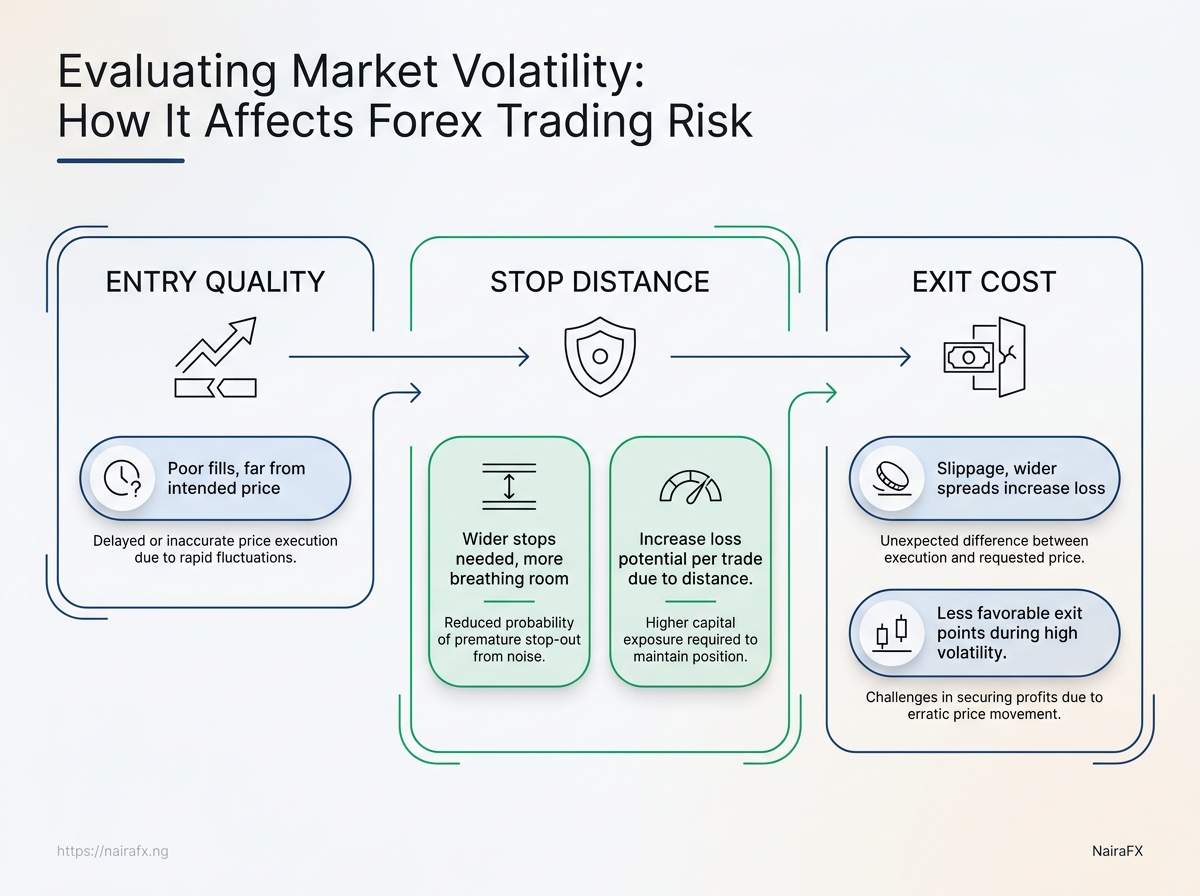
That’s why volatility affects Forex risk in three practical ways:
- Entry quality: Your execution can drift from the intended level when order books are thin or spreads widen.
- Stop distance: A stop that matches normal candle noise may be too tight once price starts moving faster than usual.
- Exit cost: Even if your direction is right, slippage and spread widening can turn a planned loss into a larger one.
So when you look back and think, “This trade was perfect yesterday,” the missing variable is often the regime: liquidity and execution conditions.
A breakout at one session time may behave like a controlled expansion; the same idea later can become choppy because the market is moving through wider spreads and faster swings.
This is also where execution-aware risk modeling matters. For a practical approach, see our Top 5 Risk Assessment Models for Forex Traders piece, which encourages using realistic spread/slippage assumptions—not just chart-based “paper risk.”
Quick rule to keep it simple: when volatility increases, first estimate how much the market can move against you during the time you’re in the trade, then estimate what it will cost to exit under that same volatility.
Once you do that, volatility becomes a planned condition—not a surprise.
How volatility changes Forex trading outcomes
In Forex, volatility doesn’t only affect candle size—it changes what the trade experiences from entry to exit.
When the market is quiet, you tend to get more consistent pricing around your levels. When the market is fast, execution becomes less predictable: price can move away quickly, bid-ask spreads can widen, and the market may tag stops that “shouldn’t” be hit based on a low-volatility chart.
That’s why one pair can look like a reliable opportunity in one regime and behave like a trap in another.
Low-volatility versus high-volatility conditions
| Condition | Market behavior | Risk level | Stop-loss impact | Best trader response |
|---|---|---|---|---|
| Low volatility session | Small candles, slower follow-through, tighter spreads | Low to moderate | Stops can sit closer, but still need room for normal noise | Use modest targets and avoid overtrading |
| High volatility session | Large candles, fast swings, wider bid-ask spreads | High | Stops often need more breathing room, so position size usually drops | Cut size, expect slippage, and plan for messy fills |
| News-driven spike | Sharp repricing, thin liquidity, sudden jumps | Very high | Stops can be tested instantly or filled far from your intended level | Wait for the initial burst to cool before committing |
| Range-bound market | Bounces between support and resistance | Moderate | Tight stops inside the range get clipped often | Trade edges carefully or stay smaller |
| Breakout attempt | Compression breaks into expansion and momentum | High | Stop distance must handle false breaks and retests | Look for confirmation, not the first burst |
In volatile regimes, drawdown can build faster because a single sharp move can pressure multiple trades—especially if you’re exposed to the same driver (e.g., USD headlines or broad risk-off/risk-on flows).
Traders who respect the regime tend to do two things well: they reduce size when swings accelerate, and they treat volatility as an input to both entry quality and exit cost—not just as “more movement.”
How can you evaluate volatility before entering a Forex trade?
Before you ask, “Is the setup good?”, ask an execution-minded question: Can I still manage the trade if the market moves with the volatility regime I’m about to enter?
Start with a quick pre-trade read that tells you whether today’s conditions match your stop, your timing, and your risk.
A practical pre-trade read
- Check ATR first: Compare current ATR to recent candles. Rising ATR usually means wider swings and more frequent stop pressure.
- Scan the news calendar (and your local timing): High-impact releases can cause sudden repricing and spread instability. Treat timing risk as part of the plan—not an afterthought.
- Note session overlap: Liquidity is often deeper during London/NY overlap; quiet hours can mean choppier fills.
- Measure where price is in its typical range: If price has already traveled most of its usual daily movement, late entries tend to have less “room” and more reversal risk.
- Match the stop to the environment: In fast markets, stops that look “technically reasonable” can still be hit by normal volatility noise.
A quick example (execution-aware)
Even if USD/JPY looks orderly on a 15-minute chart, if ATR is expanding and a major scheduled catalyst is near (in your local Nigeria time window), the trade can behave differently from what your backtest implies. The chart may stay “clean,” but your fills and stop behavior are what determine whether the risk stays controlled.
Volatility doesn’t need to be feared—it needs a check. Use it to make sure your trade plan still fits the market in front of you.
What mistakes increase risk when volatility rises?
A solid idea can fail for a boring reason: the market’s conditions change faster than the trader’s plan.
When volatility increases, you’re more likely to run into three failure modes: position sizing that’s no longer appropriate, stops placed where normal noise can reach them, and timing that ignores execution risk.
Our risk disclaimer covers the basics—spreads can widen during volatile periods and around open/close/news windows. In practice, that alone can turn an otherwise workable trade into an uncomfortable one.
Mistake 1: Position size set for the “calm version” of the market
Trading the same size in every environment magnifies losses.
- Same stop, different risk: A 50-pip stop during a calm session isn’t the same risk as a 50-pip stop during a fast release.
- Drawdown accelerates: Volatile conditions can make equity swings happen sooner, which can damage decision quality on the next trade.
- Better habit: Reduce size when liquidity thins or major news is near—especially on pairs that react sharply.
Mistake 2: Stops placed too tightly for the current regime
A tight stop can be a tool—until it becomes a habit.
- In fast markets, prices can move enough to tag your level before your thesis has time to play out.
- “Precision” in entries matters less than allowing room for normal swing behavior.
- The safer rule: place the stop where the idea is actually invalidated, not where the chart merely looks still.
Mistake 3: Forcing the trade instead of waiting for conditions to stabilize
Mini-case: a trader watches GBP/USD near a well-defined support zone ahead of a major UK data release. The market has started to “jump” rather than glide, and price is producing inconsistent candle structure.
Instead of entering and hoping volatility behaves, the trader stands aside until the initial reaction is over—then re-evaluates whether the market returns to a tradable rhythm (or whether the original thesis got undermined).
When volatility is rising, discipline isn’t an abstract virtue—it’s how traders keep risk aligned with reality.
Respect size, stop distance, and timing together, and you give yourself a far better chance to survive the bad days.
How do strategic traders manage volatility without avoiding the market?
Why chase every move when the better edge is choosing which moves deserve capital? Strategic traders do not run from market volatility; they scale into it with tighter rules, smaller size, and stricter trade selection.
The first move is often position size.
When Forex trading volatility rises, a fixed lot size becomes a blunt tool, so skilled traders trim exposure until the trade fits the day’s movement, not the other way around.
They also become pickier.
A choppy pair with wide swings and messy price action may still offer opportunity, but cleaner setups on liquid pairs usually give better control over the impact of volatility on Forex outcomes.
Another smart habit is to think in ranges, not guesses.
Our risk work at NairaFX treats volatility as a condition that changes both entry quality and exit quality, so the same setup can deserve very different sizing depending on how fast the market is moving.
A simple volatility-response plan
| Volatility level | What to check | Trade size guidance | Stop-loss guidance | Decision |
|---|---|---|---|---|
| Low | Range width, session timing, whether price is drifting | Use normal size if setup quality is strong | Keep stops near structure, not random points | Trade if the setup is clean |
| Moderate | Daily range expansion, spread stability, news calendar | Reduce size slightly if conditions are uneven | Allow more room than in low volatility | Trade selectively |
| High | Fast candles, wider spreads, thin liquidity | Cut size sharply or split into smaller entries | Use wider, structure-based stops | Trade only top-tier setups |
| Extreme | Erratic price jumps, whipsaws, poor fills | Stand down or use minimal exposure | Avoid tight stops that invite noise | Skip unless the edge is exceptional |
| News event | Scheduled release risk, spread widening, execution speed | Reduce to the smallest practical size | Place stops with extra room or wait until after release | Usually wait for post-news structure |
First comes the market condition, then the trade size, then the stop, then the final yes-or-no call.
That order matters.
Traders who respect it usually survive more bad sessions and stay mentally calm when volatility spikes.
The cleanest setups often come from patience, not action.
When the market gets loud, fewer trades and smaller size usually beat constant participation.
When should you stand aside instead of forcing a trade?
Not every red flag is a signal to “manage harder.” Sometimes it’s a signal to not participate.
Market volatility does not automatically create opportunity. It can also create uncertainty in pricing, execution, and timing—so a setup that looks fine on the chart may fail your execution test.
A trade passes only if it still makes sense after you account for:
- uncertainty in fill price,
- higher transaction friction (spread/slippage), and
- timing risk around when volatility is likely to peak.
At NairaFX, this aligns with execution-aware thinking: paper risk and real account risk diverge most when conditions get rough.
A no-trade decision rule (use it in under 30 seconds)
If any of these are true, stand aside:
- Your edge depends on a near-perfect fill. If a small slip removes the trade’s logic, the trade is too fragile.
- The market isn’t committing to a direction. If price keeps flipping between levels, the signal is still noisy.
- Your stop would sit inside normal chaos. If typical swings can knock you out before your thesis has room to work, wait.
- You can’t explain the edge clearly. If the reason sounds vague, you’re forcing a narrative, not trading a process.
- You want the trade because you’re bored. That’s emotional pressure disguised as strategy.
Rule of thumb: if the setup only works when everything goes right, it’s not a good setup for real markets.
Strong traders protect capital by skipping low-quality conditions—especially during volatile regimes where patience preserves both money and clarity.
Missing one trade is usually cheaper than carrying a low-quality one into the next session.
What is the volatility in 2026?
The article does not provide a specific volatility figure for 2026. It instead explains how rising volatility affects Forex risk by changing execution conditions—spreads can widen, liquidity can thin, and slippage can worsen your fills. Use volatility measurement tools like ATR and a news calendar to estimate current risk rather than relying on an assumed 2026 number.
Is VIX a good buy right now?
The article does not give a current recommendation on VIX or whether it is a good buy right now. What it does emphasize is that volatility instruments matter mainly because they signal changing execution risk: faster markets can widen spreads and increase stop-loss slippage. For a decision, tie any volatility view to execution-aware risk assumptions (spread/slippage) and stop placement.
What does Warren Buffett say about volatility?
The article does not attribute any specific quote or guidance from Warren Buffett about volatility. It focuses instead on practical trading mechanics: volatility changes trade conditions during entry, management, and exit by affecting fills, spreads, and stop reliability. Base your approach on measurable conditions (like ATR and news-driven liquidity changes) rather than a generic volatility quote.
What is the best indicator for market volatility?
ATR is the most actionable volatility indicator highlighted for Forex traders. The article recommends checking ATR first by comparing current ATR to recent candles; rising ATR typically means wider swings and more stop pressure. Pair that with a news calendar and session timing (e.g., London/NY overlap) to understand when volatility will affect execution.
Is slippage worse during volatility?
Yes, slippage is typically worse during volatility. The article explains that when liquidity thins out or the market moves fast around news, slippage can turn a planned loss into a larger one by filling your stop or entry at a worse price than the chart implies. That’s why risk planning must include realistic slippage and spread assumptions, not just chart levels.
When Volatility Changes the Rules, Your Plan Must Change Too
A trade doesn’t usually fail because the market “moved.”
It fails because market volatility changes the cost and timing of every decision—so your plan has to adapt before you place the trade.
The traders who last are not the ones who chase every move. They’re the ones who verify that the trade still fits the current regime.
Use this simple habit before you click buy or sell:
- Check the volatility regime (e.g., ATR + where price sits in its typical range).
- Confirm the timing risk (news/event windows + current session conditions).
- Translate it into execution reality (stop placement and position size based on what the market is likely to do during your holding time).
And if your setup only works when volatility stays calm, don’t force it. Either wait for conditions to settle or reduce exposure to a size that survives a volatility shock.
Missing one trade is usually cheaper than carrying a low-quality one into the next session.