
Why does a trade that looked safe at entry still hurt the account by the close?
That is where stop-loss orders stop being theory and start becoming survival.
A stop is not just a line on a chart; it is the point where the trade idea is no longer valid, and the loss is kept inside a planned boundary.
The catch is that risk management with stop-loss is never only about placement.
Spread widening, slippage, thin liquidity, and fast news moves can turn a neat plan into a messy exit, especially in volatile forex conditions.
In 2026, the common 1–2% risk-per-trade rule still matters because small losses are easier to absorb than one shock that cuts deep.
That is why Forex trading limits should be set before emotion enters the room.
A good stop-loss does not promise a perfect exit price; it protects the account from a bad idea becoming a bigger one.
Used well, it creates discipline.
Used badly, it becomes a false sense of safety.
Quick Answer: Stop-loss orders protect forex trades by enforcing a predefined exit at the point where your trade idea no longer holds (invalidation), which helps cap your worst-case loss. They work only if your stop distance and position size are planned together using your pre-set account-risk limit—and if you account for realistic execution (spread, slippage, and news spikes) so the filled exit doesn’t break your risk plan. For the practical mechanics and common failure modes, see the next sections on stop placement, sizing, and volatile-market adjustments.
Why Do So Many Traders Get Stop-Loss Orders Wrong?
Are you protecting your account, or just drawing a line on the chart?
That question sits at the heart of most stop-loss mistakes.
A stop-loss order is not meant to be a random escape hatch; it is a hard risk limit tied to the trade idea, your position size, and the loss you can actually absorb.
In 2026, the standard discipline is still to risk only 1–2% per trade.
That works only when the stop distance and lot size are connected, because a wide stop with the wrong size can still hurt badly.
Imagine a trader who “keeps it safe” by placing a stop far away, then opens the same lot size anyway.
The chart wiggles, spreads widen, and slippage adds a little extra damage before the exit fills.
A loss that should have been manageable suddenly starts eating into the account in a real way.
> In 2026, the standard risk cap is still 1–2% per trade.
The core mistake is simple: many traders treat stop-loss orders as a line of comfort instead of a line of invalidation.
If the trade idea is no longer valid, the stop belongs there.
If fear is setting the level, the stop is already too emotional.
- Random placement: The stop sits where it “feels” safer, not where the setup fails.
- Oversized positions: The lot size stays large even when the stop is wide.
- Execution blind spots: Spread widening and slippage are ignored until the exit is hit.
- Hope-based adjustments: The stop moves farther away once the market turns red.
A looser stop can turn a normal loss into account damage fast.
That is why we treat stop-loss orders as part of broader trade guardrails, not a box to tick after entry.
When the stop, size, and execution checks line up, risk management with stop-loss becomes real protection instead of wishful thinking.
That discipline matters even more in Forex trading limits, where thin liquidity and fast moves can punish careless exits.
How Stop-Loss Orders Support Forex Risk Management
A stop-loss is not a safety net you add later.
It is part of the trade plan from the moment you think the setup is valid.
That matters in forex, where price can move fast and calmly planned trades can turn messy in seconds.
When the exit is defined before entry, the trade has a clear ceiling for damage, and the position size can be built around that limit.
We treat the stop as the point where the idea is no longer valid.
That keeps risk management with stop-loss tied to the trade thesis, not to fear, hope, or a sudden change of mood.
A simple trade map makes this easier to see.
If a trader enters at 1.0850, places a stop at 1.0820, and aims for 1.0910, the stop defines the maximum planned loss while the target defines the reward side of the setup.
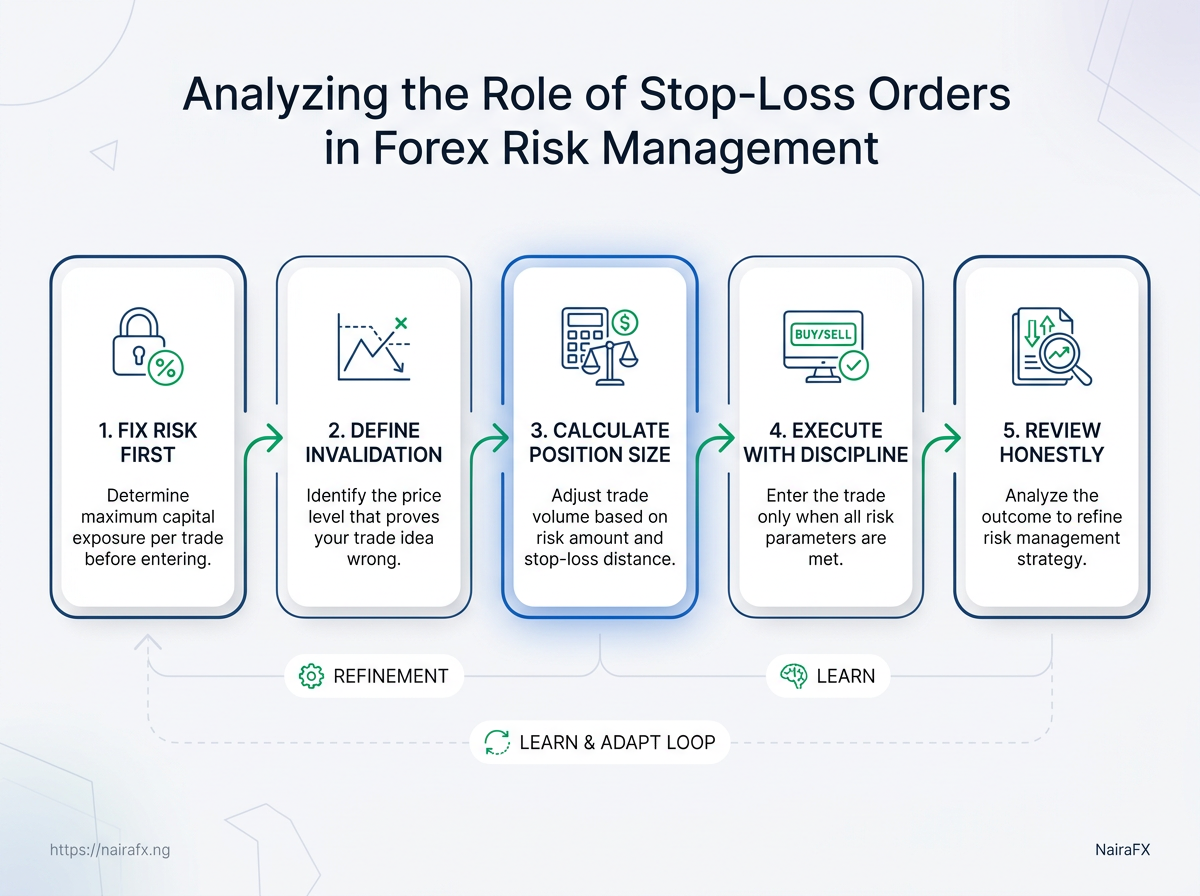
- Risk is fixed first: decide the cash amount you can lose, then work backward to the stop distance.
- The stop marks invalidation: place it where the trade idea fails, not where pain feels more bearable.
- Position size comes after that: a wider stop needs a smaller lot size to stay inside your Forex trading limits.
- Execution still matters: spread widening and slippage can push the real loss beyond the ideal number, especially during news or thin liquidity.
- Review stays honest: if the stop was hit, check whether the setup failed or market conditions distorted the fill.
For Nigerian traders, that last point matters even more.
Naira-driven swings, policy shocks, and broker differences in fills can make a good setup behave badly before the stop can do its job.
A trader who respects a 1–2% risk cap per trade gives the account room to survive a rough streak.
That is where stop-loss orders stop being a guardrail in theory and start acting like part of a real trading system.
Used well, they do more than limit losses.
They force the trade to answer one simple question before money is committed: does this idea still deserve to exist?
What Mistakes Turn a Good Stop-Loss Into a Bad One?
A trader in Lagos moved a stop-loss twice in one afternoon.
First, the stop looked “too tight.” Then price came close again, and fear took over.
That trade did not fail because stop-loss orders are weak.
It failed because the stop stopped being a rule and became a feeling.
The biggest damage usually comes from three habits: placing the stop too close to normal market noise, placing it so far away that the loss becomes painful, and moving it after entry without a clear reason.
A valid stop belongs where the trade idea is no longer valid, not where the nerves feel calmer.
That is why our risk workflow starts with position size, then stop placement, then spread and slippage checks.
In volatile pairs, a stop can be perfectly logical and still behave badly if the market is noisy or the broker’s execution shifts.
- Too tight: The stop sits inside normal price wobble, so routine movement knocks it out early.
- Too wide: The trade has room to breathe, but the loss can still hurt the account badly.
- Moved out of fear: The stop shifts farther away after entry, which quietly breaks the original plan.
- Moved after a small win: A stop is dragged to “give it more space,” then the loss grows because the trade thesis never improved.
- Emotion first: The stop changes because hope, regret, or panic takes over from logic.
A quick self-check helps.
If the stop was placed before the setup was fully understood, it is probably emotional.
If the distance ignores your lot size, it is probably too wide.
If spread widening or likely slippage would make the exit meaningless, the setup was never clean enough for entry.
The healthiest habit is simple: decide the exit before entering, size the trade from that distance, and leave the stop alone unless the plan itself changes.
That keeps stop-loss orders tied to discipline, not drama, and it protects your Forex trading limits from one bad decision turning into two.
How Should Stop-Loss Distance Match Forex Trading Limits?
A stop that looks “safe” on the chart can still blow through your limits if the lot size is wrong.
That is why stop-loss distance and position size must be planned together, not treated as separate decisions.
The real danger is simple: a wider stop does not just change the exit point, it changes how much of your account is on the line.
In our risk framework at NairaFX, the stop marks the point where the trade idea is no longer valid, and the size must fit that distance before entry.
That matters even more in Nigeria, where spread widening, thin liquidity, and fast moves can stretch losses beyond what traders expect.
Our risk management techniques for forex traders in Nigeria article puts the 1–2% risk-per-trade rule at the center of that planning in 2026.
Match risk, stop distance, and size before entry
If you know the most you can lose, the stop distance becomes a sizing problem.
The basic idea is position size = account risk ÷ stop-loss value per lot, then adjust for spread and likely slippage.
| Account size | Risk per trade | Stop-loss distance | Suggested position size | Notes |
|---|---|---|---|---|
| $500 | 1% ($5) | 20 pips | 0.025 lots | Tight stop needs a small size. |
| $500 | 2% ($10) | 40 pips | 0.025 lots | Wider stop still stays within limits. |
| $1,000 | 1.5% ($15) | 30 pips | 0.05 lots | Balanced for a routine setup. |
| $1,000 | 2% ($20) | 50 pips | 0.04 lots | Size falls as the stop widens. |
| $5,000 | 1% ($50) | 25 pips | 0.20 lots | Common for controlled intraday risk. |
| $5,000 | 2% ($100) | 60 pips | 0.17 lots | Larger stop still keeps loss capped. |
| $10,000 | 1% ($100) | 35 pips | 0.29 lots | Useful when volatility is moderate. |
| $10,000 | 2% ($200) | 80 pips | 0.25 lots | Size must shrink as stop expands. |
| $1,000 | 1% ($10) | 70 pips | 0.014 lots | News trade: reduce size, widen stop. |
That is why risk first, execution second, exits third works better than guessing from candle size alone.
For news-heavy pairs, the stop often needs extra room, but the lot size must drop to compensate.
That keeps risk management with stop-loss tied to real Forex trading limits, not to hope.
The clean habit is boring, and that is exactly why it works: set the dollar risk first, then place the stop, then size the trade.
When those three numbers agree, the trade has a fighting chance.
When Should Traders Adjust Stop-Loss Orders for Volatile Markets?
Should a stop-loss always stay fixed once the trade is live? Not in every market condition.
A tight stop can look disciplined, yet volatile markets often punish stops that sit too close to normal price noise.
In fast sessions, the better question is not “How tight can this be?” It is “Where does the trade idea actually fail, after spread, slippage, and noise are accounted for?”
That is the contrarian part of risk management with stop-loss orders.
The best stop is not always the nearest one.
In a breakout, a stop may need breathing room around the trigger zone.
In a range, the same stop can usually sit tighter because price has clearer edges.
Our own risk framework for Nigerian traders treats this as part of the same guardrail logic: position size, stop placement, and spread checks have to work together, especially when liquidity thins.
News events change the game fast
Central bank headlines, policy surprises, and sharp macro releases can turn a calm chart into a messy one in minutes.
In those moments, a stop-loss that made sense on the hourly chart may become fragile if spreads widen or price jumps through levels.
- Before news: keep the stop tied to invalidation, not fear.
- During news: expect wider spreads and less reliable fills.
- After news: reassess whether the move was true breakout flow or just a spike.
A wider planned stop can be smarter than a tight one if the setup depends on holding through the first wave of noise.
That only works when position size is reduced enough to protect the account.
Breakouts and ranges need different stop logic
Breakout trades usually need more room.
Price often retests the level before continuing, and a stop placed right on the edge gets tagged by normal churn.
Ranging markets are different.
They often reward cleaner, tighter invalidation points because price keeps snapping back toward the middle of the band.
> A useful rule: the more chaotic the market, the more your stop should reflect structure, not comfort.
Consider a volatile session in a liquid pair during a major news window.
Price spikes, pulls back, then expands again.
A trader using a wider planned stop survives the first shakeout, while a tighter stop gets clipped before the move develops.
The wider stop only works because the trade was sized for that extra room.
When volatility rises, adjust the stop only if the market structure demands it.
If the change is just fear, leave it alone.
A stop-loss should protect the trade thesis, not react to every candle.
That distinction keeps Forex trading limits intact when markets get noisy.
What happens after three losses in a row, when the next click feels heavier than the last three combined?
That moment usually exposes whether you have a process—or only a mood.
The best stop-loss habits don’t change because confidence drops, the chart looks “messy,” or the last setup failed. They stay tied to the same pre-trade constraints you defined before you entered.
After a losing streak, the temptation is to widen stops, tighten too early, or skip them entirely. None of that builds discipline.
Use this recurring routine every time—so your decision stays consistent across setups.
- Set the stop from the idea, not the feeling. Place it at the level where the setup is invalid, not where discomfort begins.
- Keep your risk budget unchanged. A losing streak isn’t a reason to raise risk. Use the same predefined account-risk limit you’ve already chosen.
- Check execution reality before entry. If spreads are widening or the session is thin, confirm your stop level still matches your plan after likely slippage.
- Use the same review questions every time. Did you move the stop? Did the exit happen where your plan said it would? Did liquidity or pricing behavior distort the fill?
- Record outcomes, not excuses. Treat a “clean loss” differently from a “bad process.” A correct process can still lose; a broken process often costs more than it should.
To understand the workflow tools behind this, see your supporting guide: Forex Risk Management Tools.
The trader who survives pressure is the one who treats each stop-loss order as a decision rule—not a rescue plan.
What is the 7% rule for stop-loss?
There is no single, reliable “7% rule” for stop-loss in the stop-loss risk framework emphasized here. The practical standard is to limit each trade’s loss to about 1–2% by tying the stop level to the trade idea and sizing the position so the maximum loss stays inside that boundary. Any percentage-based rule only works if spread widening, slippage, and thin liquidity can’t push the real loss past your planned limit.
Why do 90% option traders lose money?
Most traders lose because their risk management fails under real pressure, not because options are inherently “doomed.” A core reason is that stops (or exits) stop being rules and start becoming feelings—like moving stops after entry without a clear reason or setting them at levels that don’t match how far price can realistically move. When losses aren’t capped by a predefined boundary, trading damage compounds quickly.
What is the 90% rule in forex?
The “90% rule” is not a necessary or standardized forex risk-management method here. What matters instead is enforcing a planned exit level with a stop-loss that matches the trade thesis, then sizing the position so the worst-case loss stays within a small, repeatable limit (about 1–2% per trade). Execution realities like spread widening, slippage, and fast news moves can otherwise turn a “safe” plan into a much bigger loss.
What is the 3 5 7 rule in forex?
A universal “3-5-7” rule for forex stop-loss management is not used in this risk approach. The actionable process is to decide the maximum loss you can absorb (typically 1–2% per trade), place the stop where the trade idea is no longer valid, and adjust position size to the stop distance. You also need to account for market conditions like volatility, spread changes, slippage, and thin liquidity.
Is risking 2% per trade too much?
Risking 2% per trade is not automatically too much, and it remains a common discipline in forex (the standard discipline is 1–2% risk-per-trade). It becomes excessive only if your stop distance and position sizing don’t truly cap the loss, or if execution effects like spread widening and slippage allow the real loss to exceed 2%. Keep the stop as a rule, not an emotional adjustment.
Make the Stop Part of the Plan
A trade rarely fails because the idea was bad.
It usually fails because the exit was vague, oversized, or placed without respect for account size and market noise.
That is why stop-loss orders matter: they turn uncertainty into a defined loss, and risk management with stop-loss only works when the stop fits the trade, not the other way around.
The example that matters most is the one many traders face in volatile conditions.
A stop that looked sensible during calm price action can become too tight once spreads widen and candles stretch, which is why Forex trading limits must shape the distance before the order is placed. Check one open or recent trade today and ask whether the stop matched the market, the setup, and the amount you were actually willing to lose.
That habit changes trading faster than chasing better entries.
When the stop reflects the real plan, discipline gets easier and surprise losses get smaller.
If you want your next trade to feel less like a guess, start by testing the stop against your account rules before the market tests it for you.