
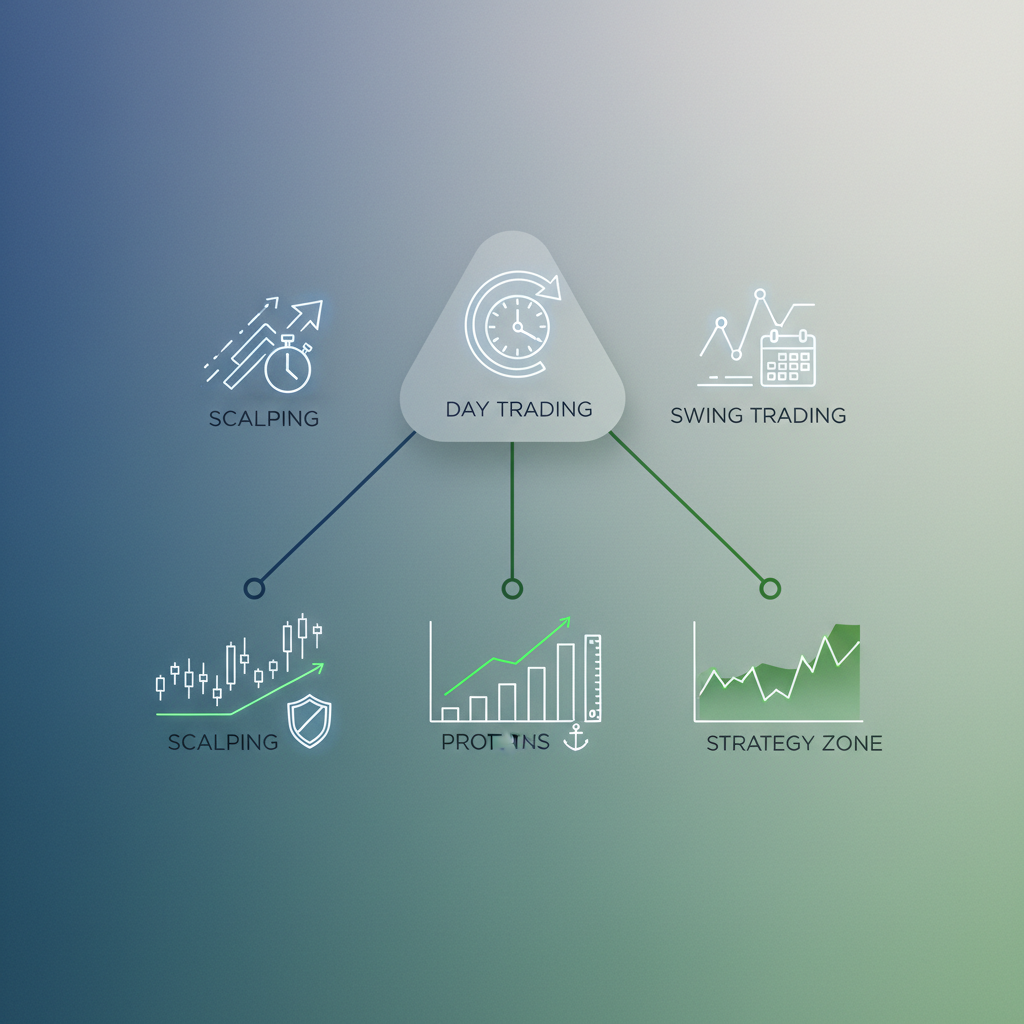
Why does a stop-loss that feels sensible in swing trading feel far too wide for a scalper? The answer is simple: Forex trading styles change the way risk behaves, even when the chart looks the same.
A trader holding positions for days can survive normal noise that would wipe out an intraday setup.
A trader opening five-minute trades cannot afford that same breathing room, because costs, spread, and timing hit harder.
That is why trading strategy risk management is never one-size-fits-all.
The best strategies for Forex traders start with the style itself, not with a random risk rule copied from someone else.
A position trader may care more about drawdown control and overall exposure, while a day trader may care more about session timing and a tighter loss limit.
Both can be disciplined and both can fail badly if the risk plan does not match the holding period.
What matters most is fit.
When risk per trade, stop placement, and position size line up with the trading style, the account gets room to breathe without drifting into reckless territory.
Quick Answer: Forex risk management must fit your trading style because the holding period changes what actually hurts: spread/execution costs, exposure time, and the chance of overnight or event shocks. – Scalping & day trading: keep per-trade risk smaller, use tighter stops, and enforce a hard daily loss limit so one bad session doesn’t snowball. – Swing & position trading: focus more on drawdown control and stop placement beyond invalidation (structure), since trades stay open through noise, swaps, and gaps. A single “set-and-forget” percentage risk number can work only if your stop distance and drawdown limits are compatible with your account. Otherwise, you need to size from the stop distance and the risk limits that keep your equity curve stable.
What changes when we apply risk management to different Forex trading styles?
Why do the same risk rules feel safe in one setup and reckless in another? Because Forex trading styles expose the account to very different kinds of pressure.
A scalper may place many trades with tight stops and tiny targets.
A position trader may hold one trade for days or weeks, where swap, gaps, and news shocks matter more than spread.
That is why trading strategy risk management has to fit the pace of the method, not just the currency pair.
The core risk factors never disappear, though.
Every trader still has to control position size, stop distance, correlation, slippage, and maximum drawdown.
The difference is how much weight each factor carries.
In fast styles, execution risk and spread matter most.
In slower styles, exposure time and event risk start to dominate.
Where one-size-fits-all rules break
A fixed 1% risk per trade rule sounds neat, but it can be misleading.
On a high-volatility pair, that same risk may force a stop so wide that the account can take a painful hit before the trade thesis fails.
For a calmer setup, the opposite problem appears.
The stop may sit so close that normal market noise knocks the trade out early.
That is why strategies for Forex traders need style-specific stop logic, not just a single percentage rule.
The risk profile changes with pace
Trade duration changes the kind of danger you face.
Short trades feel more exposed to spread, latency, and sudden price spikes, while longer trades face rollover costs and weekend gaps.
Volatility changes stop placement and sizing.
Frequency changes cost accumulation and the odds of emotional mistakes.
- Scalping: Small stops, very fast decisions, high sensitivity to spread and execution quality.
- Day trading: Moderate exposure time, more room for noise, strong focus on intraday news and session timing.
- Swing trading: Wider stops, fewer entries, greater attention to trend structure and overnight risk.
- Position trading: Long exposure, lower trade count, heavier emphasis on macro events and patience.
The practical adjustment
The safest habit is simple: match your risk rules to your holding time, not your mood.
A scalper can survive with tight controls and strict loss limits, while a swing trader often needs wider stops and smaller size to stay in the game.
That fit matters even more for Nigerian traders dealing with changing liquidity and broker conditions.
When style and risk line up, the account stops fighting the strategy and starts supporting it.
How should we manage risk in scalping and day trading?
Why do fast trades blow up otherwise solid accounts? Usually because the trader treats speed as an edge and risk as an afterthought.
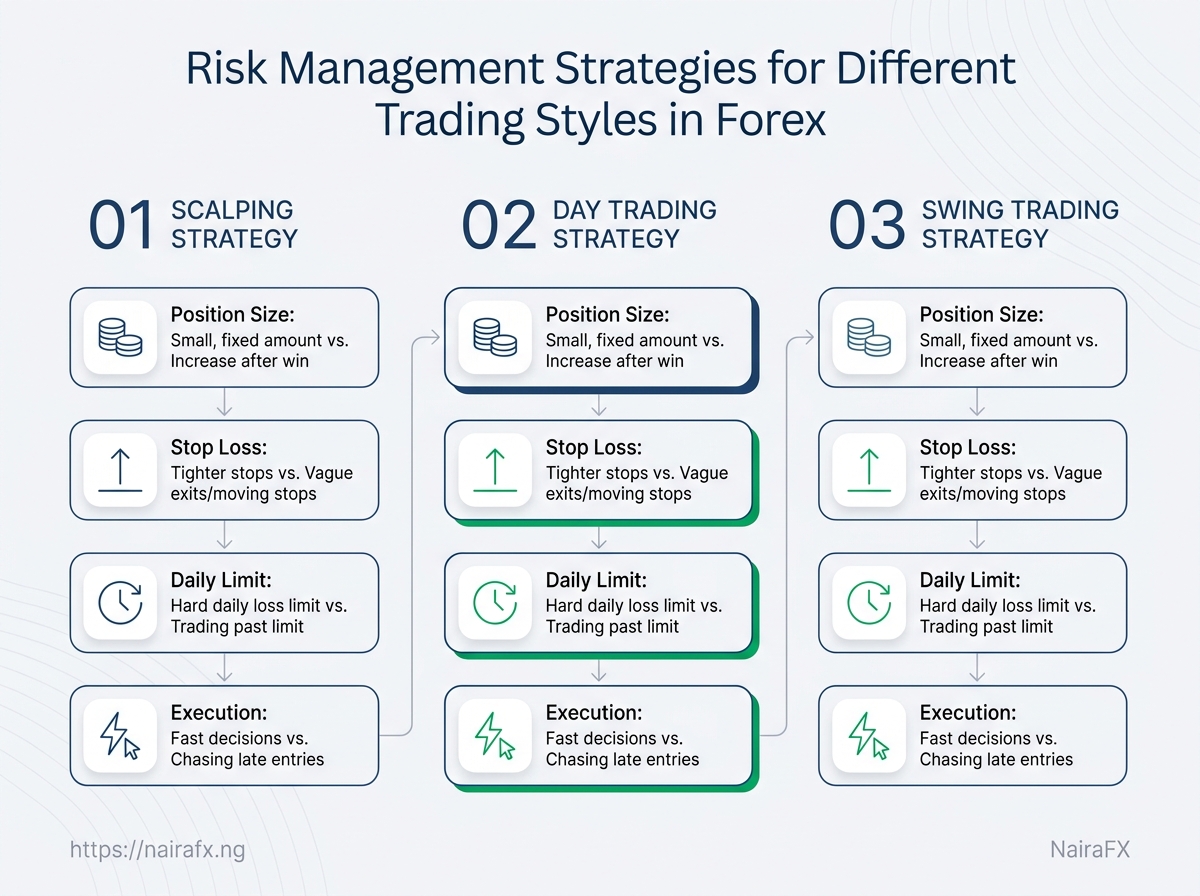
Scalping and day trading need smaller position size, tighter stops, and a hard daily loss limit.
A trade can look perfect on entry and still damage an account if the size is too big or the exit is vague.
The fastest traders also get trapped by two habits: they chase late entries and move exits when price gets uncomfortable.
Both mistakes turn a planned trade into a guessing game.
A practical rule helps here.
If the setup needs a wide stop, the position size must shrink.
If the day is already below the loss cap, the platform should be closed and the plan should stop there.
Practical do-vs-don’t checklist for short-term risk control
| Risk Area | Do | Don’t | Why It Matters |
|---|---|---|---|
| Position size | Risk a small, fixed amount per trade and size down when stops widen. | Increase size after a win or when “the setup feels strong.” | Large size turns a normal losing trade into account damage. |
| Stop-loss placement | Place the stop where the trade idea is invalid, then leave it alone. | Move the stop farther away to “give it room.” | A moving stop often converts a controlled loss into a large one. |
| Trade frequency | Take only the best setups and wait for clean structure. | Overtrade because the market is moving fast. | Too many trades raise fees, fatigue, and impulse decisions. |
| News exposure | Stand aside before major releases unless the plan is built for news. | Jump in right before scheduled volatility. | Spikes can trigger slippage and make exits far worse than planned. |
| Daily loss cap | Set a session limit and stop trading once it is hit. | Try to recover losses with one more trade. | Revenge trading is one of the quickest ways to compound losses. |
One fast loss, one moved stop, and one emotional re-entry are enough to wreck the day.
The best trading strategy risk management for Forex trading styles that move quickly is simple discipline.
Protect capital first, then look for the next clean setup with a calm head.
What risk management works best for swing traders and position traders?
Swing and position trading punish emotional risk control fast. A stop that feels “safe” often sits too close to normal price noise, while widening it just to avoid getting stopped can turn a loss into a slow bleed.
These Forex trading styles need a calmer mindset because trades last longer, hold through more volatility, and depend less on constant monitoring.
For that reason, trading strategy risk management for slower setups starts with structure, not feelings.
A stop belongs beyond a recent swing high or swing low—or outside a clear support and resistance zone that invalidates the trade idea.
Some traders also use ATR to estimate how much daily movement is normal, then size the position so the account risk stays fixed even when the stop is wider.
Sizing should be anchored to your stop distance, not to your hope. When the stop has to expand, you reduce lots so the dollar loss at invalidation remains the same.
Consider a trader long on EUR/USD during a choppy week.
Price tags the setup, then volatility expands after a news-driven move.
Instead of dragging the stop farther away and hoping, the trader cuts size by half and keeps the stop under the structure that actually matters.
The trade survives the noise, and the risk stays defined.
- Place stops where the setup fails. If price breaks that level, the trade idea is wrong.
- Size from the stop distance. If the stop is wider, reduce lots so your risk in dollars doesn’t change.
- Use the chart, not the mood. Emotional stops usually sit too close on normal swing setups.
- Respect lower trade frequency. Fewer trades should mean better selectivity, not looser discipline.
- Plan for overnight risk. Gaps, spreads, and event moves matter more when trades stay open for days.
A mini-case like this is common in real trading rooms: the surviving trader is rarely the one who “gives it room.” It is usually the one who respects the chart, reduces size, and lets the account breathe with the setup.
That approach keeps slower trades honest.
It also gives swing and position traders a cleaner edge, because the risk is anchored to structure instead of emotion.
Which risk rules should we compare across all Forex trading styles?
Which rule stays fixed when a trade lasts five minutes versus five weeks?
That question matters more than it looks. Risk per trade and account drawdown limits are the two anchors, because they protect the account before any setup has a chance to work. Reward-to-risk ratio matters too, but its weight changes by style: scalpers need cleaner execution, while position traders need room for larger moves.
Sizing comes next.
A simple fixed-percent model usually fits most traders early on, while volatility-based sizing helps when stops vary a lot between pairs or sessions.
For small accounts, keeping the risk unit tiny matters more than chasing a perfect entry, because one oversized loss can distort the whole curve.
A practical way to choose sizing is to match it to how often you trade and how wide your stop usually sits.
- Fixed fractional sizing: Risk the same percent each trade. It suits most Forex trading styles because it keeps losses proportional to the account.
- Volatility-based sizing: Adjust lot size to the stop distance. It works well when your setups change shape across pairs or market sessions.
- Fixed lot sizing: Use only when the account is tiny and the plan is very simple. It is easy to misuse, so it needs strict discipline.
Which rule matters most for each style?
| Risk Rule | Scalping | Day Trading | Swing Trading | Position Trading |
|---|---|---|---|---|
| Risk per trade | Very high priority; must stay tiny | High priority; still needs a hard cap | High priority; protects longer holds | Highest priority; one mistake can linger |
| Stop-loss distance | Usually tight and technical | Moderate, tied to intraday structure | Wider, based on swing noise | Widest, based on weekly or monthly structure |
| Reward-to-risk target | Must be efficient because frequency is high | Important for consistency | Very important; needs room to breathe | Critical; the target must justify holding time |
| Maximum open exposure | Low, because multiple fast trades stack risk | Moderate, since sessions can overlap | Medium to high, but only with clear limits | Often the strictest, because positions can run for weeks |
| Trade review frequency | After every session | Daily | Weekly | Weekly or monthly |
Swing and position trading place more weight on stop placement and account drawdown limits, because time in market creates more room for emotional mistakes.
The best size method is the one that matches both your style and your account balance.
With the right rule order, strategies for Forex traders stay disciplined instead of becoming a guessing game.
What risk mistakes do traders make when they copy strategies from the wrong style?
What happens when a scalper’s playbook lands in a swing account? The damage usually starts quietly.
A setup built for fast exits can look disciplined on paper, then fail the moment it has to survive overnight gaps, wider stops, and slower confirmation.
The rules did not get worse.
They just met the wrong trading environment.
The biggest mistake is assuming more trades means more control.
In reality, control comes from fit, not activity.
A trader who copies one of the fastest Forex trading styles into a slower account often keeps the same position size, the same exit logic, and the same tolerance for noise.
That is where trading strategy risk management breaks down.
The account is asked to behave like a different system, and it usually rebels.
A simple example makes it obvious.
Imagine a trader copies a scalping model that expects a quick reaction after entry, then uses it on a swing setup that holds through the U.S. session and into the next day.
The entries may still be valid, but the risk profile is no longer the same trade.
The mistake is not just technical.
It is structural.
- Wrong stop logic: A tight scalp stop in a swing trade gets hit by normal price noise, not by a failed thesis.
- Wrong trade frequency: More trades can create more commissions, more mistakes, and more emotional fatigue.
- Wrong holding expectations: A system that needs speed can lose edge when the trader waits for a larger move.
- Wrong exit meaning: In scalping, exit timing often matters more than conviction. In swing trading, thesis failure matters more than tick-level movement.
A useful risk audit helps before money goes live.
Ask whether the setup still makes sense if the trade lasts three times longer, if spreads widen, or if news hits while the position is open.
Then check whether the losses are supposed to be small and frequent, or rare and larger.
If the answer changes when the style changes, the strategy does too.
For strategies for Forex traders, the real test is not whether a setup works somewhere.
It is whether its risk rules match the style you actually trade.
Copying without that check is how good ideas become expensive ones.
Is 2% risk per trade too much?
2% risk per trade can be too much depending on your trading style and stop width. The key principle is that risk must match the holding period: scalpers and day traders typically need smaller per-trade risk and tighter stops because spread and execution slippage punish oversized positions. A fixed “2%” is misleading if volatility forces a wide stop that doesn’t fit your account drawdown limits.
What is the 3 5 7 rule in forex?
The “3 5 7 rule” is not a standard, style-based forex risk framework from the risk-management approach described here. Instead of relying on fixed number rules, the method focuses on anchors that stay valid across timeframes: risk per trade and account drawdown limits, plus sizing that adapts when stops widen due to volatility. Use a rule only if it produces position sizes that your stop-loss distance can support without breaking daily or total drawdown.
What is the 84% rule in trading?
The “84% rule” is not included as a specific risk-management rule in the discussed forex trading framework. What matters in practice is managing the two anchors that protect the account before any setup performs: defined risk per trade and a hard drawdown limit, with reward-to-risk considered differently for scalping versus position trading. If a rule doesn’t adjust for stop distance, spread, and holding-time pressure, it’s easy to apply incorrectly.
What is the 3 6 9 rule in trading?
The “3 6 9 rule” isn’t identified as part of the style-specific forex risk management approach here. The framework emphasizes that a single copied rule can fail when the trading environment changes—especially when you switch between fast trading (tight stops, smaller size, hard daily loss limits) and slower trading (drawdown control, stops beyond invalidation levels, and room for volatility and news). Use risk sizing and stop placement that fit your strategy’s holding period, not a generic sequence.
What did Warren Buffett say about day trading?
Warren Buffett has repeatedly criticized day trading as speculation rather than long-term investing. His core message is that most people shouldn’t treat frequent trading as a strategy for building wealth because it’s fundamentally riskier and harder to do consistently than disciplined investment with a longer time horizon. The style-based takeaway is clear: frequent trading requires tighter, stricter risk controls than slower approaches.
Risk Only Works When It Matches the Style
The real lesson is simple: Forex trading styles do not just change entry timing, they change how risk behaves.
A stop-loss that makes sense in swing trading can be absurd in scalping, while a tiny intraday stop can choke a position trade before it has room to breathe.
Once that clicks, strategies for Forex traders stop looking like one-size-fits-all rules and start looking like tools matched to a specific pace.
That is why the same setup can produce very different results depending on the trader.
The scalper needs strict loss limits, the day trader needs fast decision rules, and the swing trader often needs wider room with smaller position size to protect the account.
Good trading strategy risk management is not about making every trade safer in the same way; it is about making the risk fit the time frame, the volatility, and the reason the trade exists.
Review one live or recent trade today and ask a blunt question: does the stop, size, and target truly match the style you are trading, or did you copy a rule from a different rhythm? If that trade came from a setup you keep repeating, our risk management and equity curve work can help you test whether it belongs in your plan.
1 thought on “Risk Management Strategies for Different Trading Styles in Forex”