

1. Understanding Forex Customer Support
In Forex trading, every second counts.
This makes customer support not just helpful, but essential.
Consider the impact of executing a trade only to find that your platform is unresponsive; withdrawal processes bogged down by delays can further complicate matters.
Great customer support helps traders by quickly fixing technical issues and clearly guiding them through problem resolution.
These services take on heightened importance particularly in volatile conditions faced by traders in Nigeria.
Reliable broker support should offer realistic response times, knowledgeable representatives, and clearly defined escalation processes for various issues.
In summary, traders deserve coherent support that recognizes and respects their financial stakes during high market volatility.
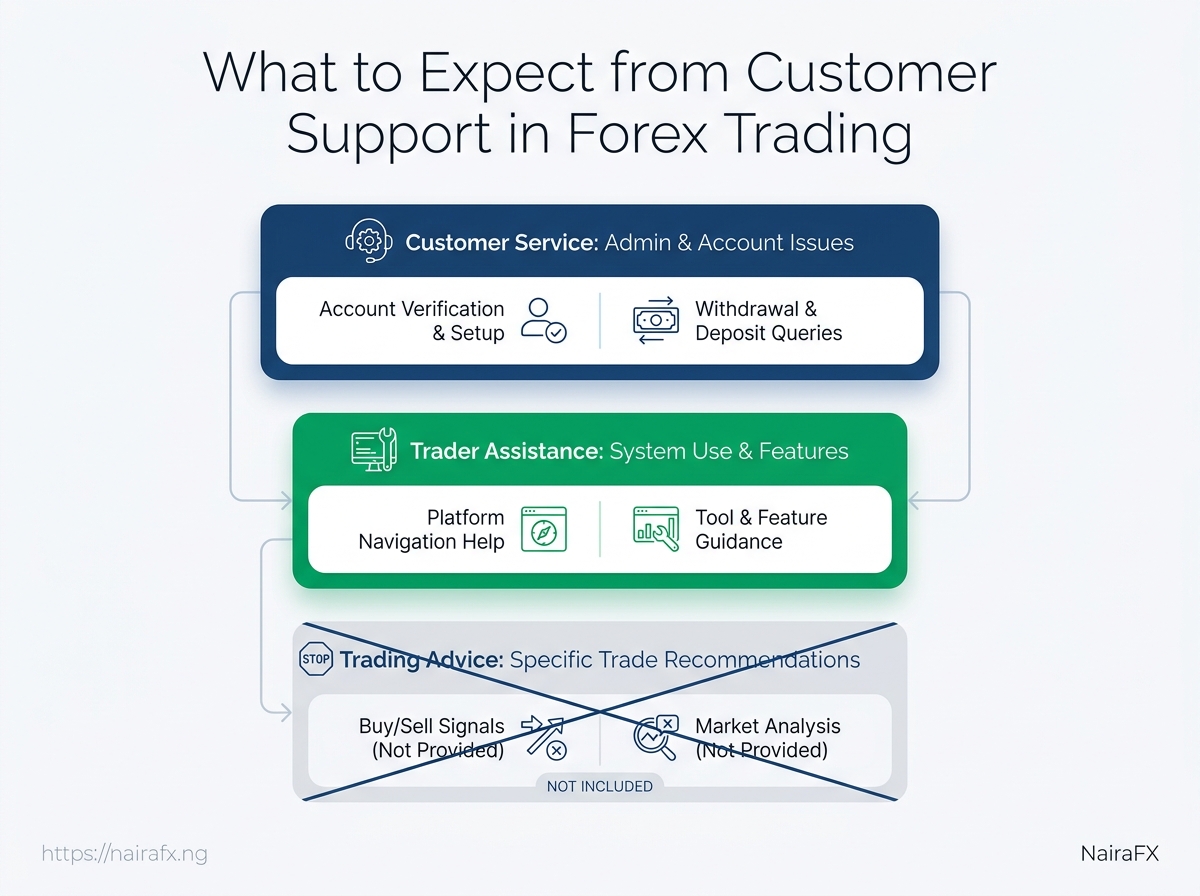
Forex customer support should provide essential services like help with platform issues, withdrawal processes, and guidance during trading difficulties.
Traders, particularly in volatile markets like Nigeria, can expect timely responses, knowledgeable representatives, and clear communication protocols to address their financial concerns effectively.
Having support in place significantly enhances traders’ overall experience and success.
Table of Contents
- 1. What Forex Customer Support Should Actually Cover
- 2. The Support Standards Traders Should Expect Before Funding an Account
- 3. How Support Should Help During Real Trading Problems
- 4. Where Customer Support Ends and Trader Responsibility Begins
- 5. How to Compare Broker Support Services with Confidence
- 6. What Strong Support Looks Like in Volatile Nigerian Markets
1. What Forex Customer Support Should Cover
During periods of market volatility, having immediate access to clear, actionable answers regarding platform difficulties, withdrawal timelines, or margin alerts is critical.
Effective support teams don’t just answer questions; they explain procedures, detail necessary documentation, and set clear expectations for issues affecting traders’ accounts.
To assist traders optimally, customer support teams should readily handle:
Account Issues: Assistance with login challenges, password resets, verification processes, and any associated restrictions.
Transaction Inquiries: Guidance on handling deposits and withdrawals, including processing timelines and what to do in the event of delays.
Market Execution and Alerts: Educating traders on interpreting margin alerts and understanding how market conditions can influence trading moves.
Through clear communication, traders can navigate Forex complexities with heightened confidence.
2. Standards for Pre-Funding Support
Before entrusting your money to a broker, what steps should you take? Testing the broker’s support capabilities provides insight into how they manage pre-funding inquiries.
Contact them with specific, real-world questions across the support channels you will later rely on, such as live chat or email.
A professional broker will provide clear, concise answers that reflect understanding and openness, particularly regarding Nigerian-specific issues like payment processes or identity verification procedures.
Tracking responses across contact points is key; any discrepancies should raise a red flag.
Maintain records of whom you spoke with, and ensure that their replies align with the publicly disclosed broker policies.
Essential Pre-Funding Questions
| Support Area | Question | Good Response Expectations | Warning Signs |
|---|---|---|---|
| Account Verification | What documentation is required for Nigerian residents during the verification process? | The response should detail accepted documents and timeframes for processing. | Unclear or vague instructions. |
By engaging with your broker’s support team before funding, you can gauge their reliability and make a more informed financial commitment.
3. How Support Should Help During Real Trading Problems
Imagine this: a trader realizes their platform is unresponsive right when a major currency pair is starting to move.
The price feed looks frozen, orders remain pending, and every click creates more uncertainty.
A trader notices the platform has stopped responding just as a major currency pair begins moving.
The price feed looks frozen, orders remain pending, and every click creates more uncertainty.
This is when Forex customer support must shift from general assistance to incident management.
The trader needs clear instructions, a detailed account of what happened, and an honest update on trading and account options.
A useful support response should help the trader control the situation without making it worse.
Issues that need immediate trader assistance
Some problems can wait for normal support hours.
Others may affect open risk, execution, or account access within seconds.
Frozen platform: The terminal stops updating prices or rejects actions while open positions remain exposed.
Failed order: A market, stop, or limit order shows as pending, rejected, or missing from the account history.
Incorrect price display: The chart and quote panel show different prices, creating uncertainty about execution.
Margin or liquidation warning: Available margin changes sharply, but the trader cannot confirm whether positions remain open.
Account access failure: Login, two-factor authentication, or server connection problems prevent the trader from managing risk.
Support should distinguish between a technical fault and a normal trading outcome.
A rejected order, for example, may result from insufficient margin, a closed market, invalid stop distance, or a genuine system error.
Information that speeds up assistance
The first reply should request only details that help locate the event.
Asking for too much information can delay action during a fast market.
Identify the account: Request the account number, platform name, and affected server.
Never ask for a password or authentication code.
Record the event: Ask for the instrument, order type, approximate time, error message, and whether the order appeared in account history.
Confirm the trader’s status: Establish whether positions are open, whether the platform is still connected, and whether another approved access method works.
Explain the next step: Provide a ticket number, escalation route, expected update time, and any temporary trading instructions.
A ticket should preserve timestamps, screenshots, order IDs, and platform logs where available.
That record supports a later review without asking the trader to rely on memory.
Never share login credentials, remote-access codes, or one-time security codes with support staff.
During an outage, document the issue, stop repeated attempts, and use the broker’s official support channel.
Do not keep resubmitting orders or open new positions simply because the screen appears unresponsive.
Good broker support services reduce confusion first.
Clear trader assistance then gives the account holder a safer path while the technical team investigates.
4. Where Customer Support Ends and Trader Responsibility Begins
Could a broker support agent remove the risk from your next trade? No. Forex customer support can explain account rules, confirm how the platform works, and investigate issues.
However, it cannot control prices, liquidity, slippage, or sudden market changes.
That boundary matters during stressful moments.
Consider a scenario where a trader asks whether a stop-loss will close at the exact requested price during a sharp announcement.
Support can explain the broker’s execution terms.
The trader must still decide whether the potential loss fits the trading plan.
Support is there to clarify facts, not replace research or judgment.
The table below separates useful trader assistance from decisions that remain firmly with the account holder.
Questions support can answer versus decisions traders must make
| Area | Support can clarify | Trader must decide | Risk to watch |
|---|---|---|---|
| Available limits, account rules, and how exposure is calculated | Whether the chosen exposure is reasonable | Larger positions can magnify losses quickly | |
| Margin calls | Margin thresholds, alerts, and liquidation procedures | Whether to reduce exposure or add funds | Positions may close automatically when margin falls |
| Stop-loss orders | Order settings, trigger rules, and execution conditions | Where to place the stop and how much to risk | Gaps and slippage can create a worse fill |
| Spreads and fees | Current spreads, commissions, swaps, and transaction charges | Whether the total cost suits the strategy | Wider spreads can affect entries and exits |
| Trading strategy | Platform features and available order types | Which strategy, market, and timeframe to use | Support cannot validate expected profitability |
| Position size | Contract specifications and margin requirements | The number of units or lots to trade | Oversized positions can damage the account |
| Economic news exposure | Trading hours, scheduled events, and relevant restrictions | Whether to hold, reduce, or avoid a position | Volatility and liquidity can change suddenly |
| Withdrawal timing | Processing stages, required documents, and stated timeframes | When and how much to withdraw | Delays may occur during verification or payment processing |
Ask, “Which margin level triggers liquidation?” rather than, “Should I keep this trade open?”
Before contacting support, record the order number, platform time, currency pair, and exact issue.
After receiving an answer, compare it with your trading plan, risk limit, and account records.
That simple pause keeps assistance useful without outsourcing your judgment.
A support agent can explain the rules of the road.
We still choose the speed, route, and level of risk.
5. How to Compare Broker Support Services with Confidence
Key Takeaway: It’s not the number of contact methods that defines a strong broker but the quality of support offered.
When evaluating brokers, remember that a lengthy contact list doesn’t necessarily equate to effective support.
Many channels such as live chat, email, and telephone don’t ensure that the representatives you encounter will resolve specific account or trading questions adequately.
A proper comparison goes deeper—it probes the consistency of answers, clarity of communication, and documentation practices throughout your engagements.
For example, while Broker A might have extensive contact points but offer inconsistent responses, Broker B with fewer options could consistently provide clearer, more accurate support.
Build a Simple Support Scorecard
Using a personalized support scorecard can help illuminate the strengths and weaknesses of your potential brokers beyond their facade.
Rate brokers on key aspects that are important to you:
Answer Quality: Does the support agent answer the question directly? Or do they resort to generic, pre-prepared replies?
Consistency: When different agents provide varying information, it signals potential issues that may arise in the future.
Escalation Capability: Can your issues be transferred to appropriate teams efficiently if they require specialized input?
Record Keeping: Are ticket numbers, confirmations, and follow-up communications provided to ensure a clear trail?
Availability: Is the broker available during critical trading hours, aligning their support operations with your trading needs?
A comprehensive scorecard builds clarity, making broker comparisons less daunting and more fact-based.
6. What Strong Support Looks Like in Volatile Nigerian Markets
Key Takeaway: Imagine trading through a sharp naira-related currency move during a busy London–New York session.
Spreads widen, prices move quickly, and your order history shows a result you did not expect.
Imagine trading through a sharp naira-related currency move during a busy London–New York session.
Spreads widen, prices move quickly, and your order history shows a result you did not expect.
While strong Forex customer support can’t predict the market or prevent losses, it helps you understand what happened and what broker rules apply.
It helps you establish what happened, when it happened, and which broker rule applies.
That distinction matters during volatile conditions.
A useful support response should address the specific instrument, platform event, execution time, and account setting involved.
Vague replies such as “the market was volatile” do not give you enough information to make a sound decision.
Ask precise questions before major announcements
Economic announcements can create unusual price movement, especially around interest-rate decisions, inflation data, employment figures, and central-bank statements.
Before an event, contact support with questions that produce clear, recordable answers.
Affected instruments: Which currency pairs may face wider spreads, reduced liquidity, or restricted trading?
Order rules: How are stop-loss orders, pending orders, and guaranteed stops handled during fast markets?
Margin settings: Can, margin requirements, or position limits change before the announcement?
Trading times: Will the broker alter market hours, rollover times, or contract specifications?
Execution records: Which timestamps, price feeds, and order details will appear in the account history?
Save the replies with the date and announcement name.
A written answer gives you a reference point when reviewing a later trade.
Build a personal support record
Trader assistance becomes more useful when it forms a reliable history rather than a collection of scattered chats.
Keep one simple record for every meaningful contact with your broker.
Record the date, contact channel, issue, account or ticket number, promised response time, final answer, and any action you took.
Add screenshots only where they clarify a platform message or account notice.
Avoid storing passwords or complete payment details in the same file.
This record can reveal patterns.
For example, repeated delays on questions about withdrawals, execution, or account restrictions may deserve more attention than one slow reply during a busy session.
Review support performance every month
Set aside 15 minutes each month to assess your broker support services.
Count how many questions received a complete answer, how often replies arrived within the stated period, and whether different agents gave conflicting guidance.
Also check whether important policies remain easy to find and whether your support records contain unresolved issues.
A simple rating from one to five can track clarity, speed, accuracy, and follow-through.
Strong support should leave you better informed, not merely reassured.
Monthly records turn isolated frustrations into evidence for better trading decisions and more careful broker comparisons.
Conclusion
Support That Protects More Than a Trade
When a platform freezes or a withdrawal is delayed, effective Forex customer support can protect both your decision-making and your account.
The best brokers do more than send standard replies.
They provide clear ways to escalate issues, explain delays, document incidents, and offer helpful support while markets are active.
That standard matters even more in Nigeria, where volatility, payment channels, connectivity, and local compliance concerns can complicate an already stressful situation.
The example of an unresponsive platform shows why support should be tested before funding, not judged after something goes wrong.
A broker that responds quickly to a simple pre-sales question may still fail during a price spike, while a slower but well-documented team may provide the dependable help traders need.
At the same time, support cannot replace responsible trading: position sizing, stop-loss planning, record keeping, and checking account terms remain the trader’s responsibility.
Test your broker today by sending one specific question about withdrawals, platform outages, and escalation procedures, then record the response time and quality.
Compare that experience with the broker’s stated support channels and the practical broker support services available during Nigerian market hours.
If the answers are vague, delayed, or impossible to verify, treat that as trading information—not a minor customer-service inconvenience.
What should I expect from customer support in Forex trading?
You should expect Forex customer support to handle important issues like platform performance, withdrawal processes, and trading guidance during volatile times.
A reliable support team will provide timely responses, knowledgeable assistance, and clear information that enhances your trading experience.
How can Forex trading customer support help me as a trader?
Forex trading customer support aids traders by resolving technical issues, providing administrative assistance, and clarifying account-related inquiries.
They ensure you understand operational processes, timelines, and the necessary steps to manage trading effectively in dynamic markets.
What are the common issues addressed by Forex broker support services?
Common issues addressed include platform functionality, withdrawal delays, account access problems, and general trading inquiries.
Support services aim to promptly resolve these concerns, providing traders with the guidance needed during critical trading situations.
What are the typical hours for Forex customer support?
Typical hours for Forex customer support vary by broker, but many offer services during key market hours to assist with urgent trading queries.
It’s essential to check your broker’s support availability to ensure you can access help when needed.
How do I choose a Forex broker based on their support services?
To choose a Forex broker based on support services, test their responsiveness by asking specific questions through various contact channels.
Look for clear, consistent answers and gauge their understanding of operational procedures, especially concerning your specific concerns like payment processes and verification.