
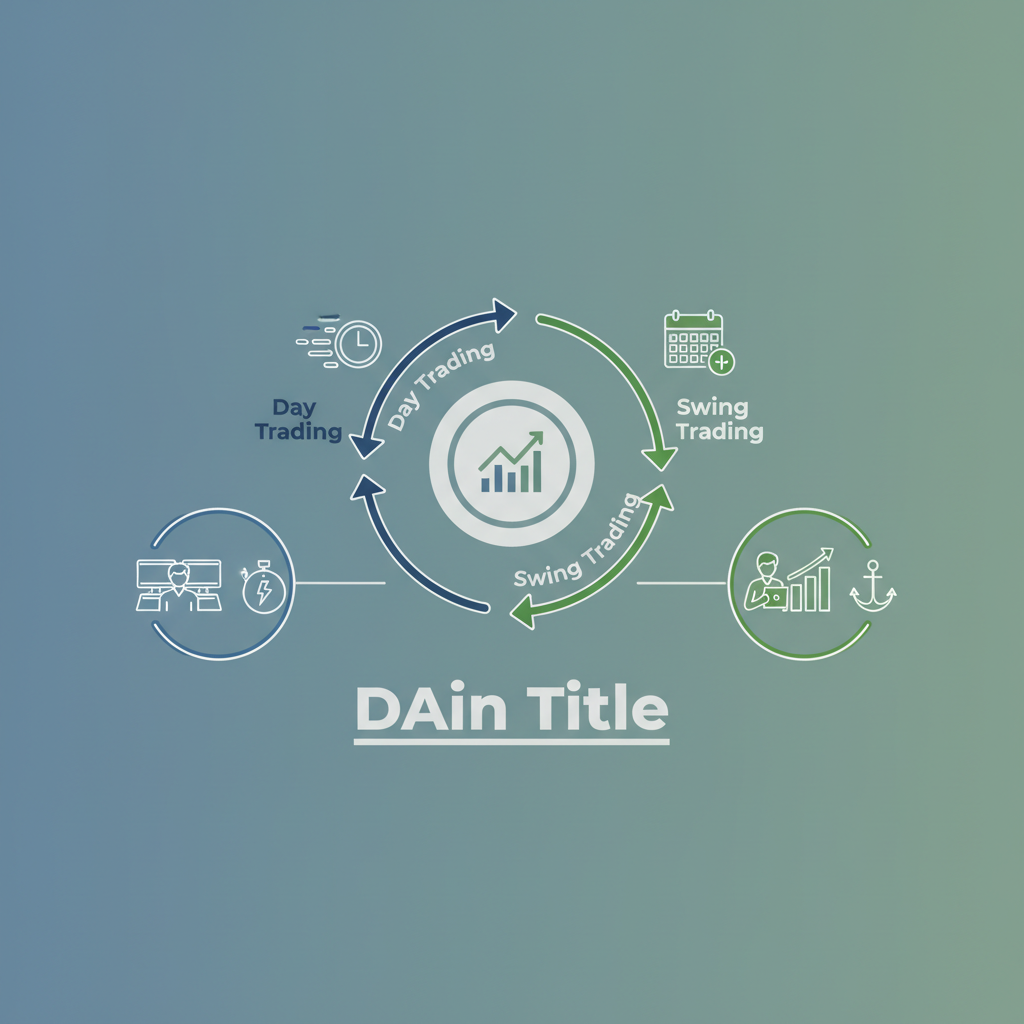
Maybe the best trading style isn’t the one that promises the fastest profits.
Instead, it could be the one that fits your time, temperament, and risk limits.
Maybe the best trading style isn’t the one that promises the fastest profits.
Instead, it could be the one that fits your time, temperament, and risk limits.
A Nigerian trader who checks charts between meetings has a different challenge than someone who watches currency pairs during the London and New York sessions.
Factors like your available time, internet access, capital, and how you react to losses all affect whether a strategy is suitable for you.
The day trading vs swing trading decision often comes down to more than holding a position for hours or weeks.
Day trading needs your constant attention and quick decision-making.
In contrast, swing trading allows positions more time to develop but risks overnight and weekend price changes.
The market itself creates plenty of opportunity and pressure.
Forex turnover is estimated to be approximately $9.6 trillion per day, based on data from April 2025, yet rapid price movement does not make every approach suitable for every trader.
Risk management must match the style.
A scalper may need tight stop-losses and very small trade risk, while a swing trader needs stops that allow for normal market noise without accepting an uncontrolled drawdown.
A useful trading styles comparison therefore asks a more personal question: can you follow the rules consistently when the market moves against you? The right choice should fit your routine and protect your capital, not simply sound attractive on paper.
Quick Answer: The best trading style for you will depend on your individual circumstances, including your available time, temperament, and risk tolerance.
Day trading requires constant attention and quick decisions.
Swing trading, on the other hand, allows positions to develop over days or weeks.
This often suits people who want to manage risks without checking as often.
Given that Forex turnover is estimated to be approximately $9.6 trillion a day, it’s important to pick a trading style that matches your ability to consistently follow rules in different market conditions.
What Trading Style Actually Means
When picking a trading style, it’s important to think about not just potential profits but also how that style fits into your daily life.
Each trader’s availability, temperament, and personal circumstances play a crucial role in this decision.
The various trading styles differ in how long positions are held and how often trades are made.
Your preferences should fit your real-life commitments, not just what seems popular online.
For instance, scalping requires constant attention and quick decision-making, whereas position traders can tolerate longer holding periods and less frequent monitoring.
Understanding these distinctions helps traders avoid the pitfalls of adopting styles that do not suit their individual circumstances.
Day Trading vs Swing Trading: The Most Common Choice
Day trading and swing trading differ significantly in their demands on time and trading strategies.
Comparing holding periods can show how your routine informs your choices.
Practical Comparison Table:
Table: Day Trading vs Swing Trading — Factor, Day trading, Swing trading & more
How Scalping and Position Trading Compare
One trader waits for several small price moves before closing each trade.
Another waits weeks for a larger market thesis to develop.
How Scalping and Position Trading Compare
One trader waits for several small price moves before closing each trade.
Another waits weeks for a larger market thesis to develop.
Both may trade the same currency pair, yet their routines, risks, and decision pressures feel completely different.
Scalping is built around speed.
The trader watches short-term price action, enters frequently, and depends on precise execution.
Factors like small spreads, commissions, slippage, and delayed orders are important because transaction costs can take a big bite out of your modest gains.
Concentration also becomes a trading cost.
A scalper may need uninterrupted attention for a session, while a position trader spends more time studying economic trends, interest-rate expectations, and broader market structure.
Position trading requires patience, but extended exposure brings overnight gaps, political shocks, and changing volatility.
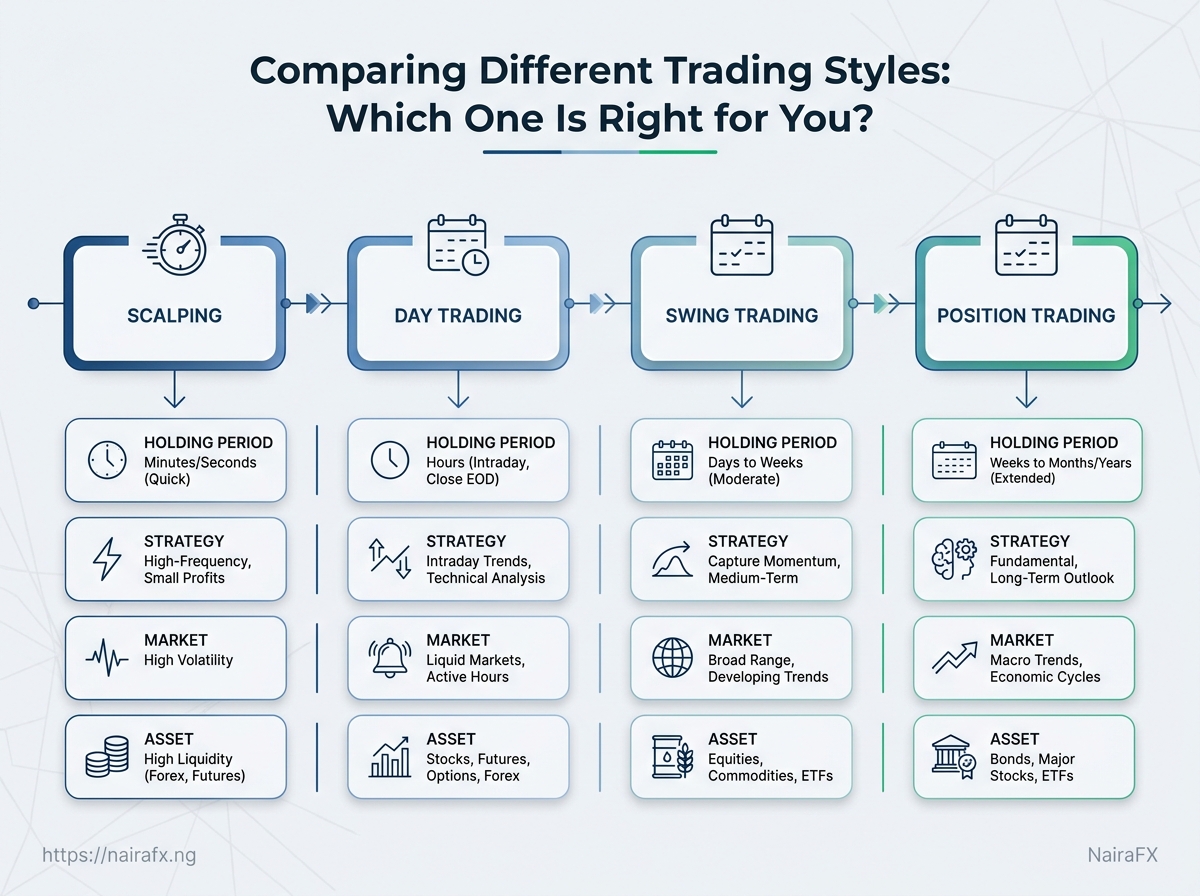
Four Trading Styles Compared
Holding periods vary by trader, market, and strategy.
This trading styles comparison uses common patterns rather than fixed rules.
Table: How Scalping and Position Trading Compare — Trading style, Typical holding period, Time commitment & more
| Trading style | Typical holding period | Time commitment | Analysis focus | Primary risk | Who may prefer it |
|---|---|---|---|---|---|
| Scalping | Seconds to minutes | High; frequent, focused monitoring | Very short-term price action, spreads, order execution | Transaction costs, execution errors, rapid losses | Traders who prefer fast decisions and can maintain intense concentration |
| Day trading | Minutes to hours; closed before the session ends | High during selected market hours | Intraday trends, breakouts, volume, scheduled news | Overtrading, sudden reversals, decision fatigue | Traders who want no overnight exposure and can follow a set routine |
| Swing trading | Several days to a few weeks | Moderate; regular review rather than constant watching | Market structure, momentum, technical and macro conditions | Gaps, overnight volatility, wider drawdowns | Traders balancing market participation with other responsibilities |
| Position trading | Several weeks to months | Lower daily monitoring, but deeper initial research | Long-term trends, economic cycles, rates, and fundamental themes | Extended drawdowns and changing market conditions | Traders who value patience and can tolerate open-position uncertainty |
Position trading reduces trade frequency, but it does not remove risk; a wider stop and longer holding period require carefully sized exposure.
Think of the styles as travel speeds.
A racing motorcycle reaches the destination quickly but demands constant attention and precise control.
A long-distance train moves more slowly, allowing broader planning, yet delays and changing conditions can affect the journey.
The best trading style depends on available time, emotional tolerance, account size, and analytical strengths—not on the fastest route to a profit.
A careful trading plan should match risk controls to the pace of the strategy.
Choose a Trading Style Based on Your Real Constraints
According to Naira Forex, the global foreign exchange market averaged $9.6 trillion in daily turnover in April 2025.
Choose a Trading Style Based on Your Real Constraints
Research from Naira Forex reports that the global foreign exchange market averaged $9.6 trillion in daily turnover in April 2025., yet a strategy can still be unsuitable for your account.
Spread costs, unreliable internet, and limited screen time may erase the advantage shown in a backtest.
A plan that works during a quiet weekend review may fail during a busy Nigerian workday.
Day trading becomes difficult when connectivity drops during an open position.
Swing trading can feel uncomfortable when overnight news causes a sharp gap or sudden repricing.
Start with your real week, not an ideal schedule.
Mark the hours when you can review charts, respond to alerts, and manage risk.
Then ask whether you can monitor positions during major economic releases or whether your routine leaves trades unattended for several hours.
Your emotional response matters just as much.
Some traders close positions too early after a small loss.
Others widen stops because they dislike being wrong.
Comfort with overnight exposure, drawdown, and waiting should influence your choice as much as technical skill.
Account structure creates another practical filter.
A small account may struggle with frequent transaction costs, while an instrument with wide spreads can make short-duration entries less attractive.
Check liquidity, contract size, margin rules, available currency pairs, and whether your broker offers the instruments your plan requires.
For Nigerian traders, funding and withdrawals deserve equal attention.
Naira conversion charges, payment delays, broker access, and changing local currency conditions can affect the true cost of a trade.
News linked to inflation, interest rates, oil markets, or foreign-exchange policy may also increase volatility around positions held overnight.
Use this scorecard before choosing a primary style.
Give yourself a score from 1 to 5 for each area, then review the pattern rather than chasing a label.
- Available time: Can you check markets reliably during planned trading hours?
- Connectivity: Can you maintain stable access for entries, exits, and emergency adjustments?
- Patience: Can you wait several days without interfering with a valid position?
- Loss response: Do you follow your stop, or make emotional changes after a losing trade?
- Capital and costs: Can your account absorb spreads, commissions, conversion charges, and normal drawdown?
- Market access: Can your broker provide suitable instruments, dependable execution, and practical withdrawal options?
A high time score with low patience may point toward shorter holding periods, while strong patience with limited screen access may suit a slower approach.
No score makes one method universally the best trading style; it shows which risks fit your circumstances.
That is the purpose of a thoughtful trading styles comparison.
Choose the method your schedule, finances, technology, and temperament can support consistently—not the method that looks most impressive online.
Build a Risk Plan Before Testing Any Style
The best trading style rarely boasts the most impressive return claims.
It is the style whose losses, trade frequency, and decision speed you can manage consistently.
A risk plan comes before a trading-style comparison.
If you don’t have a plan, a losing streak might lead you to rush from swing trading to frantic day trading, or from cautious position trades to aggressive scalping.
That reaction produces little useful evidence.
Set three limits before placing a test trade: maximum risk per trade, maximum daily loss, and a weekly review point.
For example, a trader might risk no more than 0.5% of account equity per position and stop trading after losing 1% in a day.
Size the position from the stop
Position size should follow the amount you are prepared to lose, not the confidence you feel about a setup.
Imagine a ₦500,000 account with a 0.5% risk limit.
The maximum planned loss is ₦2,500.
If one unit would lose ₦25 when the stop is reached, the position size is:
₦2,500 ÷ ₦25 = 100 units
The calculation must also allow for spread, commission, and possible slippage.
A stop does not guarantee an exact exit price during fast markets.
Table: Build a Risk Plan Before Testing Any Style — Risk factor, Short-term trading, Multi-day trading
| Risk factor | Short-term trading | Multi-day trading |
|---|---|---|
| Stop placement | Often tighter, but easier to trigger | Usually wider to allow for market noise |
| Execution delay | Repeated entries can magnify small delays | Less frequent, but news can create larger price gaps |
| Market gaps | Less common within the holding period | More relevant after overnight or weekend exposure |
| Repeated trades | Fatigue and overtrading can multiply losses | Fewer trades, but each position may remain exposed longer |
A plan suitable for rapid trades may fail when applied to positions held through major announcements.
Test one method long enough
Use a demo account first, or trade the smallest practical position.
Record the same setup, entry rule, stop distance, exit reason, spread, and emotional state each time.
- Define one approach and its valid entry conditions.
- Collect at least enough trades to reveal repeated behavior, rather than judging one week.
- Review results every weekend, including win rate, average loss, largest drawdown, and rule violations.
- Increase exposure only when the process remains consistent, not merely after a profitable streak.
Do: Keep one clearly defined approach during the testing period.
Do not: Abandon it after a small losing streak and replace it with another method.
A controlled test turns trading-style selection into an evidence-based decision.
The right style is the one your risk plan can survive.
Find Your Best Trading Style With a Practical Decision Framework
Consider your situation—whether you work full-time, have limited screen access, prefer fewer decisions, or want to manage risk carefully.
A fast trading method may look attractive, but your daily routine could make it difficult to follow consistently.
The best trading style isn’t determined by a personality type or impressive profit claims.
It is a starting point that matches your available time, emotional response, capital, research habits, and ability to follow rules.
Match the method to your working profile
Use these profiles as starting points, not fixed answers.
A trader with a full-time job might explore swing trading, while someone with reliable market access may still prefer longer-term positions.
- Full-time professional: Swing trading or position trading may fit limited screen access and fewer daily decisions.
- Active market watcher: Day trading may suit someone who can monitor prices, follow a routine, and accept frequent decisions.
- Research-led planner: Position trading or structured swing trading may fit traders who prefer economic analysis and wider market context.
- Fast decision-maker: Scalping could appear suitable, but only after testing whether speed causes impulsive entries or rule-breaking.
- Capital-conscious beginner: A simulated account or very small test size can reveal whether the method fits before meaningful funds are exposed.
A useful trading styles comparison should measure daily demands, not just holding periods.
The difference between day trading vs swing trading becomes clearer when you compare the lifestyle each method requires.
Score your fit before committing
Give each category a score from 1 to 5, then multiply it by the weight.
A low total does not prove a style will fail, but it highlights areas that need testing.
Table: Find Your Best Trading Style With a Practical Decision Framework — Decision factor, Weight, Question to score
| Decision factor | Weight | Question to score |
|---|---|---|
| Time available | 30% | Can you monitor and manage trades when required? |
| Risk tolerance | 25% | Can you accept the method’s normal losing periods? |
| Capital | 15% | Can your account support suitable position sizing? |
| Emotional fit | 15% | Do the pace and uncertainty affect your judgment? |
| Research ability | 15% | Can you prepare, test, and review the strategy properly? |
For example, swing trades might capture medium-term moves, while longer-term positions express a broader market view.
Keep separate rules, risk limits, and review records so one style does not quietly fund another.
Watch for signs of poor fit
Your chosen method may be unsuitable when you repeatedly experience:
- Missed entries: Your schedule prevents timely execution.
- Impulsive decisions: You enter without a valid setup or confirmation.
- Excessive fatigue: Trading disrupts sleep, work, or concentration.
- Repeated rule-breaking: The problem continues after several reviews.
Review the first 30 days using five questions:
- What was the net result after spreads, commissions, and other costs?
- How often did you follow the entry, exit, and position-sizing rules?
- What stress, fatigue, or distraction affected decisions?
- Which mistakes appeared more than once?
- What one rule or process should change before the next month?
A suitable style should make disciplined execution more realistic.
Your scorecard and 30-day review can reveal that fit far earlier than a large loss.
Which type of trading is best in 2026?
The best type of trading in 2026 will depend on individual factors such as time, temperament, and risk tolerance.
Each trading style has its own advantages and should align with your personal circumstances and ability to engage with the market effectively.
What are the best trading strategies for 2026?
The best trading strategies for 2026 should match your available time, risk limits, and emotional comfort with losses.
Strategies should focus on consistency and managing expectations based on the unique demands of your lifestyle, rather than adopting popular methods that may not suit your situation.
Which trading style is the most profitable?
The most profitable trading style varies per individual trader and is influenced more by how well the style fits their life and decision-making abilities.
Profitability is less about the style itself and more about the trader’s discipline and ability to manage risk and losses consistently.
Is day trading still worth it in 2026?
Day trading is largely unprofitable, with only 1 to 4% of day traders making money over the long term.
Its viability depends on a trader’s ability to manage the emotional pressure and transaction costs associated with rapid trades, which must be considered before committing.
Are swing traders more successful than day traders?
Success between swing traders and day traders varies based on individual skills and lifestyle compatibility.
While swing traders may benefit from less frequent monitoring and reduced emotional stress, effective day trading can also yield significant profits if managed properly, making broad comparisons challenging.
Choose the Style You Can Follow Consistently
The most effective trading style isn’t necessarily the fastest or most active.
It is the approach that matches your available time, emotional tolerance, capital, and ability to manage risk without breaking your own rules.
A Nigerian trader checking charts between meetings may find swing trading more practical than day trading, while someone with uninterrupted market hours and strict discipline may prefer shorter-term setups.
The comparison between day trading and swing trading matters because each demands a different lifestyle.
Scalping requires rapid decisions and close attention, whereas position trading gives trades more room to develop but exposes them to wider market moves, overnight risk, and changing economic conditions.
No style removes uncertainty; the right choice simply makes disciplined execution more realistic.
Before committing money, write down your trading hours, preferred holding period, maximum acceptable loss, and the number of trades you can review properly each week.
Then test one style on historical charts or a small demo account, record your equity curve, and review the results after at least 20 to 30 setups.
Choose the style you can execute calmly and consistently today, not the one that looks most exciting on social media.
That practical test will reveal far more about your best trading style than any generic trading styles comparison.