

A position trade might look perfect on the weekly chart, but it can still lose money.
Swap fees nibble at it every night, and a 60-pip stop sits well inside normal market noise.
Long-term position traders hold for weeks or months.
Mistakes don’t wash out overnight — they compound.
Then comes the impulse.
Move the stop, just this once.
That single decision is where long-term forex accounts quietly die.
A 50% drawdown needs a 100% gain just to break even, so every extra percent you risk makes recovery harder.
The best risk management approach for long-term forex position trading has little to do with sharper entries.
It comes down to position sizing, stop placement, trading costs, and the discipline to keep a plan intact for months rather than hours.
Nigerian traders carry an extra layer of that risk.
USD/NGN swings, overnight swap charges on multi-month holds, and broker execution during power cuts all change what a so-called safe position truly costs you.
Quick Answer: The best risk management approach for long-term forex position trading emphasizes conservative position sizing, risking only 0.5% to 2% of account capital per trade. Traders should strategically place stop-loss orders based on market structure or volatility, rather than arbitrary percentages, and maintain the discipline to stick to their plan despite market pressures. This method accounts for critical factors like swap fees and local currency fluctuations that can disproportionately affect long-term trades.
What Is the Best Risk Management Forex Approach for Long-Term Position Trading?
Picture this: a Lagos trader opens a GBP/USD long on Monday, planning to hold it for three months. By week three, the trade is 80 pips underwater, and the initial confidence is wavering with compound swap costs. This scenario illustrates why a solid risk management strategy is crucial. To survive in long-term forex position trading, we need to determine our maximum tolerable loss for each trade. It’s vital to place a stop where the trade idea is genuinely proven wrong, using the distance from entry to stop to define your position size. This way, risk transforms from an emotional response to a calculated number based on solid criteria. Position trading stretches over weeks or months and involves distinct risks compared to swing trading or scalping. For instance, position traders must account for swap fees and correlated risks that could adversely impact multiple open trades over prolonged periods. Recognizing how different trading styles impact your risks is crucial for developing strategy specifics, ensuring clarity in your risk management approach.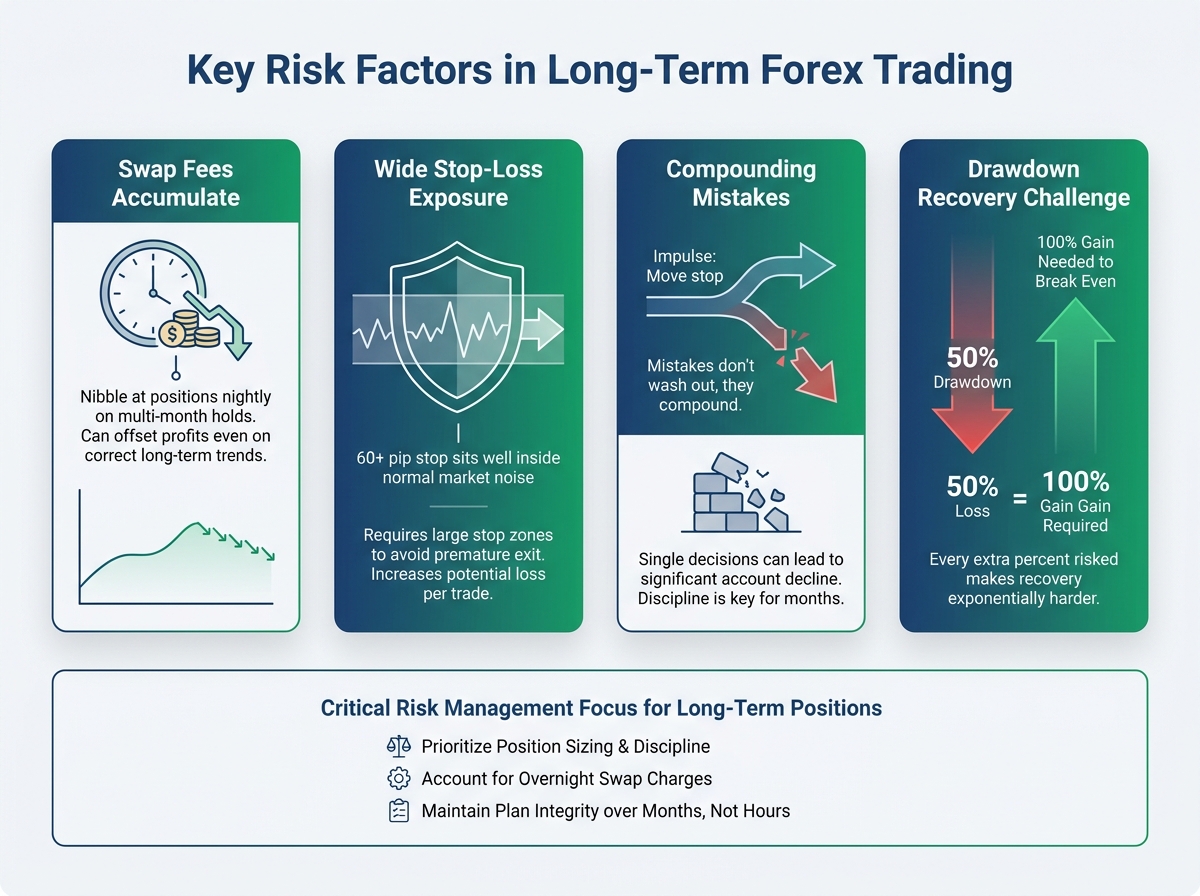
Why Long-Term Position Traders Need a Different Risk Plan
Looking at GBP/USD over three months is a different bet than analyzing it over three hours.
The chart looks identical.
The exposure does not.
Everything in the position-sizing math still applies — fixed risk per trade, stop distance in pips, size adjusted to match.
What changes over a long hold is how many unknowns the position must survive before it closes.
A day trader faces a handful of news events; a position trader faces a full earnings cycle, a rate decision or two, and shifts in market structure.
You can read the direction correctly and still lose because the trade has months of room to meet overnight financing charges, weekend gaps, spread widening, and a currency repricing that had nothing to do with your idea.
On a long position, swap is charged daily, and holding costs compound while the trade sits open.
Naira-funded accounts add a second layer: risk is measured in naira, but the trade settles in dollars.
When the naira moves against the dollar, a position that was 1% risk last month may be a different slice of your account today, making currency conversion live risk.
Signal providers and polished backtests make this harder to see.
A backtest that ignores spreads, swaps, and slippage can show a smooth equity curve that never survives contact with a real multi-month hold.
Separating a Real Risk Process From a Sales Pitch
| Question to ask | Why it matters | Evidence to request | Warning sign |
|---|---|---|---|
| Is risk stated per trade? | Must be testable | Stated % risk per position | Only win rates and pip gains |
| Are losing streaks disclosed? | Long holds mean longer runs | Longest losing streak + duration | “Almost never loses” / no streak data |
| Are spread, swap, and slippage included? | Costs decide profitability | Cost assumptions per trade | Raw mid-price only |
| Is maximum drawdown shown? | 50% DD needs 100% gain | Peak-to-trough drawdown | No drawdown figure |
| Can results be independently checked? | Verified records beat screenshots | Audited/third-party track record | “Screenshot only” |
We publish a fuller risk management guide and Nigerian case studies on how traders cut risk per trade and let the numbers breathe.
Long holds don’t need a more aggressive plan.
They need one that treats time, currency, and cost as part of the risk itself.
How the Best Risk Management Approach Works Trade by Trade
A risk plan only matters at the moment you click buy or sell.
That’s where every rule either holds or falls apart.
Start with three ceilings.
A per-trade cap limits what one position can cost you.
A per-idea cap limits everything expressing the same view — two long USD trades are one bet, not two.
An account-wide cap, often 3% to 6% of equity, limits your total open risk.
On the hypothetical ₦5,000,000 account, 1% per trade equals roughly ₦50,000.
Three correlated longs don’t each get their own ₦50,000 of comfort — together they share one idea ceiling.
Place the stop where the thesis breaks, not where the loss feels bearable.
A weekly trend continuation belongs beyond the swing low that would invalidate it.
Position size comes last.
Stop distance first, size second — working backwards from size is how stops end up sitting inside normal market noise.
Costs belong in the same calculation.
Research from Mastering Forex Risk Management: Strategies & Techniques shows that swap accrues nightly at 5 PM New York time, roughly 5 PM Lagos, with triple swap on Wednesdays for most pairs.
Over three months, financing can turn a modest winner into a loser — check it in dollars and naira before committing.
Overlapping Exposures Worth Checking
| Exposure type | Example positions | Hidden shared risk | Control to apply |
|---|---|---|---|
| Long USD | Short GBP/USD, short EUR/USD, short AUD/USD | One dollar move hits all three at once | Treat as a single idea; cap combined risk |
| Short JPY | Long GBP/JPY, long NZD/JPY | Yen strength reverses both together | Size each as half an idea, or hold one |
| Commodity-linked currency exposure | Long AUD/USD and long CAD/USD | Both respond to metals and oil sentiment |
A Worked Example, Plus Mistakes Traders Commonly Make
Picture a Lagos trader who sees EUR/USD at 1.0850 and plans to hold it for three months.
The stop sits 250 pips away at 1.0600.
With ₦50,000 marked as the loss limit on a ₦5,000,000 illustration account, position size comes out to roughly ₦200 per pip.
Every number is decided before the order goes live.
Entry, stop, risk amount, swap expectation, and the reason the trade exists.
Now set that next to a signal-led version of the same trade.
Same pair, same direction, but no fixed exit — just “hold until the channel posts a close.” That’s not a plan, because there’s nothing to measure against.
When the plan has no number, discipline has no anchor.
Lower doesn’t fix this.
only decides how much margin the broker holds.
Your real risk comes from position size and stop distance, so a 1:10 account with oversized lots can lose far more than a 1:500 account sized correctly.
Expectancy is the honest scorecard.
Multiply win rate by average win, then subtract loss rate by average loss.
A 65% win rate paired with a 1:0.4 reward-to-risk ratio quietly bleeds money.
A 45% win rate at 1:2.5 builds steadily.
Our own case studies of Nigerian traders adjusting risk per trade show the same pattern — sizing and stop discipline, not entry skill, kept those accounts alive.
The uncomfortable mistake is negotiating with the stop after entry.
Widening it once to “give the trade room” turns a defined loss into an undefined one, and that single habit undoes months of careful sizing.
Applying the Framework to Live Trading, Backtests, and Broker Decisions
Where does a risk plan actually prove itself — in the spreadsheet, or in the week your internet blinks and your swap charge doubles? Live trading is where the arithmetic finally meets reality.
A backtest tells you whether your rules survived history.
It will not tell you whether your broker filled your stop where you expected.
According to Best Forex Risk Management: Optimizing the Reward to …, add spread widening, slippage, and swap adjustments to every test, or the results flatter you.
If your backtest assumes a fixed 1.2-pip spread while your live account pays 2.5 pips during the London–New York overlap, a three-month hold can quietly cost more than the trade earns.
Algorithmic traders face the same gap.
Model requotes and delayed fills as skipped trades, not ideal entries.
Research from HYCM indicates that a strategy that assumes every signal fills at the bar close carries an invisible edge that vanishes the moment it goes live.
Then there’s the account currency.
A USD account funded in naira carries conversion risk on top of trade risk.
Research from Risk Management in Forex Trading – FBS shows that if USD/NGN moves 6% while your GBP/USD position sits flat, your naira-equivalent balance still changed.
Track that monthly rather than discovering it at withdrawal.
The Long-Term Position Review Checklist
| Review stage | Question | Pass condition | Action if it fails |
|---|---|---|---|
| Before entry | Is the stop beyond structure or 1.5x–2x ATR, and does size hold risk at 1% or less? | Risk in account currency ≤ 1% of balance after spread and commission | Recalculate size or skip the setup |
| After entry | Is price still within the original invalidation level? | Stop unchanged, no extra lots added | Exit at the planned stop; do not widen |
| Before a major event | Does a rate decision or jobs release land inside the holding window? | Stop is wide enough, or exposure is reduced | Halve the size or flatten before the release |
| Weekly monitoring | What has swap cost since the last review? | Swap drawdown within the monthly cost budget | Switch to a swap-free account or exit earlier |
| After exit | What did spread, slippage, and conversion actually take? | Realised cost within 20% of the backtest assumption | Update the cost model before the next trade |
Run the same numbers through a demo or paper account before funding anything live.
The point isn’t to prove the strategy works — it’s to find the week where execution, swap, and conversion costs combine and quietly break it.
Our own risk assessment framework guide treats naira movement, spread widening, and order rejection as first-class risks for that reason.
When you decide on a broker, compare the things that punish long holds: swap-free options, spread behaviour during volatile sessions, NGN funding and withdrawal speed, and how quickly support answers when a fill looks wrong.
A cheaper headline spread means little if withdrawals stretch over three days or requ
What are the best risk management strategies for forex trading?
For forex trading, our best risk management strategies involve conservative position sizing—risking only 0.5% to 2% of our account capital with each trade. Traders should place stop-loss orders based on market structure or volatility, maintaining discipline to adhere to their plan regardless of market pressures.
What is the 3-5-7 rule in forex?
The 3-5-7 rule in forex refers to a strategy where traders risk a maximum of 3% on any single trade and cap total exposure at 5%. This tiered approach is designed to manage risk effectively as traders scale their positions, ensuring that losses do not accumulate disproportionately.
What is the 2% rule in forex?
The 2% rule in forex states that traders should never risk more than 2% of their total account equity on a single trade. This guideline helps to protect a trader’s capital and enables them to withstand consecutive losses without jeopardizing their overall trading strategy.
What is the 5-3-1 rule in forex?
The 5-3-1 rule in forex is a guideline that suggests a maximum risk of 3% per trade, a 5% cap on total exposure across open positions, and a focus on five currency pairs, three strategies, and one trading session. This approach allows traders to manage risk effectively while progressively adjusting their exposure.
What is the best risk-reward ratio for forex trading?
The best risk-reward ratio for forex trading typically ranges from 1:2 to 1:3. This means that for every dollar risked, a trader aims to gain two to three dollars, ensuring that potential profits significantly outweigh potential losses, which is crucial for long-term success.
A position trade lives for weeks, so your risk plan must last as long.
The 60-pip stop that survives a quiet Tuesday can sit inside ordinary market noise by Friday, while swap charges quietly rewrite the maths the longer you hold.
Our worked example showed a solid-looking setup flattening once financing costs were counted.
Percentage risk is a starting point, not the whole plan.
Total broker costs, correlated pairs stacked in the same direction, and naira account value belong in the same decision.
That combination separates a durable approach from a tidy spreadsheet rule.
Add your broker’s overnight swap rate to your next backtest and check whether the edge still survives.
If it doesn’t, you’ve learned that far more cheaply than the market would have taught you.