

Picture the moment before you place a trade: charts jittering, news alerts piling up, and a nagging doubt about whether that indicator actually works for Nigerian market conditions. For many local traders the technical noise, unpredictable liquidity during market hours, and unclear risk rules feel like obstacles rather than tools—turning learning into a maze instead of a pathway.
Quality education isn’t a single course or a quick strategy; it’s a mix of Forex mechanics, practical exercises, market psychology, and rules that adapt to local realities. The challenge is separating reliable lessons from flashy promises and knowing which resources sharpen real skills versus inflate confidence.
Why Structured Education Matters for Nigerian Forex Traders
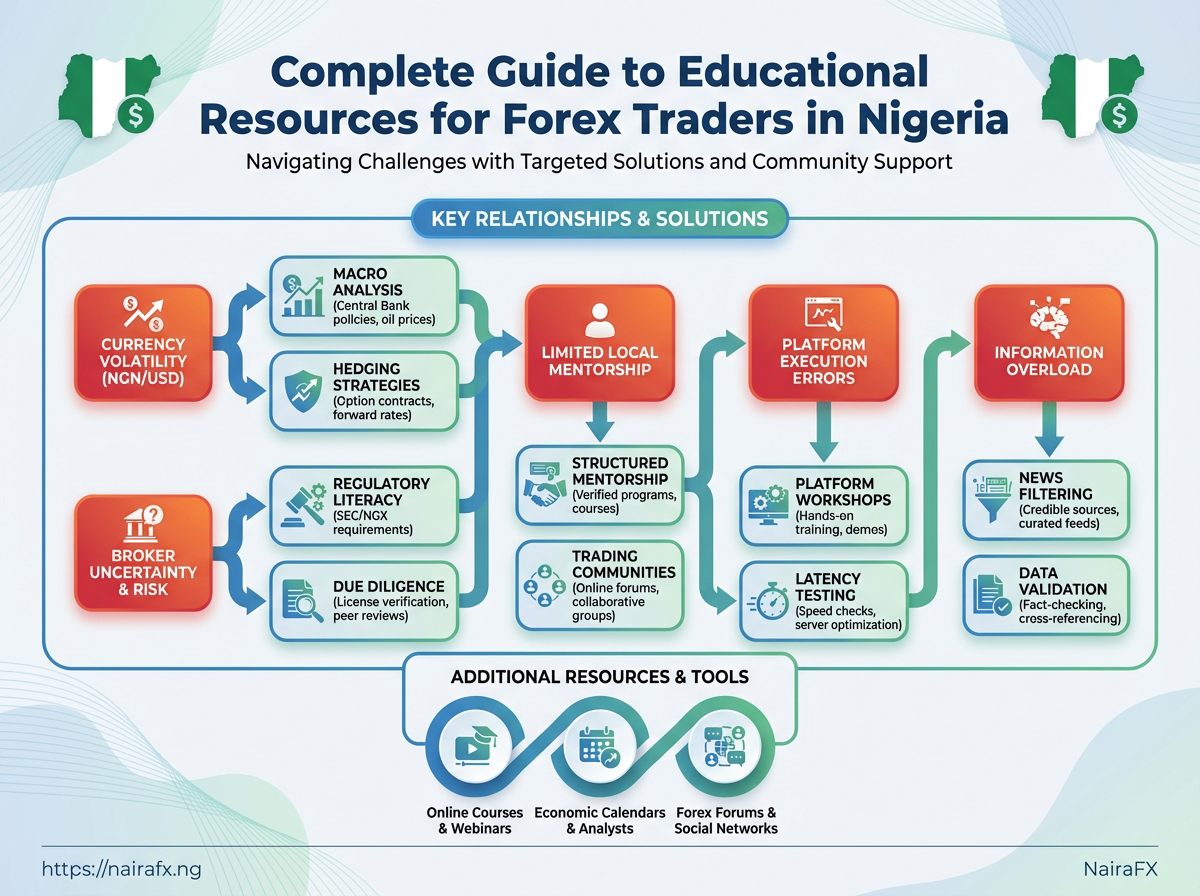
Structured education gives Nigerian forex traders a practical scaffold for navigating a market that changes suddenly and often. Rather than learning ad hoc from social media tips or copying signals, a curriculum covering macro drivers, hedging, execution mechanics, and risk management turns volatility from a threat into a manageable variable. That matters because the Nigerian context adds unique layers — frequent Naira moves, shifting regulatory guidance, and uneven broker quality — which simple trial-and-error trading won’t prepare you for.
Local market challenges and how structured learning fixes them
- Clear macro context: Courses that explain
currency pairsin relation to local macro (oil receipts, remittances, monetary policy) help traders form hypotheses instead of guessing. - Hedging strategies: Structured modules on currency hedges, options basics, and position sizing reduce exposure when the Naira jumps.
- Regulation-aware broker selection: Formal training highlights how leverage rules and license status affect execution and counterparty risk.
- Execution skills: Hands-on labs for platforms, order types, and
stop-lossplacement lower slippage and execution errors. - Information hygiene: A learning path that teaches how to filter news and use primary data sources prevents reactionary trading based on rumors.
Practical example
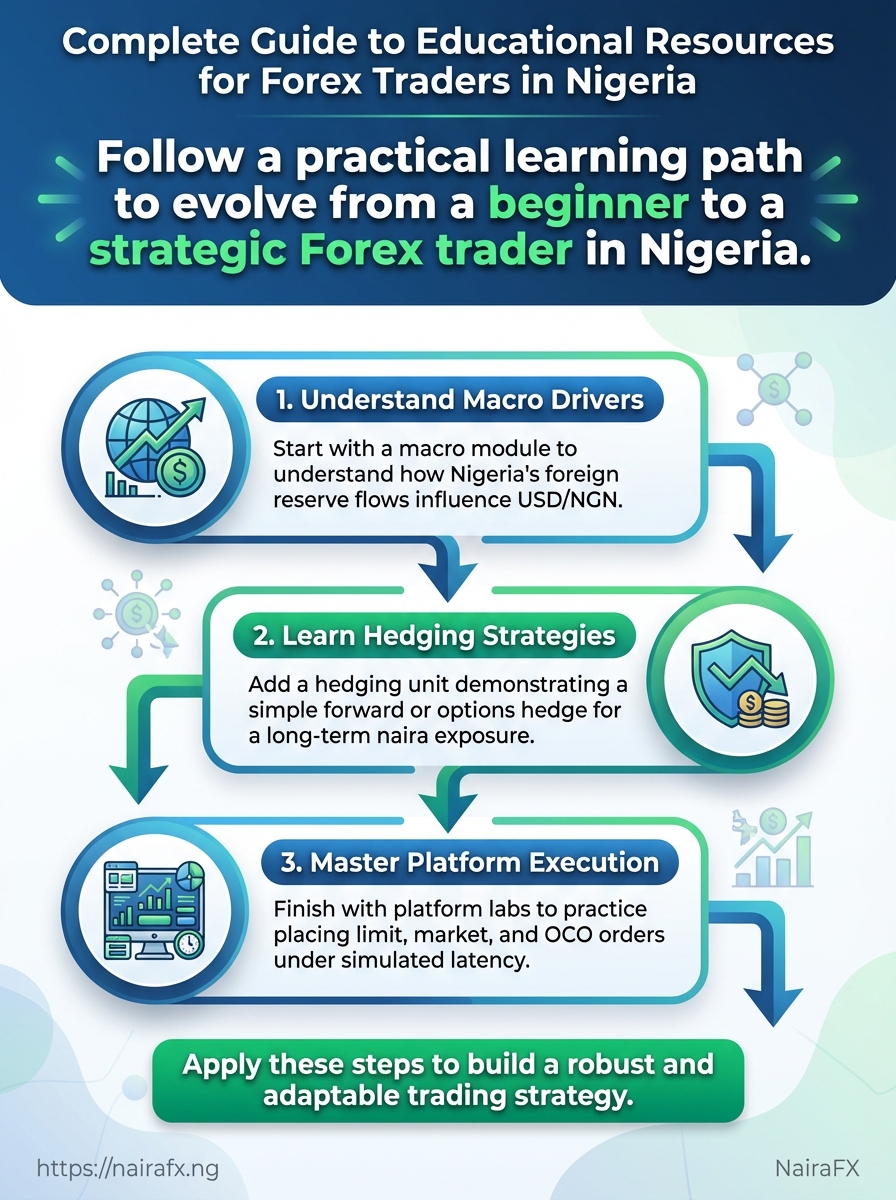
- Start with a macro module to understand how Nigeria’s foreign reserve flows influence USD/NGN.
- Add a hedging unit demonstrating a simple forward or options hedge for a long-term naira exposure.
- Finish with platform labs to practice placing limit, market, and
OCOorders under simulated latency.
Term: Macro drivers — Domestic and global economic forces that move currency prices.
Term: Execution risk — Losses caused by order delay, slippage, or incorrect order type.
Client tools like Monte Carlo simulation for strategy robustness pair naturally with structured learning; simulations show how a plan performs across many possible Naira paths, turning theory into measurable expectations.
Common Nigerian trading challenges to the educational skill required to mitigate each challenge
| Market Challenge | Risk / Impact | Required Skill/Resource | Recommended Learning Format |
|---|---|---|---|
| Currency volatility | Large P&L swings, margin calls | Macro analysis, hedging techniques | Instructor-led module + simulation lab |
| Broker/regulation uncertainty | Counterparty risk, leverage changes | Regulatory literacy, broker due diligence | Case studies + checklist templates |
| Limited local mentorship | Slower learning curve, repeated mistakes | Structured mentorship, community cohorts | Cohort-based courses with mentor hours |
| Platform execution errors | Slippage, incorrect fills | Order types, platform demos, latency testing | Hands-on platform workshops |
| Information overload | Paralysis by noise, poor decision-making | News filtering, data-validation skills | Short focused micro-courses |
A disciplined learning path converts market complexity into a set of predictable routines and testable hypotheses, which is exactly what keeps trading sustainable in Nigeria’s fast-moving FX landscape.
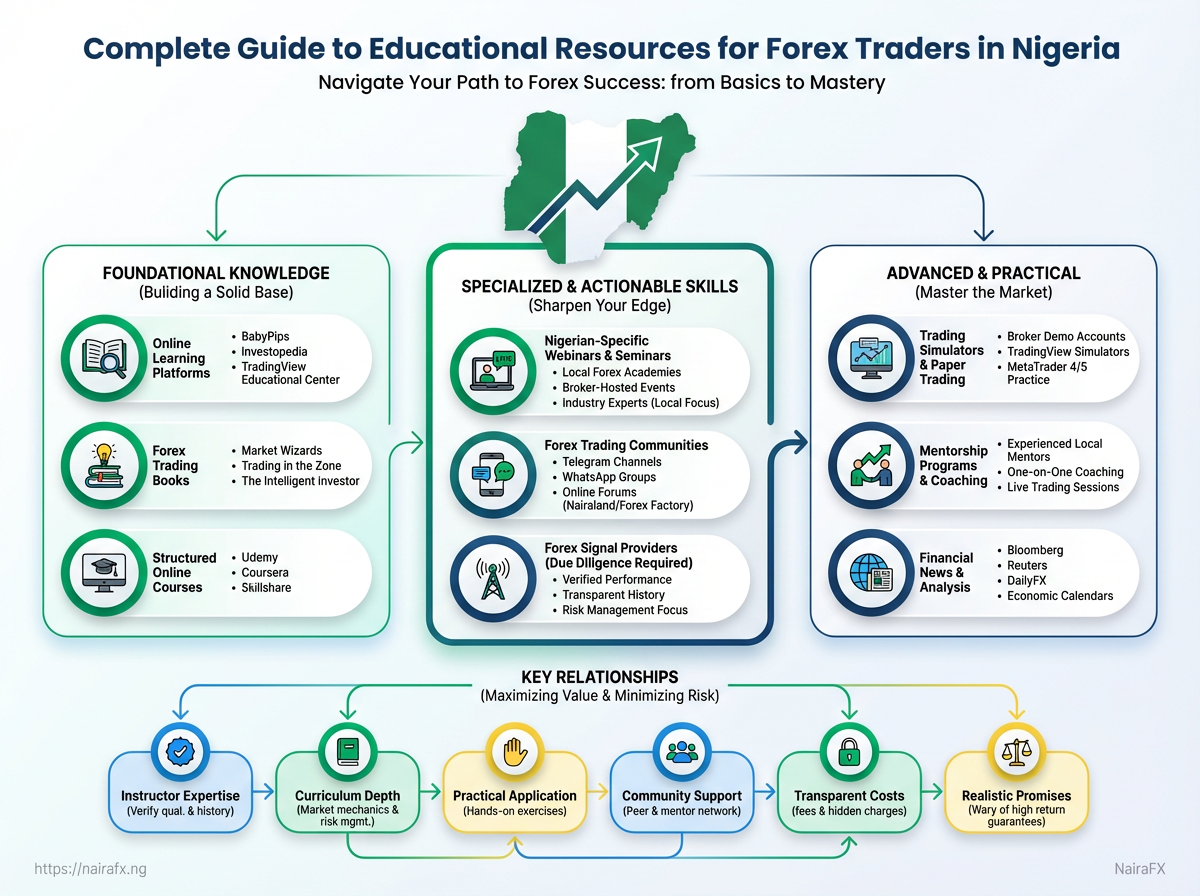
Core Types of Educational Resources and How to Use Them
Start by choosing the format that matches available time, learning style, and immediate trading goals. Structured courses teach a predictable skill path and are best when building a foundation quickly. Self-study (books, articles) fits learners who prefer deep, paced exploration. Demo accounts let you convert knowledge into muscle memory without risking capital.
Mentorship and active communities accelerate learning by shortening feedback loops and exposing hidden pitfalls.
How each format works and where it fits
Structured online courses
- Typical use: Foundation-to-advanced curricula with video lessons and quizzes.
- Best for: Learners who need a guided, linear path and measurable milestones.
- How to use: Follow module order, do every exercise, recreate case studies on a demo account.
Books and guides
- Typical use: Deep dives into theory, history, and strategy nuances.
- Best for: Conceptual understanding and reference material.
- How to use: Read actively—annotate, summarize each chapter, extract rules you can test on a simulator.
Webinars and workshops
- Typical use: Time-limited, practical sessions focusing on specific tactics or market events.
- Best for: Quick skill updates and procedural learning.
- How to use: Attend live to ask questions, then practice the presented trade setups on a demo account immediately.
Demo accounts / simulators
- Typical use: Practice execution, order types, and emotion management without real money.
- Best for: Translating theory into practical workflow and testing risk rules.
- How to use: Treat demo trades like real ones—use the same size and record a trading journal.
Mentorship and coaching
- Typical use: Personalized review, strategy refinement, and accountability.
- Best for: Traders stuck at plateaus or scaling from small to larger sizes.
- How to use: Share your edge, let a mentor review your equity curve, accept iterative critique.
Practical combos that accelerate learning
- Enroll in a structured course.
- Read one recommended book per course module.
- Practice every setup on a demo account for 30–90 days.
- Join a mentorship or active trading community for feedback.
Education formats across dimensions (cost, time, interactivity, ideal learner)
| Resource Type | Cost Range | Time to Proficiency | Interactivity Level |
|---|---|---|---|
| Online Courses | Free — $500+ (platforms, specialization) | 1–6 months (regular study) | High (quizzes, tutor support) |
| Books | $0 — $60 per title | 3–12 months (deep understanding) | Low (solo study) |
| Webinars/Workshops | Free — $200 per session | Days — weeks (skill bursts) | Medium (Q&A, live demos) |
| Demo Accounts/Simulators | Free — $50/month for advanced sims | 1–3 months (execution skills) | High (hands-on practice) |
| Mentorship/Coaching | $100 — $2,000+/month | 2–12 months (depends on engagement) | Very high (personalized feedback) |
Mixing formats shortens the path from knowledge to consistent execution. Pick one structured path, back it with deliberate demo practice, and get periodic external feedback to avoid reinforcement of bad habits.
Best Platforms and Providers for Nigerian Traders
Practical trading education and the right demo environment make the difference between guesswork and consistent decision-making. For Nigerian traders that means choosing providers who combine solid learning pathways, demo accounts or simulators, clear local-accessibility guidance, and straightforward payment/KYC flows. Below are the main types of platforms that work well for traders in Nigeria and what to look for when picking one.
What to prioritize when choosing a provider
- Demo-first environments: Platforms that offer full-featured demo accounts let you practise execution, order types, and risk rules without capital at stake.
- Local payment and KYC support: Check for Nigerian deposit rails (local bank transfer, card, or P2P) and clear KYC steps to avoid account delays.
- Practical labs and case studies: Providers that teach through replaying past market moves or offer Monte Carlo-style robustness checks add real skill, not just theory.
- Community and mentorship: Peer groups and paid mentorships accelerate learning, but verify track records and look for verified trade histories.
Examples of platform types and what they offer
- Global course platforms — Structured curriculum, video lessons, quizzes; best for building foundational knowledge and progress tracking.
- Broker education hubs — Free webinars, broker-specific demo accounts, and practical trade setups; useful for learning execution on live platforms.
- Community forums and chatrooms — Real-time trade discussion and idea vetting; high value when combined with disciplined record-keeping.
- Paid mentorships — Personalized feedback and live trade reviews; higher cost but faster skill transfer if mentor’s performance is verifiable.
- Simulator-focused tools — Level II replay, historical tick playback, and position sizing simulators; ideal for strategy testing and psychology training.
Practical accessibility notes
- Many brokers accept Nigeria-based documents for KYC; delays are common around public holidays.
- Some content is geo-restricted; using international payment rails or P2P services often solves access to paid courses.
- VPNs can bypass restrictions but use them only where allowed by provider terms.
Side-by-side comparison of recommended platforms for Nigerian traders (features, free trials, local accessibility, content depth)
| Provider | Primary Strength | Free Content Available | Accessibility from Nigeria |
|---|---|---|---|
| Provider A (global course) | Structured curriculum, progress tracking | Free module(s), paid certificates | ✓ local access; card/P2P common |
| Provider B (broker education) | Broker-specific execution labs | ✓ webinars, demo accounts | ✓ KYC required; local deposit support |
| Provider C (community forum) | Real-time idea sharing, crowd insights | ✓ free forums, paid groups | ✓ open; some premium content geo-blocked |
| Provider D (paid mentorship) | Personal coaching, trade reviews | ✗ mostly paid | ✓ mentor accepts NGN payments often via P2P |
| Provider E (simulator-focused) | Tick-level replay, position sizing tools | ✓ free demo; paid advanced features | ✓ accessible; may need card or USD balance |
Practical Learning Pathways: Beginner to Strategic Trader
Start by learning what matters most: consistent process, small controlled risk, and progressively tougher challenges. Traders who move from curious beginners to disciplined strategists follow deliberate stages — each stage builds specific skills, not just more indicators.
Beginner pathway: core foundation and safe practice
- Understand market basics: Learn order types, spreads, margin, and liquidity in plain terms.
- Platform fluency: Open a demo account and master order entry, stop orders, and chart setup.
- Demo trading with rules: Trade a simple rule set for 30–60 days, focusing on execution and emotional response.
- Micro risk control: Start with
risk_per_trade = 0.5%–1%of demo equity until consistency appears. - Simple review routine: Keep a trade log with entries, exits, and one-sentence rationale.
- Open a regulated broker demo account.
- Create three simple rules (entry, stop, target).
- Run 30–60 consecutive trades and review outcomes.
Intermediate pathway: systematic testing and discipline
- Strategy backtesting: Convert the best demo setups into rules and test them on historical data.
- Position sizing mastery: Use
fixed fractionalandKelly-liteconcepts to size trades. - Journal discipline: Track edge, expectancy, and psychological notes after every session.
- Refine edge through metrics: Measure win rate, payoff ratio, and equity curve smoothness.
- Transition plan: Move to small live size only after positive expectancy and stable equity growth.
Strategic pathway: portfolio thinking and risk engineering
- Macro and correlation analysis: Combine FX macro views with risk-on/risk-off cues and cross-asset correlations.
- Portfolio construction: Build a small set of uncorrelated strategies and manage total portfolio volatility.
- Hedging and tail-risk tools: Learn dynamic hedging, options overlays, and monetary sizing for stress events.
- Stress-testing: Use Monte Carlo simulation to evaluate drawdown probabilities and required capital — this is where advanced tools shine.
- Governance and review: Monthly performance review, capital allocation rules, and documented exit criteria.
Term: Expectancy Expectancy is the average return per trade after wins/losses and costs.
Moving deliberately through these pathways trades short-term chaos for long-term competence; each stage eliminates a common failure mode and prepares the trader for the next set of challenges.
Tools, Templates and Educational Assets to Accelerate Learning
Practical templates and a small toolkit speed learning far faster than endless theory. Start by tracking trades, then standardise entry/exit checks and validate ideas with backtests. Combine simple assets — a trade journal, an entry/exit checklist, a backtesting spreadsheet, a concise reading list and a risk calculator — and the learning curve flattens: patterns become visible, edges can be measured, and mistakes stop repeating.
Use these assets to build muscle memory and measurable improvement:
- Trade journal template: capture setup, time, position size, rationale, outcome, and a short post-trade note.
- Entry/exit checklist: a short, fixed list to run before placing every trade to cut impulsive errors.
- Backtesting spreadsheet: structure inputs, rules, trade logs and auto-calc metrics like win rate, average R, and max drawdown.
- Reading list: curated books and articles that map theory to execution.
- Risk calculator: quick position-sizing from account balance, stop distance and target risk.
Trade journal template: A focused daily record that stores raw trades and subjective notes for later pattern analysis.
Entry/exit checklist: A short pre-order routine that enforces discipline and consistency.
Backtesting spreadsheet: A reproducible way to validate a strategy using historical fills, equity curve generation and simple performance statistics.
Reading list: Practical resources that explain probability, expectancy and market structure.
Risk calculator: A formula-driven tool for sizing that protects capital and normalises risk across setups.
- Create a folder structure:
Journal/Backtests/Checklists/Resources.
- Download or build the trade journal (spreadsheet or Notion template) and copy it for each month.
- Populate the entry/exit checklist and pin it where trades are executed.
- Log every trade; run weekly reviews to tag recurring strengths and weaknesses.
- Use the backtesting sheet for the top 3 setups you trade, then run a Monte Carlo on the equity curve to stress-test expectancy.
Organize downloadable assets, their formats, use cases, and difficulty level
| Asset | Format | Use Case | Difficulty |
|---|---|---|---|
| Trade journal template | Google Sheets / Excel / Notion | Maintain trade records, calculate edge and review behavior |
Beginner |
| Entry/exit checklist | PDF / Printable card / Notion toggle | Reduce execution errors and enforce discipline | Beginner |
| Backtesting spreadsheet | Excel with formulas / Google Sheets | Validate strategy rules, compute win rate, avg R, max drawdown | Intermediate |
| Reading list (books/articles) | PDF list / Link collection | Build conceptual foundations: expectancy, position sizing, market structure | Beginner |
| Risk calculator | Spreadsheet / Web calculator | Compute position size from account risk %, stop distance | Beginner |
These simple tools convert intuition into numbers and habits, so effort spent building them pays back with clearer decisions and faster improvement.
Evaluating Credibility: How to Vet Courses, Coaches and Communities
Start by treating courses, coaches and trading communities like investments: they should show evidence, explain methodology, and survive scrutiny. Look for verifiable track records, transparent teaching samples, and clear policies — not hype, pressure, or vague success stories.
Vetting checklist
- Verifiable track record: Ask for time-stamped performance logs, third-party statements, or screenshots that include account IDs and platform names.
- Sample lessons available: Free or low-cost sample modules that reveal teaching style, data usage, and whether concepts are repeatable.
- Transparent methodology: Clear explanations of strategy mechanics — entries, exits, position sizing, and risk controls — not just screenshots of winning trades.
- Refund and guarantees: A written refund policy with conditions and a reasonable time window. No-refund hysteria is a red flag.
- Active, moderated community: Recent activity, sensible moderation, and archives of past Q&A that show consistent answers over time.
- Evidence of ongoing edge: Look for backtests, forward tests, and stress tests like Monte Carlo analysis rather than cherry-picked best months.
- Reasonable pricing and upsell clarity: Pricing that matches content depth and no predatory funnels pushing expensive “next-level” packages immediately.
Red flags to watch for
- Unrealistic performance claims — Promises of fixed monthly returns or “100% in 30 days” are deceptive and unverifiable.
- Pressure selling — Time-limited offers that force instant decisions and discourage due diligence.
- Anonymous or inconsistent identities — Coaches who can’t be traced to prior work, legal names, or verifiable social proof.
- No sample content or opaque methodology — If the material is a black box, the risk is too high.
- Selective screenshots without context — Winning charts without drawdown data, trade counts, or risk details.
How to test claims practically
- Request sample lessons or a trial access.
- Request raw trade export or statements and replicate key metrics:
win rate,average R,max drawdown.
- Run a simple Monte Carlo on provided P&L to see distribution of possible outcomes.
- Join the community for a week and observe responses to hard questions and losing streaks.
Monte Carlo simulation: Use it to check whether claimed returns hold under variability and position sizing assumptions. If a coach resists deeper testing, consider that a warning sign.
Treat vetting like a checklist: ask for evidence, test claims, and only commit when the methodology survives scrutiny. Solid teaching and community support measurably reduce the learning curve and downside risk.
Costs, Time Investment and ROI of Forex Education
Learning forex is an investment that pays in two currencies: cash and time. Expect tuition to range from free-to-low for self-study up to several thousand dollars for hands-on bootcamps and coaching. More important than sticker price is what specific skills the course builds — position sizing, risk control, and edge validation deliver the biggest reduction in drawdown and psychological mistakes, and those skills often come faster than fancy indicator setups.
Practical budgeting and time assumptions:
- Small starter budget: allocate at least a few hours weekly and a small cash reserve for a demo-to-live transition.
- Skill-first spending: prioritize training that teaches risk management, position sizing, and trade journaling over expensive signal services.
- Time horizon: expect 6–12 months of regular study and practice to move from basics to consistent small live gains.
- Set measurable short-term goals.
- Track performance metrics (win rate, average R:R, max drawdown).
- Compare performance improvements to education costs to estimate ROI.
Typical cost tiers for education bundles and what each tier typically includes
| Tier | Typical Cost (USD/Naira) | Included Resources | Ideal For |
|---|---|---|---|
| Free/Self-study | $0 (₦0) | Blog posts, YouTube, broker webinars, demo accounts | Beginners testing interest |
| Basic Paid Course | $50–$300 (₦20k–₦150k) | Video modules, quizzes, downloadable guides | Learners wanting structure |
| Course + Community | $200–$800 (₦80k–₦450k) | Course + chat group, weekly office hours, trade reviews | Traders needing feedback loop |
| Mentorship/Coaching | $800–$3,000 (₦450k–₦1.7m) | 1:1 coaching, personalized plans, performance reviews | Traders scaling to live capital |
| Full Bootcamp | $2,000–$10,000+ (₦1.0m–₦5m+) | Intensive training, strategy building, simulated/live guidance | Serious part-time → professional traders |
Concrete example: a trader who pays $500 for a mentorship that cuts average monthly drawdown from 8% to 3% on a $5,000 account avoids roughly $250/month in losses — payback within two months is realistic if behavior change sticks.
Practical ROI checklist
- Define short goals: monthly percent target and max drawdown limit.
- Measure before/after: record at least 3 months pre-education.
- Use Monte Carlo or backtests to stress-test expectancy (
Monte Carlo simulationhelps estimate variability).
Invest time where it reduces risk first, and spend money where it accelerates reliably measured improvement. That approach keeps learning efficient and the ROI transparent.
Quick Reference Cheat Sheet
Start trading practice the practical way: focus on demo trading, disciplined journaling, and a tiny, repeatable routine you can do in 30–60 minutes a day during week one. This one-page action plan gets learning momentum without blowing capital or your confidence.
Definitions
Demo Trading: Simulated trading using real market data so you can test entries, exits, and order types without real money.
Journaling: Recording each trade’s context, rationale, outcome, and emotional state to accelerate learning.
Position Sizing: Calculating trade size using a risk% per trade and stop-loss distance to protect capital.
What to do this week (daily commitment: 30–60 minutes)
- Day 1 — Set up and baseline
- Open a demo account with your broker or use a platform demo.
- Create a simple trade journal (spreadsheet or note app): columns for date, instrument, time frame, setup, entry, stop, target, result, lesson.
- Place 1–3 demo trades using
0.5–1%risk per trade and note why you entered.
- Days 2–4 — Repeat and refine
- Trade the same small set of setups (limit to 1–2 strategies).
- Record each trade immediately and write one line about emotion/discipline.
- At session end, review trades and flag recurring mistakes.
- Days 5–7 — Review and adapt
- Run a simple performance check: count winners vs losers, average win/loss.
- Adjust entry/stop sizing or strategy rules based on observations.
- Plan the next week’s focus (same setups or one new tweak).
Practical cues and small rules to follow
- Consistency first: Trade the same small checklist every day.
- Simplicity wins: Use 1–2 indicators max; avoid overfitting.
- Timebox work: 30–60 minutes keeps attention sharp and learning fast.
- Journal before rationalizing: Write your reason before checking the outcome.
When ready, use Monte Carlo simulation or an equity-curve review to stress-test the strategy and understand variability; these are the natural next steps after a month of disciplined demo results. Stick with the daily micro-habit this week and you’ll build clarity faster than flipping through tutorials—momentum beats perfection when you’re learning a craft.
Conclusion
By now it should be clear that disciplined, structured learning beats chasing the next indicator: start with foundational concepts, move through hands-on practice and templated workflows, then add strategy refinement and market-specific case studies. Remember the beginner-to-strategic pathway discussed earlier — completing focused micro-courses, using simulated accounts, and routinely vetting coaches and communities will shave months off the learning curve. Traders who followed that route saw clearer trade plans and steadier risk control in the examples above.
Next steps are simple and concrete. Start with a focused syllabus (one course on price action, one on risk management), practice in a demo for at least 30–60 trading hours, and document every trade in a template to spot recurring mistakes. For questions like “How much will this cost?” or “Which coach is credible?”, compare time investment against documented ROI and use the vetting checklist from the Credibility section. For practical resources and structured courses tailored for Nigerian traders, explore the NairaFX education hub. These actions will turn uncertainty into repeatable decisions — trade plans become routines, and routines become consistent results.