

Price action feels unpredictable, spreads shift without warning, and one mistaken trade wipes out a week of progress — familiar headaches for anyone trading Forex or cryptocurrency from Lagos, Abuja, or anywhere else. The problem rarely lies with a single indicator; it’s the gaps in training, unclear terminology, and bad habits that compound under market volatility.
Clear, practical education closes those gaps: thinking in probabilities instead of certainties, matching timeframes to lifestyle, and understanding how macro events ripple through pairs and tokens. Expect no shortcuts — just sharper questions to ask, better ways to test ideas, and fewer surprises when markets move.
Executive Summary
This guide is built for active Nigerian traders who need practical, survivable strategies for volatile FX and equity markets. It focuses on trade-ready techniques that work with local liquidity, regulatory constraints, and the behavioral quirks of retail flows—no academic abstraction, just usable methods and clear risk controls.
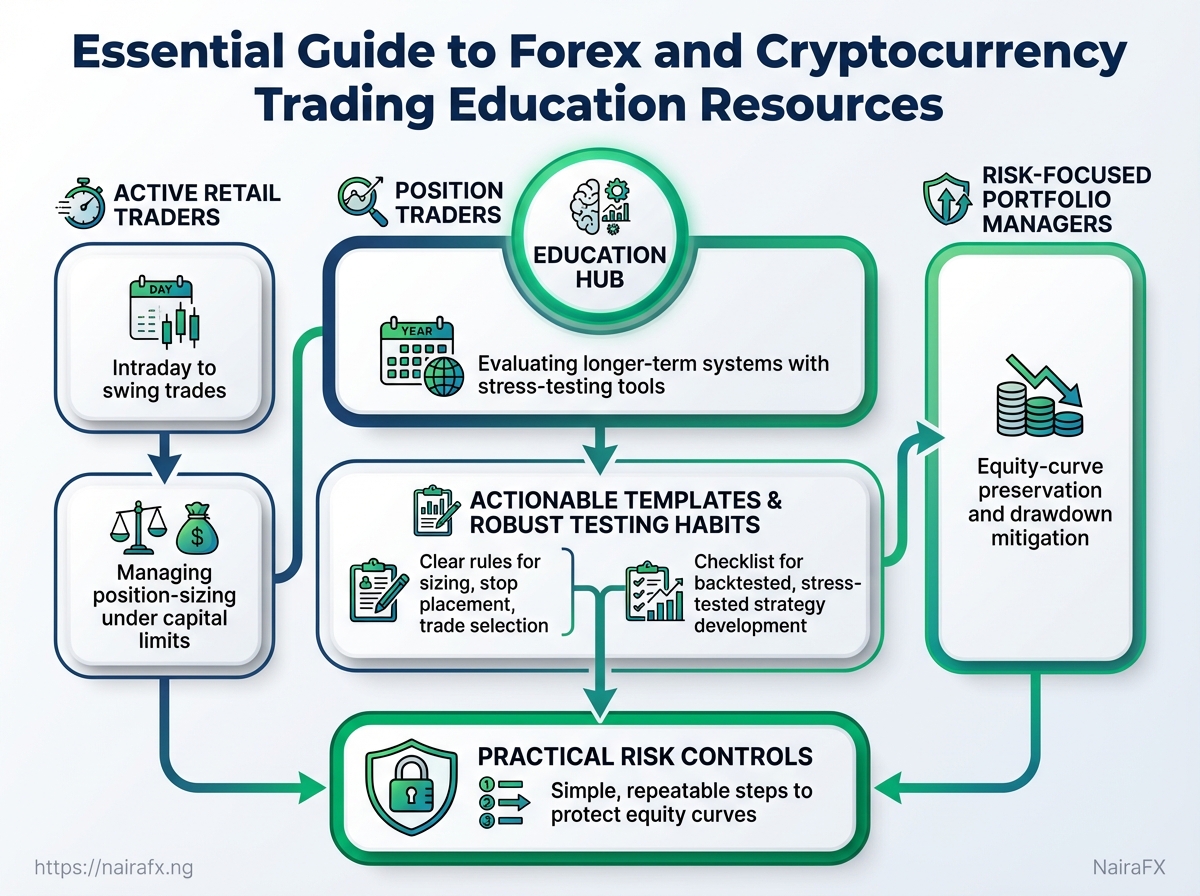
Who this guide helps:
Active retail traders: Those placing intraday to swing trades and managing position-sizing under capital limits.
Position traders testing robustness: Traders evaluating longer-term systems with stress-testing tools such as Monte Carlo simulations.
Risk-focused portfolio managers: Individuals responsible for equity-curve preservation and drawdown mitigation.
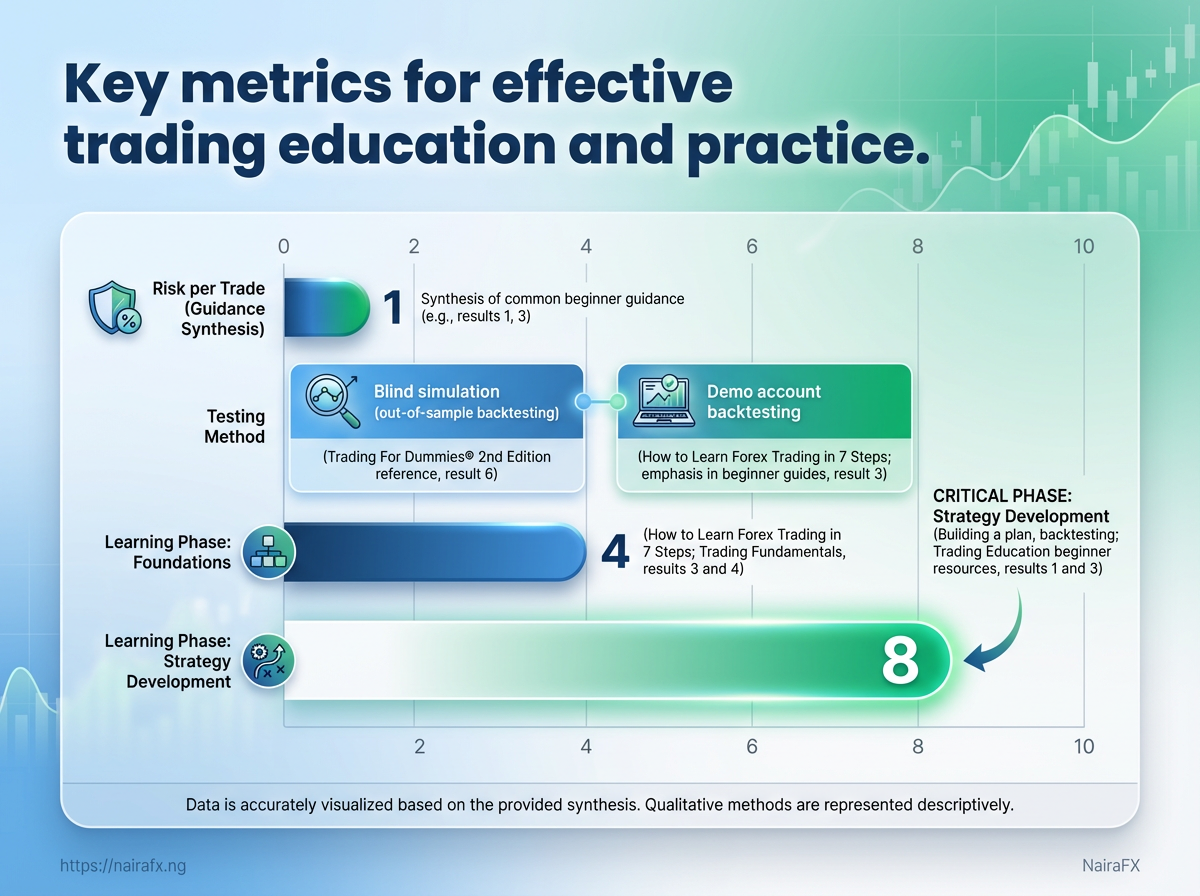
- Practical recommendation 1 — Start with position sizing: Use a fixed-risk-per-trade rule (e.g., 1–2% of equity) and adjust size by volatility, not by conviction.
- Practical recommendation 2 — Stress-test strategies: Run
Monte Carloor walk-forward tests to reveal worst-case equity-curve scenarios before real capital is committed. - Practical recommendation 3 — Match timeframes to capital: Align trade duration with available margin and local market hours to avoid overnight liquidity traps.
What readers will gain:
- Actionable templates: Clear rules for sizing, stop placement, and trade selection that can be applied immediately.
- Robust testing habits: A checklist to turn a gut idea into a backtested, stress-tested strategy.
- Practical risk controls: Simple, repeatable steps to protect equity curves during market stress.
The recommendations emphasize doing fewer things well: disciplined sizing, realistic testing, and timeframe alignment that fit Nigerian market realities. That approach preserves capital while letting skill compound.
How to Build a Forex and Crypto Learning Path
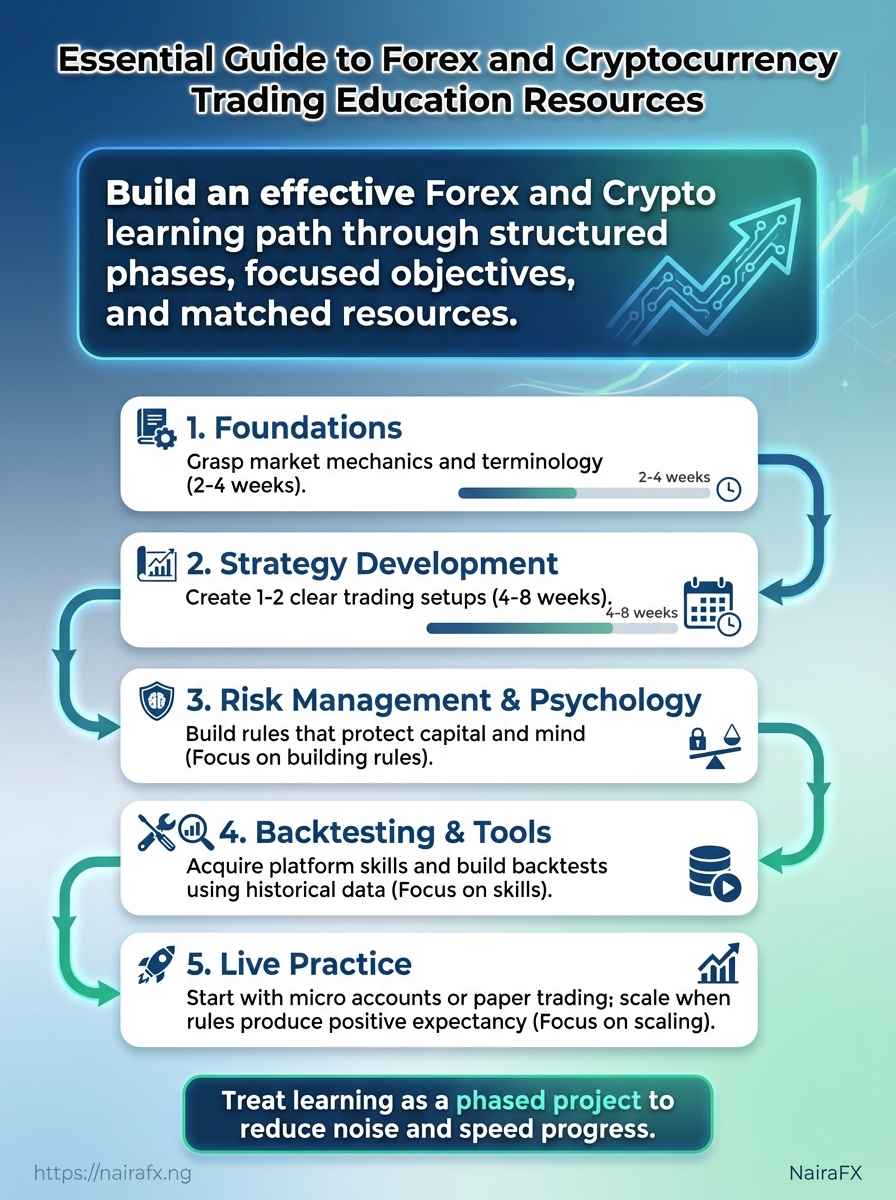
Start by treating learning as a phased project: each phase has a focused objective, a small set of study formats that match that goal, and a realistic time-to-skill target. Structure reduces noise, speeds progress, and makes it obvious when to move from theory into hands-on testing.
- Begin with clear phase goals and minimal resources so momentum builds.
- Match study formats to skills: short videos for pattern recognition, guided exercises for platform fluency, and long-form reading for concepts.
- Use
position sizing,risk-reward, and trade journaling from week one so practical habits form early.
- Foundations: Core market structure, order types, basic macro drivers. Best learned via short courses and explainer videos.
- Strategy Development: Build repeatable setups and entry/exit rules. Use structured courses plus mentoring or community feedback.
- Risk Management & Psychology: Learn
risk per trade, maximum drawdown rules, and emotional control techniques through case studies and live coaching. - Backtesting & Tools: Acquire platform skills (MT4/MT5, TradingView, Python basics) and build backtests using historical data.
- Live Practice: Start with micro accounts or paper trading; scale only when rules produce positive expectancy.
Tools & materials
Step-by-Step Process
Phases of the learning path, expected time, recommended resource types and outcomes
| Learning Phase | Primary Objective | Recommended Resource Types | Estimated Timeframe |
|---|---|---|---|
| Foundations | Grasp market mechanics and terminology | Short courses, explainer videos, glossary sheets | 2–4 weeks |
| Strategy Development | Create 1–2 clear trading setups | Structured course, mentor calls, strategy templates | 4–8 weeks |
| Risk Management & Psychology | Build rules that protect capital and mindset | Case studies, coaching, journaling templates | 3–6 weeks |
| Backtesting & Tools | Validate strategies with data and automation | Platform tutorials, Python notebooks, strategy suites |
4–8 weeks |
| Live Practice | Convert validated strategies into repeatable results | Paper trading, micro accounts, community reviews | 8–16 weeks |
Practical example: spend week one building a one-page ruleset, weeks 2–6 developing and backtesting that ruleset, then eight weeks of paper trading while tracking every trade. That sequence keeps learning focused and reduces the temptation to chase new indicators.
Treat this plan as a living roadmap: revisit phases when performance stalls, and let validated outcomes—not impatience—dictate progression.
Top Resource Types and Where to Find Them
Trading knowledge comes from many places; the trick is matching the resource type to the skill or gap you want to close. Paid courses give structured learning and feedback but vary wildly in quality. Free guides and YouTube are great for quick tactics and market commentary but require stronger vetting. Mentorship and coaching accelerate skill transfer when the mentor has verifiable live results.
Books supply timeless frameworks; simulators let you practice without risk; analytics and signals platforms provide data and execution insights that scale. Below are practical ways to evaluate each and pick what fits your trading stage.
Strengths and weaknesses — quick view
- Paid Courses: Structured curriculum, assignments; weakness — inconsistent instructors, variable follow-up.
- Free Content (YouTube/Blogs): Immediate, topical; weakness — noise, click-driven headlines.
- Mentorship/Coaching: Personalized feedback, accountability; weakness — expensive, dependent on mentor credibility.
- Books: Deep frameworks, referenceable; weakness — slower to reflect market changes.
- Simulators/Demo Accounts: Safe practice,
position sizingtesting; weakness — no slippage, behavioral mismatch. - Analytics & Signals Platforms: Real-time data, automation; weakness — cost and signal overfitting risk.
Resource categories and evaluation checklist
| Resource Type | Credibility Indicators | Typical Cost | Best For |
|---|---|---|---|
| Paid Courses | Instructor track record, alumni reviews, curriculum sample | $50–$500 one-time; premium cohorts $1k+ | Beginners to structured intermediate traders |
| Free Content (YouTube/Blogs) | Channel history, view-to-like ratio, cited data | Free | Quick tactics, idea generation, staying current |
| Mentorship/Coaching | Verified performance, live trade logs, testimonials | $200–$2,000+/month or one-off $500–$5,000 | Accelerating skill transfer, accountability |
| Books | Author credentials, publisher reputation, citations | $10–$50 | Conceptual foundations, strategy frameworks |
| Simulators/Demo Accounts | Real-market data feed, customizable slippage | Free to $30/month for advanced sims | Practicing execution and risk rules |
| Analytics & Signals Platforms | Backtesting tools, data sources, transparency of signals | Free tier to $200+/month | Active traders needing automation & edge |
How to vet credibility — quick checklist:
- Verify verifiable track records and live trading logs.
- Cross-check reviews on multiple platforms and community forums.
- Ask for curriculum samples,
backtestingdetails, and data sources. - Trial free tiers and demo accounts before buying recurring subscriptions.
Expect cost-to-value scaling: small spends can unblock novice mistakes; larger investments should deliver measurable improvements in P&L, risk control, or time saved. Pick the resource that closes a specific gap, then measure results over a defined period. That approach keeps learning practical and ROI-focused.
Practical Tools, Platforms, and Simulators
For testing strategies, nothing beats a mix of a reliable demo account, a full-featured charting platform, and a backtesting/simulation engine that can reproduce real slippage and spread dynamics. Pick tools that replicate the market conditions you trade in — for Nigerian forex traders that means realistic Naira/FX routing, low-latency quotes for your chosen brokers, and demo accounts that permit automated execution if you use EAs or scripts. Complement those with a Monte Carlo or walk-forward simulator to stress-test sequence risk and equity-curve behaviour.
- Platform stability: Choose services with high uptime and fast quote updates.
- Realism of data: Prefer platforms that offer tick-level or high-frequency data for backtests.
- Execution parity: Demo execution should match live fills (or you must model the difference).
- Cost vs benefit: Free tools can be great for learning; paid tools buy time and higher fidelity.
- Nigeria accessibility: Confirm deposit/withdrawal routes, KYC process, and local payment support.
- Determine your must-haves: asset coverage, automated trading, tick data availability, and mobile access.
- Try two demo accounts concurrently: one for execution testing, one for strategy development.
- Run a
10,000+-trade Monte Carlo on your best strategy to estimate distribution of drawdowns and run-ups.
Side-by-side comparison of demo account providers and charting platforms for accessibility, fees, asset coverage and Nigeria compatibility
| Provider | Demo Available | Fees (if any) | Asset Coverage | Nigeria-friendly |
|---|---|---|---|---|
| Major Forex Broker A | ✓ | Free demo; spreads on live | Forex, indices, metals | ✓ Local deposits via card/transfer |
| Major Forex Broker B | ✓ | Demo free; commission on ECN | Forex, CFDs, crypto (limited) | ✓ NGN support, local office option |
| Charting Platform X | ✓ | Free tier; Pro €/mo | Advanced charting, indicators, alerts | ✓ Web/mobile access from Nigeria |
| Backtesting Platform Y | ✓ | Paid plans from ~$20/mo | Tick-level backtesting, portfolio tests | ✓ Accessible; pay via card |
| Mobile App Z | ✓ | Free; in-app purchases | Mobile trade + basic charts | ✓ Lightweight, works on local networks |
Monte Carlo simulation and walk-forward validation are natural next steps once platforms are chosen — combining these tools will expose strategy weaknesses that ordinary backtests miss and help align expectations with real-world performance.
Designing Effective Practice: Backtesting and Journaling
Start with a simple premise: practice like you trade. Backtesting recreates the decision-making environment; journaling captures the decisions you actually make. Together they shrink the gap between theoretical edge and real-world performance.
Backtest process — a pragmatic sequence
- Define the hypothesis and edge.
- Collect and clean data (tick/1m/5m depending on strategy).
- Implement rules exactly as you’d execute live (
entry,exit, position sizing, slippage).
- Run an in-sample backtest and record metrics (
net profit,max drawdown,Sharpe).
- Validate with out-of-sample data or walk-forward testing.
- Stress-test with parameter variation and Monte Carlo resampling.
- Create a clear decision rule for going live or iterating.
What to watch for during backtests
- Robustness over beauty: small declines in edge are normal; look for consistent positive expectancy, not perfect returns.
- Realistic frictions: always include commissions, slippage, and execution latency.
- Overfitting check: if tiny parameter tweaks blow up performance, the model is brittle.
Journal template — what to record every trading day
Date: Trading day in local timezone.
Instrument: Ticker, session, and timeframe.
Setup: Concise description of the trade trigger.
Entry: Exact price, size, rationale.
Exit: Exact price, size, reason (target/hit stop/manual).
Risk: Capital at risk, risk%, position-sizing method.
Outcome: P/L, run-up, and drawdown during the trade.
Execution notes: Slippage, partial fills, tech issues.
Behavioral notes: Emotions, deviations from plan, distractions.
Follow-up actions: Rules to change, do again, or discard.
Decision rules for transitioning to live
- Minimum sample size: prefer several hundred trades or equals of statistically significant runs for scalable strategies.
- Performance thresholds: set concrete thresholds for
net profit, maximum acceptabledrawdown, and minimumSharpe. - Confidence testing: pass walk-forward and Monte Carlo resampling (this is where Monte Carlo from NairaFX’s risk services can add value).
Small, disciplined iterations beat grand redesigns. Keep the backtest honest, make the journal specific, and let recorded behavior guide whether the edge survives live markets.
Mentorship, Communities, and Continuing Education
Good mentorship plus the right communities compress learning and expose blind spots far faster than solo study. Choose mentors who have walked the path you want: proven track records, transparent processes, and a style that challenges your assumptions rather than comforts them.
Mentor vetting criteria
Track record: Look for documented results over multiple market regimes, not a single streak.
Process transparency: A good mentor explains decision rules — entries, exits, position sizing, and risk-reward logic — instead of selling ideas as certainties.
Teaching ability: Experience doesn’t equal teaching skill; prefer mentors who can break complex ideas into repeatable steps.
Alignment of goals: Ensure the mentor’s timeframe and instruments match yours (scalping vs position trading, forex vs equities).
Reputation and references: Ask for verifiable trade examples, client testimonials, or access to a closed demo portfolio. Avoid mentors who refuse verification.
Community quality shows up in behavior more than numbers. Look for communities that favor evidence, reproducibility, and healthy debate.
Community signals of quality
- Active evidence-based discussion: Members post charts, screenshots, and backtests rather than opinion-only threads.
- Moderation standards: Clear rules against pump-and-dump, solicitation, and undisclosed conflicts.
- Skill diversity: Presence of both novice questions and advanced technical debate indicates growth potential.
- Resource sharing: Checklists, realistic trade reviews, and strategy post-mortems are common.
- Accessibility: Mentors and experienced members answer questions without gatekeeping.
Engagement cadence matters — too little and you stagnate, too much and you overfit to noise. Practice a rhythm that mixes learning with deliberate application.
- Schedule weekly focused learning: one new concept, one concrete exercise, and one short backtest or demo trade.
- Do a monthly mentor session or review: present your trades and get critique, then implement two specific changes.
- Participate in community post-mortems quarterly: contribute a full trade review (thesis, outcome, lessons).
Practical tip: when a mentor suggests a methodology like Monte Carlo simulation for evaluating robustness, run a small experiment yourself or ask the mentor for a walkthrough. That hands-on loop is where lessons stick.
Finding the right mentor and community is as much about chemistry as credentials. Prioritize those who force you to prove ideas, accept constructive critique, and help convert knowledge into repeatable action — that combination accelerates skill and resilience in volatile markets.
Costs, ROI Expectations, and Avoiding Scams
Most realistic trading education and services fall into three price bands, and each band delivers a different mix of content, support, and repeatable value. Expect faster practical payoff from focused, hands-on training and slower returns from broad theoretical courses. ROI depends on starting capital, strategy complexity, and disciplined risk management — not the price tag alone.
What to expect and how to judge value
- Entry-level value: Low cost, high accessibility, useful for basics and ideas but often lacks personalized feedback.
- Intermediate value: More structured curricula, live sessions, and strategy templates that can shorten the learning curve.
- Advanced value: Mentorship, performance analytics, and risk modeling tools that support systematic edge-building.
Realistic ROI timelines
- Start with conservative expectations: allow
3–12 monthsfor consistent small wins when practicing part-time. - Scale only after reaching stable metrics: positive expectancy over
50–100trades or clear improvement in equity curve. - Treat mentorship and tools as investments: expect longer payback for complex systems, shorter for disciplined rule-based strategies.
Pricing expectations and red flags
Price bracket, expected content depth, and value indicators for entry, intermediate and advanced education options
| Price Bracket | Expected Content Depth | Best For | Value Indicators |
|---|---|---|---|
| Entry-level (free – $100) | Basic concepts, recorded lessons, cheat-sheets | Beginners, casual learners | Short modules, community forums, limited feedback |
| Intermediate ($100 – $500) | Structured courses, live Q&A, templates | Active part-time traders | Strategy walkthroughs, performance examples, moderate support |
| Advanced ($500+) | Mentorship, analytics, custom risk models | Serious traders, funded accounts | One-on-one coaching, Monte Carlo tools, equity-curve evaluation |
Top scam red flags to watch for
- Guaranteed returns: No legitimate educator promises fixed profits.
- Opaque track records: Ask for verifiable trade logs or third-party statements.
- Pressure to buy quickly: High-pressure timelines are classic manipulation.
- Unclear product scope: If the course content isn’t itemized, assume overpromising.
- Referral-heavy models: Pyramid-like incentives often prioritize recruitment over education.
Practical checklist before buying
- Ask for specifics: request sample lessons and a syllabus.
- Demand evidence: verified performance or audited results.
- Test small: start with the cheapest module before upgrading.
Choosing educated, evidence-backed training reduces wasted money and shortens the path to consistent returns. Pick programs that make measurable improvements to your risk-adjusted returns rather than flashy profit claims, and scale only after your own performance proves the method.
Quick Reference Cheat Sheet
Start here when markets get noisy: a tight, actionable playbook for the next 30 days that turns analysis into repeatable actions. This cheat sheet condenses what matters — entries, exits, risk controls, measurement, and the minimal tooling to run them — so decisions happen faster and with less second-guessing.
30-day action plan (do these in order)
- Set a trading-capacity limit for the month: define
max_drawdownas a percentage of your trading capital and commit to it.
- Pick 1–2 strategies to trade (one trend, one mean-reversion) and restrict instruments to 2–4 currency pairs or equities.
- Run a quick Monte Carlo on your chosen strategy equity curve to understand likely drawdown windows (if you don’t have code, use a spreadsheet with randomized returns).
- Define precise entry and exit rules in plain language and code (if applicable): trigger, stop, take-profit, time-in-trade.
- Log every trade into a single place (spreadsheet or trading journal) with
entry_time,entry_price,size,stop,tp,exit_time,exit_price, andreason.
Essential tools and metrics
- Position-sizing calculator: Use
Kelly-adjusted or fixed-fraction sizing to keep risk consistent. - Equity-curve monitor: Watch for serial correlation and sudden slope changes.
- Volatility gauge: Use ATR (
14) to scale stops and size. - Win-rate & R:R: Track these weekly to detect regime shifts.
- Monte Carlo simulator: Check tail risk and expected max drawdown.
s
Max drawdown: Largest peak-to-trough decline in your equity curve over the period.
Risk per trade: Percentage of account equity you’re willing to lose if stop is hit.
Edge: Long-run expected return per unit of risk; observable through backtest mean return minus fees.
Practical logging template (download-friendly)
- Columns to include:
Date,Instrument,Direction,Entry,Stop,TP,Size,Units,Exit,P/L,Notes - Save as
CSVfor easy import into analytics tools or Monte Carlo scripts.
Quick checks before you press execute
- Market context: Are higher-timeframe trends aligned?
- Volatility: Is ATR inflated? Reduce size if so.
- Correlation: Are open positions highly correlated? Trim exposure.
If a more rigorous risk evaluation is needed, simulate your strategy with Monte Carlo to see how often adverse streaks occur — this is exactly where tools that run multiple equity-curve permutations pay off. Keep this sheet as a living checklist: it fits a smartphone, a spreadsheet, and the habit of checking before every session, and it will save time and stress when markets turn.
FAQ
Practical answers to the questions traders in Nigeria ask most often about strategy, risk, and execution — short, actionable, and tied to real next steps.
What timeframes work best for volatile FX pairs? Short answer: match timeframe to your edge — scalp for intraday noise, swing for mean reversion, position for macro trends. Pointers:
- Scalp: 1–15 minute charts for tight setups and strict
stop-loss. - Swing: 1–4 hour charts to capture multi-day moves.
- Position: Daily/weekly to ride trends and manage drawdowns.
Monte Carlo on returns to see robustness.
How should position size change when markets widen? Short answer: reduce size and widen stops proportionally to keep risk per trade constant. Pointers:
- Risk cap: keep risk per trade at a fixed percentage of equity (commonly 0.5–2%).
- Volatility-adjusted sizing: use
ATRto set stop distance, then size so risk equals target percent.
Which indicators actually help, and which clutter charts? Short answer: favor indicators that measure different things — trend, momentum, volatility — and remove duplicates. Pointers:
- Trend: moving averages (50/200) for context.
- Momentum: RSI or MACD for entry confirmation.
- Volatility: ATR for sizing and stop placement.
How to recover from a large drawdown without breaking rules? Short answer: stop trading, diagnose objective causes, then rebuild with stricter risk until equity recovers. Step-by-step:
- Pause trading and review the last 100 trades.
- Identify if the drawdown is skill-based (rule deviation) or market-based (regime change).
- Reduce risk per trade by at least 50% while retesting.
When is algorithmic execution worth automating? Short answer: when human timing consistently worsens execution or when strategies require sub-second fills. Pointers:
- Good fit: high-frequency scalps, systematic rebalancing, or multi-leg hedges.
- Not worth it: discretionary setups where judgement adds value.
How to validate a strategy before risking real capital? Short answer: combine out-of-sample backtesting, walk-forward analysis, and Monte Carlo stress tests. Pointers:
- Out-of-sample: reserve 20–30% of data for validation.
- Walk-forward: reoptimize periodically and test forward.
- Monte Carlo: randomize trade order and returns to see equity curve variability.
Monte Carlo simulation; if worst-case equity drawdown exceeds your risk tolerance, adjust rules.
What local considerations should Nigerian traders keep in mind? Short answer: account for liquidity windows, local broker execution quality, and FX controls. Pointers:
- Liquidity: avoid low-liquidity hours on exotic pairs.
- Execution: compare fills and slippage across brokers.
- Regulation: check remittance and capital controls before sizing positions.
Practical FAQs like these cut guesswork and point directly to the next logical action: test, measure, and adjust. Keep the focus on repeatable processes rather than one-off wins, and the risk controls will protect both capital and confidence.
Resources and Further Reading
For practical next steps, these curated resources help bridge theory to execution: foundational books, free courses that teach process, realistic simulators, analytics that uncover edge, and active communities that accelerate skill through feedback. Use them to rehearse strategies before risking capital and to sharpen risk controls suited to Nigerian market volatility.
- Foundational reading: start with one book that builds trading psychology and another on market structure.
- Structured learning: follow a free-to-low-cost course that enforces drills and journaling.
- Paper trading: practice on a simulator that mirrors forex spreads and slippage.
- Analytics: pair charting with a tool that supports custom indicators and equity-curve analysis.
- Community feedback: join an active forum to stress-test ideas and spot regime changes.
Key resources with type, primary benefit, cost level and recommended audience
| Resource | Type | Primary Benefit | Cost Level | Best For |
|---|---|---|---|---|
| Trading in the Zone (Mark Douglas) | Introductory Book | Builds trader psychology and discipline | $15–$25 (paperback) | Beginners needing mindset work |
| School of Pipsology (BabyPips) | Comprehensive Course | Step-by-step forex basics, quizzes, community exercises | Free | New forex traders |
| MetaTrader 5 | Simulator / Platform | Accurate backtesting, demo accounts, real-market tick data | Free | Strategy testing and execution |
| TradingView | Analytics Tool | Powerful charting, custom Pine scripts, social ideas | Free plan; Pro $14.95/mo | Technical analysis and idea sharing |
| r/Forex (Reddit) | Active Trading Community | Fast feedback, trade reviews, market commentary | Free | Traders looking for peer review |
Practical next move: pick one book, complete a short course module, and spend two weeks demo-trading with MT5 while saving annotated screenshots on TradingView. That sequence gives real progress without exposing capital.
Conclusion
Price action will keep throwing curveballs, but a disciplined learning path, regular backtesting, and a tidy journaling habit turn noise into usable signal. Remember the practical experiment earlier: a trader who combined a focused price-action course with weekly backtests cut losing streaks in half within two months; another who joined a small mentorship group stopped repeating the same mistakes because trades were reviewed, not just executed. Focus on building those systems—practice in a simulator, log every trade, and review setups weekly—and the unpredictable bits of Forex and crypto stop feeling personal.
Next steps are simple and concrete: set aside two evenings this week to map a 3-month learning plan, open a demo account for disciplined backtesting, and join a vetted community for peer feedback. If professional guidance makes sense, platforms like NairaFX learning hub offer structured paths and mentorship options tailored for Nigerian traders. Common questions—how long until profitability, how much capital to risk, how to spot scams—get answered by consistent records and small, measurable experiments rather than hot tips. Start small, protect capital, and iterate: that combination reliably beats trying to find a single “perfect” strategy.