
Have you ever chosen a broker advertising zero commission, then wondered why your account balance still fell after several trades? For many Nigerian traders, the answer sits in the spread, currency conversion, or overnight charges rather than the headline fee.
Forex broker fees rarely appear as one simple amount.
A broker may earn through the spread, charge a separate commission, or add costs when you hold a position beyond the trading day.
Each charge can look small, but frequent trades and volatile exchange rates can make them significant.
One common misunderstanding is that a wider spread always means a dishonest broker.
Spreads often change with market liquidity, major economic news, and the currency pair being traded.
A cost that seems low during calm market hours may rise sharply when the market moves quickly.
Another mistake is comparing only the advertised commission.
A broker with no commission may still cost more than one with a clear per-lot charge and tighter spreads.
Nigerian traders must also pay attention to naira-to-dollar conversion costs, deposit and withdrawal terms, and swap rates on long-term positions.
Understanding broker charges means looking beyond the label attached to a fee.
The real cost is what reaches your account after spreads, commissions, financing, and currency conversion have all been applied.
Why Forex Broker Fees Are Often Misunderstood
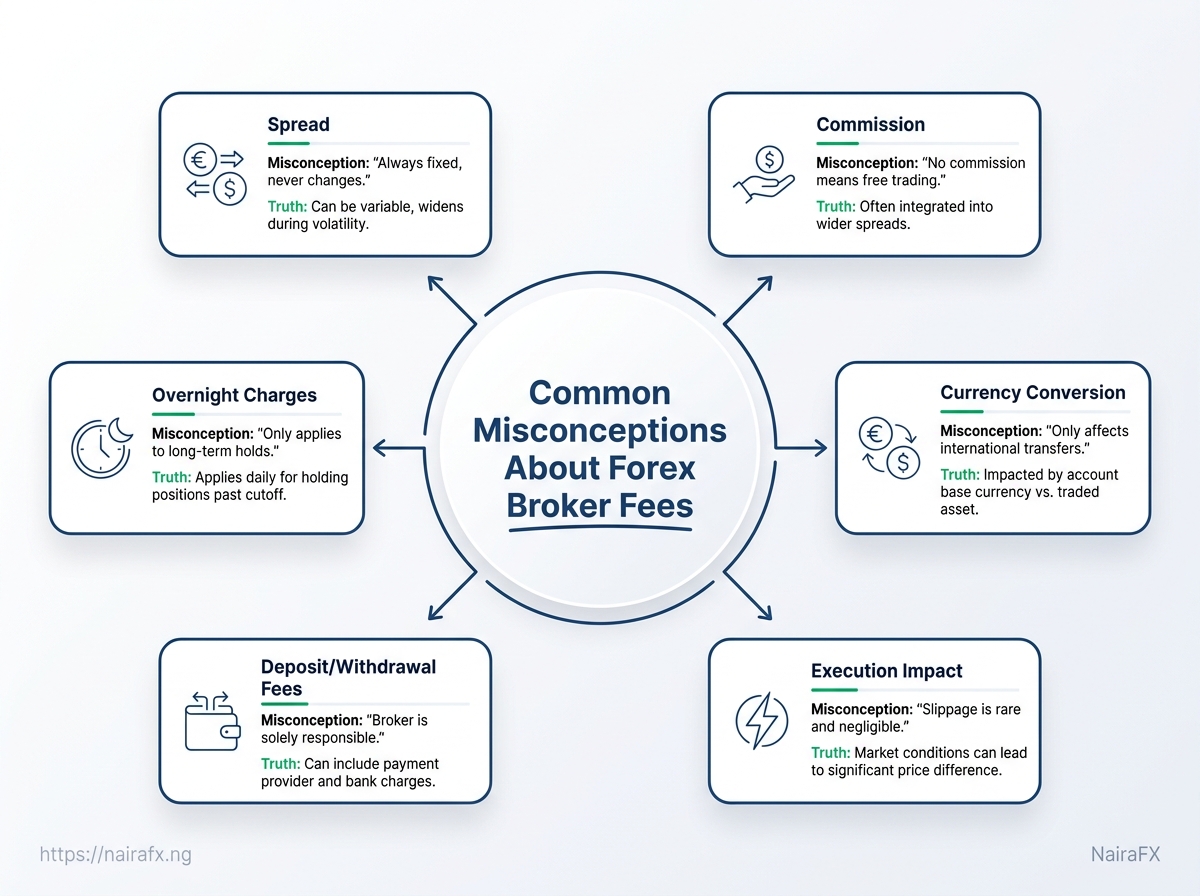
Many traders assume that forex broker fees are simply a spread and commission, but the reality is more complex.
Along with spreads and commissions, you also need to watch out for overnight swap charges, currency conversion fees, and any slippage during execution.
It’s important to look beyond a broker’s advertised costs and consider how the fees can accumulate across multiple trades and market conditions.
Understanding the total cost involves considering what negative impact liquidity and market volatility could have on spreads and execution quality.
Each cost element interacts with others to create a complete picture.
Traders should benchmark their estimated total trading costs comprehensively rather than relying solely on promotional figures.
By digging deep into their broker’s fee schedule and asking the right questions, traders can better manage their trading expenses and avoid surprises in their account balance.
Misconception 1: The Broker With the Lowest Spread Is Always Cheapest
Key Takeaway: Could a broker advertising a near-zero spread still cost more by the end of your trade? Yes.
Could a broker advertising a near-zero spread still cost more by the end of your trade? Yes.
The main spread shows just one part of the transaction.
Commissions, overnight charges, execution quality, and account rules can all alter the final cost.
A 0.0-pip quote may belong to a raw-spread account with a separate commission.
Another broker may show a wider spread but include the dealing cost inside that quote.
Comparing only the first number creates one of the most common misconceptions about trading costs.
How Different Pricing Models Affect the Final Cost
| Pricing model | Visible charge | Potential additional cost | Best suited to | What traders should check |
|---|---|---|---|---|
| Fixed spread account | A set spread quoted by the broker | The fixed quote may be wider than normal market conditions | Traders who value predictable pricing | Whether the spread stays fixed during news, market closures, and volatile sessions |
| Variable spread account | A changing bid–ask spread | Spreads may widen during low liquidity or fast price movement | Traders who mainly trade liquid sessions | Typical, minimum, and wider spreads for the chosen pair |
| Raw spread plus commission account | Very low or near-zero spread plus a stated commission | Commission applies when opening and closing the trade | Active traders who compare total transaction costs | Commission per lot, account currency, minimum charge, and both sides of the trade |
| Spread-only account | The broker builds its charge into the spread | Wider quotes may appear during thin liquidity or high volatility | Traders who prefer one visible dealing cost | Average spread, execution policy, slippage, and overnight financing |
A trader comparing broker fees should calculate the complete round-trip cost: spread, opening commission, closing commission, and any applicable financing charge.
Volatility Can Change the Quote Quickly
Nigerian traders may face wider spreads when global markets react to United States data, oil-price moves, central-bank decisions, or unexpected political news.
Liquidity can thin around rollover and during the gap between major trading sessions, making the displayed spread less stable.
A trade opened during a calm London session may show a very different spread during a fast New York move.
The advertised minimum is not a reliable picture of the price available when an order reaches the market.
Do This, Not That
Do: Compare the same pair, such as EUR/USD, during the same Nigerian time window.
Do: Record the spread at entry and calculate the round-trip commission separately.
Do: Check several trading days, including a major economic announcement.
Do not: Compare one broker’s minimum spread with another broker’s average spread.
Do not: Treat a raw spread as free trading before adding both sides of its commission.
Do not: Ignore slippage, swaps, or markups on less liquid pairs.
A fair comparison uses identical trade size, session, account type, and market conditions.
Understanding broker charges this way gives a clearer cost estimate than any promotional spread alone.
Misconception 2: Commission-Free Trading Means No Trading Costs
Key Takeaway: A trader opens a zero-commission forex account because the pricing page looks simple.
The first trade seems cheap, but the position begins slightly negative before the market changes.
A trader opens a zero-commission forex account because the pricing page looks simple.
The first trade seems cheap, but the position begins slightly negative before the market changes.
That difference comes from the spread.
On the commission-free account, the broker may build more of its charge into the buy and sell prices.
The trader pays no separate commission line, yet the trade still carries a measurable entry cost.
“Zero commission” describes one fee only.
It does not confirm that the spread, overnight financing, currency conversion, or other account charges are zero.
That’s why it’s crucial to look deeper than just one promotional label when assessing Forex broker fees.
Where the cost can appear
A broker advertising commission-free trading may recover revenue through several pricing or account features:
A wider spread: The broker adds more distance between the bid and ask prices.
Overnight financing: Positions held beyond the broker’s daily cutoff may incur swap charges.
Currency conversion: Your account currency may differ from the currency used to calculate a trade’s profit, loss, or fee.
Inactivity or account charges: Some account types may apply fees when trading activity falls below a stated level.
Execution conditions: During news, market openings, or periods of low liquidity, the available spread may widen.
The exact charge depends on the broker, instrument, account type, and holding period.
A commission-free account can suit an active trader, but only after its full pricing schedule has been checked.
A worked example
Consider a hypothetical trader using a micro position on EUR/USD:
Position size:
0.01 lotPip value:
$0.10Quoted spread:
1.8 pipsSeparate commission:
$0
The spread cost is calculated as:
1.8 pips × $0.10 per pip = $0.18
The trade therefore begins with an estimated $0.18 transaction cost, before any overnight financing or currency conversion.
If the trader closes the position after a small move, that initial cost still needs to be recovered before the account shows a net gain.
For a larger 0.10-lot position, the same 1.8-pip spread would cost about $1.80.
Position size changes the cash amount, even when the quoted spread remains unchanged.
Before opening an account, compare the spread during the hours you actually trade and add any non-trading charges.
Commission-free does not mean cost-free; it means the charge is collected somewhere else in the broker’s pricing structure.
Misconception 3: Swap Fees Only Matter to Long-Term Traders
Key Takeaway: One rollover can represent three days of financing.
In spot forex, brokers commonly apply a triple swap on Wednesday to account for the weekend, even though the market is closed on Saturday and Sunday.
One rollover can represent three days of financing.
In spot forex, brokers commonly apply a triple swap on Wednesday to account for the weekend, even though the market is closed on Saturday and Sunday.
The exact day can vary by instrument and broker.
Some contracts use Thursday, while public holidays may create additional adjustments.
Always check the broker’s contract specifications rather than assuming Wednesday applies everywhere.
Swap is the financing adjustment for keeping a leveraged position open after the broker’s daily rollover time.
It may be a credit or a charge, depending on the currency pair, trade direction, interest-rate differences, and the broker’s markup.
Why shorter trades still feel the impact
A day trader who closes every position before rollover may avoid swap entirely.
A swing trader holding for several days cannot make the same assumption.
One or two rollover events can change the result of a trade that looked profitable from its price movement alone.
Consider a position opened on Monday and closed on Thursday.
It may pass through several rollover windows, including one triple-swap adjustment.
The trade does not need to last for weeks before financing becomes relevant.
Held positions face another risk: the daily charge can continue while the market moves sideways.
A trade that earns little price profit may gradually lose money through repeated financing adjustments.
Carry strategies depend on this calculation even more.
Their expected return comes partly from receiving favorable rollover, but the credit can shrink when the broker applies its spread, changes swap rates, or adjusts terms during volatile market conditions.
Verify these details before holding overnight
Use this checklist whenever a trade may remain open beyond the rollover period:
Rollover time: Confirm the broker’s server time and convert it to Nigerian time, including daylight-saving changes where relevant.
Triple-swap day: Check which weekday carries the three-day adjustment for that specific currency pair or instrument.
Long and short rates: Compare the swap value for both directions.
A favorable credit on one side does not mean both sides receive it.
Point or account currency: Confirm whether the charge appears in points, pips, or your account currency.
Use
swap × position size × nights heldwhen estimating the effect.Holiday adjustments: Review the broker’s holiday calendar before major market closures, since several days of financing may be posted together.
Rate-change policy: Find out how often the broker updates swap values and whether rates can change without advance notice.
Checking these details turns an overlooked broker charge into a measurable trading cost.
Overnight financing matters whenever a position crosses rollover, whether it lasts one night, one week, or several months.
Misconception 4: Deposits, Withdrawals, and Currency Conversion Are Minor Details
A broker can offer a slightly tighter spread and still cost more once money moves between Nigerian naira and a foreign-currency account.
Payment costs can outweigh a small spread difference, especially when you deposit, withdraw, and convert funds more than once.
Imagine funding a dollar-denominated trading account from a naira bank account.
Your money may pass through a bank’s exchange rate, a payment provider’s processing system, the broker’s funding channel, and another conversion process when you withdraw.
Each stage can affect the final amount you receive.
The payment path deserves the same attention as the trading price.
A broker’s published Forex broker fees may look attractive, but those figures usually do not describe every charge connected with moving money.
How the naira-to-account fee path works
The first cost often appears through the exchange rate, not a separate line item.
A bank or payment provider may convert naira into dollars, euros, or another account currency using its own rate.
The difference between that rate and the mid-market rate becomes part of your funding cost.
Other charges can appear along the route:
Bank conversion: The naira amount is exchanged into the currency accepted by the broker.
Payment processing: A card, bank transfer, or electronic payment provider may add a processing charge or apply a separate exchange rate.
Broker funding: The broker may impose deposit rules, minimums, supported currencies, or charges for certain payment methods.
Withdrawal: The broker or payment provider may charge for sending funds back to a Nigerian account.
Return conversion: Foreign currency may be converted back into naira at a rate that differs from the original transaction.
A deposit that appears free can still carry a cost through an unfavorable conversion rate.
The same applies to withdrawals, where the amount received in naira may be lower than expected even when no explicit withdrawal fee appears.
Questions to ask before funding
Before choosing a payment method, ask:
Which party sets the exchange rate?
Is the quoted rate fixed, live, or subject to change?
Are deposit and withdrawal fees charged separately?
Must withdrawals return through the original payment method?
Does the account holder’s name need to match the funding account?
Are there transaction limits, delays, or currency restrictions?
What happens if a payment fails or requires a refund?
Keeping a simple record of the naira sent, foreign currency credited, and naira returned creates a clearer view of understanding broker charges.
Payment friction is not a minor detail; it belongs in the total cost of trading.
Misconception 5: Published Fees Are the Only Costs That Affect Execution
Can a trade show a profit on the chart yet deliver much less in your account? Yes.
The difference may come from execution rather than the published commission, spread, or account fee.
Imagine a trader places a buy order after a strong price breakout.
The platform displays one price, but the order fills slightly higher because the market moves before the broker executes it.
The trade still wins, yet the entry delay and worse fill reduce the final return.
That extra amount is slippage.
Positive slippage can improve a fill, while negative slippage works against the trader.
Fast markets, thin liquidity, major economic announcements, and large orders can all increase the gap between the requested price and the executed price.
The execution costs hiding between quote and fill
A spread is the difference between the bid and ask at a given moment.
It can widen while markets move quickly, even when the broker advertises a low typical spread.
A requote occurs when the requested price is no longer available and the broker asks whether the trader accepts a new one.
This can create a second delay.
By then, the opportunity may have weakened or disappeared.
Market impact matters when an order is large compared with available liquidity at the best quoted prices.
Parts of the order may fill at less favorable levels, creating an average price that differs from the first quote.
These costs are separate from the fee shown on the pricing page:
Slippage: The difference between the requested and executed price.
Execution delay: Time between order submission and confirmation.
Requote cost: The price difference created when the original quote expires.
Market impact: A worse average fill caused by limited available liquidity.
How to inspect the real cost
Trade statements often provide enough detail to measure execution, but traders must compare the right fields.
For each order, record the requested price, execution price, order type, timestamp, spread where available, and any rejection or requote message.
Then calculate:
Execution difference = executed price − requested price
For a buy order, a positive difference generally represents a worse fill.
For a sell order, the direction reverses.
Multiply the price difference by the position size to estimate its monetary effect, while remembering that the platform’s point value depends on the currency pair and account currency.
Review several trades across calm and volatile periods.
A single poor fill may be normal; a repeated pattern during ordinary market conditions deserves closer attention.
Published Forex broker fees matter, but the trade statement reveals what execution actually cost.
Misconception 6: A Broker’s Fee Schedule Tells the Whole Story
Could we judge a broker from its pricing page alone? Not safely.
A fee schedule may show spreads, commissions, and account charges, while the account and instrument terms contain restrictions that change the real cost of trading.
Strategic traders need more than a price list.
They must check contract sizes, minimum trade volumes, margin rules, trading hours, swap conventions, and whether certain instruments are available under the chosen account type.
These details can affect a position long after the advertised fee has been accepted.
A broker may also publish separate terms for standard, raw-spread, Islamic, professional, or managed accounts.
Instrument specifications can differ too.
The terms for EUR/USD may not apply to gold, indices, or exotic currency pairs.
The broker-fee due diligence checklist for strategic traders
Use the broker’s official documents rather than relying on comparison pages or promotional summaries.
Check the trading platform specifications alongside the legal terms, because each document may reveal different account conditions.
| Cost area | What to verify | Why it matters | Where to find the information |
|---|---|---|---|
| Spread | Whether spreads are fixed, variable, or account-specific | Pricing can change by account and market condition | Official fee schedule and platform specifications |
| Commission | Rate, calculation method, minimum charge, and currency | A percentage or per-lot fee may apply differently across instruments | Fee schedule and account terms |
| Swap or overnight financing | Daily rates, triple-charge day, and long/short differences | Holding costs can alter a position’s expected return | Instrument specifications and swap policy |
| Deposit and withdrawal | Processing charges, limits, payment methods, and processing times | Funding rules can affect access to trading capital | Payments page and client agreement |
| Currency conversion | Conversion rate, markup, and supported account currencies | Converting between naira and another currency can reduce realised returns | Fee schedule and account terms |
| Inactivity fees | Trigger period, amount, and account types affected | Dormant strategic accounts may incur charges | General terms and fee schedule |
| Execution and slippage terms | Order execution model, requotes, and slippage policy | The final fill may differ from the displayed quote | Execution policy and platform terms |
| Regulatory and client-money information | Licence status, legal entity, and custody arrangements | The contracting entity determines available protections | Regulator records and client agreement |
Those are not always labelled as fees, yet they can force a position to close or restrict a planned strategy.
Extra scrutiny is justified when:
Terms are difficult to locate: Missing or vague documents make independent checking harder.
Legal entities are unclear: The website name may differ from the company accepting deposits.
Costs remain discretionary: Phrases such as “fees may change” deserve clarification before funding.
Instrument details are incomplete: No clear contract size, trading hours, or financing method is a serious gap.
Withdrawal conditions appear restrictive: High minimums, unexplained delays, or unusual verification demands require caution.
Understanding broker charges means reading the rules behind the numbers.
A sound fee comparison begins with the account agreement and instrument terms, not the headline price.
How to Compare Forex Broker Fees for Your Trading Strategy
The cheapest broker depends on how, when, and what we trade.
A scalper may care most about consistent execution during liquid sessions, while a swing trader may place fewer orders and hold positions for several days.
That difference makes broad claims about low-cost accounts unreliable.
Comparing Forex broker fees works better when we model our own trade frequency, position size, holding period, and preferred currency pairs.
Match the Broker to Your Trading Style
| Trading style | Most important cost | Other costs to monitor | Useful broker questions |
|---|---|---|---|
| Scalping | Round-trip cost across many small trades | Execution speed, requotes, slippage during active sessions | Is pricing stable during London and New York overlap? Are order fills recorded with timestamps? |
| Day trading | Cost per completed position | Intraday slippage, platform fees, minimum commission rules | How does the broker handle fast entries and exits during volatile periods? |
| Swing trading | Financing across several trading days | Wider overnight pricing, guaranteed-stop charges, inactivity fees | Which instruments have the most predictable holding costs? |
| News trading | Execution quality during sudden price moves | Slippage, rejected orders, temporary spread changes | Are market orders accepted during major economic releases? |
| Occasional trading | Fixed account and transaction charges | Withdrawal rules, account inactivity, minimum deposit conditions | Does the account remain economical when trading volume is low? |
A useful calculation records the expected monthly cost for each broker:
monthly cost = completed trades × average cost per trade + expected holding costs + account charges
For example, record 40 planned trades, the average position size, and the typical number of nights held.
Use the same assumptions for every broker so the comparison stays fair.
| Item to record | Broker A | Broker B |
|---|---|---|
| Completed trades per month | 40 | 40 |
| Average position size | 0.50 lot | 0.50 lot |
| Average round-trip cost | [record quote] | [record quote] |
| Average holding cost per position | [record quote] | [record quote] |
| Monthly account charges | [record quote] | [record quote] |
| Estimated monthly total | [calculate] | [calculate] |
After testing, use several small live transactions and compare the quoted price, fill price, timestamp, and final account debit.
Keep the test consistent.
Trade the same pair, during similar market hours, with matching order types and position sizes.
This separates broker pricing behavior from changes caused by different trading conditions.
The strongest comparison is not a search for the smallest headline fee.
It is a repeatable monthly estimate tested against real execution.
Conclusion
Make Every Trading Cost Visible
A broker’s advertised spread or zero-commission account never tells the full story.
The true cost of trading can also include markups, overnight swaps, deposit and withdrawal fees, currency conversion, slippage, and execution differences.
Understanding broker charges means judging the complete cost of placing and holding a trade, not choosing the most attractive number on a promotional banner.
The zero-commission example captures the problem well: an account can lose value after several trades even when no separate commission appears.
A wider spread may have reduced the position’s starting value, while conversion fees or overnight financing added further pressure.
Similarly, a broker with the lowest published spread may become more expensive during volatile sessions if execution worsens or spreads widen sharply.
Your trading style should decide which Forex broker fees matter most.
A position trader needs to examine swap rates and funding terms, while an active intraday trader may care more about spreads, commission, slippage, and order execution.
Today, calculate the complete cost of one typical trade with each broker you are considering, including entry, exit, holding, conversion, and withdrawal charges.
That simple comparison will expose misconceptions about trading costs and give you a more reliable basis for choosing a broker.
What are common misconceptions about Forex broker fees?
Common misconceptions include the belief that broker fees consist only of the spread and commissions.
Many traders overlook additional costs such as overnight fees, currency conversion charges, and price slippage, which can significantly impact overall trading expenses.
How do Forex broker fees affect trading profits?
Forex broker fees can dramatically reduce trading profits by increasing the total cost of executing trades.
Even small fees can add up quickly, especially with frequent trading and volatile market conditions, making it crucial for traders to account for all potential charges.
What types of fees do Forex brokers typically charge?
Forex brokers typically charge various fees, including spreads, commissions, overnight swap fees, and currency conversion fees.
These fees can vary widely between brokers and greatly affect the cost of trading.
Are there hidden fees in Forex trading?
Yes, hidden fees can exist in Forex trading, often hiding within the spread or due to currency conversion costs.
Traders should scrutinize their broker’s fee structure to uncover any additional charges that may not be immediately obvious.
How can I minimize Forex broker fees?
To minimize Forex broker fees, traders should carefully compare brokers and their fee structures, looking beyond advertised commissions.
Opt for brokers with transparent pricing models, low-cost trading accounts, and be mindful of costs associated with frequent trading or holding positions overnight.