
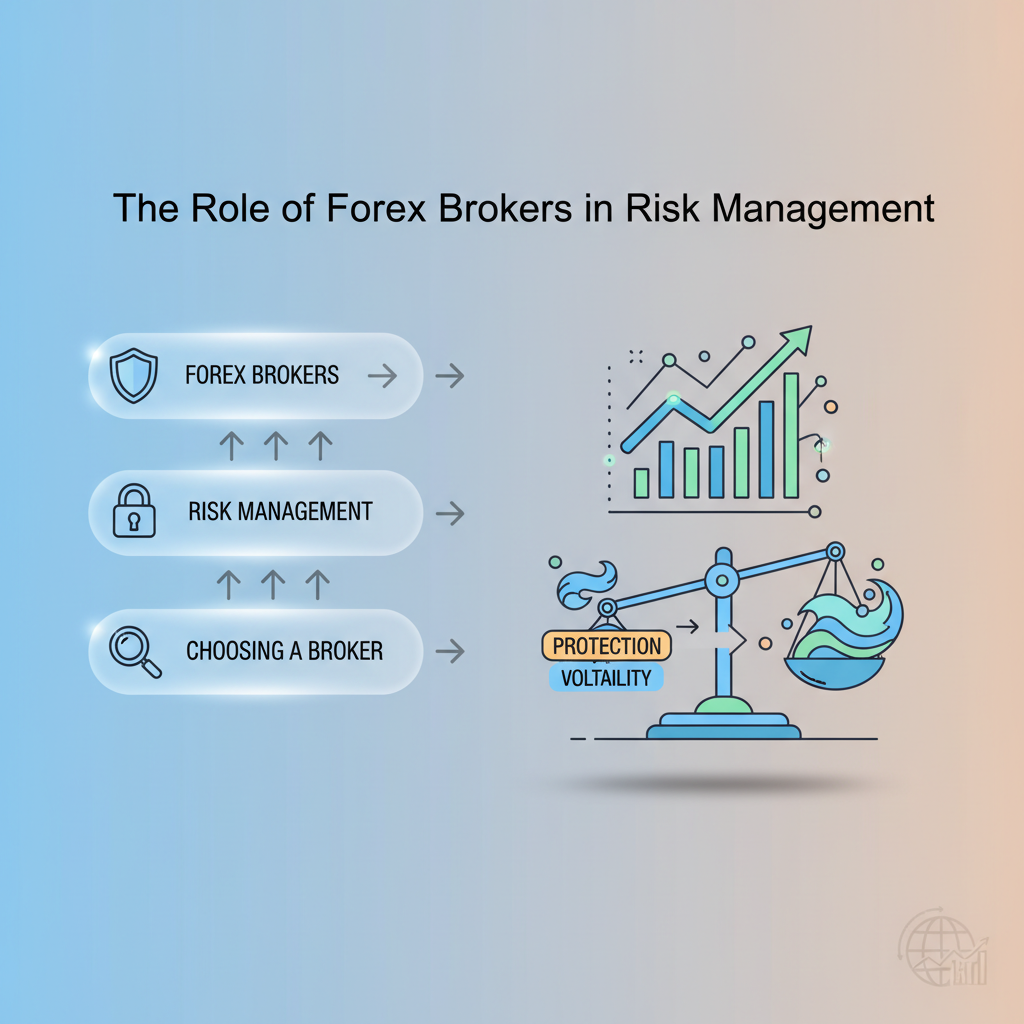
The wrong Forex broker can hurt a trade before the market even moves.
A delayed fill, a widened spread, or a messy margin rule can turn a decent setup into a loss.
That is why risk management is not only about where you place a stop-loss.
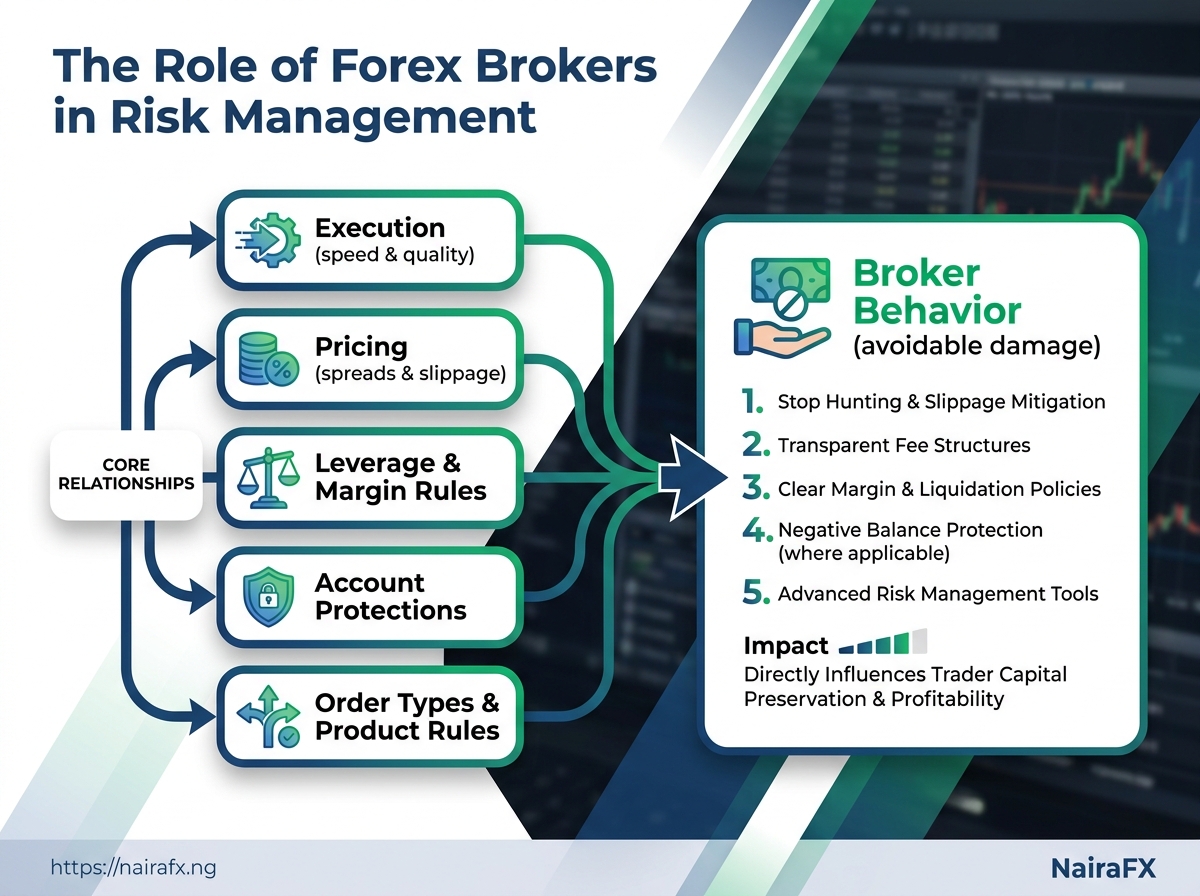
It also depends on how the broker handles execution, pricing, leverage, and account protections.
A trader can have a solid plan and still get burned by poor broker behaviour.
A lot of newer traders focus on bonuses or flashy platforms when choosing a broker.
That part feels exciting.
The quieter questions matter more: How fast are orders filled? How often does slippage show up? What happens when volatility spikes?
Broker risk management is really about reducing the ways a broker can add avoidable damage to your trades.
A good broker should make it easier to control losses, not harder.
When those controls are weak, even careful traders can lose more than they expected.
Why Forex Brokers Matter in Risk Management
Ever placed a trade and wondered who is actually taking the other side, routing the order, or deciding whether it even goes live? That is where Forex brokers stop being background noise and start shaping your risk.
A broker does more than “open” a trade.
It handles execution, pricing access, order types, margin rules, and sometimes the way your position is matched in the market.
Those details can change slippage, widen spreads at bad moments, or trigger a margin call faster than you expected.
That matters especially for traders in volatile markets, where a small difference in execution can turn a decent idea into an avoidable loss.
Good broker risk management starts with understanding that the broker is part of the trade environment, not just the login screen.
Execution quality: If a broker sends your order slowly or at a worse price, your risk rises before the trade even has room to breathe.
Margin rules: Higher leverage looks exciting, but it also shrinks the distance between your entry and a forced close-out.
Product rules: Some brokers limit hedging, news trading, or certain order types, and those limits affect how you manage open exposure.
Pricing behavior: Spread widening during thin liquidity can make stop-losses harder to trust, especially around major news releases.
A common mistake is treating all brokers as the same once the spread looks low.
Another is assuming a bonus, a high leverage offer, or a polished app means safer trading conditions.
Traders also miss the difference between market risk and broker risk.
Market risk comes from price movement.
Broker risk comes from the rules, execution, and structure around that movement.
The smart habit is simple: choosing a broker should include checking regulation, execution model, margin policy, and withdrawal terms before any real money goes in.
That review protects the account as much as any stop-loss does.
For traders building serious habits, the broker is part of the risk plan.
Ignore that piece, and even good entries can get messy fast.
Broker Features That Help Control Trading Risk
A glossy trading platform can look impressive and still be a bad fit for risk control.
The real test is whether the broker gives you tools that help limit damage when a trade moves fast against you.
That usually starts with the basics: stop-loss orders, take-profit orders, margin controls, and clear rules around leverage.
If those are weak or buried in fine print, broker risk management becomes guesswork instead of a habit.
Execution matters just as much.
A clean order entry is useful, but a slow fill, poor price stability, or nasty slippage can turn a planned loss into something bigger than expected.
Broker features that matter most
| Broker feature | How it helps manage risk | Why it matters for traders |
|---|---|---|
| Stop-loss and take-profit orders | Automatically closes trades at pre-set loss or profit levels | Keeps emotions out of exits and protects capital |
| Negative balance protection | Prevents account equity from falling below zero | Limits worst-case damage during sharp market moves |
| Margin call and stop-out levels | Warns or closes positions before losses spiral | Helps traders know when a position is getting too risky |
| Guaranteed stop-loss orders | Executes at the exact price set, even if the market gaps | Useful during news events and fast-moving sessions |
| Trade alerts and price notifications | Sends updates when price reaches a chosen level | Helps traders react faster without staring at charts all day |
| Trailing stop orders | Moves the stop as price moves in your favor | Locks in gains while leaving room for the trade to breathe |
| Partial close options | Lets traders reduce position size instead of closing everything | Gives more control when a trade turns uncertain |
| Maximum leverage setting | Caps how large a position can become | Reduces the chance of oversized losses |
| One-cancels-the-other orders | Links two orders so one cancels the other | Prevents double exposure on conflicting setups |
It simply gives you more ways to control it before a small mistake becomes an expensive one.
Execution speed, slippage, and leverage are the hidden trio that often decide how safe a broker really is.
Fast fills matter most during volatile sessions, while slippage becomes painful when spreads widen or liquidity thins.
Leverage deserves special attention too.
A 1:100 setting can make a small market move feel much larger, which is exciting until it isn’t.
That is why choosing a broker should include checking whether you can set lower leverage, not just higher.
For broker reviews, we always look at how these controls work together, not just whether they exist on a feature list.
The best setup is the one that helps you survive the bad days, not just celebrate the good ones.
How to Judge a Broker Before You Deposit Money
Would you hand over cash to a broker just because the website looks polished? That is how a lot of traders get burned.
When choosing a broker, the first job is not finding the fanciest platform.
It is checking whether the firm is licensed, transparent, and easy to verify.
A regulated broker in a known jurisdiction is usually easier to challenge when something goes wrong.
Fees deserve the same suspicion.
The headline spread is only part of the bill, because commissions, swap charges, withdrawal fees, and inactivity fees can quietly eat into a strategy.
For broker risk management, the question is simple: can your account survive normal trading costs without turning every trade into a grind?
Account type matters just as much.
A scalper, a swing trader, and a long-term position trader do not need the same pricing model or execution setup.
If the account structure fights your style, the broker is already a poor fit.
A quick broker check can stay simple:
Regulation and licence: Confirm the broker’s regulator, licence number, and legal entity.
If those details are vague or missing, walk away.
Fee structure: Compare spreads, commission, swap rates, deposit fees, withdrawal fees, and inactivity charges.
A low spread can be a trap if the other costs are heavy.
Trust signals: Look for clear contact details, client fund segregation, and transparent order terms. Vague bonus offers are not trust signals.
Account fit: Match the account to your plan.
Micro accounts suit smaller test positions, while raw-spread accounts often suit active traders who care about tight pricing.
Imagine a trader who holds positions for several days.
A tight spread matters, but swap charges may matter more over time.
Someone using frequent entries may care more about execution quality and commission structure than a flashy bonus.
The best brokers make these details easy to find.
The weaker ones hide them in fine print, and that tells you almost everything you need to know before the first deposit.
Risk Management Mistakes Traders Make With Brokers
High leverage looks exciting until one normal losing streak wipes out a week of careful work.
That is why so many traders make the same mistake when choosing a broker: they chase the biggest number on the homepage and forget how broker risk management really works.
A broker offering 1:500 leverage can seem attractive, but it also tempts people into oversized positions.
One bad trade can do more damage than five good ones can repair.
Then there is the quieter problem: money movement.
A broker can look fine on paper and still create headaches with slow withdrawals, awkward funding steps, or surprise fees that chip away at returns.
Chasing leverage instead of control: High leverage is not a reward.
It is a force multiplier, which means losses grow fast when position size is sloppy.
A trader who uses it well keeps trades small enough to survive noise.
Ignoring withdrawal rules and funding friction: Some Forex brokers make deposits easy and withdrawals painful.
That is a warning sign, because profit only matters when it actually leaves the account.
Overlooking platform reliability in fast markets: A platform that freezes during a sharp move can turn a planned exit into a messy one.
Slippage, rejected orders, and delayed confirmations are not small annoyances when price is moving hard.
Treating bonuses like free money: A welcome bonus can hide turnover rules that trap capital.
Read the conditions before you build a plan around funds you may not be able to touch.
Assuming every broker handles execution the same way: Two brokers can show the same pair, but one may handle fast moves better.
Poor execution often shows up only when volatility arrives.
A cleaner habit helps here.
Before choosing a broker, test the ugly parts, not the shiny parts.
Check how withdrawals work with a small test amount.
Trade during active market hours and watch for freezes or delay.
Keep leverage low enough that one bad candle does not end the account.
A trader can survive a mediocre setup.
It is much harder to survive a broker that works against the plan.
Choosing a broker is really about removing avoidable risk.
Once those three mistakes are out of the way, the trading decision gets a lot clearer.
A Simple Broker Risk Checklist for Nigerian Traders
Would you trust a broker that answers everything in vague, polished language? That is usually where trouble starts.
Before opening an account, the real test is not the homepage.
It is whether the broker can answer direct questions about regulation, spreads, withdrawals, risk tools, support speed, and platform stability without changing the story.
Red flags usually show up early.
Hidden fees, withdrawal friction, bonus conditions that lock your money, and a platform that struggles during busy market hours all deserve a pause.
Good broker risk management starts with asking boring questions before any money moves.
Questions to ask before opening an account
| Check item | What to confirm | Pass or fail |
|---|---|---|
| Regulation status | The broker names its regulator, legal entity, and license details clearly on the website and account documents. | Pass if the details match public records; fail if the broker is vague or evasive. |
| Spread transparency | The broker shows typical spreads for major pairs and explains when spreads can widen. | Pass if pricing is easy to find; fail if costs only appear after signup. |
| Withdrawal terms | The broker states processing times, fees, and withdrawal channels before deposit. | Pass if the rules are clear; fail if withdrawals depend on hidden conditions. |
| Risk tools available | Stop loss, take profit, margin alerts, and negative balance protection are available and easy to set. | Pass if tools work in the platform; fail if they exist only on paper. |
| Customer support response time | Live chat, email, or phone support responds within a reasonable time and gives direct answers. | Pass if support replies clearly; fail if replies are slow or scripted. |
| Platform stability | Charts load fast, orders place cleanly, and the app stays stable during active sessions. | Pass if testing feels smooth; fail if the platform freezes or disconnects often. |
Try the platform first with a demo account, then move to the smallest live size possible if everything still looks clean.
Open a demo account first. Place a few trades, change stop levels, and check whether the platform behaves normally.
Check live pricing with a tiny position. Watch for spread jumps, slippage, and order delays when the market gets busy.
Request a small withdrawal early. That one move tells you a lot about processing speed and paperwork.
If any answer feels slippery, treat that as data, not noise.
A broker that passes this checklist is not perfect, but it is far less likely to create avoidable surprises.
How Brokers Fit Into a Wider Risk Plan
Even a solid Forex broker is only one piece of the puzzle.
A trader can still lose money fast with oversized positions, weak discipline, or a habit of chasing bad entries after a loss.
That is why broker risk management should sit beside your trading rules, not replace them.
A good broker can support execution, but your habits decide how much damage a bad trade can do.
Habits that matter more than people admit
A lot of avoidable losses come from trader behavior, not platform settings.
The classic offenders are taking random trades, increasing size after a win, and ignoring the daily pain limit.
A simple example: two traders can use the same broker and the same pair, yet one survives the month while the other burns out.
The difference is usually position sizing, exit discipline, and patience, not the account type.
Fixed risk per trade: Keep the risk amount consistent, so one mistake does not wreck the account.
Trade journal: Write down why each trade was taken, then review whether the logic still makes sense.
Pause after losses: A short break after a bad run stops emotional revenge trades.
Clear session rules: Decide in advance when to trade and when to stop for the day.
When the broker deserves another look
Some broker issues only show up after real trading begins.
Delays, slippage, awkward withdrawals, or spreads that widen at the worst moments can quietly distort your results.
Review the broker again after a few weeks of live trading, especially if any of these show up:
Execution feels inconsistent: Orders fill differently from what you expected.
Costs look heavier in practice: Spreads, swaps, or fees eat into planned risk.
Support is slow or vague: Small account issues become bigger when no one answers.
Withdrawals take longer than promised: That is not a minor annoyance in live trading.
Platform behavior changes during volatility: That is when a broker proves its worth.
A broker should fit your system as it grows.
If your trading style changes, your account size rises, or market conditions shift, revisit the setup instead of assuming it still works.
The smartest traders treat choosing a broker as an ongoing check, not a one-time decision.
That habit keeps risk control grounded in real trading, not just a polished signup page.
Conclusion
The Broker Is Part of the Trade
A broker is not just the doorway to the market.
In real forex trading, execution speed, how spreads behave in fast markets, and the broker’s margin rules directly shape what happens after your signal is correct. If those parts are weak, even a good setup can turn into an avoidable loss.
So instead of treating broker choice as an afterthought, treat it like part of your risk system—alongside position sizing, stop placement, and trade discipline.
Use the broker checklist before you commit real funds (regulation, withdrawal terms, risk tools, and platform stability), then verify performance with a small live test. If anything looks inconsistent, don’t wait—switch or adjust before scaling up.
If you want a second set of eyes, our broker reviews and risk-focused analysis are built to help Nigerian traders make cleaner decisions with less guesswork.
How do forex brokers manage risk?
Forex brokers manage risk by controlling the mechanics that determine trade outcomes, including execution speed, pricing quality (spreads and potential widening), order handling, and margin/leverage rules. They can also trigger margin calls sooner than expected if margin rules are applied aggressively during volatile conditions. Strong broker risk management shows up in reliable fills, manageable slippage, and clear protections—not just stop-loss placement by the trader.
What should traders look for when choosing a forex broker for risk management?
Traders should prioritize whether the broker is properly licensed and transparent, since a regulated firm is easier to challenge if something goes wrong. Focus on operational risk controls: fast order fills, consistent pricing, low and predictable slippage, and clearly explained margin call/liquidation terms. Also scrutinize total costs beyond the headline spread, including commissions, swaps, withdrawal fees, and any inactivity fees, and verify the broker’s support speed and platform stability during busy market hours.