
What happens to a trade plan when spreads jump, headlines turn ugly, and a currency pair stops behaving like itself? That is where crisis management stops being theory and starts protecting real money.
The traders who stay calm in nasty markets usually do one thing well: they treat Forex trading strategies as living systems, not fixed recipes.
A setup that works in a steady session can unravel fast when liquidity thins, volatility widens, or sentiment flips in minutes.
That is why risk management during crises matters more than prediction.
The IMF’s April 2026 Global Financial Stability Report pointed to elevated financial stability risks amid the war in the Middle East, and that kind of pressure tends to show up in FX first.
Price can move hard, then harder, and the traders who survive are usually the ones who already planned for ugly conditions.
In uncertain times, the goal is not to be brave.
It is to stay in the game long enough for the market to make sense again.
Quick Answer: Use crisis management to keep execution survivable when the market stops filling like normal. Before you enter (pre-trade thresholds): – If spreads are widening beyond your crisis limit, or liquidity is thin on your broker/venue, stand aside or cut size immediately. – Pre-define your maximum slippage/gap tolerance and the point where your stop becomes “untrusted” (not where it’s merely “plausible” on the chart). During the event (process, not prediction): – Place the trade only if your exit plan still works under worse fills (assume spread/slippage worsens, then verify your loss stays within limits). – If execution quality degrades (late fills, partials, repeated misses), switch from “trade management” to “risk management”: reduce exposure or close/avoid. After the event (learning loop): – Record the actual spreads/slippage you got and adjust your crisis thresholds for next time.
Why Forex Crises Feel So Different
A normal market wobble is messy.
A Forex crisis feels like the rules of the market changed while you were staring at the chart.
Prices stop behaving in neat patterns, and that’s not just because “the chart looks scary.” It’s because the plumbing breaks:
- Liquidity withdraws quickly. Dealers and market makers narrow risk appetite, so fewer quotes are available. Even if only a small number of trades hit the book, the visible prices jump.
- Order books thin out. With fewer resting orders, your trade moves price more easily—both on entry and exit.
- Stops cluster and become fuel. Once price reaches popular levels, stop-losses trigger more market orders, which pushes price farther than expected.
- Execution gets unreliable. Slippage and widening spreads mean your “planned” exit often becomes a worse fill.
The result is a cycle: uncertainty rises → liquidity falls → spreads widen → price gaps/slippage increase → traders overreact → volatility amplifies.
For Nigerian traders, that cycle can feel harsher because local conditions often stack on top of global stress:
- Dollar demand surges during risk-off moments, tightening local FX liquidity.
- Execution quality varies across brokers/venues, so two traders trading the same pair can get meaningfully different fills.
That is why risk management during crises matters more than prediction.
The real edge is not knowing the next candle—it’s surviving the moments when stops, spreads, and liquidity stop acting “normal,” and your strategy only works if execution conditions stay within your assumptions.
Once you treat crisis conditions as a different operating environment (not a temporary inconvenience), the period becomes less mysterious—and less expensive.
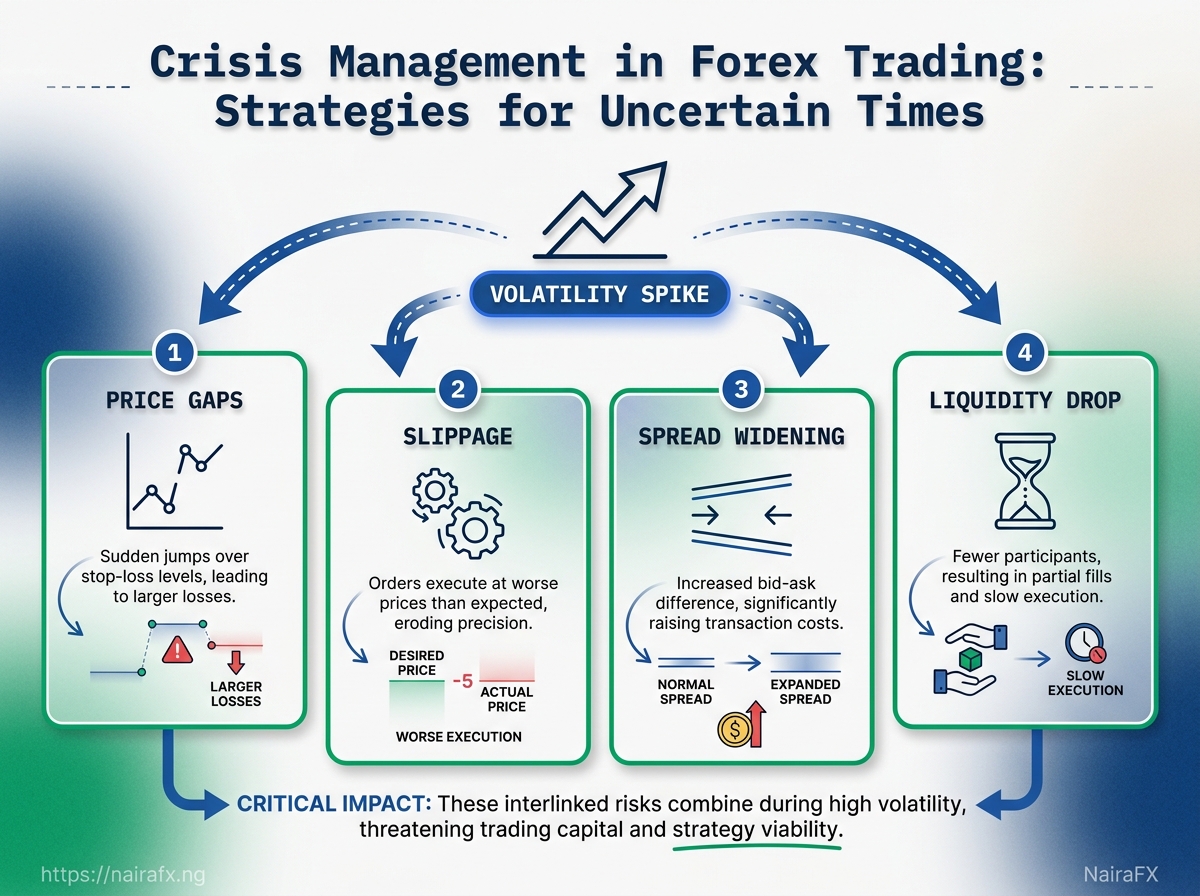
The Main Risks Traders Face in Uncertain Times
When markets get jumpy, the danger is not just direction.
It is execution.
A trade can look perfect on the chart and still go wrong the moment liquidity dries up. Orders fill late, stops slip, and spreads widen just when traders need clean exits most.
That is why crisis management in Forex trading starts with execution risk, not entry signals.
Common crisis-era trading risks
| Risk | What It Looks Like | Impact on Trades | Why It Matters |
|---|---|---|---|
| Price gaps | Price jumps over your stop after a weekend reopen or major shock | Stop-losses may fill far from the intended level | Gaps can turn a controlled loss into a much larger one |
| Slippage | Your order executes at a worse price than expected | Entries and exits lose precision | Even small slippage can erase edge on short-term trades |
| Spread widening | Bid and ask move much farther apart during stress | Transaction costs jump sharply | Wider spreads make tight setups less viable |
| Liquidity drop | Fewer buyers and sellers show up at the same time | Partial fills and slow execution become common | Thin liquidity magnifies every other trading error |
| News-driven spikes | A surprise headline sends prices racing in seconds | Stops get hunted, entries get missed, and reversals turn violent | Shock moves punish strategies built for calm markets |
A trader who takes one bad fill may chase the next move, widen a stop “just this once,” or double down to win it back. Under pressure, those habits compound fast.
That’s also why standard systems can fail.
Many setups quietly assume stable spreads, quick execution, and orderly price movement. During a shock event, those assumptions break—so your job shifts from “find the best entry” to “limit damage and preserve the next opportunity.”
The practical move is simple:
Size smaller, expect slippage, and treat headlines like live explosives rather than normal trade signals.
That discipline matters more than having the “perfect” Forex trading strategy on paper.
Core Crisis Management Rules We Should Follow
Why do some traders survive a messy market while others blow up on a single bad day?
Usually, it’s not prediction skill.
It’s how fast you cut risk when conditions start breaking.
Rule 1: cut exposure before the news hits
If a central bank decision, major release, or geopolitical headline can move your pair hard, waiting until the candle is already flying is usually too late.
In a crisis, volatility and execution problems arrive together. Your goal is to make sure you’re not relying on “clean” spreads, orderly fills, or the ability to exit at the planned level.
A practical way to apply this during Nigerian trading sessions:
- If spreads are already widening before the event, reduce size immediately (don’t wait for the first spike).
- If you’ve seen late ticks/slippage from your broker/venue during similar sessions, assume exits will be worse and tighten your “skip the trade” criteria.
Pre-trade crisis checklist
| Check | Yes/No | Action if No |
|---|---|---|
| Is the market highly event-driven? | Yes | Stand aside or cut size sharply. |
| Are spreads within your crisis limits? | Yes | Wait for conditions to normalize. |
| Is position size within crisis limits? | Yes | Reduce the lot size before entry. |
| Is the stop-loss realistic for current volatility? | Yes | Skip the setup or redesign it. |
| Do we have a clear exit plan before entry? | Yes | Define the exit before placing the order. |
Protect capital before chasing returns
In a crisis, you don’t need to catch every move.
You need to stay in the game long enough to trade the next setup under conditions you can actually control—so your decisions should favor survivability first, opportunity second.
The smartest crisis rule is the least exciting one: reduce damage early, so one ugly trade can’t become an account-ending trade.
Forex Trading Strategies That Fit Uncertain Markets
When a pair is chopping around without a clear edge, does it really deserve your money?
Sometimes the smartest move is not to trade.
In uncertain markets, waiting protects capital—and capital is the only thing that lets you stay in the game long enough for better setups to appear.
Low-exposure trend following sits in the middle ground.
You still take trades, but you size them smaller and demand cleaner structure, because uncertain markets often produce fake starts and ugly reversals.
Event-based trading can work too, but only when the setup is unusually strong.
A major release, central bank decision, or surprise headline can create a tradable move—but you must have a clear plan, tight exposure, and a reason to believe volatility will expand in a controllable way instead of whipsawing.
Comparing crisis-era approaches
| Strategy | Best Market Condition | Risk Level | Best For | Main Limitation |
|---|---|---|---|---|
| Waiting on the sidelines | No clear trend, broken correlations, erratic spreads | Very low | Traders protecting capital during disorderly price action | Missed moves if the market turns quickly |
| Low-exposure trend following | Clear directional drift with occasional pullbacks | Low to moderate | Position traders who can stay patient | False breakouts can still cut into returns |
| Breakout trading | Tight ranges before a major catalyst | Moderate to high | Traders who can act fast and cut losses quickly | Many breakouts fail in noisy conditions |
| News-event trading | High-impact releases with a clean pre-event setup | High | Experienced traders who track macro calendar risk | Slippage and whipsaws around the release |
| Short-term mean reversion | Overextended moves that snap back inside a range | Moderate | Traders reading exhaustion and liquidity pockets | Dangerous when the market is starting a real trend |
If the chart is messy, standing aside is a strategy.
If the trend is visible but not strong, smaller size keeps you alive.
When price finally offers clarity, the edge gets simpler.
Until then, patience, light exposure, and selective event trading usually beat forcing a trade that was never there.
How to Build a Personal Crisis Plan
What happens when the market turns ugly and your brain starts bargaining with itself? That is exactly when a personal crisis plan earns its keep.
A good plan is not about predicting the shock.
It is about deciding, in calm conditions, how you will respond when spreads widen, liquidity thins, and your own judgment gets noisy.
The IMF’s April 2026 Global Financial Stability Report makes the point clearly: stress can spread fast, so preparation matters more than bravado.
The cleanest crisis plans are boring on purpose.
They fit on one page, name your hard limits, and spell out the exact conditions that force a pause, a size cut, or a full stop.
That fits the same logic behind the Federal Reserve’s 2026 stress test scenarios: build for bad weather, not fair weather.
- Crisis trading rulebook: Write your rules before the next shock hits. Include max daily loss, max open risk, acceptable spread levels, and which news events are off-limits.
- Stop-trading conditions: Decide what ends the session immediately. A fast rule might be two consecutive execution failures, a slippage spike beyond your comfort level, or one loss that breaks your daily risk cap.
- Post-session review: Keep it simple. After each high-volatility session, record what changed, what you did, and whether your actions matched the plan.
- Check the market state. Note whether the move came from news, thin liquidity, or a broad risk-off wave.
- Check execution quality. Look at spread, slippage, and whether your order size was still realistic.
- Check your behavior. Ask whether you chased price, hesitated, or forced a setup that no longer fit.
- Decide the next action. Trade normally, reduce size, or pause completely. The CEPR review on foreign exchange lessons from crisis periods supports that kind of stress-based control.
A crisis plan works because it removes improvisation from the worst moments.
That is the whole game in crisis management and risk management during crises.
At NairaFX, we treat that discipline as part of sound Forex trading strategies, not an afterthought.
Trade Less, Survive More
When markets turn chaotic, the edge is rarely in better prediction.
It’s in making sure your risk still behaves predictably when spreads widen, fills get late, and headlines override normal price action.
A practical way to apply what you’ve learned today is simple:
- Open your current plan and write your maximum loss for the day, week, and single trade.
- Reduce your next position size to match crisis conditions.
- Remove any trade that depends on “calm” execution returning soon.
If you want a deeper discipline layer, use the crisis plan structure above (hard limits, stop-trading conditions, and a post-session review) to stress-test your approach before the next shock hits.