

The trade looked perfect until the second red candle hit.
That is usually the moment trading psychology stops being abstract and starts taking money off the table.
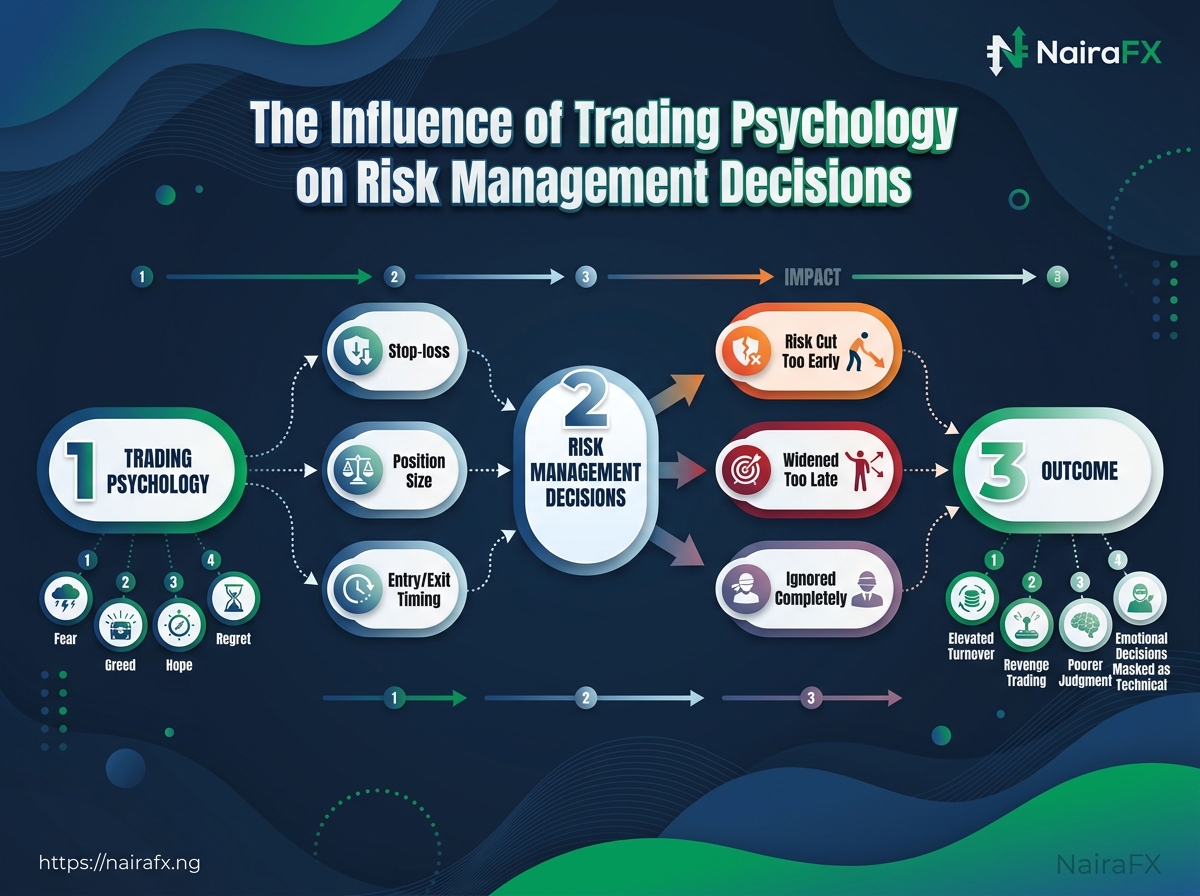
A trader may have a solid plan, but psychological factors like fear, greed, hope, and regret can still push the button at the wrong time.
Risk gets cut too early, widened too late, or ignored completely when the next setup feels “certain.”
That is why risk management decisions are never just math.
They are emotional decisions wearing a technical mask, and the mask slips fast when a position goes against you.
Research on result-focused trading has linked that pressure to elevated turnover, revenge trading, and poorer judgment under stress, as noted in recent work on harmful trading behavior.
The hard part is that these mistakes often feel reasonable in the moment.
A trader protects a losing trade, adds to it, or skips a stop because the story in their head feels safer than the numbers on the screen.
Quick Answer: Trading psychology shapes risk management by influencing how you react to uncertainty—especially when you’re tempted to change your rules. The “same setup” can lead to very different risk outcomes because bias affects four decisions: how big you size the trade, where you place the stop, when you exit, and whether you follow your plan after a loss. In the next sections, you’ll see which emotions drive specific risk mistakes (fear/greed/overconfidence/revenge behavior), why Nigerian traders feel the pressure more during volatile moves (spreads, naira uncertainty, capital constraints), and how to reduce impulsive decisions with a pre-trade checklist, journaling patterns, and pause rules.
Why trading psychology matters before any trade is placed
Why do two traders stare at the same setup and still take very different risks? One sees a clean entry and sizes sensibly.
The other sees a chance to “make it back” and doubles down.
That gap usually starts before the order ticket is even open.
Trading psychology sits underneath every risk management decision.
It shapes stop-loss placement, position size, patience, and even whether a trader respects the plan after a loss.
A solid setup can still become a bad trade when fear, greed, hope, or regret start steering the wheel, which lines up with the emotional patterns described in Trade Ideas’ 2025 discussion of emotions in trading decisions.
Two traders can face the same chart and still behave differently because their internal pressure is different.
One trader may have just taken three losses and starts shrinking confidence; another may be riding a win streak and feels untouchable.
Research on trading under pressure shows that losses and gains can change bias, judgment, and the way risk gets perceived, especially when the market turns nasty, as seen in research on cognitive bias in a simulated bear market.
> A 2026 preprint on result-focused trading linked that mindset to elevated turnover, revenge trading, and weaker calibration, which is a fancy way of saying traders start reacting instead of thinking.
The same pattern shows up in broader risk research too.
MDPI’s 2025 study on behavioral risk management in investment strategies points to psychological variables as a real force in investing choices, not a side note.
- Fear changes size: scared traders often cut winners too early and avoid valid entries.
- Greed changes distance: greedy traders widen stops or add too much size.
- Frustration changes timing: revenge trading usually starts after one bad outcome, not a bad setup.
The practical habit is simple.
Check your state before you check the chart, because a perfect setup can still be mishandled by a tense mind.
When psychology is steady, risk feels boring.
That is usually a good sign, because boring risk tends to survive longer than emotional risk.
Ever moved a stop because the trade started hurting? That tiny decision usually says more about trading psychology than about the chart.
Fear, greed, overconfidence, and revenge trading show up in risk management decisions by changing three things: how much you risk (size), where you allow the market to invalidate you (stop placement), and when you decide to exit (timing).
Loss aversion is the sneaky one.
Traders often tolerate a bigger loss than planned because closing the trade feels worse than being wrong. Then, paradoxically, they may also cut winners early—banking a small gain feels “safer” than letting a good setup play out.
Biases that bend a trading plan
Fear makes a clean setup look dangerous, so traders shrink size or move stop-loss levels closer than the setup allows.
Greed does the opposite and pushes take-profit targets farther than the market structure supports, which turns good trades into annoying near-misses.
Overconfidence usually shows up after a winning streak.
The trader treats a repeatable process like a personal superpower—then risks too much on the next signal.
Revenge trading is worse because it feels urgent.
A loss creates emotional heat, and the next trade becomes an attempt to “get it back,” which is exactly when discipline tends to disappear.
- Confirmation bias: Only seeing evidence that supports the trade, while ignoring cleaner opposing signals.
- Anchoring: Fixating on an old entry price, round number, or recent high instead of current market structure.
- Recency bias: Giving the last win or loss too much weight when setting risk on the next trade.
- Sunk-cost fallacy: Holding a bad position because time, effort, or attention has already been spent on it.
Trade psychology studies keep arriving at the same uncomfortable point: the biggest damage rarely comes from one bad setup.
It comes from a nervous (or overconfident) mind making small risk errors over and over.
Why does a trader follow the plan in the morning and wreck it by lunch? Because trading psychology does not stay in the background once money is on the line.
It reaches straight into position sizing, stop-loss placement, and risk-reward choices—the decisions that protect (or destroy) an account.
A trader under pressure often sizes too large after a win or too small after a loss.
Both are emotional reactions, not risk management decisions.
Stop-loss behavior shows the same pattern.
A trader may place a sensible stop, then move it because the trade feels “too important” to lose. That turns a controlled risk into an open-ended bet.
Risk-reward rules get bent in quieter ways too.
A setup that once needed 1:2 may suddenly feel “good enough” at 1:1 because the trader wants certainty more than edge.
That habit looks harmless on one trade, but it quietly weakens the whole system over time.
When traders ignore risk-reward rules
| Risk Decision | Disciplined Behavior | Emotion-Driven Behavior | Likely Outcome |
|---|---|---|---|
| Position sizing | Risks the same fixed percentage per trade | Increases size after wins or loss streaks | Uneven drawdowns and unstable equity growth |
| Stop-loss placement | Places the stop at a logical invalidation point | Moves the stop farther away to “give it room” | Small losses turn into large ones |
| Trade entry timing | Waits for the setup to meet plan rules | Enters early from fear of missing out | Worse entries and weaker reward potential |
| Exit discipline | Takes profit where the plan says to exit | Closes winners early from anxiety | Smaller average wins and poor expectancy |
| Risk-reward ratio | Only takes trades with acceptable payoff | Accepts weak ratios because the trade feels certain | More work, less edge, lower long-term growth |
Discipline keeps each decision connected to the original risk plan, while emotion makes every decision feel negotiable.
That gap is where accounts usually leak.
Close the gap, and the rest of the trading process gets much easier.
Why volatile markets can intensify psychological pressure for Nigerian traders
Ever noticed how a fast move in the market can make a disciplined trader act like it is the first day on the job?
That pressure rises quickly when prices jump, spreads widen, and the naira adds another layer of uncertainty.
A move that looks ordinary on paper can feel much bigger when your account is modest and every loss matters.
Volatile conditions also make trading psychology more fragile because your brain starts hunting for certainty that the market won’t actually provide.
Research discussed earlier in this article links this exact kind of pressure to outcome-chasing behaviors—like turning one bad result into revenge trading—and to weaker decision calibration under stress. The key point: it’s not that you suddenly “forgot” your rules. It’s that volatility changes what your brain labels as urgent.
When capital is small, capital preservation stops feeling like a rule and starts feeling like survival.
That is where traders begin making lopsided risk management decisions: cutting winners early, holding losers too long, or trading too large because one good move feels urgent.
Currency pressure makes it worse.
For Nigerian traders watching both the chart and the naira, the fear is not only losing a trade.
It’s losing purchasing power while your account is already under strain.
A few mistakes show up again and again in fast markets:
- Chasing late entries: A sudden spike tempts traders to enter after the move is already stretched.
- Moving stops wider: The loss starts to hurt, so the stop gets pushed “just a little.”
- Sizing up after fear: Traders try to recover quickly and take bigger risk than planned.
- Trading news without a plan: Big headlines trigger emotion before logic gets a say.
- Revenge trading after a loss: One bad trade becomes a rush to win it back.
Volatile markets do not just move prices.
They test patience, restraint, and the ability to stay boring when everything around you is loud.
For Nigerian traders, that emotional load is often the real battle.
A practical framework for making calmer risk management decisions
A calm trade usually starts before the order ticket is even open.
That sounds obvious, but trading psychology tends to show up first in the prep work, not during the exit.
The cleanest habit is a checklist that mixes numbers with mindset.
Behavioral research keeps pointing in the same direction: when emotions and risk rules are separated from the rush of the moment, traders make steadier risk management decisions and fewer impulsive ones, especially under pressure (Behavioral Risk Management in Investment Strategies, Trading Psychology and Emotional Dynamics).
A journal helps even more.
It turns emotional mistakes into patterns instead of surprises, which is where the real learning starts.
Pre-trade checklist
| Check Item | Why It Matters | Pass/Fail |
|---|---|---|
| Risk per trade defined | Keeps losses small enough to survive a bad run | Pass / Fail |
| Stop-loss set before entry | Removes emotional bargaining after entry | Pass / Fail |
| Position size matches account risk | Prevents one trade from distorting the whole account | Pass / Fail |
| Trade reason documented | Forces a clear logic, not a gut impulse | Pass / Fail |
| Emotional state reviewed | Catches fear, revenge, or overconfidence early | Pass / Fail |
Boring is good in trading.
The most useful journal entries are not polished ones.
They are blunt notes like “moved stop because I was annoyed” or “entered late after a winning streak,” because those patterns expose the psychological factors behind poor timing and weak discipline.
That lines up with the warning in The Psychology of Result-Focused Trading, which links outcome chasing with revenge trading and worse calibration.
Pause rules matter too.
After two straight losses, stepping away for the rest of the session can stop tilt from stacking up.
After a strong winning streak, a short break also helps, because overconfidence often shows up right after things go well.
- Write the rule first. Decide the pause trigger before the session starts.
- Record the trigger. Note whether the pause came after losses, wins, or both.
- Review weekly. Look for repeat behavior, not just single bad trades.
That small loop keeps risk management decisions grounded.
It gives trading psychology a place to land before it turns into avoidable damage.
Tools and habits that support better discipline over time
What keeps a good trader from improvising at 9:15 a.m.? Usually not talent.
It is the small systems that stop a mood from becoming a trade.
Trading journals, alerts, and rule-based plans work because they remove guesswork before the session gets noisy.
They also give your brain fewer chances to argue with itself in real time—where many trading psychology problems start.
Earlier in the article, we covered how outcome pressure can push traders toward revenge trading and weaker calibration. These tools exist to interrupt that loop before it turns into sloppy execution.
Tools that keep discipline visible
A journal turns memory into evidence.
Instead of relying on vibes, you can see which setups, times, and moods tend to lead to bad exits or oversized entries.
Alerts help for a different reason.
They keep you from staring at every candle and reacting to every twitch.
That matters because fear, hope, and regret can distort decisions even when the chart looks unchanged.
Trade ideas are useful too—especially when you translate them into rules you can actually follow:
- Trading journal: Record setup, entry, stop, exit, and the reason for each action.
- Price alerts: Let the market come to you instead of chasing random moves.
- Rule card: Keep entry, exit, and sizing rules in one place, not in your head.
- Pre-session checklist: Confirm news, spread, and session conditions before placing a trade.
Routines before the session starts
A good routine makes discipline boring, and that is a compliment.
When the same steps happen every morning, there is less room for impulse and less excuse for “just this once” behavior.
That kind of structure matters because psychological variables influence how people handle risk under pressure.
Use a simple routine like:
- Review the journal from the previous session.
- Check whether today’s setup matches the written rules.
- Set alerts at preplanned levels.
- Decide the maximum loss before the first click.
- Walk away if the setup is unclear.
When the plan needs a refresh
Plans should be reviewed after a losing streak, after a strong month, or when market conditions clearly shift.
A plan that once fit a trending market can become awkward in a choppy one.
The mistake is changing rules mid-trade because of frustration.
The better move is to review the journal, spot the pattern, and adjust only after enough trades give you real evidence.
That keeps the plan honest without letting emotions edit it on the fly.
A disciplined trader does not need more hype.
They need a system that makes good behavior easier to repeat.
How this topic fits into the broader trading education cluster
Why do some traders keep a strategy alive long after it stops working, while others ditch it after one rough week? That gap usually has less to do with the chart and more to do with trading psychology shaping how people judge evidence.
This topic sits right between strategy evaluation and capital protection.
A trader who cannot separate a normal drawdown from a broken system will make shaky risk management decisions.
And a trader who keeps chasing results will often miss the real question: does the edge still hold, or is emotion doing the talking?
That’s also why this article matters beyond “mindset” alone.
Capital protection is not just about stop-losses and position size.
It also depends on whether you can evaluate a strategy under pressure—without panic, overconfidence, or the urge to “make it back” on the next trade.
If you understand that link early, the rest of the education cluster lands with more force:
Trade planning can focus on entries, exits, and scenario prep.
Discipline pieces can cover execution habits and review routines.
Market behavior articles can then show how crowd emotion, volatility, and news shocks feed back into your own psychological factors.
At NairaFX, we treat this section as the bridge that keeps the series from feeling fragmented.
If readers understand this connection early, the later pieces on discipline, market behavior, and long-term planning feel like a single system—not separate lessons.
The Trade Plan Is Only Half the Job
What really separates a steady trader from a shaken one is not the entry signal.
It is what happens when trading psychology meets pressure, because that is where risk management decisions either hold firm or fall apart.
The trade from the article’s opening matters for exactly that reason: the setup looked clean, but the second red candle exposed the psychological factors sitting underneath the plan.
That is the part many traders miss in volatile markets, especially when quick moves and sharp reversals make every tick feel personal.
A good plan does not need perfect conditions; it needs a trader who can follow it when fear, hope, and revenge are all shouting at once.
If that sounds familiar, the answer is usually not a new indicator.
It is a tighter routine around position size, loss limits, and the moment a trade is no longer valid.
Write your next trade before you place it. Set the maximum loss, define the exit, and note the one emotional trigger that usually pushes you off script.
If you want a more structured way to test those rules over time, our risk management and equity curve work can help turn guesswork into something far more disciplined.