

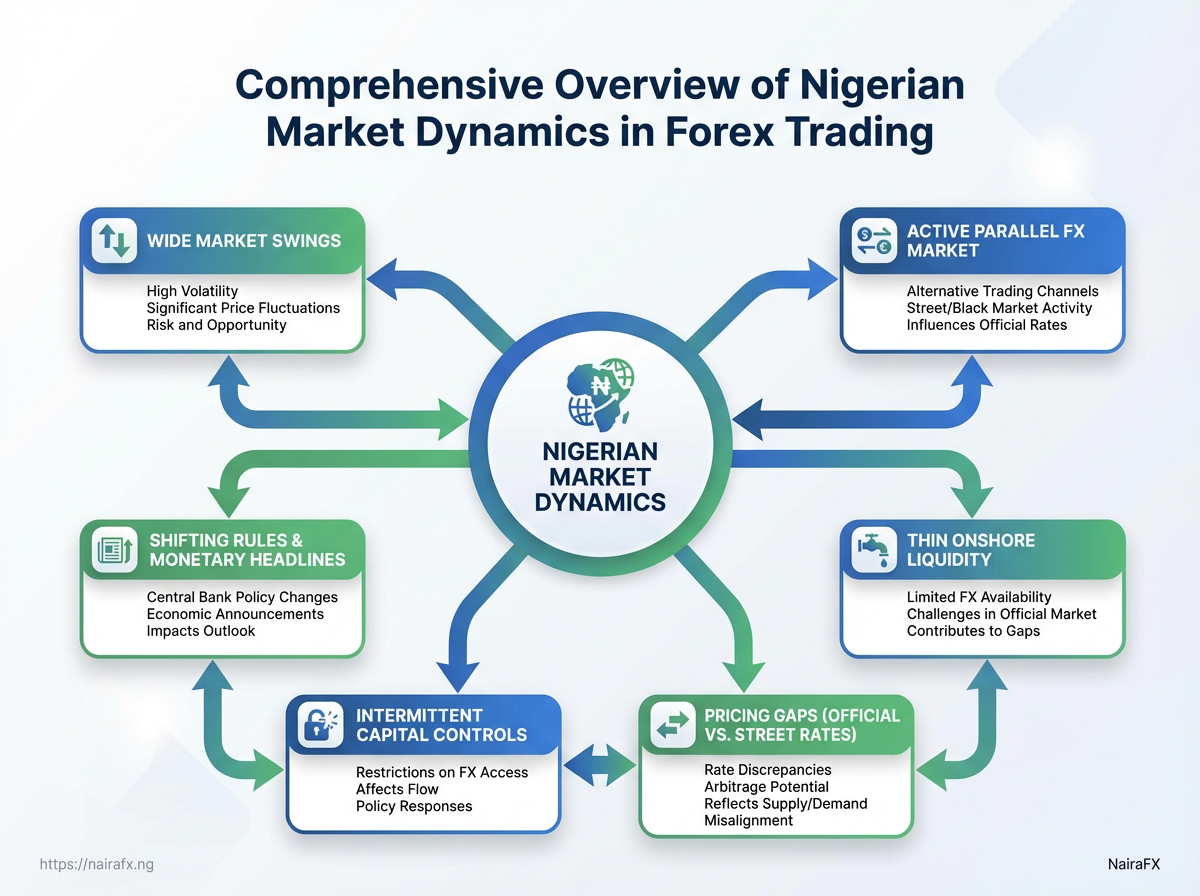
The daily reality for many traders in Nigeria is quick to reveal itself: wide Nigerian market swings, an active parallel FX market, and rules that shift around monetary headlines. Those who trade forex trading here wrestle with thin onshore liquidity during stress, intermittent capital controls, and pricing gaps between official and street rates. Recognising those patterns early separates guesswork from a repeatable approach.
Macro events — oil receipts, central bank signals, and diaspora flows — land here with outsized impact, often compressing opportunities into tight windows. Add the growing influence of crypto and offshore capital, and the result is a market where execution, timing, and local regulatory nuance matter as much as strategy. For anyone placing orders from Lagos, Abuja or abroad, mastering these dynamics is the baseline, not the edge.
Overview of Nigerian Macroeconomic Drivers
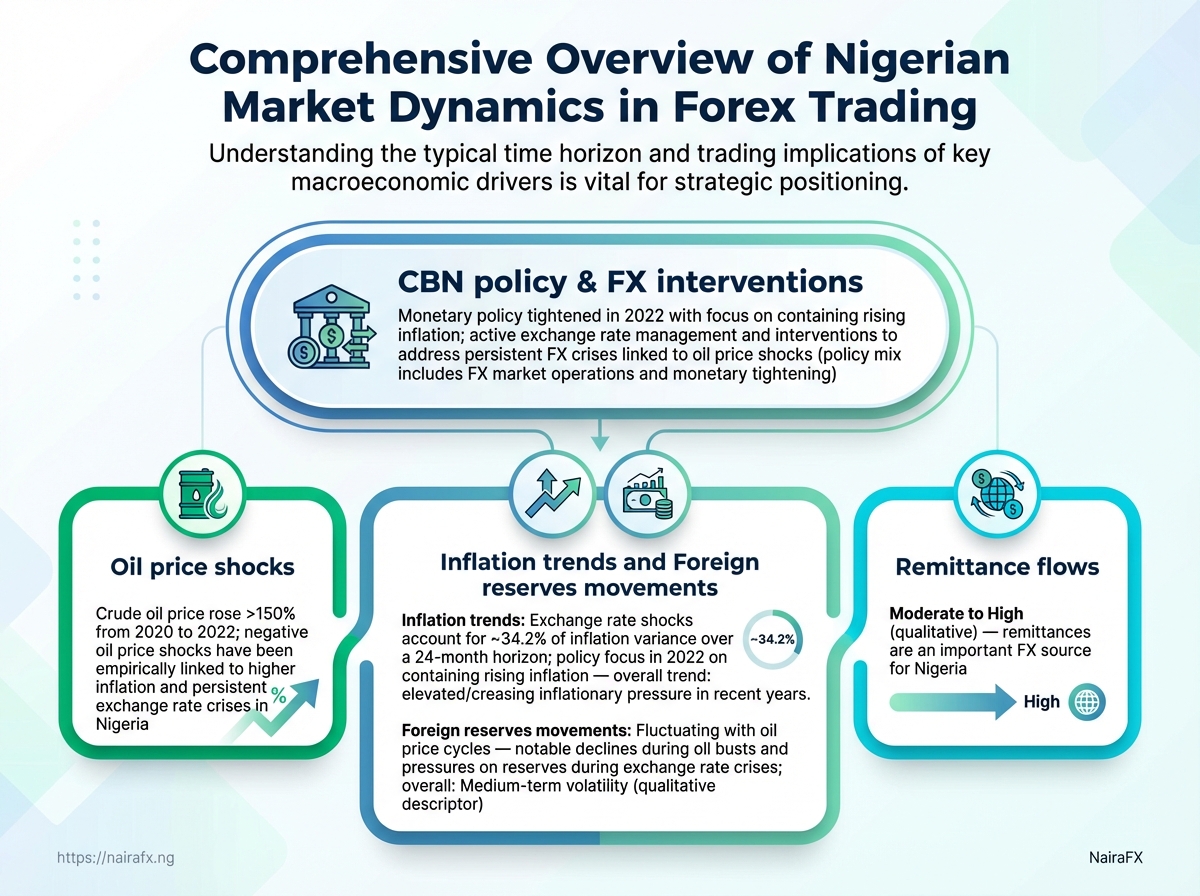
Nigerian currency and market moves are driven by a small set of powerful, often-interacting forces. Expect short bursts of volatility from central bank actions, persistent pressure or relief from oil markets, and longer-term currency trends shaped by inflation and interest-rate differentials. Traders who watch these three in combination get a much clearer read on likely naira trajectories than those who follow them in isolation.
- Central Bank of Nigeria (CBN) policy and FX interventions: CBN liquidity operations,
MPRchanges, and FX auctions directly shift short-term naira liquidity and the parallel market spread. Sudden FX sales or tightened liquidity can move the naira intraday. - Oil price shifts: Nigeria’s budget and FX inflows are oil-linked. Rising Brent typically increases FX receipts and sovereign flexibility; crashes reduce government FX availability and deepen pressure on the naira.
- Inflation and interest-rate differentials: Persistent high inflation erodes real returns; wider domestic rates versus external yields attract flows but can’t offset runaway inflation long-term.
- Foreign reserves movements: Reserves cushion currency shocks; declines limit the CBN’s ability to defend the naira, while rebuilds support more stable FX policy.
- Remittance flows: Steady remittances provide ongoing FX supply to retail market segments and can blunt short-term volatility during external shocks.
Macro drivers by mechanism, typical time horizon of effect, and trading implication
| Macro driver | How it affects FX | Typical time horizon | Trading implication |
|---|---|---|---|
| CBN policy & FX interventions | Alters naira liquidity via auctions, sales, and MPR guidance |
Days to months | Short-term volatility; trade around policy windows and auction schedules |
| Oil price shocks | Changes export receipts and government FX availability | Weeks to quarters | Trend shifts in naira; momentum trades when oil direction is clear |
| Inflation trends | Affects real currency value and purchasing power | Months to years | Position sizing adjusted for erosion risk; favor strategies hedging inflation |
| Foreign reserves movements | Determines central bank defence capacity and market confidence | Months | Risk-on when reserves rise; avoid large directional bets when reserves fall |
| Remittance flows | Provides steady retail FX supply, easing spot pressures | Ongoing (stable) | Use as a base liquidity layer; short-term volatility reduced during high remittance periods |
Watching these dynamics closely makes trading decisions less guesswork and more probabilistic — the difference between getting whipsawed and staying on the right side of moves.
Market Structure and Liquidity Channels
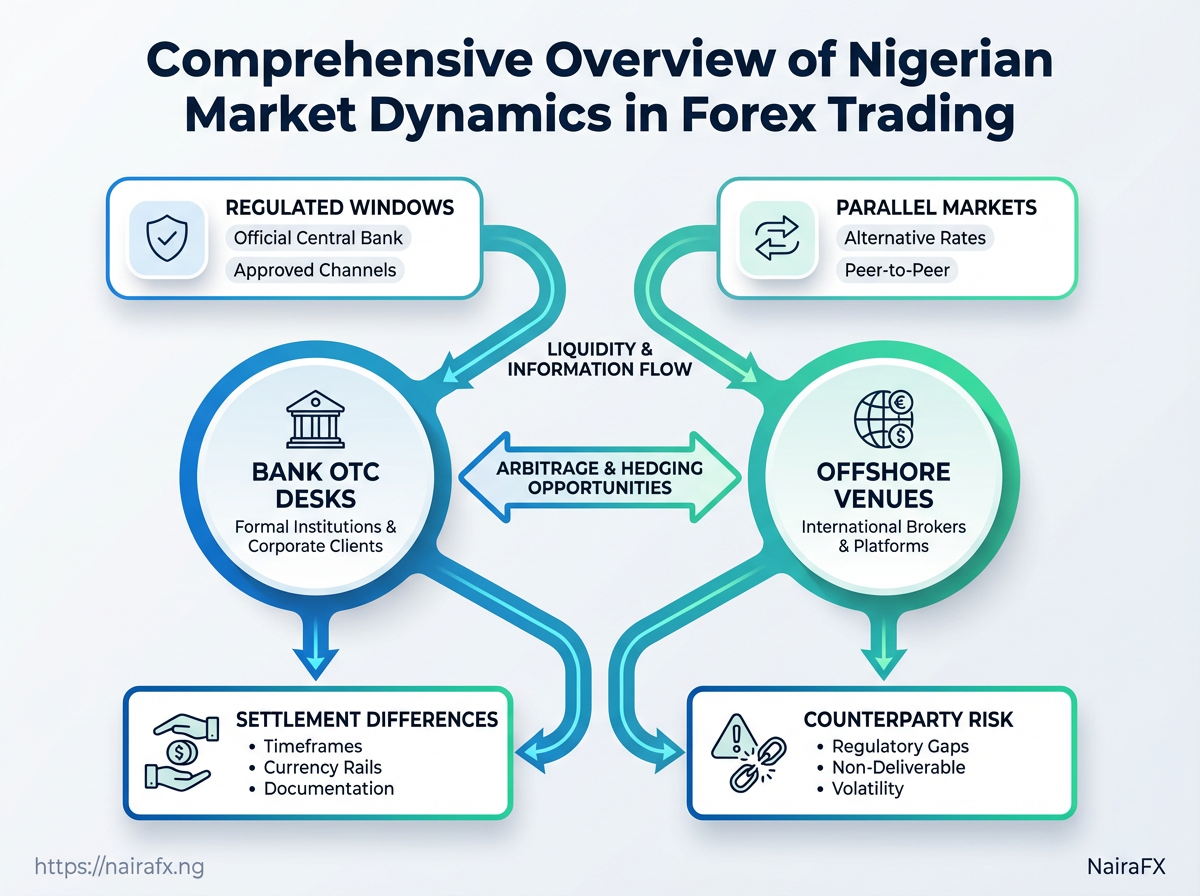
Regulated windows, parallel markets, bank OTC desks and offshore venues form the plumbing that moves naira liquidity — each behaves differently under stress and news. Understanding where liquidity sits, who supplies it, and how settlement and counterparty risk change between venues is what separates reactive traders from those who can position ahead of moves.
NAFEM (Nigeria Autonomous Foreign Exchange Market): A regulated onshore venue where banks and authorized dealers post quotes for corporates and institutional flows; liquidity here is transparent but depth can thin during shocks.
Commercial bank OTC desks: Bank-provided liquidity for retail and corporate clients, often used for large ticket corporate flows; spreads widen with balance sheet constraints.
Parallel market: Informal, over-the-counter pricing primarily via bureaux and individual dealers; reacts quickly to news with higher spreads and settlement risk.
Bureau de Change: Retail-focused cash FX outlets; useful for small physical currency needs but limited for hedging and large transfers.
Offshore markets: FX instruments traded outside Nigeria (for example, USD/NGN derivatives or dollar contracts via international brokers); offer hedging and broader liquidity but introduce cross-border settlement and regulatory considerations.
How each venue functions in practice
- Price formation: On regulated windows prices reflect order flow between banks and corporates; in the parallel market pricing is supply-demand driven and often incorporates a premium for settlement uncertainty.
- Liquidity providers: Banks, international FX desks, and market-making bureaux supply quotes; offshore liquidity comes from global banks and ECNs.
- Settlement mechanics: Regulated venues typically use formal bank settlement rails; parallel trades may require cash or informal nets, increasing counterparty risk.
- Reaction to news: Parallel market and offshore instruments usually price news faster; regulated windows can lag due to approval and operational constraints.
FX venues on accessibility, typical spreads, settlement speed, and regulatory risk
| Venue | Accessibility | Typical spread | Settlement speed | Regulatory risk |
|---|---|---|---|---|
| CBN/NAFEM | Restricted to licensed banks/authorized dealers | Narrow during normal conditions, widens in shocks | Same-day to T+1 via bank rails | Low — centrally regulated |
| Commercial bank OTC | Widely accessible to corporates and customers | Moderate; depends on bank balance sheet | Same-day to T+2 | Moderate — bank oversight |
| Parallel market | Broad informal access (cash/deal networks) | High; premium over official rates | Immediate (cash) or delayed (settlement risk) | High — limited regulation |
| Bureau de Change | Retail access at airports & cities | High for cash transactions | Immediate (cash) | High — regulated locally but limited oversight |
| Offshore markets | Requires foreign broker/accounts | Variable; often tighter due to global liquidity | Depends on instrument; can be instant (CFD) or T+2 | Moderate to complex — cross-border rules |
Practical approach: use regulated venues for predictable settlement and large corporate flows, tap parallel for immediate price discovery when speed matters, and layer offshore hedges for exposure management. Knowing which channel to use before a news event is often the edge that preserves P&L and reduces operational headaches.
Price Drivers, Correlations, and Volatility Patterns
Price moves in Nigerian FX and local asset markets are rarely isolated; they ride on a handful of external pulses and domestic regime changes. Oil prices and the US dollar index (USDX) are the two primary external correlates that commonly set direction. When oil weakens, Nigeria’s external receipts compress, pressure on the naira rises, and FX volatility tends to spike. When the USDX strengthens, capital often flows toward dollar assets and away from emerging markets, tightening liquidity and widening local spreads.
Oil price correlation: Oil revenues drive fiscal space and FX supply; sharp oil falls quickly tighten FX availability and raise risk premia.
US dollar index correlation: Moves in USDX affect global carry and capital flow dynamics; a rising dollar increases funding stress in naira markets.
Domestic policy surprises can flip regimes overnight. Sudden changes in monetary policy, FX windows, or subsidy statements cause structural jumps rather than incremental repricings. These are not small mean-reverting blips—those events often require re-running scenario analyses and widening stop buffers.
Volatility clustering is a persistent feature: calm stretches are followed by intense bursts. That pattern makes static risk rules fragile. Dynamic controls that adjust to realized volatility outperform fixed limits in practice.
Practical signals and controls to use:
- Volatility filter: Use a 20-day rolling realized volatility to scale position size.
- Correlation watch: Monitor a short basket (oil,
USDX, regional FX) for directional alignment before adding exposure. - Liquidity buffer: Maintain a cash or short-duration bond buffer sized to cover margin moves during a 1-in-50 stress day.
- Policy alert: Treat central bank or fiscal policy releases as high-impact events; cut exposure 24–48 hours around announcements.
- Calculate rolling 20-day realized volatility and set maximum position size inversely proportional to it.
- Overlay a correlation heatmap of oil vs naira vs
USDXweekly; reduce leverage when correlations converge in adverse ways.
- Run a quick Monte Carlo or scenario stress (10k sims or 50 bespoke stress scenarios) to estimate tail exposures and required liquidity.
Using Monte Carlo simulations for strategy sizing and stress-testing is especially useful after policy shocks. Traders who make volatility regime detection and correlation alignment routine preserve capital and avoid being caught on the wrong side of sudden runs. This practical framing helps bridge daily trade decisions with the bigger macro drivers that actually move markets.
Risk Management and Trade Execution Strategies for Nigerian FX
Managing risk in Nigerian FX feels different from developed markets — liquidity gaps, capital controls, and counterparty uncertainty change the calculus. Use volatility-adjusted position sizing, prefer option-based or offshore-swap hedges for large exposures, and treat every hedge as a settlement and counterparty decision, not just a pricing exercise. Those priorities keep P&L stable when markets lurch.
Volatility-adjusted position sizing
- Measure volatility: Use
ATR(14)on the USD/NGN or your traded pair to define risk per unit. - Position size rule: Risk per trade = Account equity × target risk % / (ATR × monetary value per pip).
- Practical steps:
- Calculate
ATR(14)in NGN pips. - Choose target risk (e.g., 1% of account equity).
- Compute lot size so that a move of
ATRequals the target loss.
Example: With 1,000,000 NGN account, 1% risk = 10,000 NGN. If ATR ≈ 200 NGN and one contract = 10,000 NGN per pip, scale position so 200-pip move ≈ 10,000 NGN.
Hedging choices and when to use them
- Options: Best when skewed tail risk matters — pay premium for defined loss and keep upside optionality.
- Offshore USD/NGN swaps: Good for large corporates needing multi-month cover; useful when local forward markets are constrained.
- Currency forwards via banks: Cheap and straightforward for routine FX exposures but watch bank credit lines and documentation.
- Natural hedges: Match currency revenues and liabilities to avoid explicit hedges; lowest settlement risk but may be operationally complex.
- CFDs/leveraged broker exposures: Quick and cheap for tactical hedges, but high counterparty and liquidation risk.
Settlement and counterparty risk—practical controls
- Use multiple counterparties: Avoid concentration with a single bank or broker.
- Netting arrangements: Where possible, net multiple trades to reduce gross settlement flows.
- Collateral and margin terms: Negotiate haircuts, currency clauses, and settlement windows; test operational flows with small trades before scaling.
- Documentation: Confirm ISDA/CSA or local equivalents for large swaps and options; even for smaller trades, have written settlement procedures.
Hedging instruments by cost, liquidity, and settlement risk
| Hedging instrument | Typical cost | Liquidity | Settlement/counterparty risk |
|---|---|---|---|
| Offshore USD/NGN swaps | Typical dealer spread 0.5–2.0% p.a. over reference | Thin for large tenors, moderate intra-dealer liquidity | Medium–high; requires offshore counterparty and FX settlement pathways |
| Currency forwards via banks | Bank spread ~0.2–1.0% depending on tenor | Moderate onshore liquidity for short tenors | Low–medium; bank credit exposure but standard settlement processes |
| FX options | Premium typically 1–5% of notional (volatility dependent) | Limited onshore, better offshore via international dealers | Low for exchange-cleared; medium for OTC (counterparty credit) |
| Natural hedge (asset/liability matching) | Operational cost only; financing/opportunity cost varies | N/A (internal) | Low; settlement risk minimal if matched correctly |
| CFD or derivative exposures via brokers | Spreads + overnight fees; effective cost often 0.1–1.0% | High for liquid pairs with reputable brokers | High; counterparty and liquidity risk if broker under stress |
Risk controls and execution protocols are the muscle memory of surviving Nigerian FX volatility — size positions to market noise, pick hedges that match the exposure horizon, and build operational checks so settlement never surprises you. Keep testing with small tickets and scale only when the end-to-end flow is proven.
Trading Strategies Adapted to Nigerian Market Conditions
Nigerian markets demand flexible strategies that account for thin liquidity, wide spreads during off-hours, and frequent news-driven volatility. Match the approach to the prevailing liquidity regime: tighter, scalp-friendly tactics during Lagos trading hours; swing or positional methods around major macro events; and event-driven breakout plays where order flow concentrates. Below are concrete templates, precise entry/exit rules, and sample trades that translate cleanly to local conditions.
Strategy template: Intraday liquidity scalp (best during NSE active hours)
- Objective: Capture small, high-probability moves when bid/ask tightness is good.
- Entry rule: Enter after a confirmed price rejection at a local VWAP with volume spike > average 20-period volume.
- Stop:
0.2%–0.5%below entry or below the recent micro-swing low. - Target:
1:1.5to1:3reward-to-risk; scale out at1:1then let remainder run with trailing stop. - Timing: Trade only between 10:00–14:00 local time when liquidity concentrates.
Strategy template: Event-driven breakout (use around CBN announcements, GDP releases)
- Objective: Ride directional moves when fundamentals shift sentiment.
- Entry rule: Predefine a breakout band using the high/low of the 30-minute range before release; enter on breakout with confirming volume.
- Stop: Inside the breakout band; widen for FX crosses with known wider spreads.
- Target: Use
1:3R:R as baseline and adjust for implied volatility. - Risk control: Reduce position size by 25–50% if spread > typical session spread.
Strategy template: Position trade with Monte Carlo stress-testing
- Objective: Multi-week hold across corporate earnings or policy cycles.
- Entry rule: Fundamental alignment + technical pullback to 50–100 EMA on weekly chart.
- Stop: Volatility-adjusted stop using ATR(14) ×
2. - Sizing: Use equity curve and Monte Carlo simulation to estimate drawdown probability — consider running a Monte Carlo test to pick a conservative position size.
Sample trade: NSE banking stock swing
- Identify stock with strong relative strength and pullback to 50 EMA.
- Confirm sector momentum and absence of upcoming earnings in the week.
- Enter at pullback close with stop at
1.5 × ATR(14)below entry. - Scale out one third at
1:2R:R, remainder ontrail 20-day low.
Practical tip: Keep an events calendar synced to local time and always measure spread before sizing positions. For rigorous risk modelling, Monte Carlo simulations offered by specialized providers can show how strategies perform across volatile sequences. These approaches make trading in Nigeria manageable and measurable — choose the template that fits your hours, appetite, and the liquidity you actually see.
Operational Considerations: Brokers, Settlement and Compliance
Choosing the right broker and nailing settlement and compliance processes matter as much as a trading edge. Execution quality, access to NGN liquidity, clear settlement timelines, and robust client-fund protections determine whether a strategy performs on paper or in the real market. Focus on brokers that demonstrate low slippage on NAFEM/NGN flows, publish settlement procedures, and show transparent regulatory standing.
Broker selection priorities
- Execution quality: Measure typical spreads, slippage, and order fill rates during your active trading hours.
- NGN liquidity access: Confirm direct access to NAFEM liquidity or reliable offshore/nostro routing for large orders.
- Regulatory standing: Verify registration with relevant Nigerian authorities and any international regulators the broker claims.
- Client fund protection: Check for segregation of client accounts and published custodian arrangements.
- Settlement & disputes: Ensure documented settlement windows, margin call procedures, and an escalation path for disputes.
Settlement best practices and operational steps
- Verify settlement timelines and cutoffs with the broker before funding an account.
- Establish a documented funding and withdrawal workflow, including bank details, expected clearing times, and reconciliation points.
- Run a small live trade cycle to validate execution, settlement, and reconciliation before scaling capital.
- Maintain a written dispute resolution process with SLA expectations and escalation contacts.
Practical examples
- Example — Execution test: Place a 0.5–1 lot trade during peak hours, log executed price vs. quote, then reconcile with the broker’s execution report.
- Example — Settlement test: Fund NGN via your local bank, record clearing time, and test withdrawal to confirm round-trip timings.
Feature matrix for broker selection criteria and what to verify with each provider
| Criteria | What to check | Why it matters | Red flags |
|---|---|---|---|
| Liquidity access (NAFEM/offshore) | Ask for NAFEM connectivity details, nostro routing, and typical depth | Determines ability to execute large NGN orders without market impact | Broker cannot show routing or cites opaque counterparty lines |
| Execution speed and slippage | Request historical slippage reports; run live execution tests | Affects realized P&L vs. backtest | Consistent large negative slippage or no execution reports |
| Regulatory registration | Confirm registration numbers with CBN/SEC or equivalent | Legal protection and oversight | No verifiable registration or conflicting claims |
| Client fund protection | Request custodian agreements and segregation proofs | Reduces counterparty risk to client capital | Client funds held in operating accounts or unclear custody |
| Customer support and settlement record | Review SLA, settlement cutoffs, dispute logs, references | Smooth operations and fast resolution of issues | Poor response times, unresolved settlement disputes |
Choosing a broker and ironing out settlement processes removes a major hidden source of performance leakage. Get these operational pieces right and strategy returns are less likely to be eaten by execution, settlement, or compliance failures.
Quick Reference: Cheat Sheet for Nigerian Forex Traders
Start with a few short, non-negotiable rules you can recall under pressure: trade only when your plan and market structure align, never risk more than your pre-set percent of equity on a single trade, and always size positions to protect the downside first. These simple anchors shorten decision time during fast-moving sessions and help keep emotions out of execution. The checklist below is designed to be actionable in under two minutes, with a one-minute emergency protocol for extreme volatility and a handful of quick definitions you’ll reference often.
Fast Pre-Trade Checklist (under 2 minutes)
- Confirm trade idea aligns with trend and higher-timeframe structure.
- Check current economic calendar items for the next 60 minutes.
- Set
stop-loss,take-profit, and calculate position size so risk ≤ pre-defined % of equity.
- Verify spread and liquidity (avoid trading wide-spread pairs during news).
- Enter trade only if entry price matches strategy rules (no late chasing).
- Quick check: If two of these items fail, skip the trade.
Immediate steps for extreme volatility
- Halt new entries: Stop opening trades for the next 15–30 minutes unless following a specific break-out rule.
- Tighten risk: Reduce position size by 50% or widen
stop-lossonly if the trade still meets your risk/reward and plan. - Use limit orders: Avoid market orders during spikes to reduce slippage.
- Monitor central feeds: Watch local NGN liquidity and broker execution — fast price moves often mean widened spreads and slower fills.
Pocket rules and reminders
- Risk cap: Never risk more than 1–2% of account on any single trade.
- Daily loss limit: Stop trading for the day after losing 3–5% of equity.
- Journal: Note trade rationale in one sentence immediately after entry.
- Liquidity pairs: Prioritize majors (EUR/USD, USD/JPY) during thin local sessions.
- Broker checks: Confirm your broker supports NGN withdrawals and has clear execution reports.
Stop-loss: A pre-set price where the trade is closed to limit loss.
Position size: Number of lots or units adjusted so risk equals your % of equity.
Slippage: Difference between expected fill price and executed price during volatile conditions.
A two-minute routine and a one-minute emergency plan save capital and sanity when markets go chaotic — keep this cheat sheet printed, practiced, and reachable from your trading desk.
FAQ and Common Trader Questions
Most traders wrestle with the same handful of practical problems: position sizing, managing emotions, filtering signals, and adapting strategies to local market conditions. Below are the top questions that come up repeatedly, with short, actionable answers and clear next steps.
What size should my position be? Start by risking a fixed percentage of your capital per trade — commonly 1–2%. Calculate position size using your account equity, the distance to your stop-loss, and desired risk percentage. Actionable steps:
- Calculate risk per trade:
Account Equity × Risk %. - Divide that by distance to
stop-loss(in account currency) to get position size. - Recompute after every equity change and large drawdown.
How do I avoid overtrading? Overtrading usually follows unclear rules or boredom. Tighten your edge: trade only when your setup meets predefined filters.
- Rule-based entries: Trade only when all criteria are met.
- Daily trade limit: Stop after 3 losses or 5 trades per day.
- Routine: Keep a brief pre-market checklist to reduce impulsive trades.
How should I place stop-losses and take-profits? Use market structure and volatility, not arbitrary pips. Place stop-loss beyond logical swing points or ATR-based bands.
- Volatility rule: Set
stop-lossat 1.5–2× ATR(14). - Structure rule: Place beyond recent swing high/low.
- Reward-to-risk: Target at least 1.5:1 on average.
My strategy worked in backtests but fails live — why? Common causes: data-snooping, unrealistic slippage, friction, and overfitting. Validate with out-of-sample tests and forward-walk analysis. Actionable steps:
- Run Monte Carlo simulations for different sequences of wins/losses.
- Include realistic spreads, slippage, and commission in tests.
- Trial on a small live size for several months.
How do I adapt strategies to Nigerian market conditions? Local markets have unique liquidity windows and news drivers. Shorten intraday horizons during thin liquidity, and monitor domestic macro events closely.
- Trade around local windows: Avoid opening positions near Nigerian market open/close if liquidity drops.
- News sensitivity: Adjust
stop-losssize ahead of major domestic releases.
What’s the best way to manage drawdowns? Treat drawdowns as an information signal: if equity curve metrics degrade, reduce size or pause.
- Rule: Cut exposure by 25–50% after a 10% drawdown.
- Metric watch: Track equity curve skew and consecutive-loss runs.
If you want to stress-test a strategy, NairaFX’s Monte Carlo simulation service can show how equity curves behave under random sequences and worst-case runs. These questions and habits separate consistently profitable traders from the rest; apply the rules above and iterate based on real, live feedback.
Resource List and Further Reading
For practical trading, the difference between guesswork and edge usually comes down to the quality of your feeds and how you combine them. Below are the sorts of sources to prioritise and the specific tools that make those sources actionable for a Nigerian forex trader: real policy and macro releases from official agencies, fast price & news feeds for intraday monitoring, and analytics/charting platforms for correlation and risk checks. Use these together to build signals, backtest hypotheses, and monitor liquidity and macro drivers that move the naira.
- Official policy and macro: Central bank releases, national statistics, and fiscal bulletins drive medium-term FX trends.
- Real-time price and news: Low-latency price feeds and dedicated Nigeria/EM news desks catch market-moving events early.
- Charting and correlation: Tools that let you run correlation matrices, overlay macro series and test strategies against equity curve scenarios.
- Data automation: Prioritise providers with
APIaccess and CSV exports so strategy backtests are reproducible. - Commodities & external drivers: Oil prices, global risk proxies, and US dollar indices routinely explain naira moves.
- Decide which series matter for your time frame.
- Subscribe to an
APIor websocket feed for prices and a newsletter or official feed for policy dates. - Into your charting platform, link price feeds and macro series; run rolling correlation checks weekly.
Organize resources by category, link type, and why useful
| Resource | Type | Primary use | Notes |
|---|---|---|---|
| Central Bank of Nigeria (CBN) | Official data portal | Monetary policy statements, intervention data | Primary source for policy rates and FX intervention announcements |
| National Bureau of Statistics (NBS) | Official statistics | GDP, inflation, trade balance releases | Use for macro anchors and validating trend drivers |
| Reuters Nigeria feed | Real-time news | Fast market headlines, local political/economic events | Low-latency reporting useful for intraday risk management |
| Bloomberg Markets | Market data & analytics | Global price feeds, terminal analytics, EM research | Comprehensive cross-asset context and charting tools |
| Brent oil price feeds (commodity vendors) | Commodity data | Oil price moves that influence FX and fiscal revenue |
Key insight: The most resilient workflows combine official macro releases (CBN/NBS) with fast news and reliable market data (Reuters/Bloomberg) and a commodity feed for oil — layering them allows clear attribution when the naira moves.
Practical next steps: pick one official feed, one real-time news source, and one analytics/charting tool, then integrate them via API into your backtest environment. That triad turns raw data into decisions that survive Nigeria’s volatility.
Conclusion and Next Steps
The practical outcome: take the strategies you’ve learned and make them routine. Small, disciplined changes to risk controls, execution checks, and review processes turn a promising plan into repeatable results. Traders who treat strategy development as an operational system — not a one-off idea — consistently protect capital and improve returns over time.
Start with the essentials you can apply this week
- Calibrate
position sizingto your real equity and risk tolerance.
- Implement a daily pre-market checklist for liquidity, spread, and economic events.
- Log every trade with entry, stop, rationale, and outcome for weekly review.
Operational checks to protect capital and execution
- Pre-market verification: Confirm platform connectivity and available margin before placing trades.
- Order hygiene: Use limit orders where appropriate and always set stops — avoid market orders in thin sessions.
- Latency awareness: Be aware of execution delays during news; widen risk buffers or pause trading in those windows.
- Routine backups: Keep account access and two-factor authentication updated to prevent operational interruptions.
Risk-control behaviors to institutionalize
- Hard stop discipline: Set and honor maximum daily drawdowns per account.
- Size caps: Limit any single trade to a small percentage of usable equity, typically under
2%. - Diversification guardrails: Avoid over-concentration in correlated FX or equity pairs during volatile periods.
Use measurable review cycles
- Weekly: Review trade logs for pattern errors and edge erosion.
- Monthly: Run a quick equity-curve check and spot-test the strategy with a small Monte Carlo shuffle (this is where simulation helps).
- Quarterly: Reassess strategy fit against changing market regimes and macro risk.
Practical housekeeping
- Save or bookmark your trade journal and this checklist for easy reference.
- If model-driven adjustments are needed, run a short backtest on recent data before increasing size.
- Consider tools that automate execution checks; for Nigerian traders, local liquidity windows and Naira funding mechanics deserve special attention.
For traders who want a quantified next step, consider running a 30-trade validation with strict stops and fixed sizing, then decide to scale by percentage of successful trades. Stick to disciplined operations and regular reviews — that’s what separates occasional winners from consistent ones.
Conclusion
Trading Nigeria’s FX market rewards respect for volatility, structural quirks, and the policy cycle. Remember the way the naira’s 2023 policy shifts rippled through both the formal and parallel markets — that episode shows how macro announcements, liquidity corridors and on‑the‑ground settlement frictions combine to move prices fast. Combine disciplined position sizing, a clear rule for slippage and settlement risk, and active monitoring of correlation changes between FX, oil prices and short‑term rates, and the randomness of headline shocks becomes a manageable part of the opportunity set. Practical trade execution and contingency checks are as important as the strategy itself.
For immediate next steps: revisit your risk limits and execution checklist, stress-test trades against a central‑bank announcement scenario, and lock a settlement workflow with a trusted broker. If implementation help is useful, services like NairaFX provide brokerage and operational support tailored to these exact pain points. Traders still asking whether to scale in or out around policy windows should prefer smaller, staged entries and an explicit stop/funding plan — that approach preserves optionality while the market decides.