

The naira can look calm in the morning and turn restless by lunch, especially when global markets are sending mixed signals.
That is the daily reality behind forex market trends: a rate decision in Washington, a surprise oil move, or a rush into safe-haven currencies can hit your chart before local news even catches up.
That is not noise.
It is international trading influence in action, and the scale is huge.
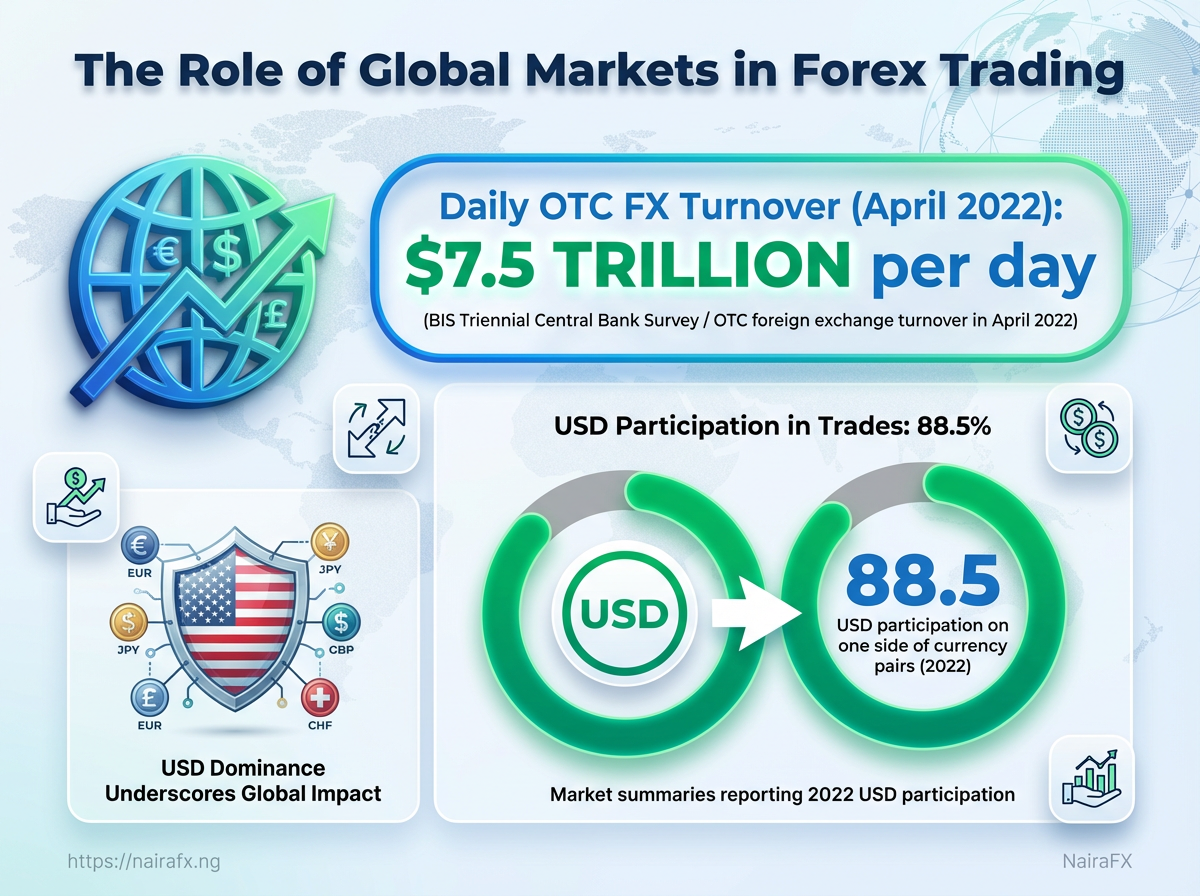
The BIS reported that over-the-counter FX trading averaged $7.5 trillion per day in April 2022, with the U.S. dollar on one side of 88% of all trades, which explains why global risk sentiment travels so fast through currency pairs.
The real mistake is treating forex like a local chart game.
A rate hike cycle, tariff tension, or a shift in oil prices can change the market’s mood long before price settles into a clean trend.
That is why macro context matters so much in trading decisions.
When traders read currency moves through the lens of policy, commodities, and risk appetite, the chart starts making more sense, and the random-looking spikes begin to look less random.
Quick Answer: Global markets shape forex price moves through shifting central-bank expectations, geopolitical/supply shocks, and cross-border risk sentiment—so the naira often reacts after the initial global impulse. For Nigerian traders, the practical edge is to watch the international “decision windows” first and then translate them into local execution: 1) Check upcoming Fed/ECB/BoE/BoJ and major inflation/jobs releases before you plan entries. 2) Monitor the USD backdrop via oil/risk sentiment and major yields (not just today’s headline). 3) Only trade once liquidity/spreads are workable in your local time window, and reduce size when the expected event could flip correlation or execution conditions. BIS data underlines that global FX flow is massive and USD-centered—use that to anticipate speed, not to over-index on the exact numbers.
Opening thought: What if global markets matter more than your local news?
What if the biggest move in your trading account starts in Washington, London, or Tokyo, not in Lagos?
That is often how global markets forex actually works.
The FX market is huge, fast, and deeply linked to dollar flows, central bank expectations, oil, and risk sentiment.
BIS turnover data underscores that FX liquidity is massive and heavily USD-centered, which helps explain why global risk sentiment can move through currency pairs quickly (BIS OTC FX turnover data).
Local headlines still matter, especially for the naira.
But they often arrive after the bigger global shift has already started.
The IMF noted in its April 2026 Global Financial Stability Report that emerging-market portfolio flows remain highly sensitive to global risk sentiment, and that stress can tighten financing conditions fast (IMF Global Financial Stability Report, Chapter 2, April 2026).
That is why forex market trends can look calm locally while the real pressure is building elsewhere.
> The global market often moves first, and the local story catches up later.
A few things usually drive that first move:
- Central bank expectations — Fed, ECB, BoE, BoJ, and others can reset currency pricing in minutes. Axiory’s 2026 event guide points to these banks as the most influential drivers for pairs (Axiory key FX events for 2026).
- Trade and tariff shocks — Convera’s February 2026 outlook highlights renewed tariff threats and coercive trade messaging as major FX drivers (Convera global FX outlook, February 2026).
- **Oil and risk sentiment — For Nigerian traders, oil-linked currency weakness can matter more than a headline about yesterday’s local policy debate.
That is why we treat macro context as the filter.
In our own analysis, a bearish oil-driven setup only matters if price action confirms it and risk stays tight enough to keep drawdown below 2% of equity.
A loud headline is easy to notice.
A global shift is usually the one doing the real work.
In global markets forex, the clock matters almost as much as the chart.
A pair can feel quiet in Asia, then wake up when London opens, and get sharper when New York joins. That rhythm comes from liquidity concentration—more participants, tighter spreads, and faster order flow when a major center is active.
Sydney and Tokyo usually shape the quieter stretches of the day. Tokyo often sets the early tone for JPY pairs, while Sydney can show thinner liquidity and quicker, more range-like movement.
London changes the mood. It brings the deepest European flow and often creates the first convincing breakout attempts.
New York then decides whether that move survives. The London/New York overlap is typically where participation is highest, moves accelerate, and many intraday setups get their confirmation—or their failure.
A practical way to read it is simple: when a session opens, ask whether liquidity is adding fuel (continuation with follow-through) or just noise (wicks, mean-reverting pushes, and stop-hunts).
Sydney: thinner liquidity, cleaner ranges, slower tests. Tokyo: stronger influence on JPY crosses, early positioning. London: main driver for breakouts (especially EUR, GBP, and cross pairs). New York: heavier dollar flow and sharper reactions to US data.
Session overlap: highest participation, fastest moves, and most useful price action.
Example: GBP/USD around the London open. If price has been boxed in during Asia, the first London push often reveals whether the market is building a trend—or just hunting stops. That’s why session timing belongs in every trading plan.
Comparing major market centers and what they mean for your trades
Ever notice how the same pair can feel calm for hours, then suddenly wake up and run? That usually comes down to which market center is in charge.
The four big ones do not behave the same way.
London tends to set direction, New York often decides whether that move survives, Tokyo can keep things orderly or boxed in, and Sydney usually starts the day with thinner flow and more selective swings.
That matters in global markets forex because the market is huge, but it is not random.
BIS turnover data shows the FX market is heavily USD-centered, which is why the biggest sessions still shape most major pairs (BIS 2022 Triennial FX survey).
Axiory’s 2026 event guide also keeps the Fed, ECB, BoE, BoJ, and PBoC near the top of the catalyst list (Axiory’s 2026 key FX events guide).
Session hours and what they usually mean
| Market center | Local hours (UTC) | Overlap windows | Typical volatility (major pairs) | Primary drivers (news/events) | Practical tip for Nigerian traders |
|---|---|---|---|---|---|
| London | 07:00–16:00 | London/New York: 12:00–16:00 | High | ECB, BoE, eurozone data, UK data, London fix | Best for clean directional moves in EUR/USD and GBP/USD |
| New York | 12:00–21:00 | London/New York: 12:00–16:00 | High | Fed, NFP, CPI, Treasury yields, US trade headlines | Watch for strong continuation or reversal after US data |
| Tokyo | 00:00–09:00 | Sydney/Tokyo: 00:00–07:00 | Low to moderate | BoJ, Japan data, regional risk, China spillover | Good for range trades and JPY crosses when news is quiet |
| Sydney | 22:00–07:00 | Sydney/Tokyo: 00:00–07:00 | Low | RBA, Australia data, China demand, commodity tone | Useful for planning entries before Europe opens |
Tokyo and Sydney matter more when your pair is tied to JPY, AUD, NZD, or commodity-sensitive themes.
The overlap is where the real action lives.
London/New York often gives the cleanest breakouts, while Sydney/Tokyo is more useful for slower range setups and early positioning.
The IMF’s April 2026 Global Financial Stability Report chapter on emerging markets notes that cross-border flows remain very sensitive to global risk sentiment, which is exactly why overlap periods can turn fast when sentiment flips (IMF Global Financial Stability Report, April 2026).
For Nigerian traders, the most useful window is often the afternoon into early evening, when London is already active and New York is joining in.
That is when spreads are usually more workable, price moves have more follow-through, and false starts get exposed faster.
A simple habit helps a lot here: match the pair to the center driving it, then match your risk to the session.
That keeps the noise down and makes forex market trends much easier to read.
Why does one CPI release sometimes move forex harder than a whole week of chart action? Because markets trade expectations, not headlines.
Inflation, central bank decisions, employment, and trade data tend to matter most because they reshape rate outlooks fast.
A hotter CPI print can push traders to price fewer cuts, while a weak jobs report can do the opposite.
Central banks sit at the center of that reaction, which is why the ECB, Fed, BoE, BoJ, and PBOC get so much attention in global markets forex and broader forex market trends (see Axiory’s 2026 list of key forex events).
Geopolitics adds a second layer of chaos.
Tariff threats, sanctions, shipping disruptions, and supply-chain shocks can change terms of trade quickly. Often, the first impact shows up in commodity currencies and spreads into other pairs through risk sentiment.
Convera’s February 2026 global FX outlook highlights renewed tariff threats, while Forex.com’s March 2026 seasonality note argues that geopolitical concerns can overpower seasonal patterns.
The IMF also notes that cross-border portfolio flows to emerging markets remain sensitive to global risk sentiment, and that stress can tighten financing conditions quickly.
> The core takeaway: big releases and big events matter most when they change expectations—and when those expectations shift liquidity and positioning across currencies.
- CPI: Higher-than-expected inflation usually pressures rate-cut bets and lifts the currency tied to the hawkish central bank.
- Central bank decisions: Rate moves matter, but the language around future policy often matters more than the decision itself.
- Employment data: Payrolls, unemployment, and wage growth can flip rate expectations in minutes.
- Trade data: Surpluses, deficits, and export strength often matter most for commodity and export-heavy currencies.
The cleanest trading habit is simple: watch the release, check the policy reaction, then confirm whether correlation patterns still hold in the new risk regime.
At NairaFX, we pair that macro read with strict risk limits, because global shocks rarely respect your stop loss.
A rising dollar rarely moves alone.
In global markets forex, the USD, oil, stocks, and bond yields often tug on each other—because the USD sits at the center of most global pricing and hedging flows.
For Nigerian traders, that matters in a very practical way.
Brent crude can affect expected FX supply, U.S. 10-year yields can pull the dollar around, and equity stress can change risk appetite fast enough to wreck a clean setup.
That is why your macro context filter should treat oil, yields, and risk sentiment as one story, not three separate stories.
The IMF has highlighted that cross-border portfolio flows to emerging markets can become more sensitive to global risk sentiment—and that stress can tighten financing conditions quickly.
Correlations also refuse to stay polite.
Tariff threats, geopolitics, and policy shifts can flip them. That is why renewed tariff pressure (per Convera’s February 2026 outlook) and the risk that geopolitical concerns overwhelm seasonal patterns (per Forex.com’s March 2026 note) are often visible in correlation changes.
Example 90-day correlations traders watch
| Asset pair | Calm period correlation (90d) | Stressed period correlation (90d) | Practical trading implication |
|---|---|---|---|
| USD/NGN vs Brent crude | -0.24 | -0.66 | Oil strength tends to support naira sentiment; weak crude makes USD longs easier to defend. |
| USD/NGN vs S&P 500 | -0.12 | -0.48 | Equity selloffs usually bring dollar demand, so USD/NGN longs often work better in risk-off tape. |
| USD/NGN vs US 10y yields | +0.29 | +0.61 | Higher yields can back the dollar, so U.S. rate spikes deserve more weight than chart noise. |
Calm markets produce softer links because local flow still matters, but stress makes the cross-asset signal much louder.
That is where strategy flips happen.
A setup that looked perfect on a quiet morning can fail once crude rolls over or Treasury yields jump, so the smarter move is to ask which market is driving the day before you commit size.
A simple habit helps: check the pair, then check oil, equities, and yields, then decide whether the cross-asset backdrop agrees with the trade.
That one extra look usually saves more money than it costs.
Is a clean EUR/USD setup still clean when NFP is minutes away and spreads start acting nervous? Not always.
Global markets move fast because FX is huge and interconnected—and on high-impact days, the international impulse can overwhelm a local chart pattern before you get a chance to react.
For Nigerian traders, the smartest edge is usually restraint:
- We typically keep risk per trade around 0.5%–2%
- and cap total open risk near 3%–5%
That way, if a policy or jobs headline flips the tape, your account survives the volatility surge.
A quick pre-trade filter
| Check | What to look for | If yes — suggested action | If no — suggested action |
|---|---|---|---|
| Session/liquidity check | London–New York overlap is near, spreads are normal, and EUR/USD is moving with follow-through; for Nigeria, this is often around 1:00 p.m. to 4:00 p.m. WAT (varies with US daylight saving) | Trade with normal size or slightly reduced size if the setup is clean | Wait for overlap or accept a smaller, slower move |
| Major economic releases scheduled | US NFP at 8:30 a.m. ET (first Friday of the month) plus CPI, Fed, ECB, BoE, or BoJ decisions close by | Cut size, require cleaner confirmation, or trade only the post-release reaction | Skip the entry and reassess after the first impulse settles |
| Correlation swing detected | Dollar strength, yields, or oil are suddenly moving against your pair’s usual behavior (often a regime shift signal) | Recheck the trade thesis and reduce exposure | Stand aside until the relationship stabilizes |
| Local market constraint | Broker spread is wider than usual, funding is delayed, or open risk is already near your limit | Trim position size and protect margin | Pass and preserve capital for a better window |
If the release hits at 1:30 p.m. WAT during US daylight saving (or 2:30 p.m. WAT otherwise), it may be smarter not to chase the first spike. Our workflow treats that moment as a filter, not an invitation.
If price holds a level after the first burst—and the loss stays inside your planned risk—the trade gets a second look. If not, the market keeps it.
On crowded news days, waiting is often the most profitable action.
Risk management and tools to track international influence
What happens when a tariff scare lands while a trade is already open? The loss usually comes from position size, not from the headline itself.
Cross-border shocks need a different playbook from normal chart noise.
A central bank surprise, sanctions update, or shipping disruption can change direction, spreads, and execution at the same time.
In global markets forex, that is why size comes first, alerts come second, and the broker check comes last.
In our market-analysis workflow, the rule is simple: keep risk at 0.5%–2% per trade, and hold total open risk near 3%–5%.
If a move could reset policy expectations, cut size before the event, not after the candle.
That matters when watching the 2026 event calendar from Axiory’s key forex events guide, the geopolitical pressure noted in Forex.com’s March 2026 seasonality note, and the stress channels flagged in the IMF’s April 2026 Global Financial Stability Report chapter.
That same lens helps with forex market trends too.
Convera’s February 2026 global FX outlook is useful for broad policy themes, while IMF updates help separate one-off noise from a real shift in risk sentiment.
- Spread behavior: Watch how far spreads widen during major releases.
- Stop execution: Check whether stops fill close to the intended level.
- Order speed: Test whether execution slows when volatility jumps.
- Funding access: Confirm deposits and withdrawals still work smoothly.
- Alert quality: Make sure news alerts arrive fast enough to matter.
A simple test during a news window tells you more than a month of calm trading.
If the platform stalls, the broker gets slippery, or alerts arrive late, that setup is not ready for international trading influence.
At NairaFX, we treat that checklist like a seatbelt, not decoration.
Clean analysis still needs clean execution, especially when global shocks hit fast and the chart gets messy.
Reading the Bigger Market Before You Trade
What matters more for your next trade: the local headline, or what New York is about to do? In forex, the bigger force usually wins.
Global markets shape price far more often than traders expect, and that is why a calm morning in Lagos can turn into a sharp move before the session ends.
The real lesson is simple: forex market trends are rarely isolated.
A US inflation surprise, a jump in oil, or a risk-off move across equities can ripple through currency pairs fast, especially when international trading influence is already strong.
That is the same reason a seemingly quiet setup can fail once London and New York start pushing in the same direction.
So before you place the next trade, spend ten minutes on a basic cross-check: the US calendar, crude oil, and the dollar’s direction against major peers. Trade the market in front of you, not the story you hoped would happen. For traders who want a more disciplined way to handle that pressure, our risk management and equity-curve work is built for exactly this kind of environment.