

Imagine it’s 9 pm in Lagos.
The Naira has weakened after a policy headline, and your open USD/NGN-correlated position is bleeding.
Do you let your expert advisor (EA) follow its programmed rules, or close the trade yourself because the news changed the story?
That moment defines the forex trading robots vs manual trading risk management debate.
The choice is not machine versus human, discipline versus instinct.
Risk management is one shared process: position sizing, stop placement, spread and slippage awareness, exposure limits.
Either it holds under pressure or it doesn’t; your method changes who enforces it.
The numbers add weight.
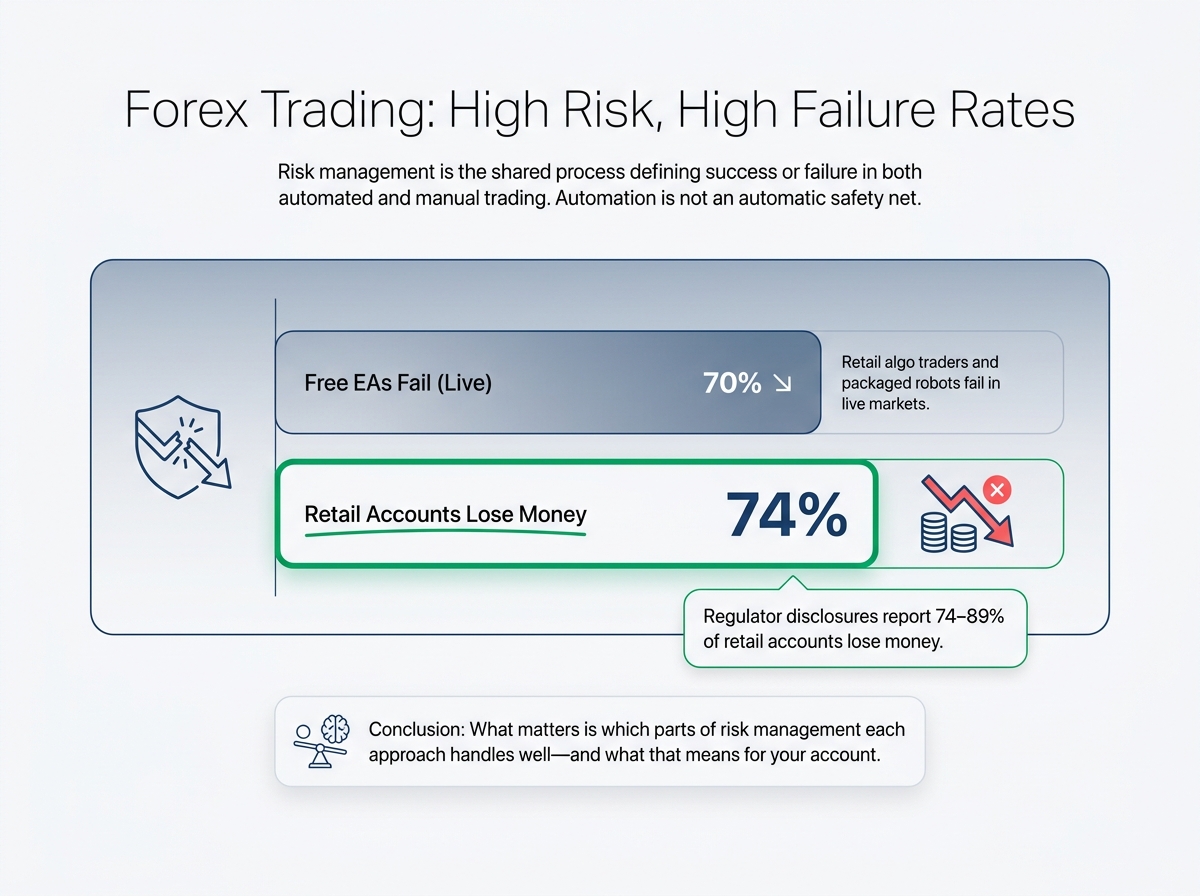
A 2022 Southwest Jiaotong University study found that 93.2% of free forex expert advisors fail once they hit live markets, according to research from Southwest Jiaotong University.
Research from ESMA shows that between 74% and 89% of retail accounts lose money.
Automation is not an automatic safety net.
What matters is which parts of risk management each approach handles well—and what that means for your account in naira terms.
Quick Answer: Forex trading robots can enhance risk management through consistent execution of trades and automated position sizing, yet they lack the adaptability needed for unexpected news events. In contrast, manual traders retain the ability to make nuanced decisions based on real-time market conditions, although they often struggle with emotional biases. Ultimately, the effectiveness of each method varies depending on the trader’s understanding and implementation of risk management strategies.
What Forex Trading Robots and Manual Trading Actually Control
What Forex Trading Robots and Manual Trading Actually Control
Can software really make trading safer? It’s not that simple.
A forex trading robot, often called an Expert Advisor or EA, only takes over part of the job—and rarely the part that empties accounts.
An EA reads price data and fires orders when pre-set rules line up, following moving average crossovers, RSI levels, or candle patterns without hesitation.
Manual trading means you read the chart, pick the setup, size the position, and manage the exit yourself.
The real difference in forex trading robots vs manual trading risk management isn’t who is cleverer.
It’s who controls each decision.
Execution, strategy, and risk are separate jobs, and automation reshapes only one or two.
| Decision area | Robot role | Manual trader role | Risk that remains |
|---|---|---|---|
| Trade entry | Fires when coded conditions are met | Chooses the setup in real time | Bad rules produce bad entries either way |
| Position sizing | Calculates lot size from a fixed risk % | Applies judgment, often inconsistently | A wrong lot size still destroys an account |
| Stop-loss placement | Places stops automatically per settings | Decides where the idea is proven wrong | Slippage can fill stops far from the set price |
| Trade management | Applies fixed trailing or break-even rules | Can hold, cut, or adjust mid-trade | News gaps skip past any management logic |
| Broker execution | Sends orders through the platform | Sends orders manually, same platform | Spread widening and requotes hit both sides |
| Emotional decision-making | Removes fear and greed from execution | Must manage impulse and loss aversion | A disciplined human still overrides rules |
That right
Why This Choice Matters for Nigerian Traders
We often think a strategy is affordable based on its initial cost, but that perception changes when we factor in naira costs, spreads, and execution realities.
For a Nigerian trader, the sticker price of an expert advisor is only the starting point.
The account may be denominated in dollars, but the funding path runs through an NGN conversion, so every deposit and withdrawal carries its own friction.
That changes how you judge whether an EA is truly affordable.
Picture a Lagos trader running a scalping EA on a $500 account funded through an NGN conversion.
The robot fires 40 trades a week, and every one pays spread.
At that pace, spread is not a background detail; it is a recurring cost built into the strategy’s logic
How Risk Management Works in Robots and Manual Trading
How Risk Management Works in Robots and Manual Trading
Spread is one line item.
The real test is who enforces the risk budget once a position is live.
Start with a fixed plan: risk 1% per trade, cap daily losses at 2%, stop trading after three losses.
That plan belongs to the trader, not to the software.
A robot inherits it.
A human either honours it or quietly renegotiates it at 11pm.
A robot reads those numbers as code.
Position size comes from stop distance, the stop-loss sits exactly where the rule says, and the daily cap triggers a shutdown without argument.
It runs the same maths on a winning Tuesday and a losing Friday.
There is no mood variable to override the calculation, no urge to give a losing position “room.” The rule remains fixed until a human changes the code.
Manual traders face identical rules with a nervous system attached.
A 1979 study from Kahneman and Tversky found that losses feel roughly twice as intense as equivalent gains, which is why stops get widened or deleted right before they matter most.
Around 60% of stop-loss orders are triggered by short-term volatility rather than a genuine trend change.
So the urge to intervene is not weakness — it is predictable.
That is why the fix is procedural.
Write the rule down, then wait before touching any stop or position size.
A written rule creates a deliberate pause between the impulse and the action.
It does not remove emotion, but it puts a checkpoint in front of it.
The robot enforces the budget mechanically; the manual trader has to enforce it deliberately.
Examples, Backtesting Evidence, and Misconceptions
Even a perfect robot can lose money if it strictly follows a faulty plan—something many comparisons overlook.
A 2022 study from Southwest Jiaotong University found that 93.2% of free forex expert advisors fail in live markets — not because the code crashed, but because the strategy underneath was never sound, according to research from Southwest Jiaotong University.
Automation removes hesitation.
It does not remove a bad entry rule.
Manual trading has the mirror-image risk: discretion is not automatic safety.
A trader who drags a stop-loss “just this once” breaks the same rule a robot would have held without complaint.
So how do you separate a strategy that works from one that only looks good on a tidy equity curve? Each test is meant to stress the strategy by attacking the assumptions behind the backtest, not by celebrating what happened in one convenient sample.
| Test | What it checks | Warning sign | Decision question |
|---|---|---|---|
| Out-of-sample test | Performance on data the strategy never saw | In-sample and out-of-sample results look identical | Does it hold up when it cannot memorise the past? |
| Spread and slippage assumptions | Whether costs match real execution | Backtest assumes zero or fixed spread | Would it survive a doubled spread? |
| Monte Carlo analysis | How results shift when trade order is randomised | The equity curve only works in one sequence | Can it survive 1,000 reordered versions of itself? |
| Walk-forward test | Whether the strategy adapts across periods | Parameters tuned once, then never revisited | Does it keep working on next year’s unseen data? |
| Live or demo forward test | Real fills, latency, and spread behaviour | Only backtest data exists, no forward record | Has it traded through a full cycle of market conditions? |
| Drawdown and recovery review | Worst loss and time needed to recover | Maximum drawdown is never stated plainly | Could your account survive the worst case? |
A robot is not “set and forget” and can keep trading into spread spikes or thin liquidity it wasn’t designed to detect.
Demo performance is not live performance: instant demo fills can hide the real spreads you’ll actually pay.
Before live capital moves, the question isn’t robot or manual—it’s whether your evidence has survived tests built to break it.
Practical Decisions for Safer Live Trading
Think about a trader in Abuja who has successfully tested the same expert advisor on demo for six weeks.
The next decision isn’t robot or manual — it’s which method covers the weakness that drains an account fastest.
Start by naming your worst trades in plain language.
If they come from impulsive entries and doubling down after a stop-out, automation attacks the right problem.
The expert advisor does not get bored, revenge-trade, or decide that one more entry will fix the last one.
Its value is not that it predicts better; it removes the moment where you override your own plan.
If your worst trades come from holding through a central bank announcement that you didn’t see coming, manual judgment with a hard pause rule does more for you.
Automation can keep firing into a news spike if it has no filter.
A rule that forces you flat or blocks new entries around scheduled events addresses the actual leak.
Here, the manual trader’s ability to read context matters less than the discipline to stop trading when the rule says stop.
The method is not a identity.
It is a control.
Ask which loss pattern costs you most: the one you create by clicking, or the one you create by waiting.
Then choose the tool that makes that pattern harder to repeat.
Match the method to the flaw, not to the label.
Test the fix on demo first, then live with small size, and keep the rule that solves the expensive problem.
Which forex trading bot is the best in 2026?
The best forex trading bot in 2026 is not definitively identified; effectiveness varies based on strategy and execution. A robot’s performance largely depends on the soundness of its underlying strategy rather than just its programming.
Do forex trading robots really work?
Forex trading robots can enhance trade execution and risk management, but their effectiveness is contingent on the underlying strategy. A study found that 93.2% of free forex expert advisors fail in live markets due to inadequate strategies.
Is automated trading profitable?
Automated trading can be profitable, but success largely depends on the strategy employed and adherence to risk management. While robots can execute trades without hesitation, they are not a guaranteed pathway to profit.
Is it true that 99% of traders fail?
While many traders indeed struggle, specific statistics indicate that about 93.2% of free forex expert advisors fail in live markets. The challenges in trading are often due to poor strategies rather than a failure rate as high as 99%.
What is the 3-5-7 rule in forex?
The 3-5-7 rule in forex is a risk management guideline where traders risk a maximum of 1% per trade, limit daily losses to 2%, and stop trading after three consecutive losses. This framework helps maintain disciplined trading practices.
Which One You Trust at 9 pm Comes Down to Your Rules
At 9 pm in Lagos, the robot and the manual trader face the same question: what happens when the market moves against you? Neither gets a pass, because both answer to the same stop-loss.
The difference is never the software.
It is whether your risk rules — position size in naira, stop distance, a daily loss limit — were written down before the trade and priced against NGN volatility.
A robot executes discipline; it does not invent it.
Before your next live entry, backtest both your EA and your manual plan across a weak-Naira stretch, then log the drawdown each produced. Let that number, not the hype, decide which approach you fund. Our backtesting and risk framework guidance walks through how.