

Rules alone won’t prevent risk drift.
Your emotions, like fear, pride, or the desire to recover quickly, can still take control.
The chart may seem clear.
However, decisions made in the moment are often based on emotions, not analysis.
A stop loss may be widened because hope seems easier to handle than taking a loss.
A winning trade gets cut early because the mind wants certainty.
A fresh setup looks perfect until the last bad trade is still sitting in memory.
That is where the Forex trader mindset gets tested.
In fast markets, especially when prices change suddenly, emotions can make traders ignore the plan they trusted just minutes before.
Loss aversion makes this situation worse.
A loss often feels much heavier than a similar gain.
Strong risk control is not just about numbers on a screen.
It is about building habits that hold up when confidence cracks, patience thins, and the pressure to “do something” gets loud.
Quick Answer: ### Here’s one critical move: pause before you click “modify” If you feel the urge to change the trade (stop, size, entry, or timing), see it as a warning signal, not an improvement.
Do this immediately: 1) Pause (don’t modify anything). 2) Ask one question: Will this change break my pre-written invalidation logic, approved risk amount, or entry timing? 3) If yes: cancel the impulse and wait for the next qualifying setup. 4) If no: proceed with management within the limits you approved before entry.
That’s the fast path back to process.
> Key Takeaway:
> Key Takeaway:
Why risk feels harder than it should in Forex
Knowing the rules doesn’t guarantee you’ll stick to them when pressure mounts.
Because the…
> Key Takeaway:
Why risk feels harder than it should in Forex
Knowing the rules doesn’t guarantee you’ll stick to them when pressure mounts.
Because the problem is rarely knowledge.
Why risk feels harder than it should in Forex
Knowing the rules doesn’t guarantee you’ll stick to them when pressure mounts.
Because the problem is rarely knowledge.
It is often a trading psychology issue: a clear rule faces a quick emotional trigger, causing the mind to change the plan in an instant.
Fear says get out early, greed says add one more lot, and regret says hold on until the market comes back.
A clean setup can still turn messy when the trader starts negotiating with the stop-loss.
That is where risk management psychology gets real: the plan exists, but the mind edits it under pressure.
On our side at NairaFX, we treat risk controls as guardrails because emotions get louder when spreads widen, liquidity thins, or price moves fast.
> Kahneman and Tversky’s prospect theory found that losses can feel about twice as intense as equivalent gains.
That gap explains a lot.
A trader may cut a winner too early just to “bank something,” then hold a loser far too long because closing it feels worse than hoping.
Smart traders do not break rules because they are careless.
They break them because the Forex trader mindset is under stress, and stress pushes the brain toward relief, not discipline.
The same pattern shows up in volatile sessions.
A sudden naira move, a news spike, or a spread jump can make a normal decision feel urgent, and urgency is where bad risk choices grow fastest.
- Fear: triggers early exits, smaller-than-planned holds, and second-guessing after entry.
- Greed: tempts traders to increase size or ignore a valid stop.
- Regret: keeps losing trades alive far longer than the original plan allowed.
- Hope: turns a clear exit into “just wait a little longer.”
The fix is not more willpower.
It is tighter process, smaller risk, and rules that survive bad conditions, not just perfect ones.
When the market gets rough, disciplined traders do less guessing and more following through.
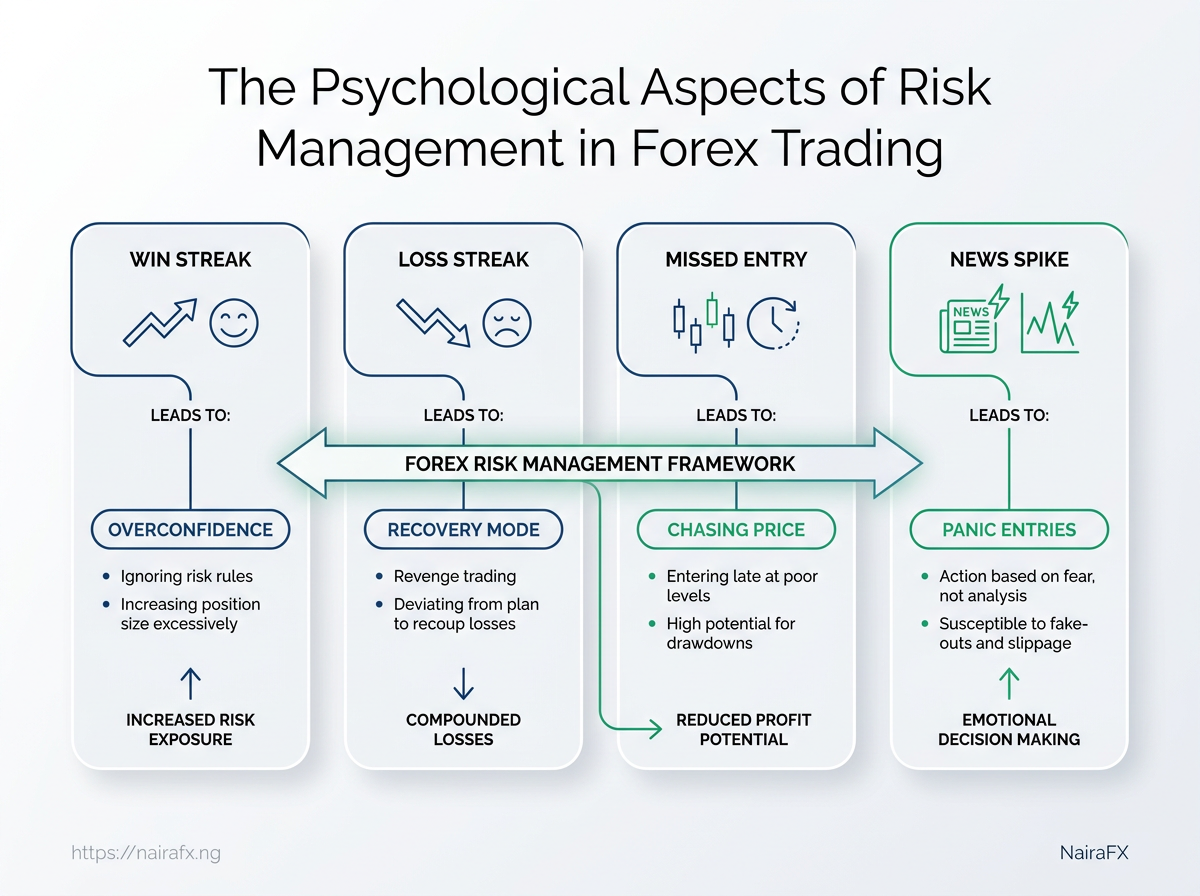
Emotional mistakes that quietly damage risk control
When a trade goes off-script, you might change your plan—such as exit logic, position size, or entry timing—seeking immediate relief.
To handle these impulsive changes, use the ‘pause first’ rule.
When feeling the urge to modify, immediately halt any potential changes.
This rule serves as a critical boundary check before altering any decisions.
Assess the situation: categorize your urge to modify into one of the following groups: stop/exit edits, size/risk edits, timing/entry edits, or conditions edits.
Each category should guide your management strategy.
If any proposed change would violate your pre-approved logic, resist the temptation to edit.
Instead, return to your established criteria and exit or wait for the market conditions to align with your plan.
> Key Takeaway:
> Key Takeaway: ## A trader story that shows how one bad decision grows
A short story: how one small loss became a permission slip to edit
Fear showed up first—not as panic, but as a personal sting.Step 1 —…
> Key Takeaway: ## A trader story that shows how one bad decision grows
A short story: how one small loss became a permission slip to edit
Fear showed up first—not as panic, but as a personal sting.Step 1 — Fear: after a small loss, the trader decided the stop…
A trader story that shows how one bad decision grows
A short story: how one small loss became a permission slip to edit
Fear showed up first—not as panic, but as a personal sting.Step 1 — Fear: after a small loss, the trader decided the stop felt “unfair” and mentally searched for more room.
Step 2 — Impatience: price didn’t move immediately, so the trader shortened the waiting time between signals—then tried to “solve” uncertainty by acting faster than the setup required.
Step 3 — Poor lot sizing: instead of accepting a controlled loss and moving on, the trader increased exposure so the trade would feel worth the wait.
The market didn’t have to be ‘wrong’—the risk behavior was.
At first, the direction still looked acceptable.
But the moment exit logic and position sizing stopped matching what was approved before entry, the trade stopped being governed by risk control.
What changed when the trader adopted a pre-trade rule set
The fix wasn’t learning new emotions. It was creating a system that makes emotional edits hard to justify:- Lot size became a math rule, not a mood rule. If the pre-trade risk amount stayed the same, the size could not change just because the trader felt uneasy.
- Stop logic became an approval rule. If widening/adjusting the stop would be required to ‘make the trade work,’ the trade was treated as a no-go, not a rescue mission.
- Entry timing was restricted to the setup window. If urgency tempted the trader to re-enter outside the approved conditions, the correct response was to wait—not to rewrite the conditions.
The trader’s key realization: plan drift usually starts as a ‘feels like’ decision (fear), then turns into ‘do it now’ behavior (impatience), and ends as a silent risk change (lot sizing).
When the pre-trade rules remove discretion from those three steps, the urge has nowhere to convert into risk.
That’s how one small loss stopped becoming permission to edit—and started becoming the signal to follow the process the trader already agreed to.
What the psychology of risk really looks like in daily trading
Understanding the real psychological aspects of trading risk involves more than just post-entry reflections.
It requires prep work and a mindset that considers loss management before ever placing the trade.
Strong traders identify the emotional and psychological triggers that affect their decisions ahead of time.
Rather than simply waiting for a stop-loss to be hit, they analyze their comfort levels about uncertainty prior to execution.
Emotional clarity in decision-making
Trading stress can manifest just before an order is executed, highlighting the need for self-awareness.
Successful traders start with established criteria and reassess them with each new setup, possibly re-evaluating their willingness to adapt to changing market conditions or unexpected volatility.
The reality of stop-loss assessments
Not only is a stop-loss a strategic number, but it also reflects your psychological limits.
Adjusting stops based on emotional responses often leads to greater trading failures, indicating that traders must train themselves to accept their pre-defined parameters instead of letting panic dictate their actions.
Building resilience through loss management
Managing losses actively can set a tone for future trades.
By absorbing small losses consistently, traders can avoid the emotional compulsion to override their plans.
Understanding the rationale behind one’s entry and exit criteria becomes pivotal.
It’s a practice that refines discipline and resolves internal conflicts, helping maintain focus amidst market noise.
Weekly habit for emotional monitoring
Instead of merely executing trades, traders should establish a review process where they regularly articulate and assess their emotional state pre-trade to strengthen their resilience against irrational decisions.
Practical habits that support a better Forex trader mindset
The goal isn’t to force yourself to “feel calm.” The goal is to keep emotion from quietly taking control of your risk.A stronger mindset forms when your decisions are boundary-based: you know what you’re allowed to do before the moment arrives.
A quick pre-trade calibration (before the order is sent)
Right before entry, run a fast check that helps you spot the likely behavior you’ll regret later: 1) Label your state (one word): calm, impatient, angry, excited, tired. 2) Predict the pressure move: What will your hands want to do if the trade struggles right away (widen the stop, add size, enter late, or ignore liquidity/spread concerns)? 3) Choose the go/no-go outcome:- If you expect yourself to override risk, don’t try to manage the override with improvisation—wait for conditions that match your rules.
- If you expect yourself to follow the plan, proceed using the parameters you approved.
Journaling to catch repeat psychological mistakes
A journal shouldn’t only record outcomes. It should record the psychology pattern so you can stop the next override earlier.After each trade, capture:
- Pre-trade emotion label (the one-word state you wrote down before entry)
- Setup trigger adherence: did it start for the right reason?
- Override type (pick one):
- Stop override
- Size override
- Entry-timing override
- Conditions override (spread/liquidity/volatility ignored)
- Intent vs action: what you wanted to do (e.g., “give it more room”), and what you actually did (keep plan vs step outside it)
Review weekly.
The value isn’t self-blame—it’s pattern recognition: you’re training your ‘signal’ for overrides so your next decision stays automated in the right direction.
What disciplined traders do when emotions rise
After a losing week, disciplined traders don’t just grit their teeth.
They protect the quality of their decisions by pausing actions until they regain control.
The losing-week reset: pause → audit → earn permission
Consider this a gatekeeping routine: pause any impulsive trades, then check if you’re sticking to your plan instead of reacting to recovery urges.
1) Cooldown (break the impulse loop) After the next losing close—or as soon as you notice “I need to fix it now”—stop placing new orders for a set pause.
2) Compliance audit (where did the drift start?) Answer these, focusing on the pattern, not the outcome:
- Exposure drift: Did you change size beyond what you pre-approved?
- Decision drift: Did you change why/when you entered (or why you would exit) because you were anxious to feel better?
- Execution drift: Did spreads/liquidity become materially worse than what your plan could realistically handle?
If you find drift, you don’t “manage harder”—you extend the cooldown until the reason is clear.
3) Resume criteria (only trade when your plan is still the plan) Before the next order, confirm you can state:
- the exact setup trigger you’re acting on,
- the worst-case outcome you already designed for (without needing recovery behavior),
- and whether execution conditions are still in-bounds.
Mini-case (Abuja)
A trader in Abuja notices that after a losing week they start averaging down because price “looks close.” They pause, cut risk back to the level they started with, and refuse any add-on that would require changing their risk behavior. If the audit shows more than one rule drift, they stop for the day.Key difference: the reset isn’t about feeling better—it’s about earning the right to trade with clean decision boundaries.
Frequently Asked Questions
What is the “3-5-7 rule” in risk management/Forex?
It’s a clear pause-and-check process when you feel the urge to change your risk.- 3: Pause placing new trades while the impulse is active.
- 5: Confirm the trade still matches your pre-set entry/exit logic (invalidation + timing).
- 7: Only trade again if execution conditions are still compatible with your plan (spreads/liquidity) and you’re not acting from recovery.
What is the most common psychological mistake among traders?
Trying to erase a loss by changing risk behavior—widening stops, increasing size, or entering late/early because urgency feels justified.What are the “4 fears” of trading?
Fear, Greed, Regret, and Hope are the most common emotional drivers behind “wrong edits.” When one of them pushes you toward the modify button, apply your pre-trade boundaries: would this change violate your invalidation logic, approved risk amount, or entry timing?Conclusion
In Forex, risk management becomes psychological the moment the urge to “fix” a position replaces your original decision process—usually through changes to stops, position size, or timing.The solution isn’t about forcing calm during the moment; it’s about creating a process that prevents emotional impulses from easily changing the rules.
When you consistently follow your pre-trade process and only act when your setup is truly still valid, small losses remain small—because you stop the “permission slip” behavior that grows one bad decision into a pattern.