

A crowded trade book can look busy and still be fragile.
One sharp dollar move, one oil shock, or one surprise policy headline can pressure every position at once.
That is where diversification in trading stops being a buzzword and starts protecting capital.
In forex, it is not about scattering money across more pairs and hoping for the best.
Real Forex diversification strategies reduce exposure to the same driver, so one bad theme does not control the whole account.
That matters even more for Nigerian traders.
The naira can react quickly to dollar demand, local policy shifts, and wider market stress, which means concentration can turn one mistake into several losses at once.
Risk reduction in Forex works best when it is tied to structure, not emotion.
A trader who holds several pairs but all of them depend on the same USD move is still carrying one big risk, just in different clothes.
The smarter habit is to think in clusters, not symbols.
When positions share the same force behind them, they should be treated like one exposure, because the market rarely gives separate warnings before it moves against them.
Quick Answer: Diversification in forex risk management means reducing concentration by spreading exposure across different underlying “drivers,” so one USD shock, oil move, or policy headline can’t dominate your whole book. Instead of adding more pairs, treat correlated positions as one risk cluster and cap the cluster’s total loss before entry, typically using a 0.5%–2% per-trade risk plan. This is especially important for Nigerian traders exposed to fast naira and dollar-driven moves.
A single trade should never have the power to wreck your mood, your account, and the next three decisions.
In forex, the usual problem isn’t that each trade is “bad.” It’s that several trades can be correct on their own and still be wrong together—because they’re reacting to the same underlying move.
That’s what diversification in forex risk management really means: you’re not spreading tickets, you’re separating exposures.
Start by asking what risk you actually own
Before you enter, answer one question for every setup:What driver is likely to move the pair?
- USD strength/weakness
- oil and commodity risk
- global risk sentiment (risk-on vs risk-off)
- local policy/liquidity conditions (Nigeria-specific volatility)
Then do the overlap audit:
- Map each position to its driver.
- Sum the drivers, not the symbols.
- Cap the driver’s total loss before entry.
If EUR/GBP is trending and you also hold EUR/USD, you can still be concentrated if both positions are largely responding to the same macro impulse (for example, broader EUR reaction to USD momentum). Price labels may look different; the exposure can be the same.
In our diversification approach, you treat overlap like one decision you already made—so your risk limit applies to the cluster.
If you want a quick implementation step, use this 2-minute check:
- Label the main mover (USD / oil / risk sentiment / local headline).
- Group all open trades by that label.
- Cut or resize any group whose total risk violates your plan.
In Nigeria, this discipline matters even more because naira and USD dynamics can reprice quickly—turning “three setups” into “one exposure” faster than most traders expect.
For a tighter position-control mindset, this logic sits alongside your stop-loss rules, lot-size limits, and your discipline framework—so your account survives the headline and your decisions stay consistent.
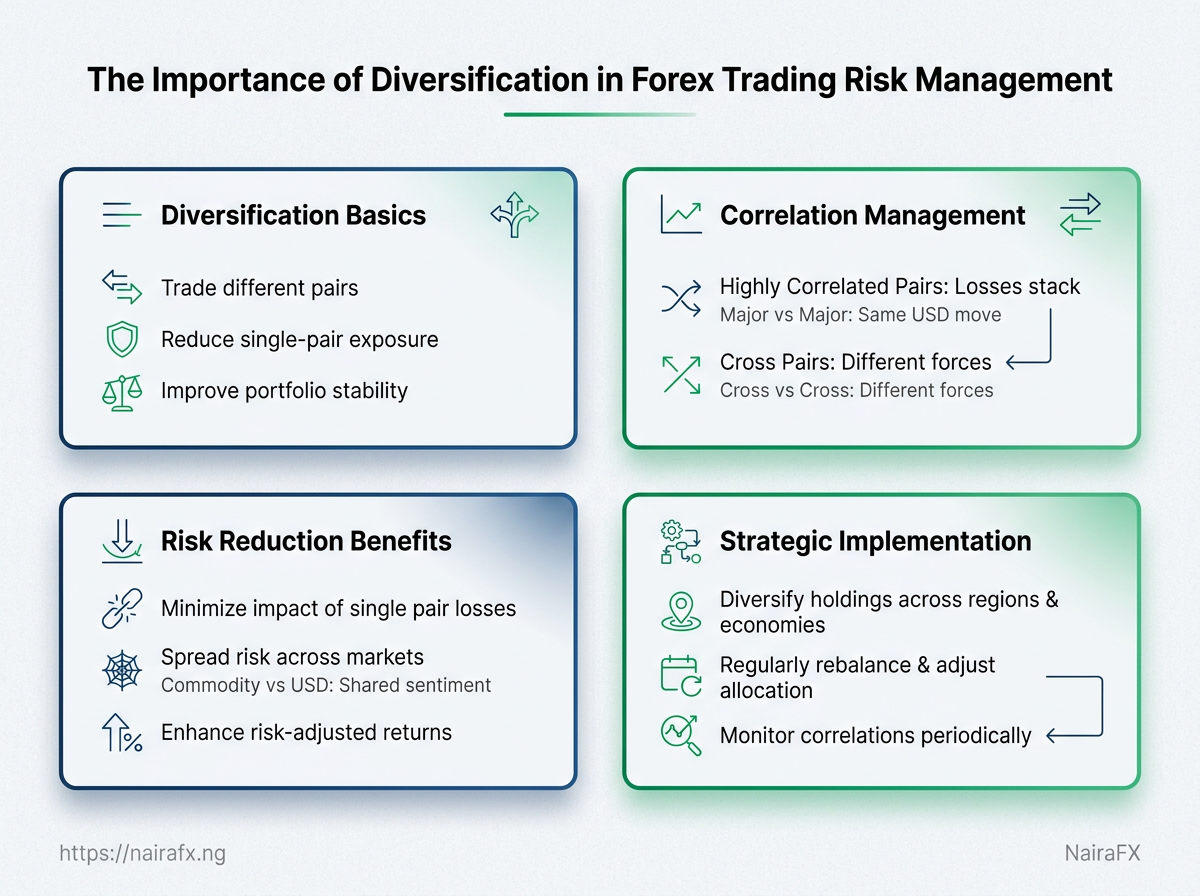
A strong claim: most account damage comes from overconfidence, not bad luck
A trader can be right on three positions and still hurt the account in one session.
That usually happens when the trades are cousins, not strangers.
Overconfidence shows up in small, familiar ways.
It looks like adding another EUR/USD-style trade because the first one “feels safe,” or treating two USD-heavy positions as separate risks when they share the same driver.
The danger is simple: the market does not care how many tickets you opened.
If the same currency story turns against you, the loss arrives across the whole cluster at once.
How correlated currency pairs can quietly double your risk
| Pair type | Typical relationship | Risk implication | Better diversification choice |
|---|---|---|---|
| Major vs major | EUR/USD and GBP/USD often react to the same USD move | Two trades can behave like one larger dollar bet | Pair one with a cross like EUR/GBP or USD/JPY |
| Commodity pair vs USD pair | AUD/USD and NZD/USD often share risk sentiment and dollar direction | One risk-off shock can pressure both positions | Mix with a less linked cross or a different regional driver |
| Cross pair vs cross pair | EUR/GBP and EUR/JPY may share one currency leg but react to different forces | Overlap is lower than majors, but it still exists | Use pairs with different base and quote drivers |
| Highly correlated pairs | EUR/USD, GBP/USD, AUD/USD, and NZD/USD often move in the same broad USD pattern | Losses can stack fast if the dollar turns | Keep total cluster risk inside one plan |
| Low-correlation pairs | EUR/GBP, USD/JPY, USD/CHF, and CAD/JPY often follow different central-bank or regional themes | Shared downside is lower, so the account is less fragile | Use these when you need cleaner diversification in trading |
In practice, diversification in trading works best when you track the shared driver first and the pair second.
A quick check helps.
If two trades win or lose for the same reason, they are not truly separate.
- Same currency leg: If both trades depend on USD strength or weakness, count them together.
- Same market story: Oil shocks, risk-off flows, or policy surprises can hit more than one pair at once.
- Same direction: Two longs that rise together are usually one exposure in disguise.
- Same session risk: London or New York volatility can widen spreads and move linked pairs together.
That habit turns Forex diversification strategies into real risk reduction in Forex, not just a longer trade list.
Spot the overlap early, and overconfidence loses its favorite hiding place.
A U.S. news surprise can hit multiple charts at once—especially when you’re holding several “different” setups that are actually driven by the same macro impulse.
When that impulse shifts, the trade screens may look separate, but the risk behaves like a single position.
Think in terms of exposure buckets (not charts)
A helpful mental model is to create exposure buckets based on drivers.- If several trades respond mainly to the same macro headline (e.g., USD repricing around a major data release), they belong in one bucket.
- If they respond to different drivers, they can be treated as separate buckets.
Then you apply limits to the bucket’s combined risk, not just to each trade’s individual size.
Safer trade combinations that hold up better
| Do | Don’t | Why it matters | Trader takeaway |
|---|---|---|---|
| Mix pair types | Hold only one currency theme | Different pair structures often react to different drivers | Pair a USD-sensitive setup with a cross that’s less dependent on the same immediate driver (e.g., consider a EUR/GBP-style exposure alongside a USD theme). |
| Treat similar setups as one idea | Stack trades that are really the same macro bet | Overlap makes losses arrive together | If the “reason” for both trades is the same macro impulse, resize them as one bucket. |
| Limit exposure per theme | Let one macro story dominate the account | One shock can propagate across positions | Cap total bucket risk (not just single-entry risk) before you enter. |
| Check driver overlap before entry | Assume different symbols = different risk | Correlation can be hidden by chart appearance | Confirm the mover for each trade; then group by mover. |
| Track open risk as a running total | Judge each trade in isolation | Live positions add up quickly | Keep a simple “bucket risk total” so you don’t accidentally compound exposure. |
| Add trades with a real reason | Add random positions to feel diversified | Random entries rarely reduce true concentration | Every additional trade should introduce a different driver, or you’re just adding noise. |
A book that looks active during news can still be fragile—because the real question is whether the same impulse can harm multiple positions at once.
That’s the practical side of forex diversification strategies: align your trade plan to drivers, then design your risk limits to survive the headline.
Surprising stat: a small account can still survive volatile markets with the right spread of risk
A small account does not need heroic position sizes to survive sharp market moves.
In 2026, many traders still keep per-trade risk around 0.5% to 2%, because smaller losses are easier to absorb and easier to think through.
That matters because position sizing supports diversification; it does not replace it.
A compact account with three unrelated exposures can handle stress better than a larger account packed into one USD-driven theme, especially when spreads widen around news and market open or close.
Time matters almost as much as pair choice.
A setup taken during the London session, from 8:00 AM to 4:00 PM WAT, faces a very different market mood from one taken late in New York, from 2:00 PM to 10:00 PM WAT.
A simple balance template
Use pair, session, and setup as separate checks.
If all three point to the same driver, the account is not really diversified, even if the symbols look different.
| Bucket | Simple rule | Why it helps |
|---|---|---|
| Pairs | Keep the same driver cluster to one or two trades | Cuts overlap from hidden correlation |
| Sessions | Split entries across London and New York only when setup quality holds | Reduces timing risk from one burst of volatility |
| Setups | Stick to tested setups, not random ideas | Keeps one pattern from dominating results |
It keeps the screen cleaner and makes diversification in trading easier to judge at a glance.
- Label each trade by its main driver.
- Check whether the entry shares the same session pressure.
- Cut size if two trades lean on the same theme.
That is where real risk reduction in Forex starts.
It is not about scattering trades everywhere; it is about making sure one shock cannot hit the whole account at once.
That discipline sits at the center of how we think about diversification for Nigerian traders, and it keeps a small account far more durable than size alone ever could.
More positions do not automatically mean more safety.
It’s possible to hold five pairs and still be exposed to one dominant macro move. It’s also possible to hold three pairs and be meaningfully diversified—if those trades respond to different drivers.
Picture two traders during a sharp naira move:
- Trader A adds more USD-exposed positions and spreads them across different symbols.
- Trader B checks what actually drives those positions and limits the combined risk of the shared exposure.
Two traders, same market, different outcomes
The undiversified approach usually mistakes variety for balance.The diversified approach asks: If the market shocks one driver, which parts of my book are likely to react the same way?
Here’s a simple decision worksheet you can run on your open positions:
- Name the driver for each trade (USD repricing, oil/commodity shock, risk sentiment shift, or local policy/liquidity).
- Group by driver—not by chart.
- Cap each group’s total loss using your predefined risk plan.
If two positions share the same driver bucket, treat them as one exposure—even if they’re different pairs.
Why Nigeria makes this matter more
Naira-driven volatility, oil-linked shocks, and sudden USD demand can create fast repricing across multiple instruments at once.So traders in Nigeria should treat “multiple setups” with caution when the setups are actually responding to the same headline stream.
When you build your risk plan around driver separation, you don’t just reduce drawdown—you protect your decision-making under stress. A trader who catches concentration early usually trades calmer later.
What is the diversification strategy for 2026?
Use diversification by reducing concentration around shared “driver clusters” so one USD shock, oil move, or policy headline can’t dominate your whole forex book. In 2026, traders typically manage this with per-trade risk around 0.5% to 2%, and they cap the total loss for each correlated cluster before entering trades.
What is the 3-5-7 rule in forex?
The 3-5-7 rule is a risk-limiting framework that sets stop-loss style limits at three levels: 3% maximum loss per trade, 5% maximum loss per day, and 7% maximum loss per week. It helps you avoid overextending after a correlated move hits multiple positions at once.
What should my investment strategy be for 2026?
Build a forex strategy around structure, not emotion: diversify by treating correlated positions as one risk cluster and cap the cluster’s total loss before you trade. Keep individual trade risk in a controlled band (commonly 0.5% to 2%) so smaller losses are easier to absorb when spreads widen around news and market open.
What sectors will outperform in 2026?
No diversification strategy can guarantee which sectors will outperform in 2026, because performance depends on the prevailing macro regime. What you can control is risk concentration: avoid betting everything on one theme by spreading exposure across different underlying drivers, so one shock doesn’t spill into the entire portfolio.
What is the 3 5 7 rule in forex?
The 3-5-7 rule in forex limits losses in a tiered way: 3% per trade, 5% per day, and 7% per week. This directly supports diversification and risk management by preventing a single correlated market move from causing runaway drawdowns across multiple positions.
What matters most isn’t how many trades you hold.
It’s whether your positions can be harmed by the same shock at the same time.
The trader who lost three setups to one news event didn’t fail because of bad entries alone—they failed because the book wasn’t separated by exposure.
For forex diversification strategies in Nigeria, that means pressure from naira moves, policy headlines, and dollar swings must be treated as potential “shared shocks,” not separate events.
Your one-question pressure test (today)
Review every open position and ask:If one major macro event hit tomorrow, which driver buckets would take the hit?
If most of your book belongs to the same bucket, you don’t need more trades—you need better separation (different drivers) or tighter bucket-level limits.
If you want the deeper checklist behind this pressure test, use your risk management and equity-curve review resources to evaluate bucket risk, stop placement logic, and consistency under volatility.