
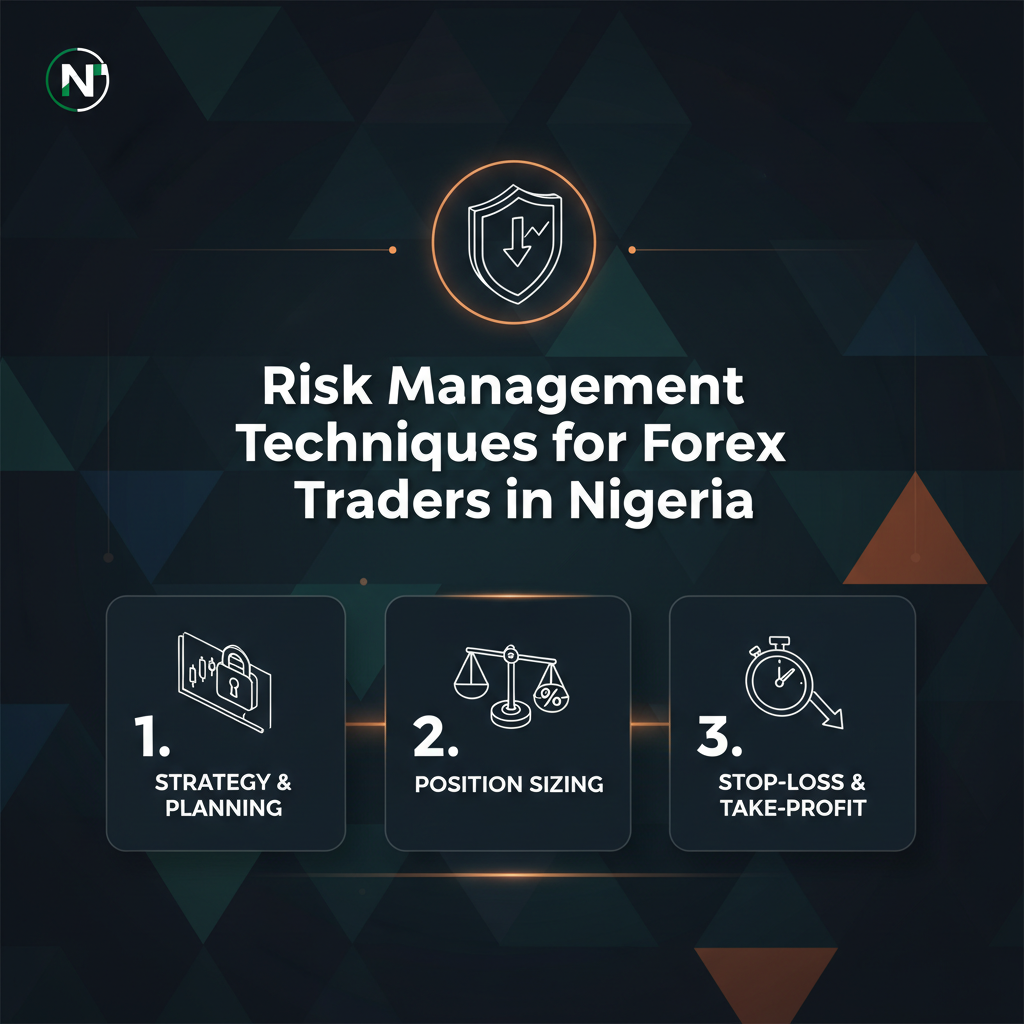
A profitable setup can still wreck an account if one trade is too large.
That is the part many new forex traders in Nigeria learn the hard way.
Risk management is what keeps a rough week from becoming a wiped-out account.
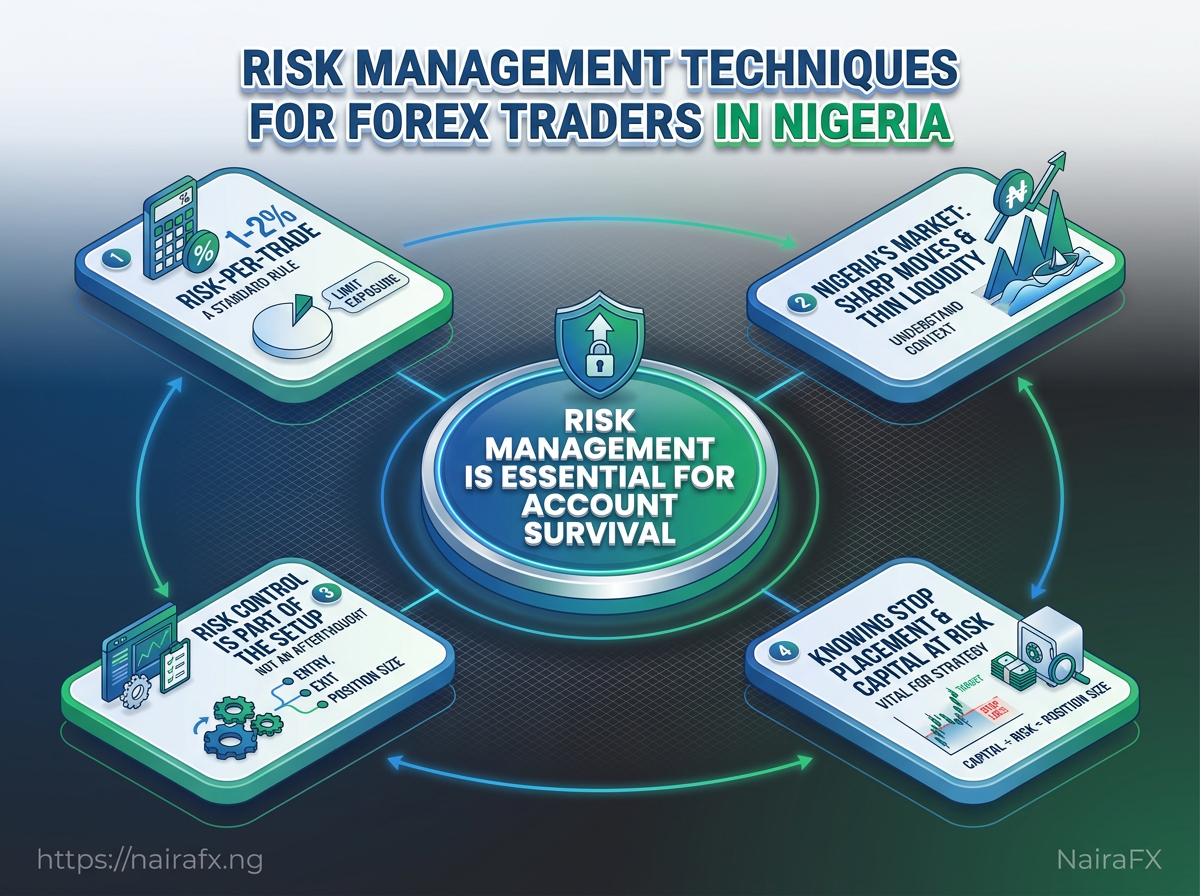
According to Risk Management Rules Every Trader Must Follow in 2026, the 1–2% risk-per-trade rule is still the standard in 2026, because it limits damage when losses come in a streak.
That matters even more in Nigeria, where sharp currency moves, spread changes, and thin liquidity can turn a decent idea into a messy trade.
Strong forex risk strategies are not about fear; they are about staying in the game long enough for skill to matter.
The traders who last usually treat trading risk control as part of the setup, not an afterthought.
They know where the stop belongs, how much capital is actually at risk, and when to stay flat instead of forcing a trade.
Quick Answer: Start with two rules: decide what you can lose, and make sure your order can realistically get filled. 1) Size the trade from your invalidation point – Pre-define your maximum loss for the day and per trade. – Calculate lot size from the stop-loss distance (so the loss is controlled even if Nigeria’s spreads or momentum get messy). 2) Validate execution before you place the order – Check spread widening and likely slippage windows (especially around major releases and fast session moves). – Confirm your broker/platform behavior is stable during volatile hours (fills, stop behavior, and delays). 3) Place exits to match your plan (not your emotions) – Use stop-loss as “idea is no longer valid,” and take-profit at a realistic stall/target. – Set session guardrails to prevent overtrading after wins or losses. 4) Reassess quickly after the trade – Log whether the outcome broke your rules or whether execution/spreads/liquidity distorted the result. That’s the Nigeria-focused flow: risk first, execution second, exits third—so one rough move doesn’t turn into a rough month.
In Nigeria’s forex market, one trade can erase a week—not because the idea was impossible, but because local conditions can turn a “reasonable” setup into an outsized loss.
A trader can be directionally correct and still lose badly when the position is too large, the stop is placed in a spot that won’t survive typical spikes, or execution worsens during volatile windows.
At NairaFX, we often see this pattern: traders spend most of their effort on entries, then rely on hope when spreads widen, price jumps on news, or liquidity thins out at busy hours.
Here’s the Nigerian reality: fixed risk isn’t just a theory—it’s what you use to survive unexpected movement. Many traders cap risk per trade at a small, fixed fraction of the account (often around 1–2%) so that even a streak of bad outcomes can’t wipe out the account.
Nigeria adds extra “noise” you can’t ignore:
- naira-driven swings that distort how quickly price travels to your stop
- policy and macro surprises that change volatility without warning
- broker differences that affect fills, slippage, and spread stability
That’s why the most practical forex risk strategies for Nigeria focus on two things: (1) sizing your position to the stop distance you’re actually placing, and (2) placing stops where your plan still makes sense after typical volatility.
Example: if a trader sizes for a calm move but the naira-driven spike creates a fast, stop-through moment, the trade can undo multiple earlier wins. The fix isn’t finding a “perfect” entry—it’s tightening the link between stop distance and position size, so one spike can’t dominate your month.
Strong trading risk control also protects you psychologically. When losses happen within your rules, you’re less likely to chase revenge entries, widen stops “to breathe,” or break the plan after emotions take over.
Bottom line: in Nigeria’s forex market, risk management is what keeps your good ideas from becoming account damage.
A lot of traders lose money not because their direction was wrong, but because their exits and discipline were loose.
One oversized mistake can wipe out the profit from several careful trades—so in this section, focus on how to make stops and targets behave like part of your strategy (not like emergency reactions).
Using stop-loss and take-profit with intention
A stop-loss is not a panic button.It is the price where your trade idea is no longer valid. Your take-profit should match where the market is realistically likely to stall, not just where “it feels like it should reverse.”
| Risk Tool | What It Controls | Best Use Case | Common Mistake | Impact on Capital | |—|—|—|—|—| | Fixed risk per trade | Account exposure on each setup | Consistent strategy execution | Changing risk based on confidence | Protects the account from one bad decision | | Stop-loss order | Maximum loss on a trade | Fast-moving pairs and news-sensitive windows | Placing it too tight for local volatility | Caps damage before it grows | | Take-profit order | Exit point for planned gains | Structured setups with clear targets | Moving it endlessly out of greed | Locks in gains and reduces giveback | | Trailing stop | Profit protection as price moves | Trends with room to run | Setting it too close to normal noise | Preserves gains while leaving upside open | | Hedging | Temporary exposure offset | Specific situations where you must balance risk | Using it as a substitute for invalidation | Can reduce swings, but adds complexity |
The table’s point: each tool has a job. Stops define invalidation; take-profits define what “success” looks like; trailing/hedging should only be used when they support your original thesis.
Overtrading controls that actually work in practice
Overtrading usually starts after emotion takes over.A win can make you reckless; a loss can make you try to force recovery.
Use simple, repeatable guardrails:
- Set a session trade cap: If you already have your best setup, don’t keep clicking.
- Stop after a limit breach: After two consecutive losses (or one max daily drawdown), stand down and reassess.
- Trade only your setup: If it doesn’t match your plan, you’re not “being proactive”—you’re adding risk without a reason.
These forex risk strategies work because they turn risk into a process: define exits up front, follow the plan during volatility, and remove the decision-making load when emotions rise.
Position Sizing, Leverage, and Exposure: The Numbers That Matter
A trade only makes sense when the numbers make sense.
Most traders fixate on entry and exit, then forget the part that actually decides survival: how much of the account is on the line.
The cleanest starting point is still a fixed risk per trade.
In 2026, guidance from Risk Management Rules Every Trader Must Follow in 2026 and Forex Risk Management Tips to Trade Safely in 2026 keeps pointing traders back to the same habit: risk a small slice of the account, then size the position around the stop-loss distance.
The formula is simple: position size = account risk ÷ stop-loss value per unit.
If a $1,000 account risks 1%, the maximum loss is $10.
If the stop is 25 pips away, the lot size must be small enough that a 25-pip loss still lands near that $10 limit.
SIFX’s 2026 position-sizing overview makes the same point from a different angle: the stop distance and the trade size have to fit together.
Leverage is where traders get sloppy.
A broker may let a small deposit control a much larger position, but that extra buying power cuts both ways.
A $1,000 account using 30:1 exposure is effectively controlling $30,000 of market value, so a modest move can turn into a painful account swing very quickly.
A simple sizing checklist
| Check Item | Yes/No | Why It Matters |
|---|---|---|
| Account risk per trade confirmed | Yes | Keeps one loss from becoming a disaster. |
| Stop-loss level set | Yes | Defines the exact money at risk. |
| Lot size calculated | Yes | Matches the trade size to the stop. |
| Maximum daily loss noted | Yes | Stops a bad session from snowballing. |
| Trade fits the plan | Yes | Prevents random entries and impulse trades. |
RealTrading’s forex risk management guide treats position sizing as a decision process, and that mindset matters more than any fancy indicator.
Use the same numbers every time.
That steady habit keeps trading risk control grounded in facts instead of adrenaline, which is where forex risk strategies either hold up or fall apart.
Why do some trades look perfect on paper and still go sideways in Nigeria? Usually, the problem is not the setup.
It is the market conditions around the setup.
Currency volatility is the first trap.
The naira can move fast, and that can distort how your trade feels even when your analysis is right.
Add news events and liquidity gaps, and price can jump in ways that make tidy charts look careless.
Where the pressure starts
Risk does not appear at entry alone.
It creeps in before the trade, during execution, and again when you try to exit.
A simple way to think about it is that every trade has three weak spots: the market, the broker, and the platform.
That is why trading risk control in Nigeria needs more than a stop-loss.
It needs a quick check on whether your broker fills orders cleanly, whether spreads widen around major releases, and whether your platform stays stable when local internet quality gets messy.
According to TradeTaurex’s 2026 forex risk management tips, disciplined traders keep risk structured with stop-loss orders and consistent trade planning.
The same logic matters even more when execution quality is unpredictable.
- Currency volatility: Nigerian traders face faster sentiment shifts when the naira weakens or global dollar demand spikes.
- News events: Central bank decisions, U.S. data releases, and surprise headlines can trigger sharp slippage.
- Liquidity gaps: Thin liquidity can create jumpy prices, especially around market opens or fast-moving sessions.
Broker choice matters more than shiny spreads
A low spread means very little if orders fill badly.
Poor execution can turn a decent plan into a bad entry, and that is where many traders quietly lose edge.
Real Trading’s forex risk management guide and NORDFX’s margin and risk explanation both point to the same practical lesson: execution, margin behavior, and position handling shape real-world results.
In Nigeria, that also means checking regulation, payment reliability, and how the broker behaves during volatile hours.
- Execution quality: Test fills on calm days and news days.
- Platform risk: Watch for disconnects, freeze-ups, and delayed order updates.
- Broker reliability: Check how they handle slippage, withdrawals, and margin calls.
A trader can have a good system and still bleed through bad infrastructure.
That is why we treat broker and platform checks as part of risk management, not admin.
The trade map is simple once you see it.
Risk enters before the order, through the broker while it is live, and through the market when volatility gets ugly.
A repeatable risk control routine is how you stay consistent when the market stops cooperating.
Instead of trying to “trade better” on the fly, you control what you can measure: your maximum loss before entry, your trade management while it’s live, and what you learn after it closes.
Once your max-risk rule is set and your position sizing is calculated from your stop distance, the routine becomes the system that protects it.
A simple three-pass routine
- Before the trade: Confirm the setup conditions are met, define your invalidation point (your stop), and verify the execution context. In Nigeria, that means a quick check for: spread expansion around major releases, likely slippage windows, and whether your broker/terminal has been reliable during volatile hours. Then calculate the position size from the planned stop distance (using the same method every time).
- During the trade: Manage according to the plan only. Don’t move the stop just because price is fluctuating—unless your invalidation level is reached or your thesis is truly broken. If the market is volatile, focus on whether your execution is matching your plan (fills, slippage, and stop behavior).
- After the trade: Log the outcome and label what happened truthfully: Was the trade executed well even if it lost? Or did execution/spread/slippage turn a valid idea into a poor result? This is how you separate strategy issues from execution issues.
A monthly performance review table for traders
A monthly scorecard makes the routine real.It also prevents one number—like win rate—from fooling you. You can win often and still lose money if losses are systematically bigger than planned or if your risk-to-reward is too weak.
| Metric | Target | Current Result | What It Tells You |
|---|---|---|---|
| Win rate | 45%–55% | 48% | The strategy is landing often enough to stay viable. |
| Average risk-to-reward ratio | At least 1.5:1 | 1.7:1 | Winners are paying more than losers cost. |
| Maximum drawdown | Below 10% | 7.4% | The account is staying within a tolerable damage zone. |
| Number of trades | 15–30 per month | 22 | The sample is large enough to judge process quality. |
| Average loss per trade | No more than planned risk | 0.96R | Losses remain aligned to your rule, not your emotions. |
- If drawdown rises while win rate stays flat, you likely have a stop-placement or trade-selection problem.
- If risk-to-reward slips, your exits/targets probably need tightening.
- If losses spike around certain news/withdrawal/spread conditions, your execution risk handling needs improvement.
That’s how risk strategies become repeatable: your process stays consistent, and your results become diagnosable.
The sharpest “edge” in forex isn’t a better entry—it’s preventing one trade from damaging your future.
If you remember one thing from this guide, make it this: your risk controls should be set before you trade, then verified again through execution, not adjusted mid-chaos.
Before your next trade:
- Confirm your position sizing matches your planned invalidation (stop-loss) and your max loss limits.
- Check that spreads/liquidity and your broker/platform are likely to behave well enough for your stop and target to work as intended.
- Follow the repeatable routine: plan → execute within the plan → review the result to separate strategy issues from execution issues.
When you protect capital consistently, your strategy has a fair chance to show whether it truly works.