
Why does a trade that looks perfect on the chart still damage an account so fast? The answer is usually not the entry.
It is the missing guardrails around the trade.
Forex risk management tools exist for that exact reason.
They do not predict the market, and they do not turn bad setups into good ones.
They help control the damage when price slips, spreads widen, or a volatile move hits before a stop can do its job.
That is where Forex risk assessment becomes practical rather than abstract.
A trader who knows the account size, stop distance, and position size is already ahead of the trader who is guessing.
The best trading tools for risk management make that process faster, clearer, and harder to ignore when emotions start pushing for “one more lot.”
A common mistake is treating risk control like a last-minute check.
In reality, it is part of every decision, from the pair chosen to the amount placed on the line.
In fast-moving markets, that habit can be the difference between a manageable loss and a wiped-out week.
Quick Answer: Forex risk management tools protect your account by enforcing trade guardrails—position sizing, stop placement, and spread/slippage checks—so a setup only risks an amount you can survive even during volatile spikes. For example, when spreads widen or liquidity thins, a “good” entry can become a bad one before your stop works, which is why risk assessment must include entry costs and market conditions, not prediction. Done correctly, this turns “one more lot” impulse into controlled, pre-defined maximum loss.
What happens when a trade goes wrong and you have no risk plan?
Have you ever watched a clean setup turn ugly in seconds? That is where discipline gets tested, and where a weak plan starts to hurt fast.
Without Forex risk management tools, one bad entry can do more damage than three good trades can repair.
A stop loss sits too wide, position size runs too large, and the market does what it always does: it moves without asking permission.
For Nigerian traders, that pressure shows up even faster.
A widening spread on a news spike, thin liquidity outside active sessions, or a sharp naira move can turn a manageable idea into a painful loss before you can react.
A solid Forex risk assessment is not about predicting every move.
It is about checking whether the trade still makes sense after costs, volatility, and account risk are all put on the table.
- Position size: Match lot size to account size, so one loss does not wreck the week.
- Stop placement: Set an exit where the trade idea fails, not where fear feels comfortable.
- Spread and slippage check: Confirm that entry costs are small enough to keep the setup valid.
- Market condition scan: Ask whether the pair is calm, noisy, or reacting to news right now.
When that process is missing, trading tools for risk management stop being optional and start becoming damage control.
A trader may keep clicking entries, but every trade carries hidden stress, and that stress usually shows up in the equity curve.
Picture a GBP/USD trade opened during a fast London move.
If the spread widens and price slips through the stop, the loss is often larger than planned, and the next decision gets worse because emotion takes over.
That is why the real job of risk checks is simple: protect the account first, then let the setup breathe.
Strong risk habits do not remove losing trades, but they make sure one loss stays just a loss.
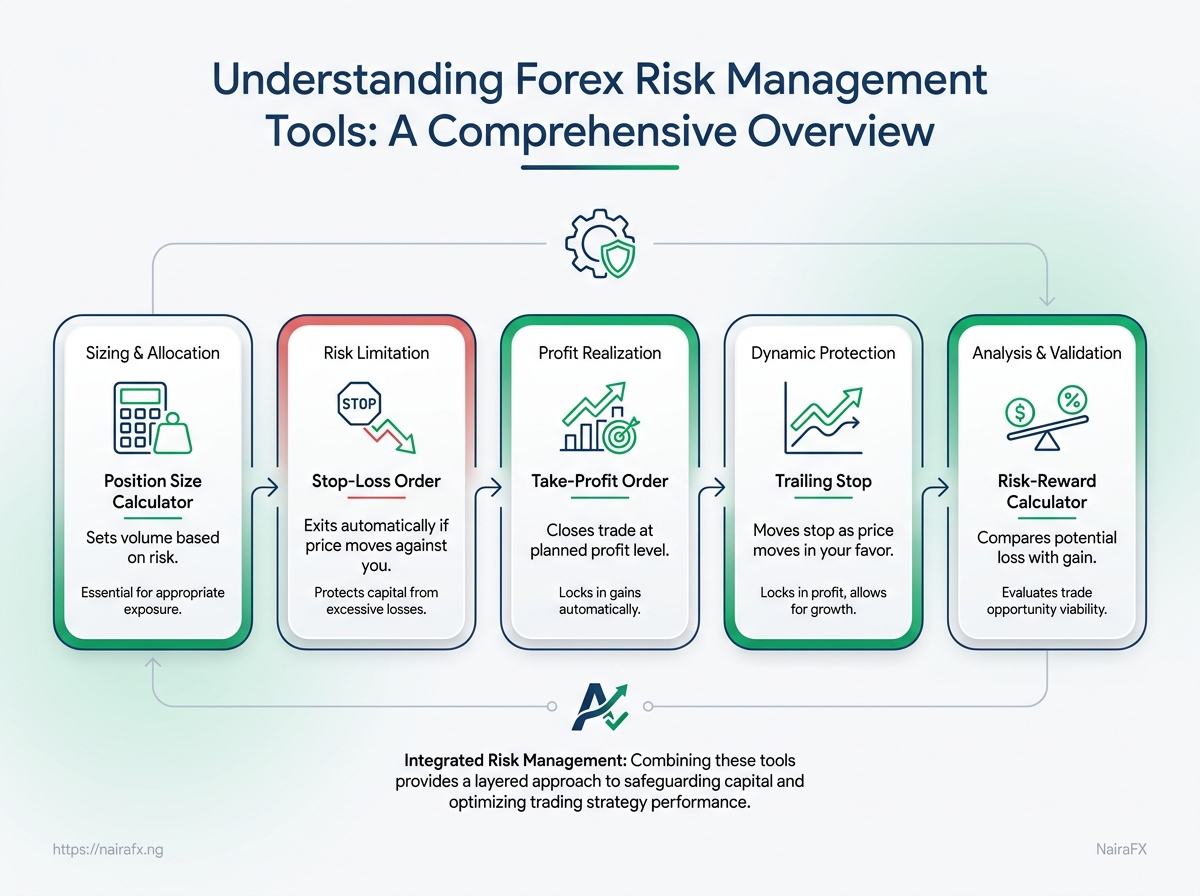
The tools that quietly protect your trading capital
What actually keeps a trade from becoming a disaster when the market snaps back?
The answer is rarely one magic rule.
It is usually a small set of Forex risk management tools working together before the order ever hits the market.
A position size calculator keeps every trade tied to the same dollar risk, even when the pair, stop distance, or account size changes.
A stop-loss order acts like a hard exit when price proves you wrong.
A take-profit order locks in a planned exit so winners do not turn into givebacks.
That mix matters because traders often focus on entry quality and forget the exit math.
Our team has seen the same pattern again and again: the chart looks clean, but the trade sizing is too large for the account.
One bad idea then does far more damage than it should.
Trade protection tools and what each one does
| Tool | Main purpose | Best use case | Risk controlled | Common mistake |
|---|---|---|---|---|
| Position size calculator | Sets trade volume based on account size and stop distance | Before every new trade | Oversized losses | Choosing lot size by gut feeling |
| Stop-loss order | Exits automatically if price moves against you | Any trade with a clear invalidation level | Large drawdowns | Placing it too tight around normal volatility |
| Take-profit order | Closes the trade at a planned profit level | Setups with a defined target zone | Reversals after gains | Setting a target that ignores market structure |
| Trailing stop | Moves the stop as price moves in your favor | Strong trends and breakout trades | Giving back too much profit | Using it in choppy markets where price whips around |
| Risk-reward calculator | Compares potential loss with potential gain | Before entering any discretionary setup | Bad trade selection | Taking trades with weak upside compared with downside |
If a trader risks 1% on every setup, the position size calculator keeps that risk steady even when one stop is 20 pips and another is 60 pips.
That consistency is the real value of trading tools for risk management.
The tools do not predict direction, but they make each decision easier to judge through a clean Forex risk assessment.
Good traders do not ask, “Can this trade win?” They also ask whether the stop is sensible, the target is worth the risk, and the size fits the account.
That discipline protects capital long after the entry excitement fades.
A quick story: how one simple check can change a trader’s outcome
A trader in Lagos kept getting hit by the same problem: one bad entry would turn into an oversized loss before he could react.
His charts were fine.
His idea was fine.
The damage came from a habit he barely noticed, which was entering too fast when a setup looked “obvious.”
He changed one thing: before every trade, he checked whether the position size matched the account risk.
That single pause did more for his results than any new indicator ever had.
The habit worked because it forced a real Forex risk assessment instead of a hopeful guess.
He stopped treating every setup like a must-trade moment and started treating it like a decision.
A simple three-check routine does the same job.
- Check the risk in cash terms.
If the number feels too large, the trade is too large.
- Check the market conditions.
A good setup can still be a poor trade when conditions are messy.
- Check the exit before the entry.
If that level is unclear, the setup is not ready.
That routine is one of the most practical trading tools for risk management because it slows impulse down just enough to matter.
A trade journal makes this even stronger.
Most traders think journals are for recording wins and losses.
That is too narrow.
The real value is pattern spotting: which setups you chase, which hours hurt you, and how often size creeps up after a loss.
- Entry quality: Did the setup match your rules?
- Position size: Was risk fixed or emotional?
- Exit discipline: Did you follow the plan or improvise?
A journal turns scattered mistakes into clear feedback.
That is why it often beats most Forex risk management tools for long-term improvement.
When a trader can see the same error five times on paper, the fix becomes obvious.
The next trade starts cleaner, and the losses usually get smaller before the wins even improve.
The numbers that reveal whether a risk tool is doing its job
Ever notice how traders can debate entries for hours, yet barely check the numbers that decide survival? That gap is bigger than most people think.
A sharp entry matters, but it only matters inside a risk framework.
Our approach to Forex risk assessment starts with that simple truth: a good setup with poor risk numbers can still drain an account.
The fastest way to test any Forex risk management tools is to ask one question: do they help you measure risk before money is on the line, or only after the loss arrives? If a tool cannot show risk per trade, position size, stop distance, and expected reward, it is not doing much heavy lifting.
- Risk per trade: Keep it fixed in advance, usually as a small slice of equity. If this number moves around emotionally, the tool is failing.
- Stop-loss distance: Measure how much price can move against you before the setup is invalid. A wider stop changes position size, even when the entry looks identical.
- Risk-reward ratio: Compare what you can lose with what you expect to make. A 1:1 setup needs a much higher win rate than a 1:2 setup.
- Maximum drawdown: Watch the worst peak-to-trough slide, not just the last trade. A system that looks fine at 5% drawdown may feel very different at 20%.
- Win rate: Track it with context, not ego. A high win rate means little if average losses are larger than average wins.
- Expectancy: Use
expectancy = (win rate × average win) - (loss rate × average loss)to see whether the edge is real.
The numbers also need to work together, not in isolation.
A 40% win rate can still be healthy if winners are larger than losers, while a 70% win rate can still fail if one loss wipes out many small gains.
That is why the best trading tools for risk management do more than place stops or size positions.
They show how drawdown, win rate, and risk-reward interact across many trades, which is where the real picture appears.
When those three numbers line up, the strategy has room to breathe.
When they clash, the account usually tells the story before the trader does.
The tools traders often ignore until it is too late
The problem is rarely a lack of tools.
It is that many traders only start caring after the account has already taken a hit.
A margin alert does nothing if it is muted.
A news filter does nothing if it is ignored during a major release.
The best Forex risk management tools are usually the dull ones, because they force small decisions before damage grows.
That is why Forex risk assessment should not begin with fancy software or extra indicators.
It starts with simple controls that catch bad exposure early, then a trader still has to act on the warning.
Do versus don’t: using alerts, margin checks, and news filters the right way
| Risk habit | Do | Don’t | Why it matters |
|---|---|---|---|
| Using alerts | Set price, spread, and margin alerts before entry so they trigger action early | Wait for the platform to flash red or for the trade to be under stress | Alerts only help when they arrive before the problem becomes urgent |
| Checking margin | Review free margin and margin level before adding size or a second position | Assume the account can handle more risk because equity looks fine | Margin pressure often appears only after volatility rises |
| Filtering news events | Mark high-impact releases and cut size or stay flat when needed | Trade every release as if spreads and slippage will stay normal | News shocks can turn a clean setup into a poor fill |
| Limiting open trades | Cap total exposure across all pairs, including correlated ones | Treat each trade as separate when they all depend on the same move | Correlation can quietly turn small trades into one big bet |
| Setting drawdown alerts | Use account-level alerts that warn before a daily or weekly limit is hit | Check the balance only after the damage is done | Early warnings create time to stop trading, not chase losses |
| Watching spread spikes | Pause entries when spreads move far beyond normal conditions | Enter at market just because the chart still looks good | Wider spreads raise entry cost and weaken stop placement |
| Reviewing overnight exposure | Reduce weak trades before rollover if the setup is no longer strong | Leave every position open because the stop feels safe | Overnight swaps and gap risk add hidden cost |
| Manual trade review | Confirm the trade idea still makes sense before adding more risk | Let automation keep firing after the market regime has changed | A human check catches context that code can miss |
Alerts, margin tools, and news calendars are best at spotting timing and exposure problems; they are not substitutes for reading the market.
Automation helps most when the rule is clear.
Manual review still matters when liquidity thins, volatility jumps, or a central bank statement changes the mood in minutes.
- Use automation for fixed rules like margin warnings and max loss alerts.
- Keep manual review for news spikes, weekend risk, and thin trading hours.
- Use both together when positions are correlated or held overnight.
- Avoid full automation when the setup depends on context, not just numbers.
Good tools reduce surprises.
They do not excuse weak habits.
The traders who last are usually the ones who treat these controls as a guardrail, not a crutch.
A trading day scenario that shows how the toolkit fits together
Picture a trader watching the market during a fast-moving session, with price jumping harder than usual after a fresh news release.
The setup still looks valid, but the candles are wider, the spread is moving around, and the usual entry feels far less forgiving.
That is where Forex risk management tools stop being theory and start shaping every decision.
A good plan does not begin with the entry alone.
It begins with the market context, the amount at risk, and the distance that price needs to breathe.
Imagine a trader who wants a long position, but the session is noisy and liquidity is uneven.
Position size has to come down, because the same stop-loss that works in calmer conditions can become too tight once spreads widen.
The trade may still be worth taking, but the structure changes from “push for precision” to “protect room for normal movement.”
That blend of position sizing, stop-loss placement, and market context is what makes trading tools for risk management useful in real life.
They turn a vague idea like “this looks good” into a set of controlled decisions.
- Check the session first: News, overlap hours, and thin liquidity change the whole trade. A setup during a quiet Asian session is not the same as one during a sharp London move.
- Set risk before entry: Define the cash amount at risk, then size the position around it. A wider stop means a smaller lot size, not a bigger gamble.
- Place the stop around structure: Put it beyond the level that should invalidate the idea, not just at an arbitrary number of pips.
- Adjust for spread and slippage: When spreads widen, the real entry cost rises. That means the trading plan needs extra room, or the trade should be skipped.
In a rough market, the best Forex risk assessment is often simple: if the spread eats too much of the edge, the trade is probably not clean enough.
A small delay, a smaller size, or no trade at all can protect a week’s work.
That is the real value of the toolkit.
It keeps the trader focused on survival first, then on opportunity.
What is the 3-5-7 rule in forex?
The 3-5-7 rule in forex is a multi-tier risk-limit framework that caps your maximum allowable loss across different time horizons. It’s designed to act like guardrails—so you stop or reduce size when you’ve already hit your predefined loss limits instead of “one more lot.” Apply it by linking those caps to position sizing and hard stop-loss levels.
What are the risk management tools in forex?
Forex risk management tools protect your account by enforcing trade guardrails before losses grow. The core tools include a position size calculator, stop-loss orders, and take-profit orders, plus checks for spreads and slippage when conditions are volatile. Supporting controls like alerts, margin checks, and news filters also help you catch bad exposure early so you can act fast.
What is the 3 6 9 rule in trading?
The 3-6-9 rule in trading is a three-tier risk control method that sets predefined maximum limits for losses across successive horizons. Its purpose is to prevent a string of bad moves from turning into account damage by forcing you to respect your maximum loss boundaries. Use it alongside position sizing and stop-loss discipline so risk is measured before the trade rather than after.
What is the 3 5 7 rule in risk management?
The 3-5-7 rule in risk management is a predefined loss-limiting structure that caps how much you can lose at increasing levels of time or exposure. This directly supports practical forex risk assessment: you decide the maximum loss you can survive first, then size the trade and place stops accordingly. When your limits are hit, you stop trading or reduce risk instead of reacting emotionally.
What is the 5 3 1 rule in forex?
The 5-3-1 rule in forex is a risk framework that uses a five-three-one set of thresholds to control exposure and limit losses across defined stages. It functions as an execution discipline tool: once the relevant threshold is reached, you stop adding risk and rely on hard exits like stop-loss orders rather than hope. Implement it by tying each threshold to position sizing and your planned stop distance.
Turn Guardrails Into Trading Habits
The most important lesson is simple: a good entry means very little without protection around it.
Forex risk management tools are not there to make trading feel safer on paper; they are there to keep one bad move from snowballing into a damaged account.
That is why the trader in the earlier example survived the day not because the market turned kind, but because the stop, position size, and exposure limits were already in place.
A trading setup becomes far more durable when those checks work together.
Stop-loss rules, lot-size calculators, equity curve review, and drawdown limits all do different jobs, but they point to the same discipline: protecting capital before chasing profit.
At NairaFX, we treat that discipline as part of a broader Forex risk assessment, because the chart only tells half the story.
Review one trade today and ask whether your risk controls would still hold if the market moved against you in the first ten minutes.
If the answer feels vague, tighten the plan before the next entry, not after the loss.
The best trading tools for risk management are the ones you actually use when emotions start to rise.