

Why does the same strategy look clean on paper, then fall apart the moment real money is on the line? That gap is often not a strategy problem.
It is trading psychology changing the way the plan gets executed.
A trader may know the rules, yet still size too large, move a stop, exit too early, or hold a loser longer than planned.
That is the real work of strategy evaluation psychology: separating the setup itself from the human reactions wrapped around it.
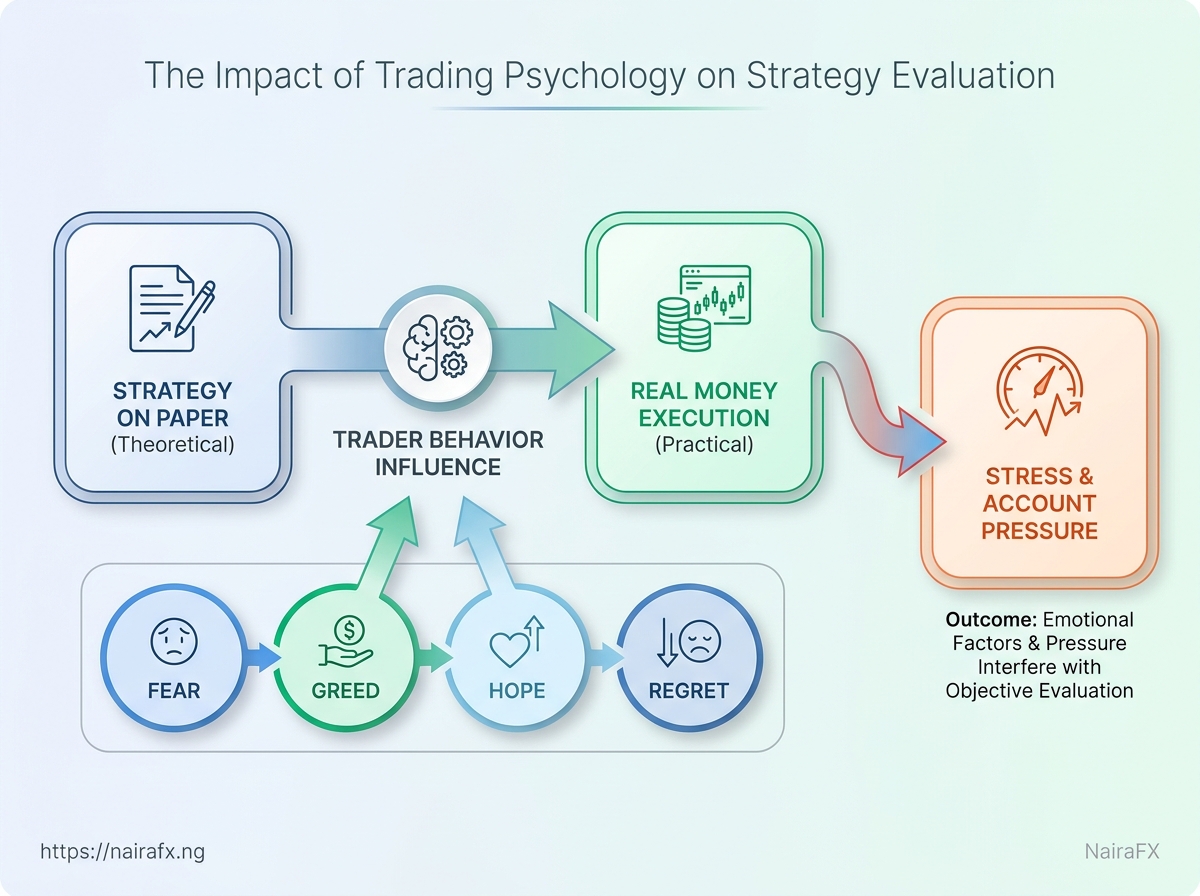
Fear, greed, hope, and regret do not stay outside the trade.
They shape trader behavior influence in ways a backtest cannot fully capture, especially when stress is high and the account is already under pressure.
A setup that looks solid in hindsight can become a different trade once the trader starts protecting ego instead of capital.
This matters even more when spreads widen, liquidity thins, or a sharp naira move hits without warning.
In those moments, evaluation is no longer just about entries and exits.
It becomes a test of whether the trader can keep the rules intact when the market gets uncomfortable.
Quick Answer: Strategy evaluation breaks in live trading when stress pushes you into process drift—meaning your execution stops matching your planned rules. Instead of blaming the setup, verify three things: – Rule adherence: did your entry/stop/exit follow the plan (especially during drawdowns)? – Risk consistency: did position sizing and stop distance stay within what you committed to? – Decision conditions: was the trade taken under the market conditions your backtest assumed (spreads, slippage, liquidity)? Practical starting point: set a risk cap you can keep during drawdowns (often ~1–2% per trade) so psychology can’t turn normal variance into rule-breaking decisions.
Why a good strategy can still look bad in your hands
Have you ever watched a setup work on paper, then fail live, and immediately blamed the strategy? That reaction is common, but it often hides a quieter problem: the trader changed the size, moved the stop, or exited too early.
That is where trading psychology starts to shape results more than the chart itself.
In strategy evaluation psychology, the real question is not only whether the setup has an edge, but whether trader behavior influence is distorting the way that edge gets expressed.
Fear makes winners feel too small and losses feel too dangerous.
Greed does the opposite, stretching exits and tempting traders to widen stops after price starts moving against them.
A drawdown can be read the wrong way, too.
In a journal, it may be a normal pause inside a system’s range, but in a live account it can feel like proof that the method is broken, especially when volatility is sharp and spreads are widening.
Three things usually get warped first.
- Wins: a small profit can feel underwhelming, so the trader exits before the setup has room to work.
- Losses: a normal loss can feel personal, so the trader skips the stop or adds risk to “fix” it.
- Drawdowns: a temporary dip can feel like failure, so the trader abandons a valid plan before enough trades have played out.
Consider two traders using the same entry on a fast-moving pair.
Trader A keeps the planned size, respects the stop, and records the loss as part of the system.
Trader B reacts to the pain, cuts risk too soon, then widens the stop on the next trade.
By the end of the week, Trader B calls the setup unprofitable, even though the entry logic never changed.
That is why we treat execution discipline as part of the strategy itself, not an afterthought.
A clean method can still look bad when the hands using it are emotional, inconsistent, or afraid of normal variance.
Common psychology mistakes that distort strategy evaluation
Most bad strategy reviews are behavior problems wearing a strategy mask.
The chart gets blamed first, but the real damage usually comes from fear, impatience, or overconfidence.
That pattern shows up fast in trading psychology.
A trader takes three losses, rewrites the rules, then calls the strategy broken; another gets a few early wins and starts calling luck a skill set.
The result is distorted strategy evaluation psychology.
Instead of asking whether the system still matches the market, the trader starts reacting to the last emotion they felt.
How disciplined traders read the same evidence
| Evaluation Habit | Do | Don’t | Psychology Risk |
|---|---|---|---|
| Sample size review | Judge performance over a meaningful run of trades with the same rules. | Rebuild the system after a small losing streak. | Recency bias |
| Loss review | Separate setup quality, execution quality, and market regime. | Treat one loss as proof the idea is dead. | Loss aversion |
| Rule changes | Change one variable at a time and write down why. | Alter entry, stop, and size all at once after frustration. | Impulse trading |
| Journal use | Record entry, exit, spread, slippage, and emotion. | Trust memory to explain why trades felt “right.” | Self-justification |
| Position sizing review | Keep size consistent while testing the edge. | Increase size to “prove” the strategy works. | Overconfidence |
Once entries, exits, and feelings are on paper, trader behavior influence becomes visible instead of invisible.
That matters in volatile conditions too.
Our own education pieces on risk management and discipline point to the same problem: when spreads widen or a loss stings, traders often mistake discomfort for evidence.
The clean habit is simple.
Review the same data with calm rules, then ask whether the problem is the setup, the execution, or the person pressing the button.
That separation saves a lot of good strategies from being buried too early.
It also keeps a trader honest when a hot streak starts to look like genius.
How trader behavior influences strategy results in real life
A setup can look identical on two screens and still produce very different results.
One trader follows the plan calmly, while another flinches at the first pullback, moves the stop, or jumps in late because the candle feels urgent.
That gap comes from trader behavior influence, not from the chart alone.
In live trading, trading psychology shows up in the small decisions that never appear in a backtest: entry timing, exit timing, patience, and whether the trader keeps risk where it was planned.
News spikes make this even clearer for Nigerian traders.
Spreads can widen fast, liquidity can thin outside active sessions, and sharp naira moves can pressure a trader into changing rules mid-trade.
Fear changes the trade before the market does
Fear usually shows up first as hesitation.
A trader sees a valid entry, but waits for “more confirmation,” then buys higher or misses the move entirely.
It also shows up in exits.
A position that should have room gets cut too early because the trader wants emotional relief, not market evidence.
Revenge trading and overconfidence pull in opposite directions
Revenge trading tends to enlarge the next mistake.
After a loss, the trader may increase size, chase a missed move, or ignore a stop just to get even.
Overconfidence does the reverse in a quieter way.
The trader trusts the last win too much, widens risk, and treats normal market noise as proof the setup is “still fine.”
- Fear: weakens patience and shortens valid trades.
- Revenge trading: turns one loss into a chain of poor entries.
- Overconfidence: makes the trader override limits and accept extra risk.
Strategy evaluation is closer to testing a recipe
A recipe should not be judged after one bite, and a strategy should not be judged after one emotional trade.
Good evaluation needs repeatability, because a live trader’s mood can change the result more than the signal itself.
That is why structured review matters.
A disciplined process looks at entry, stop placement, position size, and post-loss behavior together, then checks whether the trader kept those rules across different market conditions.
A simple Nigerian example makes the point well.
If a trader backtests a setup on calm sessions but executes it during a news spike with wider spreads and less liquidity, the live result can look far worse even when the signal is valid.
We see stronger strategy reviews when the trader records behavior, not just profit and loss.
That is the real test of trading psychology in practice.
A strategy review gets reliable only when you grade what you controlled—not what your emotions narrated after the fact.
If you’ve already seen the common psychology mistakes and the “do vs don’t” evaluation habits, use that list as your first filter. In this section, we turn it into a repeatable workflow you can run every time.
The 5-part workflow (the part psychology usually breaks)
- Trade plan (rules you committed to): Write the exact entry, stop, exit, and any non-negotiable conditions. If you changed something mid-trade, note the time and what triggered the change.
- Execution record (what actually happened): Before you interpret results, capture the observable facts—entry timing, stop placement, whether you exited early, and whether spreads/slippage differed from what you assumed.
- Behavior notes (why you drifted): Add short labels for moments of hesitation, urgency, revenge impulses, or overconfidence—especially right before you moved a stop or skipped the plan.
- Sample review (enough data to judge): Evaluate the strategy over a meaningful run of trades using the same rules. Treat very small batches as insufficient, even if the outcome feels emotionally “obvious.”
- Decision (strategy vs trader verdict): Only after the first four steps do you decide: Is the setup flawed, is the execution failing, or is the market/stress regime making the plan fragile?
The quick “pre-judgment” check
Before trusting a result, ask:- Did the outcome depend on assumptions about spread/liquidity holding up?
- Did your stop/entry/exit follow the rules—or did pressure cause a tweak?
- Was the sample large enough to avoid recency bias?
When you follow this sequence—plan → execution facts → behavior notes → sample review → decision—you stop trading psychology from rewriting the evaluation after the fact. The goal isn’t to remove emotion; it’s to keep emotion from grading your strategy.
What Nigerian traders should watch for in volatile markets
A strategy can look steady in calm hours and messy the moment volatility wakes up.
That is not always a sign the system is weak; sometimes the market is simply testing assumptions about spread, slippage, and liquidity.
For Nigerian traders, that test gets louder around news spikes, thin overnight sessions, and sharp naira moves.
A setup that works cleanly in backtest data can start failing in live conditions if the exit price shifts faster than the plan allows.
The trader behavior influence shows up fast here.
Confidence drops after one wide spread, one skipped stop, or one trade that looks “almost right” but lands offside because the market moved too quickly.
- Watch the spread first. A wider
spreadcan turn a valid entry into a poor one before price even moves.
- Check slippage risk. Fast markets may fill your order away from the intended price, especially during news bursts.
- Compare session liquidity. Thin trading outside active hours can make normal stops and exits behave very differently.
- Track currency pressure. Sharp naira movement can add stress that changes size, timing, and exit discipline.
- Test the plan under stress. A strategy should survive a rough week, not just a smooth chart.
A simple way to evaluate strategy evaluation psychology is to ask three questions before trusting a result.
Did the trade depend on a tight spread? Did the market need deep liquidity to behave as expected? Did emotional pressure tempt a rule change after the first loss?
If the answer is yes, the system needs a tougher test.
That is why our risk management material treats position sizing, stop placement, and spread checks as guardrails, not predictions.
A useful review routine looks like this:
- Record the entry spread and exit spread.
- Note whether the trade happened during active or thin liquidity.
- Compare planned risk with actual loss after slippage.
- Recheck whether the exit followed the rule or the mood.
This keeps the focus on execution quality, not just chart shape.
In volatile markets, the chart may still be valid while the trader’s process quietly breaks.
A strategy that survives Nigerian volatility earns more trust than one that only looks clean on paper.
How this topic fits into the wider trading psychology cluster
The goal is not to make traders emotionless.
It is to stop emotion from grading the strategy.
That matters because strategy evaluation psychology sits between knowing the rules and following them under pressure.
If the trader behavior influence is ignored, the review turns into a story about feelings instead of evidence.
This section sits deeper in the learning path than basic psychology.
Earlier pieces explain why good plans can look bad, how risk choices get distorted, and why volatile Nigerian conditions raise pressure; this one connects those ideas into a broader map.
It also fits the reality that, in 2025, only 5–10% of traders passed prop firm challenges, while only 20% of funded traders ever saw a payout, which says discipline and review habits matter as much as setup quality.
A strong cluster needs the next layer too.
Trading journaling, risk management, position sizing, emotional discipline, and backtesting basics all support cleaner strategy evaluation because they separate process evidence from momentary reactions.
Related topics that strengthen this path
| Related Topic | Why It Matters | Reader Benefit | Best Placement |
|---|---|---|---|
| Trading journaling | Captures decisions before memory edits them. | Makes emotional patterns visible over time. | Right after this section |
| Risk management | Sets guardrails around every trade. | Reduces damage when judgment slips. | Before execution-focused lessons |
| Position sizing | Controls how much pressure each trade creates. | Keeps one bad decision from wrecking a week. | Alongside risk rules |
| Emotional discipline | Helps traders follow the plan when stress rises. | Improves consistency during live trading. | After psychology foundations |
| Backtesting basics | Tests ideas against past market conditions. | Builds realistic expectations before money is on the line. | Before advanced evaluation methods |
Journaling records behavior, risk management limits damage, and position sizing keeps emotions from turning small mistakes into large ones.
Backtesting basics then anchor the review in evidence, while emotional discipline keeps the trader from rewriting the rules mid-trade.
Together, they turn strategy evaluation psychology into a repeatable system instead of a mood-driven judgment call.
Trading psychology affects whether your strategy’s edge is expressed—not by “making markets emotional,” but by changing what you actually do under pressure.
So the practical way to judge a strategy is to separate two questions:
- Does the setup have an edge? (based on the rules and repeatable conditions)
- Can you execute the rules reliably when conditions change? (especially when spreads widen, liquidity thins, or price moves fast)
If you notice that your entries, stop placement, or position sizing routinely drift during stress, then the issue is usually execution reliability, not the idea itself. When the rules stay intact and results still miss, then you can investigate whether the setup needs adjustment.
Judge the Strategy, Then Check the Trader
A clean strategy can still look messy once fear, impatience, and overconfidence enter the room.
That was the real lesson behind the breakout example: the rules did not change, but trader behavior influence did, and the results changed with it.
Trading psychology is not a side topic; it sits inside strategy evaluation psychology.
For Nigerian traders facing fast swings, that matters even more.
A setup that survives calm conditions can look broken when spreads widen, news hits, or position size feels too large for comfort.
The real test is simple: did the edge fail, or did the trader drift away from the edge?
Today, review your last ten trades and mark every entry, exit, and stop that was moved for emotional reasons.
Then compare those trades with the ones you followed exactly, because the gap usually tells a clearer story than the chart.
If you want a deeper read on that gap, our risk management and equity-curve review can help separate a real flaw from a psychology problem.